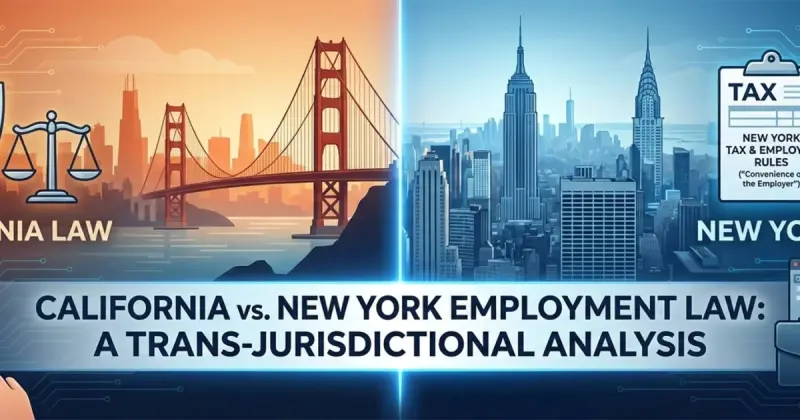
Navigating remote work laws in CA vs. NY? Uncover critical differences in taxation, expense reimbursement, and non-competes in this expert comparative guide.
Executive Summary
The modernization of the global workforce, catalyzed by the COVID-19 pandemic and sustained by the digital revolution, has fundamentally altered the geography of employment. Yet, the legal scaffolding that supports the employer-employee relationship remains resolutely tethered to state sovereignty. For the millions of "remote" workers—individuals whose physical location is decoupled from their employer's headquarters—and for the corporations that employ them, the United States does not function as a single legal entity but rather as a patchwork of competing jurisdictions. Nowhere is this friction more palpable, nor the legal stakes higher, than in the dichotomy between California and New York.
These two states serve as the economic engines of the nation, yet they represent diverging philosophies in employment jurisprudence. California has cultivated a highly regulated, protectionist framework that prioritizes the employee through rigid statutory mandates, such as strict expense indemnification under Labor Code Section 2802 and absolute prohibitions on restrictive covenants. Conversely, New York remains a bastion of traditional common law, emphasizing contractual freedom, the "convenience of the employer" doctrine in taxation, and a more employer-centric view of expense reimbursement and at-will employment exceptions.
This report provides an exhaustive, expert-level analysis of the legal conflict zones between California and New York. It is designed for legal professionals, human resources executives, and informed employees who require a nuanced understanding of how remote work intersects with state statutes. The analysis encompasses taxation, expense reimbursement, wage and hour laws, pay transparency, restrictive covenants, and the unique ethical obligations of legal professionals in a distributed environment. Furthermore, it integrates an assessment of emerging legal resources, including digital legal defense tools like Attorney Shield and the role of disciplinary bodies such as the Attorney Registration and Disciplinary Commission equivalents in these jurisdictions.
1. The Jurisdictional Battleground: Taxation and Sourcing
The most immediate financial consequence of the California-New York divide for remote workers is the taxation of income. As remote work allows employees to perform their duties from any location, the aggressive revenue-capture strategies of states have led to significant legal conflicts, particularly regarding double taxation and the sourcing of wages.
1.1 The California Model: Physical Presence and Market-Based Sourcing
California’s approach to income taxation is grounded in the "physical presence" standard, a doctrine that aligns with the traditional view that the right to tax labor is derived from the location where the labor is performed.
1.1.1 The Residency and Sourcing Nexus
The California Franchise Tax Board (FTB) asserts jurisdiction over all income earned by California residents, regardless of where the employer is located. For non-residents, California taxes only "California-source" income.
-
The Mechanism: If a non-resident employee (e.g., a New Yorker) travels to California and works for two weeks, California technically asserts the right to tax the income allocable to those two weeks.
-
Implication for Remote Workers: For a remote worker living in California but employed by a New York firm, the analysis is straightforward from California's perspective: the work is performed in California, so the income is California-sourced. The employee owes California state income tax on 100% of their earnings.
However, the complexity arises not from California's claim, but from its interaction with other states' claims. California generally offers a tax credit for taxes paid to other states to avoid double taxation. Yet, this credit is not automatic or guaranteed if the other state's tax claim is based on a sourcing rule that California does not recognize, such as the "Convenience of the Employer" rule.
1.2 The New York Model: The "Convenience of the Employer" Rule
New York operates under a significantly more aggressive extraterritorial tax doctrine known as the "Convenience of the Employer" rule. This rule is a critical area of concern for any remote worker employed by a New York entity.
1.2.1 The Doctrine Defined
New York dictates that if a non-resident is employed by a New York-based employer and works remotely from another state for their own convenience—rather than out of strict business necessity—the income is sourced to New York and is fully subject to New York state income tax.
-
Rationale: The state argues that the employee is availing themselves of the New York economic market and the benefits of a New York job, and therefore owes tax to New York, even if they physically sit in a home office in Los Angeles or Connecticut.
1.2.2 Judicial Affirmation: Zelinsky and Hayes
The legal foundation of this rule is robust in New York courts. In Hayes v. State Tax Comm, the Appellate Division held that a nonresident performing work outside New York is subject to tax liability if the work is performed outside the state for personal convenience.
More recently, the doctrine has withstood scrutiny in the post-pandemic era. In May 2025, the New York State Tax Appeals Tribunal issued a pivotal opinion upholding the convenience rule against a law professor who worked from his Connecticut home.
-
The Case: The taxpayer argued that the pandemic forced his remote work, making it a "necessity."
-
The Ruling: The Tribunal affirmed the Administrative Law Judge's determination, holding that unless the employer requires the employee to work out-of-state because the work cannot be done in New York (e.g., testing equipment that is fixed in another state), the remote work is deemed "convenient." The Tribunal explicitly stated that hiring remote employees simply because they are the "best candidates" or because they "prefer" to live elsewhere does not constitute a business necessity sufficient to break the New York tax nexus.
1.2.3 The "Business Necessity" Threshold
To escape the New York tax net, a remote worker must prove that their home office constitutes a "bona fide employer office." This is an exceptionally high evidentiary bar. The "Primary Factor" test usually requires that the home office contains specialized facilities that cannot be made available at the employer's place of business.
-
Result: A California resident working for a New York firm will likely be taxed by New York (under the convenience rule) and by California (under physical presence). Because California does not recognize New York's right to tax income earned by a worker physically present in California, California may deny the credit for taxes paid to New York. This results in legally sanctioned double taxation.1
1.3 Comparative Tax Impact Table
2. The Economics of the Home Office: Expense Reimbursement
Perhaps the most tangible friction point in the daily life of a remote worker involves the costs of operation. Who pays for the gigabit internet connection, the ergonomic chair, the electricity to cool the home office, and the mobile data plan? The answer depends entirely on whether the worker is subject to California Labor Code Section 2802 or New York Labor Law Section 198-c.
2.1 California: The Doctrine of Strict Indemnification
California maintains the most pro-employee expense reimbursement framework in the United States. The cornerstone of this framework is Labor Code Section 2802.
2.1.1 Statutory Mandate: Labor Code Section 2802
Section 2802 mandates that an employer must indemnify (reimburse) an employee for "all necessary expenditures or losses incurred by the employee in direct consequence of the discharge of his or her duties".6
-
"All Necessary Expenditures": This phrase has been interpreted broadly by the courts. It includes not just obvious costs like travel, but also the structural costs of remote work: internet bandwidth, cellular data, personal computer usage, and even a portion of utility bills.
-
Reasonable Percentage: The courts have clarified that even if an employee has an "unlimited" data plan, the employer must reimburse a reasonable percentage of the bill to account for the business usage. The logic is that the employer should not receive a windfall (free data transmission) simply because the employee has already paid for a personal plan.
2.1.2 The Thai v. IBM Decision (2023)
The definitive interpretation regarding pandemic-era and government-mandated remote work came in July 2023 with Thai v. International Business Machines Corporation.
-
The Conflict: IBM argued that it should not be liable for remote work expenses because the employees were working from home due to Governor Newsom’s stay-at-home order, not IBM’s directive. IBM contended the government order was an "intervening cause" that absolved them of liability.
-
The Ruling: The California Court of Appeal for the First Appellate District decisively rejected this argument. The Court held that the obligation under Section 2802 exists regardless of why the employee is working remotely. If the expenses are "necessarily incurred" to perform job duties, the employer must pay.
-
The Rationale: The Court reasoned that Section 2802 is designed to allocate the financial risk of business operations to the employer, not the employee. Whether the move to home was caused by a virus, a governor, or a CEO, the cost of doing business (internet, phone, etc.) belongs to the business.
2.1.3 Implications for "Voluntary" Remote Work
While Thai dealt with mandatory orders, its logic extends to voluntary arrangements. If a California employee requests to work remotely, and the employer agrees, the expenses incurred to perform that work (Zoom calls, emails) remain a direct consequence of the discharge of duties. Consequently, prudent California employers now provide monthly stipends (typically $50-$100) to cover these costs to avoid class-action litigation (PAGA claims).
2.2 New York: The Contractual and "Wage Supplement" Model
New York’s approach is fundamentally different, relying on the agreement between the parties rather than a statutory mandate for indemnification.
2.2.1 Labor Law Section 198-c
New York Labor Law Section 198-c governs the payment of "benefits or wage supplements," which the statute defines to include "reimbursement for expenses".
-
The Agreement Requirement: The critical distinction is that Section 198-c generally requires employers to pay these supplements only if they have agreed to do so. If an employment contract, handbook, or collective bargaining agreement outlines a reimbursement policy, the employer is criminally liable (misdemeanor) for failing to pay.
-
The Silence of the Law: Conversely, if the employer has not promised reimbursement, and there is no agreement, New York law generally does not impose an automatic statutory duty to reimburse remote work expenses (internet, electricity), provided the employee's wages remain above the minimum wage.
2.2.2 The Executive Exception
New York Labor Law Section 198-c(3) contains a significant carve-out. The section explicitly states that it does not apply to employees in a "bona fide executive, administrative, or professional capacity whose earnings are in excess of one thousand three hundred dollars a week" (approximately $67,600 annually).
-
Impact: This means that for high-earning remote professionals (lawyers, software engineers, executives), the Department of Labor may not enforce expense reimbursement claims even if an agreement exists. These employees would be left to pursue civil breach of contract claims in court rather than utilizing the administrative machinery of the Labor Department.
2.2.3 Federal Floor (FLSA)
In the absence of a strong state mandate, New York remote workers often fall back on the federal Fair Labor Standards Act (FLSA). The FLSA "kickback" rule only requires reimbursement if the unreimbursed expense drives the employee's earnings below the federal minimum wage.7 For a software engineer earning $150,000, $100 in internet costs does not violate the FLSA, leaving them with no federal recourse.
2.3 Comparison of Expense Liability
3. Professional Mobility: Restrictive Covenants and Non-Competes
The ability of a remote worker to leave one job and take another in the same industry is governed by the state's attitude toward restrictive covenants. Here, California and New York stand at opposite ends of the legal spectrum.
3.1 California: The Fortress of Free Mobility
California has long held a public policy against non-compete agreements, codified in Business and Professions Code Section 16600. Recent legislative updates have turned this shield into a sword, specifically targeting remote and cross-border employment.
3.1.1 The Total Ban (Section 16600)
Section 16600 states that "every contract by which anyone is restrained from engaging in a lawful profession, trade, or business of any kind is to that extent void." This is not a "reasonableness" test; it is a blanket prohibition, with very narrow exceptions (sale of a business, dissolution of a partnership).
3.1.2 SB 699 and AB 1076 (2024): Extraterritorial Reach
In 2024, California strengthened this ban with Senate Bill 699 and Assembly Bill 1076.
-
SB 699: This law explicitly extends the ban to contracts signed outside of California. If a remote worker moves to California, or is hired by a California company, a non-compete signed in a different state (like New York) is unenforceable in California courts.
-
Implication for Relocating Workers: If a New York banker with a strict non-compete moves to San Francisco to work remotely or for a CA firm, California law purports to void that non-compete, protecting the employee from enforcement actions within California.
-
Private Right of Action: SB 699 created a private right of action. Employees can now sue employers who attempt to enforce a void non-compete or even include one in a contract. This includes the recovery of attorney’s fees.
-
Notice Requirement: AB 1076 required employers to notify current and former employees (employed after Jan 1, 2022) that their non-compete clauses were void by February 14, 2024. Failure to do so constitutes an act of unfair competition.
3.2 New York: The Common Law "Reasonableness" Standard
Despite legislative attempts to ban non-competes, New York remains a common law jurisdiction regarding restrictive covenants.
3.2.1 The BDO Seidman Standard
A non-compete is enforceable in New York only if it survives the "reasonableness" test established in BDO Seidman v. Hirshberg. To be valid, the restriction must be:
-
Reasonable in time and geographic scope.
-
Necessary to protect the employer’s legitimate interests (e.g., trade secrets, unique services, client lists).
-
Not harmful to the general public.
-
Not unreasonably burdensome to the employee.
3.2.2 Legislative Stalls
In late 2023, the New York legislature passed a bill to ban all non-competes, but it was vetoed by Governor Hochul. The Governor indicated a preference for a compensation threshold—likely banning non-competes for lower-wage workers while allowing them for highly compensated executives. As of 2025/2026, bills like S4641 are pending, which would prohibit non-competes generally but allow them for "highly compensated individuals," yet the common law standard remains the current law of the land.
3.2.3 "Stay-or-Pay" Provisions
Both states are addressing "stay-or-pay" contracts (Training Repayment Agreement Provisions or TRAPs).
-
California: AB 692 (effective 2026) broadly restricts contracts that require employees to pay for training if they leave.
-
New York: The "Trapped at Work Act" prohibits requiring payment for training if the worker leaves before a specified time, signaling a convergence in this specific area of worker mobility.
3.3 The Remote Worker Conflict Scenario
The conflict of laws here is profound.
-
Scenario: A New York company employs a remote software architect. The contract has a non-compete. The architect moves to California.
-
California View: Under SB 699, the non-compete is void and the employee can sue the NY employer in CA court for trying to enforce it.
-
New York View: The NY employer may try to sue in NY court, arguing that NY law applies (Choice of Law clause). However, California courts often refuse to enforce choice-of-law clauses that violate strong public policy (like 16600).
-
Result: A "race to the courthouse" often ensues, with the employee filing in CA to void the contract and the employer filing in NY to enforce it.
4. Job Security and Termination: The At-Will Doctrine
Both California and New York are "at-will" employment states, meaning termination can generally occur with or without cause. However, the exceptions to this rule vary, providing different levels of security for remote workers.
4.1 California: Broad Exceptions and Implied Contracts
California courts have carved out significant exceptions to at-will employment, making termination riskier for employers and providing more avenues for wrongful termination suits.
-
Implied-in-Fact Contracts: Based on Foley v. Interactive Data Corp. (1988), California recognizes that an employer’s conduct can create an implied contract to fire only for cause. Factors include duration of employment, commendations, promotions, and assurances of continued employment (e.g., "You'll have a job as long as you perform").
-
Public Policy (Tameny Claims): Employees cannot be fired for reasons that violate fundamental public policy (e.g., refusing to break the law, reporting safety violations). California interprets "public policy" broadly, tethered to statutes or constitutional provisions.
-
Covenant of Good Faith: California law implies a covenant of good faith and fair dealing in employment contracts. While this cannot override an explicit at-will provision, it prevents bad faith actions intended to deprive employees of the benefits of the agreement.
4.2 New York: The Strict At-Will Doctrine and Wieder
New York is notoriously strict in upholding the at-will doctrine and resistant to creating exceptions.
-
Rejection of Implied Covenant: In Murphy v. American Home Products, the New York Court of Appeals explicitly rejected the tort of abusive discharge and refused to imply a covenant of good faith and fair dealing into at-will employment relationships. The court held that creating such exceptions is the job of the legislature, not the judiciary.
-
The Wieder v. Skala Exception: New York has a unique, narrow exception specifically for attorneys. In Wieder v. Skala (1992), the court held that an associate attorney fired for insisting that his firm report another lawyer's misconduct (as required by ethical rules) had a valid claim for breach of contract.
-
The Reasoning: The court found that complying with the Code of Professional Responsibility was "intrinsic" to the employment relationship of a lawyer. Therefore, there was an implied understanding that the firm would not fire the lawyer for following those rules.
-
Limitation: This exception is extremely narrow. It generally does not extend to non-lawyers or even to lawyers objecting to non-ethical business improprieties. It is not a general "whistleblower" protection for the private sector.28
4.3 Relocation Fraud (Labor Code 970)
A specific danger for remote workers is being induced to move (or not move) based on false promises.
-
California Labor Code 970: This statute prohibits employers from influencing a person to change their residence (to, from, or within California) by means of "knowingly false representations" concerning the kind, character, or duration of work.
-
Application: If an employer tells a remote worker, "Move to Redding, we will keep you fully remote forever," and then fires them or demands RTO (Return to Office) three months later, the employee may have a claim for double damages under Section 972.34 New York lacks a specific statutory equivalent with these penalty multipliers, relying instead on common law fraud which is harder to prove.
5. Pay Transparency and Equity Reporting
Transparency laws are the new frontier in closing the wage gap. Both states have enacted laws, but the mechanics differ.
5.1 California Senate Bill 1162: Comprehensive Disclosure
Effective January 1, 2023, California's SB 1162 significantly expanded pay transparency.
-
Job Postings: Employers with 15 or more employees must include the "pay scale" (salary or hourly wage range) in any job posting. This applies to any position that can be performed in California, covering almost all remote job postings by national firms.
-
Pay Data Reporting: Employers with 100+ employees must file an annual report with the Civil Rights Department (CRD), disclosing median and mean hourly rates broken down by race, ethnicity, and sex. This "mean and median" reporting is a unique California requirement intended to expose structural wage gaps.
5.2 New York: Local vs. State Layers
New York's transparency landscape is a patchwork.
-
New York City (Local Law 32): NYC employers with 4 or more employees must include minimum and maximum salary ranges in job postings. This applies to any job that can be performed, in whole or in part, in NYC—including remote roles.
-
New York State (Labor Law 194-b): The state law largely mirrors the city law, requiring businesses with 4 or more employees to disclose compensation ranges.
-
"Good Faith" Standard: New York law explicitly requires the range to reflect what the employer "in good faith" believes they are willing to pay at the time of posting.
-
Reporting: While NYC has proposed bills for pay data reporting similar to California (reporting gender/race data to the Department of Consumer and Worker Protection), the state landscape is currently focused on the posting requirement rather than the aggregate reporting requirement seen in CA's SB 1162.
6. Professional Responsibility and Ethical Frameworks
For legal professionals working remotely, or for corporations managing internal legal risks, the rules of professional conduct and privilege differ significantly.
6.1 Regulatory Oversight: ARDC Equivalents
Attorneys working remotely must understand which disciplinary body governs their conduct.
-
New York: Disciplinary matters are handled by the Attorney Grievance Committees appointed by the Appellate Division of the Supreme Court (e.g., First Department for Manhattan/Bronx, Second Department for Brooklyn/Queens). This is the NY equivalent to the Attorney Registration and Disciplinary Commission (ARDC) found in states like Illinois. The structure is decentralized compared to unified bars.
-
California: Discipline is centralized under the State Bar of California and the State Bar Court. This is a unified administrative system.
-
In-House Counsel Registration:
-
New York (Part 522): In-house counsel not admitted in NY but working there must register. Failure to do so is professional misconduct.
-
California: Similar registration (Registered In-House Counsel program) is required for those not licensed in CA.
6.2 Attorney-Client Privilege: The Corporate Shield
-
California (Subject Matter / Upjohn): California strictly protects corporate privilege. It follows the Upjohn standard: privilege applies to communications with any employee (regardless of rank) if made at the direction of superiors to secure legal advice.49 Crucially, California courts generally reject the Garner exception, meaning shareholders cannot easily pierce the privilege in lawsuits.
-
New York (Fiduciary Exception / Garner): New York recognizes the Garner v. Wolfinbarger doctrine (the fiduciary exception). This allows shareholders in a derivative suit to pierce the corporation's attorney-client privilege upon a showing of "good cause."
-
Implication: For a remote General Counsel, an email sent from a NY home office might be discoverable by shareholders in NY litigation, whereas the same email sent from a CA home office might be absolutely privileged under CA law.
7. Emerging Legal Resources for the Remote Workforce
The complexity of these laws has given rise to new legal service models and resources designed to protect employees and navigate the cross-border legal landscape.
7.1 Prepaid Legal Services and Digital Defense
For remote workers who cannot afford traditional retainers, prepaid legal plans have become vital.
-
LegalShield / Attorney Shield: Services like Attorney Shield and LegalShield offer subscription-based access to legal advice. Attorney Shield specifically focuses on immediate legal support during police interactions via an app, which, while more relevant to civil rights, represents the growing "legal tech" sector. LegalShield provides broader employment law consultation, allowing a remote worker to have an attorney review a severance agreement or a non-compete for a monthly fee (e.g., ~$26.95/mo) rather than an hourly rate of $400+.
-
Relevance: In the context of "New York vs. California," having access to a national network of attorneys through such plans allows a worker to get advice on both NY and CA law simultaneously, a crucial benefit for the cross-border employee.
7.2 Finding Specialized Counsel
Given the nuances of Thai v. IBM or Wieder v. Skala, generalist attorneys may lack the specific expertise required.
-
Specialized Firms: Entities like 907 Legal (though Alaska-based, they illustrate the regional specialization of personal injury and employment law) or attorneys like Moin Choudhury (a NY-based litigator with significant verdict history) demonstrate the importance of selecting counsel with a track record in the specific jurisdiction where the dispute is centered.
-
The "Best Attorney" Criteria: For a user visiting bestattorneyus.com, the selection criteria should focus on attorneys who understand conflict of laws. An attorney like Moin Choudhury, who handles complex liability cases in NY, would be well-versed in NY's specific evidentiary rules, whereas a CA specialist would be needed to leverage the PAGA statute for expense reimbursement.
Conclusion
For the remote worker and the multi-state employer, the choice between California and New York law is not merely administrative—it is a choice between two distinct legal philosophies.
California offers a regime of codified protection: stringent expense reimbursement (Section 2802), absolute freedom from non-competes (Section 16600), and robust transparency (SB 1162). However, this comes with the complexity of physical-presence taxation and high regulatory burdens.
New York offers a regime of contractual flexibility and aggressive revenue capture: limits on reimbursement rights (Section 198-c), potential enforcement of reasonable non-competes, and the expansive "Convenience of the Employer" tax rule which can result in significant tax burdens for the unwary remote employee.
As the legal landscape continues to fracture along state lines, utilizing resources like in-house counsel registration, specialized legal apps (Attorney Shield), and understanding the specific disciplinary bodies (Grievance Committees vs. State Bar) becomes essential. The remote worker is no longer just an employee; they are a multi-jurisdictional legal entity, requiring a sophisticated understanding of their rights and liabilities in the digital age.