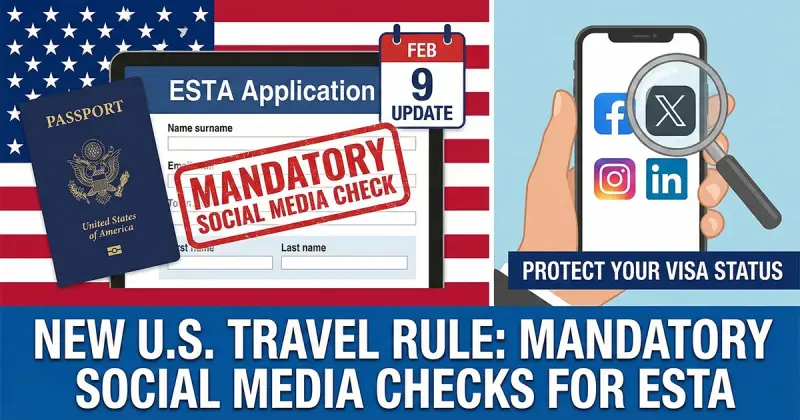
Starting Feb 9, U.S. immigration requires social media history for ESTA applicants. Find out which accounts are checked and how to protect your visa status.
Imagine this: You are packing your bags for a dream vacation to Miami or New York. You come from a "safe" country—maybe France, the UK, or Australia—so you don't need a complicated visa. You just hop online, fill out the quick ESTA form, and you're good to go, right?
Not anymore.
As of February 9, the rules of the game are changing. The "quick and easy" travel authorization now has a new hurdle: Your Digital Footprint.
The U.S. government is expanding its social media background checks. What started as a requirement for complex immigrant visas has now reached the most casual travelers. If you want to enter the United States, Uncle Sam wants to know what you’ve been posting on TikTok, X (Twitter), and Instagram for the last five years.
Here is everything you need to know about the new mandatory social media review, explained simply.
The Big Change: ESTA is No Longer "No Questions Asked"
For years, the ESTA (Electronic System for Travel Authorization) was the fast track for citizens of 41 countries (like most of Europe, Japan, South Korea, etc.). It was a simple "security check."
The New Rule:
To comply with Executive Order 14161, Customs and Border Protection (CBP) is adding a mandatory field to the ESTA application.
Why? The government calls it "Protecting the United States from Foreign Terrorists and Other Threats." They want to see if your online life matches your offline story.
Who Else Is on the "Watch List"?
It’s not just tourists. This net is being cast very wide. If you are applying for almost any U.S. immigration benefit, your Facebook timeline is now fair game.
You must provide social media info if you are applying for:
-
Green Cards: (Forms I-485, DS-260).
-
Citizenship: (Form N-400).
-
Student Visas: (F-1, M-1).
-
Exchange Visitors: (J-1 Au Pairs, Interns).
-
Refugee/Asylum Status: (I-590, I-730).
-
Travel Documents: (I-131).
The "Student" Warning:
In June, the rules got stricter for students (F, M, and J visas). This was triggered by campus protests regarding the conflict in Gaza. Secretary of State Marco Rubio made it clear: "If you come to the U.S. for social activism, we will revoke your visa."
Real-Life Example: Mahmoud Khalil, a Palestinian student on a visa, faced deportation scrutiny not because of a crime he committed, but because of his high-profile activism. The government now uses your posts to decide if your "intent" in the U.S. is truly just to study.
What Exactly Do I Have to Give Them?
Don't panic—they (usually) don't want your password.
1. The "What":
They want your Usernames or Handles.
2. The "Where":
The forms now have a dropdown menu listing almost every platform in existence.
-
The Big Ones: Facebook, Instagram, X (Twitter), LinkedIn, TikTok, YouTube.
-
The Specific Ones: Reddit, Pinterest, Tumblr, Flickr.
-
International: VK (Russia), Sina Weibo/Douban (China), Twoo.
3. The "When":
They want the history for the last 5 years.
Comparison Table: What They Check vs. What They Don't
It is important to know the boundary between "security" and "privacy."
| The U.S. Government WANTS |
The U.S. Government DOES NOT WANT |
| Usernames / Handles |
Passwords (Never give this!) |
| Public Posts (Photos, Tweets) |
Private DMs (Unless they get a warrant) |
| Friend Lists (Who you follow) |
Login access to your account |
| Platforms used in last 5 years |
Accounts you never created |
| Archived/Closed Accounts |
deleted history (Harder for them to see) |
What Are They Actually Looking For? (The Red Flags)
You might think, "I'm boring. I just post pictures of my cat." You are probably safe. But here is what the algorithm (and the officers) are hunting for:
1. Terrorist Ties:
Following accounts linked to extremist groups (ISIS, Al-Qaeda, etc.). Even "liking" a controversial post can flag you for manual review.
2. The "Work" Lie (LinkedIn Trap):
-
Scenario: You apply for a B-2 Tourist Visa (which prohibits working).
-
Social Media Check: Your LinkedIn profile says: "Excited to start my new freelance job in New York next month!"
-
Result: Denied. Your online life proved you intended to work illegally.
3. The "Relationship" Lie (Green Card Trap):
-
Scenario: You apply for a marriage Green Card, claiming you live happily with your spouse.
-
Social Media Check: Your Facebook status is "Single," and you are posting party photos with a "new girlfriend" in another city.
-
Result: Fraud Investigation.
4. "Immoral Conduct":
This is vague, but it can include evidence of drug use (marijuana is still federal illegal in the U.S., even if legal in your state/country) or hateful rhetoric.
Real-Life Scenarios: U.S. Law in Action
To understand how strict this is, let's look at two scenarios.
Scenario A: The Honest Tourist
Name: Sarah (UK Citizen).
Action: She fills out her ESTA. She lists her Instagram and Twitter. She has a Twitter account she used 4 years ago but deleted.
Question: Should she list the deleted account?
The Law: YES. The form asks for accounts used in the last 5 years. Sarah lists the old handle. Her ESTA is approved because her content is harmless.
Scenario B: The "Secret" Activist
Name: Ahmed (F-1 Student Applicant).
Action: Ahmed is active on Reddit discussing radical political protests. He decides not to list Reddit on his visa application because it's "anonymous."
The Catch: CBP officers can sometimes link emails or phone numbers to accounts.
The Consequence: If they find the account, Ahmed is denied not necessarily for the posts, but for Material Misrepresentation (lying on a federal form). That is a permanent ban.
Frequently Asked Questions (FAQs)
Q1: I don't have social media. Will I be rejected?
A: No. If you genuinely do not have accounts, you can select "None." However, do not lie. If you are 25 years old and say you have zero digital footprint, they might find that suspicious and dig deeper.
Q2: What if I forget a username?
A: Try your best to recover it. If you honestly cannot remember, providing the email address associated with the account is often helpful. The key is intent—show you are trying to be transparent.
Q3: Can I set my profile to "Private" before I apply?
A: Yes, you can. The government primarily reviews public information. However, setting it to private right before applying can look suspicious. Also, if you are at the border, an officer can ask you to unlock your phone and show them the app (though this is rare for standard tourists).
Q4: Does this apply to WhatsApp?
A: Generally, no. WhatsApp is considered a messaging app, not "social media" for public broadcast. However, check the specific dropdown list on the form when you apply, as definitions change.
References & Official Sources
Stay updated with official government channels:
-
ESTA Official Site: CBP - ESTA Application
-
Visa Policy Updates: U.S. Department of State - Consular News
-
Form DS-160 Info: USCIS - Social Media Collection