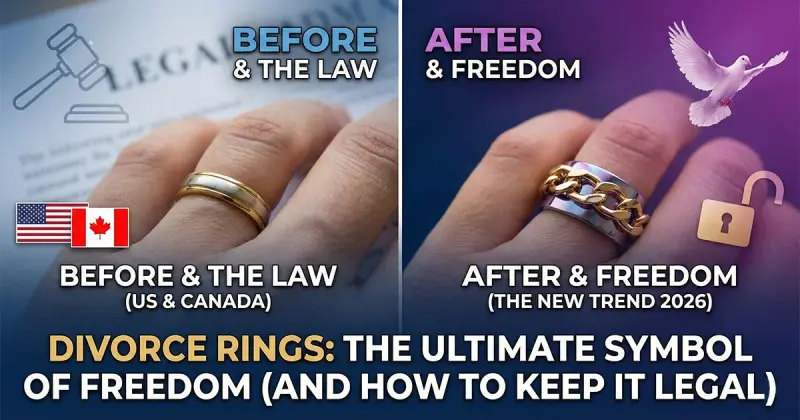
Divorce rings are 2026's viral trend. Discover why women are repurposing bands and learn the tricky US vs. Canada legal rules on who actually keeps the ring.
You are sitting in a lawyer's office. The papers are finally signed. The long, exhausting battle over custody, the house, and the dog is over. You look down at your left hand. It feels... naked.
For years, that finger held a promise. Now, it just holds a tan line.
But lately, a new trend is taking over Instagram feeds and jewelry stores, led by celebrities like Emily Ratajkowski and regular women alike. It’s called the Divorce Ring.
Instead of hiding the scar of a failed marriage, women are celebrating the survival of it. They are taking their old diamonds—or buying brand new ones—and creating a symbol of their "Next Chapter."
But before you rush to the jeweler to melt down your wedding band, you need to hit the brakes. Divorce is a legal minefield, and yes, even your jewelry is part of the war zone.
Here is your complete guide to the Divorce Ring trend, the "repurposing" revolution, and the legal reality check you didn't know you needed.
What Exactly IS a Divorce Ring?
A divorce ring isn't just a piece of jewelry; it’s a statement.
For decades, divorce was something people whispered about. It was seen as a failure. Today, in 2026, it is often seen as a triumph. It means you chose happiness over misery. You chose you.
There are two main ways to get one:
-
The "Repurpose" (The Phoenix Rising):
You take your old engagement ring—the one that might carry bad memories or bad energy—and you change it. You ask a jeweler to pop out the diamond and set it into something completely new. Maybe a necklace, or a "Toi et Moi" (You and Me) ring where the "Me" is just... well, you.
-
The "Fresh Start" (The Splurge):
You buy something brand new. No bad juju. No history. Just a stone you picked out with your own money (or your settlement money).
Why now?
Reports from Vogue and The Guardian show that luxury jewelers are overwhelmed with requests. Why? because women are earning their own money. In the 1960s, a woman might have needed a husband to open a credit card. Today, she can buy her own emeralds to celebrate getting rid of him.
The Big Legal Question: Can I Sell My Engagement Ring to Buy This?
This is where things get messy. Before you run to the pawnshop or the jeweler to trade in your engagement ring for a divorce ring, you need to know who actually owns it.
You might think, "He gave it to me, so it's mine."
The law says: "It depends."
The "Conditional Gift" Rule
In most places, an engagement ring is considered a conditional gift. The "condition" is the marriage itself.
However, once you are married and then get divorced, the ring is usually considered your "separate property" in the U.S. That means it’s yours to keep, sell, or turn into a divorce ring. It usually doesn't get split 50/50 like the house.
BUT (and this is a big but):
If you upgraded the ring during the marriage (like adding a bigger diamond for your 10th anniversary), that upgrade might be considered "marital property." If you sell it, your ex might be entitled to half the cash.
Real-Life Legal Scenario: The Tale of Two Borders (US vs. Canada)
To understand how tricky this can be, let's look at a comparison. Even though we are discussing US law, looking at our neighbors in Canada helps show how "who keeps the ring" isn't always simple.
Scenario A: Jessica in New York (The "Fault" Line)
Jessica and Mike are getting divorced in New York. Mike cheated. Jessica wants to keep her $20,000 engagement ring and turn it into a pendant.
-
The Law: New York courts generally view the engagement ring as the wife's separate property once the marriage takes place. It doesn't matter that Mike paid for it. The condition (marriage) was met.
-
The Outcome: Jessica keeps the ring. She makes her pendant. Mike gets nothing from it.
Scenario B: Sarah in Ontario, Canada (The "Exclusion" Rule)
Now look at Sarah. She lives in Toronto. She is getting divorced.
-
The Law: In Ontario, under the Family Law Act, the engagement ring is usually considered a gift given before the marriage date. Therefore, it is excluded from the "Net Family Property" calculation. Sarah gets to keep it, and its value is NOT split with her husband.
-
However: What if she bought a new wedding band with joint money during the marriage? That specific band is marital property.
-
The Outcome: If Sarah tries to hide the wedding band or sell it secretly, the Canadian judge can punish her for hiding assets.
The Lesson: In both countries, the engagement ring is usually safe after the wedding. But if you touch "family money" to buy your new Divorce Ring before the papers are signed, you are in trouble.
The Financial Warning: Don't Buy Your "Freedom Ring" Too Soon
This is the number one mistake people make.
You are separated. You feel free. You want to celebrate. You go to Cartier and drop $5,000 on a new ring.
STOP.
If your divorce is not final, that $5,000 might still be considered "marital money."
Your ex's lawyer can accuse you of "Dissipation of Assets." This is a fancy legal term for "wasting our family money on yourself."
The Consequence: The judge might make you pay your ex back for half the cost of the ring.
The Advice: Wait until you have the "Decree Absolute" (the final divorce paper). Or, use money that is clearly defined as "inheritance" or "separate funds" that your ex has no claim to.
Comparison Table: Engagement Ring vs. Divorce Ring
Confused about the difference? Here is the breakdown.
| Feature |
Engagement Ring |
Divorce Ring |
| Who Buys It? |
Usually the Partner |
You (or repurposed from old jewelry) |
| Which Finger? |
Left Hand, Ring Finger |
Right Hand, Pinky, or Middle Finger |
| Symbolism |
Promise, Union, "We" |
Freedom, Self-Love, "Me" |
| Legal Status |
"Conditional Gift" (pre-marriage) |
Personal Property (if bought post-divorce) |
| Typical Stone |
Diamond (Hardness 10) |
Anything! (Sapphire, Ruby, Emerald) |
| The Vibe |
Expectation & Tradition |
Rebellion & Style |
How to Style Your "Breakup": Stone Guide
If you are designing your own ring, you don't have to follow the boring rules. However, you need to be practical. If you plan to wear this ring every day to remind yourself how strong you are, the stone needs to be tough.
The Mohs Hardness Scale (Don't Buy Soft Stones!)
-
Diamond (10/10): The hardest. Great for everyday wear. (You can reuse your old one!)
-
Sapphire & Ruby (9/10): Excellent choices. Durable and colorful.
-
Emerald (7.5/10): Risky. They are brittle and can crack if you hit your hand on a door.
-
Opal & Pearl (5-6/10): AVOID. These are too soft for daily rings. They scratch and break easily. Keep these for necklaces, not rings.
Pro Tip: "Cocktail" style rings (big, chunky stones) are popular for divorce rings. They are meant to be worn on the middle finger or right hand to avoid looking like a wedding band.
Frequently Asked Questions (FAQs)
Q1: Can my ex-husband demand the engagement ring back after the divorce?
A: generally, no. Once the wedding happens, the "contract" is fulfilled. The ring is yours. However, if it was a family heirloom (like his grandmother's ring), some courts might order you to return it, or give him the option to buy it back from you to keep it in his family.
Q2: Is it bad luck to reuse the diamond from my failed marriage?
A: That is entirely up to you! Some women believe the stone holds "bad energy" and sell it. Others believe the diamond is just a rock, and they give it meaning. Re-setting it into a new design is a great way to "cleanse" the history.
Q3: Can I buy a divorce ring if I’m a man?
A: Absolutely. While marketing targets women, men are also celebrating their new chapters. Men often opt for a new watch or a signet ring on the pinky finger instead of a flashy gem.
Q4: What if I sell my ring for cash? Do I have to split the money?
A: If the ring is your separate property (which it usually is after marriage), the cash is yours too. But always ask your lawyer before you sell it, just to be 100% sure your specific state laws don't have a weird exception.
Conclusion: It’s Your Finger, Your Rules
The rise of the divorce ring isn't just about consumerism or "retail therapy." It is about marking a timeline.
Marriage has a ring. Engagement has a ring. Why shouldn't the moment you reclaimed your life have one too?
Whether you choose to melt down the past or buy a sparkling new future, remember: the most valuable thing isn't the diamond. It's the freedom to choose what you do with it.
Disclaimer: This article provides general information and does not constitute legal advice. Laws regarding property division and engagement rings vary significantly by state and country (like the US vs. Canada examples above). Always consult with a qualified family law attorney in your jurisdiction.