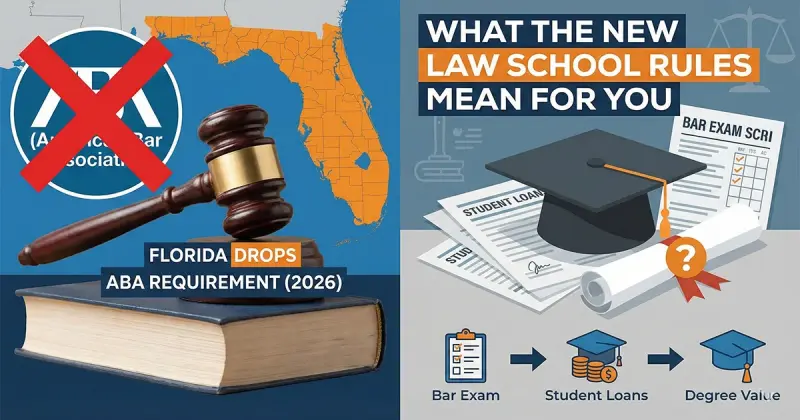
Florida follows Texas in dropping the ABA as the sole accreditor for law schools. Learn how this 2026 ruling affects your law degree, student loans, and bar exam eligibility.
You dream of being a lawyer in Miami. You’ve studied for the LSAT, saved up for tuition, and you are ready to apply. But suddenly, the rules change. The gold standard for law schools—the American Bar Association (ABA)—is no longer the only sheriff in town.
As of January 15, 2026, the Florida Supreme Court has officially shaken up the legal world. They ruled that relying only on the ABA to decide which law schools are "good enough" is no longer in the best interest of Floridians.
If you are a pre-law student, a current 1L, or just a concerned parent, you probably have a million questions. Does my degree still count? Will I get a job? Is this a political stunt?
Here is your plain-English guide to the new Florida law school rules, written for real people, not legal robots.
The Big News: Florida Breaks Up with the ABA
For over 30 years, the deal was simple: If you wanted to take the Florida Bar Exam and become a lawyer, you had to graduate from a law school accredited by the American Bar Association (ABA).
The ABA was the "gatekeeper." If they gave your school a thumbs up, you were in. If they didn't, you were out.
The New Rule:
The Florida Supreme Court released a nine-page opinion saying, essentially, "We don't need the ABA to be the only boss."
Starting October 1, 2026, Florida law schools can be accredited by other agencies, as long as those agencies are approved by the U.S. Department of Education and the Florida Supreme Court.
Why is this happening?
It’s not just about education; it’s about politics and values.
-
The "Woke" Debate: Governor Ron DeSantis and other Florida leaders have criticized the ABA for being too political. They argued that the ABA was pushing "woke" ideologies and diversity standards that didn't align with Florida's values.
-
The St. Thomas Incident: Recently, Florida Attorney General James Uthmeier accused the ABA of discriminating against a Catholic law school, St. Thomas University, over hiring practices. While that dispute was resolved, it left a bad taste in the state's mouth.
Texas Did It First (The Trendsetter)
Florida isn't going rogue alone. They are actually following a path cut by the Lone Star State.
In January 2026, the Texas Supreme Court finalized a similar rule. They decided that Texas law schools didn't need the ABA's stamp of approval anymore. They wanted more control over their own education system.
Now that two massive states—Texas and Florida—have made this move, experts think other conservative states might follow. This is the beginning of a potential "red state vs. blue state" split in how lawyers are trained.
What Does This Actually Mean for Students?
This is the part that matters to your wallet and your career.
1. If You Go to an ABA School (Like UF, FSU, or Miami)
You are safe.
The Court was very clear: "Graduates of ABA-accredited law schools will continue to be eligible to sit for the bar examination." Most established schools will keep their ABA accreditation because it carries prestige nationally.
2. If You Go to a "New" Alternative School
This is where it gets risky.
In the future, new law schools might pop up that aren't ABA-accredited but are approved by the state of Florida.
Comparison: Accredited vs. Non-Accredited Schools
California has allowed non-ABA schools for years. Let’s look at the data to see how they compare. It’s a cautionary tale.
| Feature |
ABA-Accredited Law School |
Non-Accredited (State Only) School |
| Prestige |
High (National Recognition) |
Low (Local/State Recognition) |
| Bar Exam Pass Rate |
~70-80% (First-time takers) |
~15-20% (California data) |
| Tuition Cost |
Expensive ($$$) |
Generally Cheaper ($$) |
| Job Prospects |
Big Firms, Federal Jobs, Judges |
Small Firms, Solo Practice |
| Financial Aid |
Federal Loans & Pell Grants |
Often Private Loans Only |
| Portability |
Can take the Bar Exam in any state |
Stuck in the state where you studied |
Warning: In California, pass rates for non-accredited schools are historically very low. Many students pay tuition but never pass the bar to become lawyers. Florida students need to be careful not to fall into this "debt trap."
Real-Life Scenario: The "Transfer" Trap
Meet Alex.
Alex wants to save money. In 2027, he enrolls in the newly formed "Sunshine State Law Center," a school accredited by Florida but not the ABA.
-
Year 1: Alex does well but realizes he wants to work in corporate law in Atlanta.
-
The Problem: Georgia requires an ABA degree. Alex tries to transfer to Florida State University (an ABA school).
-
The Result: FSU rejects his credits. They say his Contract Law class wasn't up to national standards. Alex has to restart as a freshman or stay in Florida forever.
-
The Lesson: "Cheaper" isn't always better if it locks you into one state.
Internal Links (Suggestions)
Frequently Asked Questions (FAQs)
Q1: Will my law degree be worthless if my school drops the ABA?
A: Not "worthless," but it might be "limited." You can still take the Florida Bar and be a lawyer in Florida. But if you try to get a job in New York or Washington D.C., employers might look at your resume with skepticism.
Q2: Is the ABA going away completely?
A: No. The ABA has been around since 1878. Top-tier schools (like Harvard, Yale, and UF) will keep their ABA accreditation because it proves they are elite. This ruling just opens the door for other schools to exist without the ABA.
Q3: Can I still get federal student loans?
A: Only if the new accreditor is recognized by the U.S. Department of Education. If Florida approves a school that the federal government doesn't recognize, you cannot get federal financial aid. Always check the FAFSA eligibility of a school before you deposit!
Q4: Why did Governor DeSantis dislike the ABA?
A: It’s largely political. The ABA has standards regarding "diversity and inclusion" that conservative leaders argue are forced ideology. By removing the ABA requirement, Florida can approve schools that don't follow those specific diversity mandates.
References & Official Sources
Do not just take our word for it. Verify the changes yourself at these official sites:
-
Florida Supreme Court Opinion: In Re: Amendments to Bar Admissions Rules (Jan 2026)
-
ABA Accreditation Standards: American Bar Association - Section of Legal Education
-
Department of Education: Database of Accredited Postsecondary Institutions