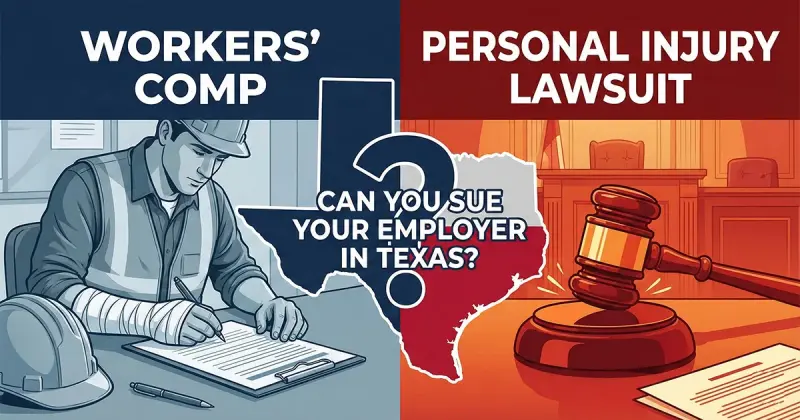
Injured at work in Texas? Learn the key differences between workers' comp and personal injury claims, and find out when you can legally sue your employer.
Executive Summary: The Texas Legal Anomaly and the Injured Worker
In the broader tapestry of American labor law, the state of Texas stands as a singular, often bewildering anomaly. It is the only jurisdiction in the United States that allows private employers to voluntarily opt out of the state-mandated workers' compensation system. This unique legislative choice creates a bifurcated legal reality for the millions of individuals—from the high-rise steelworkers in Houston to the roughnecks in the Permian Basin and the warehouse associates in the sprawling logistics hubs of Dallas-Fort Worth—who power the state's economy. For these workers, the legal path following a catastrophic injury is entirely dependent on a single, often obscure administrative detail: Is the employer a "subscriber" or a "non-subscriber"?
The distinction is not merely a matter of paperwork or insurance premiums; it is a fundamental divergence in legal rights, potential recovery, and the burden of proof. A "subscriber" participates in the state's workers' compensation program, exchanging the risk of unpredictable lawsuits for the certainty of insurance premiums. In return, they receive immunity from most civil litigation—a shield known as the "exclusive remedy" provision. Their employees, when injured, are funneled into an administrative system designed to provide medical care and partial wage replacement without the need to prove fault, but with strict caps on benefits and no recovery for pain and suffering.
Conversely, a "non-subscriber" operates outside this system. By rejecting the state's insurance scheme, these employers forfeit key common-law defenses, exposing themselves to direct personal injury lawsuits where the damages are uncapped and the burden of proof shifts in ways that can be devastating for a negligent company. For the injured worker, this opens the door to full compensation for pain, suffering, physical impairment, and mental anguish—damages wholly unavailable under workers' compensation—but it also requires navigating a high-stakes litigation process where nothing is guaranteed.
This report serves as an exhaustive, authoritative guide for the stressed, injured worker in Texas. It is designed to demystify the statutes, decode the legal jargon, and provide a comprehensive roadmap through the aftermath of a workplace accident. Whether dealing with a denial of benefits, a third-party liability claim, or the intricacies of gross negligence, the analysis below offers the clarity needed to make informed decisions in a time of crisis. We will explore the historical context of the "Grand Bargain," the procedural labyrinths of the Texas Department of Insurance, the specific legal battles involving non-subscribers like Walmart and Amazon, and the critical "Golden Rule" that every injured Texan must know.
What to Do Immediately After a Truck Accident in California? Red more ...
Hit By Truck in Texas? Read more ...
Part I: The Subscriber System – The "Grand Bargain" of Workers' Compensation
1.1 The Philosophy of the "Exclusive Remedy"
The workers' compensation system is built on a historical compromise often referred to by legal scholars as the "Grand Bargain" or "Quid Pro Quo." To understand the current frustrations of injured workers, one must understand the origins of this system. In the early 20th century, the industrial revolution brought with it a surge in workplace injuries. Under the traditional common law of the time, an injured worker had to sue their employer to recover damages. These lawsuits were often unsuccessful because employers had access to powerful defenses, such as the "assumption of risk" (the argument that the worker knew the job was dangerous and accepted the consequences) and "contributory negligence" (the argument that the worker was partially at fault).
To resolve this social crisis and prevent the destitution of injured laborers, the workers' compensation system was devised. The trade-off is simple in theory but complex in application:
-
The Employee gives up the constitutional right to sue the employer for negligence in civil court. This means waiving the right to recover damages for pain and suffering, mental anguish, loss of consortium, and punitive damages (except in death cases).
-
The Employer gives up the right to defend against the claim by arguing the employee was at fault. Even if a worker is clumsy, distracted, or negligent (short of intoxication or intentional self-harm), they are covered.
-
The Result is a "no-fault" administrative system where benefits are paid out relatively quickly and predictably, but are strictly capped by statute.
In Texas, this creates the "Exclusive Remedy" rule. If your employer has workers' compensation insurance, you generally cannot sue them, even if their negligence caused your injury. The insurance benefits are your exclusive source of recovery against the employer. This provision shields subscribing employers from civil lawsuits, effectively immunizing them from the multi-million dollar verdicts often seen in personal injury cases.
1.2 The Scope of Coverage: "Course and Scope of Employment"
For an injury to be compensable under the Texas Workers' Compensation Act (TWCA), it must occur within the "course and scope of employment." This phrase is the subject of thousands of administrative disputes annually. It is not enough to simply be "at work"; the activity must be in furtherance of the employer's business.
1.2.1 The General Rule and Its Exceptions
The "Course and Scope" definition generally requires that the injury occur while the employee is engaged in work-related activities. However, the boundaries are often blurred.
-
Furtherance of Affairs: The activity must have been done in furtherance of the employer's business affairs. An injury sustained while running a personal errand during work hours, for instance, may be denied.
-
Time and Place: It generally must occur during work hours and on the premises, though exceptions exist for work-related travel.
-
The "Coming and Going" Rule: Injuries sustained during a standard commute are typically not covered. Travel to and from work is considered a personal risk, not an employment risk. However, exceptions exist if the employer provides the transportation, if the travel is a "special mission" directed by the employer, or if the employee is a "travelling employee" (like a sales rep).
1.2.2 Gray Areas: Horseplay and Deviations
Insurance carriers frequently deny claims based on "horseplay" or "deviation."
-
Horseplay: If an employee is injured while wrestling or playing pranks, coverage is often denied unless the employee was a non-participating victim or the horseplay had become a regular, condoned part of the workplace culture.
-
Deviation: If a delivery driver stops to visit a friend and is hit by a car, they have "deviated" from the course and scope. If they stop to buy a soda (a "personal comfort" doctrine exception), they remain covered.
1.3 The Benefits Structure: What Is Actually Covered?
If you are trapped within the subscriber system, your recovery is limited to specific categories of benefits. Unlike a lawsuit where a jury can award any amount they deem fair, workers' compensation benefits are calculated using rigid statutory formulas. Understanding these is crucial for managing financial expectations.
1.3.1 Medical Benefits
The system pays for "all reasonable and necessary medical care" related to the compensable injury. There is no time limit and no dollar limit on medical benefits, provided the treatment remains medically necessary.
-
The Network Issue: Many insurance carriers use certified healthcare networks. If your employer is in a network, you must choose a doctor from that list to get your care paid for. Going outside the network without approval can leave you personally liable for the bills. This restricts the injured worker's freedom of choice and often forces them to see doctors who are financially beholden to the insurance industry.
-
Pre-Authorization: Unlike regular health insurance, workers' comp often requires pre-authorization for significant treatments like surgery, MRI scans, or physical therapy. Disputes here are common. Utilization Review (UR) agents—often doctors who never examine the patient—can deny treatments recommended by the treating doctor, forcing the worker into a specialized administrative fight.
1.3.2 Income Benefits
Texas law provides four types of income benefits to replace lost wages. Crucially, these never replace 100% of your lost income, creating a financial strain on families accustomed to a certain standard of living.
-
Temporary Income Benefits (TIBS):
-
Purpose: Paid while you are recovering and unable to work.
-
Calculation: They equal 70% of the difference between your pre-injury "Average Weekly Wage" (AWW) and your current earning capacity. For workers earning less than $10/hour, this rate increases to 75%.
-
Duration: They end when you reach "Maximum Medical Improvement" (MMI) or after 104 weeks, whichever comes first. This 104-week cap is a hard stop for TIBs, regardless of whether the worker is fully healed.
-
Waiting Period: Benefits are not paid for the first week of lost time unless the disability lasts for two weeks or more.
-
Impairment Income Benefits (IIBS):
-
Purpose: Compensation for permanent physical damage.
-
Calculation: Once you reach MMI, a doctor assigns an "Impairment Rating" (IR)—a percentage reflecting permanent physical damage (e.g., "5% whole body impairment").
-
Payout: You receive three weeks of pay for every percentage point of impairment. A 10% rating results in 30 weeks of benefits.
-
Critique: This is a rigid formula that often feels woefully inadequate for permanent injuries. A worker who loses a finger might get a small check but loses the dexterity required for their trade, yet IIBs do not account for lost future earning capacity, only the physical impairment itself.
-
Supplemental Income Benefits (SIBS):
-
Purpose: For workers with significant long-term disabilities who cannot return to their previous wage level.
-
Eligibility: Reserved for workers with an IR of 15% or higher who haven't returned to work or are earning less than 80% of their pre-injury wages.
-
Bureaucracy: Applying for SIBS requires proving you are actively looking for work every single week. This is a burdensome bureaucratic hurdle that trips up many legitimate claimants. One missed job application or paperwork error can result in a denial of benefits for that quarter.
-
Lifetime Income Benefits (LIBS):
-
Purpose: Reserved for the most catastrophic injuries.
-
Eligibility: Specifically listed conditions: total and permanent loss of sight in both eyes; loss of both feet at or above the ankle; loss of both hands at or above the wrist; loss of one foot and one hand; spinal cord injury resulting in permanent paralysis of both arms, both legs, or one of each; or a traumatic brain injury resulting in incurable insanity or imbecility.
-
Payout: These are paid for life and can increase 3% annually. However, qualifying is notoriously difficult, and insurance carriers aggressively litigate against LIBs claims because of the high long-term cost.
1.3.3 Death and Burial Benefits
If a worker dies, the surviving spouse and dependent children (and sometimes grandchildren or parents, if dependent) receive 75% of the worker's average weekly wage.
-
Redistribution: If a spouse remarries, they receive a lump sum of two years of benefits, and the remainder is redistributed to minor children.
-
Burial: Burial benefits are also provided, capped currently at $10,000. This amount often barely covers modern funeral costs.
1.4 Exceptions to the Shield: When Can You Sue a Subscriber?
While the exclusive remedy rule is formidable, it is not absolute. Texas courts and the legislature have carved out narrow, high-stakes exceptions where a civil lawsuit is permitted against a subscribing employer. These exceptions are the "escape hatches" from the administrative system, allowing for the recovery of full civil damages.
1.4.1 The Intentional Tort Exception
An employee can sue a subscribing employer if the injury was caused by an "intentional tort." However, the legal bar for "intent" in Texas is incredibly high.
-
The Escobedo Standard: The Texas Supreme Court, in Texas Workers' Compensation Insurance Fund v. Mandlbauer and subsequent cases like Escobedo, clarified that it is not enough for an employer to be reckless or to know that an injury is "highly likely." The employer must specifically intend to injure the employee, or believe that injury is "substantially certain" to follow from their conduct.
-
The Reality Check: Proving "substantial certainty" is nearly impossible in standard industrial accidents. Even removing a safety guard from a machine (a classic example of gross negligence) is often not considered an "intentional tort" because the employer did not desire the injury to occur; they likely just desired faster production. Courts distinguish between "intent to act" (removing the guard) and "intent to injure" (wanting the worker's hand crushed).
1.4.2 The Gross Negligence Exception (Fatalities Only)
The Texas Constitution (Article 16, Section 26) protects the right to recover exemplary (punitive) damages for homicide. Because of this constitutional guarantee, the Workers' Compensation Act cannot block a lawsuit for "gross negligence" if the employee dies.
-
Who Can Sue: Only the surviving spouse or heirs of the body (children). Parents generally cannot sue for gross negligence under this exception unless they are heirs of the body (which they are not under descent and distribution laws if children exist).
-
Defining Gross Negligence: Under the Texas Civil Practice and Remedies Code Section 41.001, gross negligence involves two distinct prongs:
-
Objective Prong: The act involved an extreme degree of risk, considering the probability and magnitude of the potential harm to others. This is more than just a dangerous workplace; it must be an extreme risk.
-
Subjective Prong: The actor (employer/manager) had actual, subjective awareness of the risk involved, but nevertheless proceeded with conscious indifference to the rights, safety, or welfare of others.
-
Damages: This lawsuit allows for the recovery of punitive damages only. Compensatory damages (lost wages, medical bills, loss of companionship) are still covered by the workers' comp insurance death benefits. This creates a hybrid scenario where the family receives weekly comp benefits and sues for a punitive lump sum.
1.4.3 The Independent Contractor Distinction
Workers' compensation only applies to employees. If you are truly an independent contractor, the exclusive remedy rule does not apply to you. You can sue the company that hired you for negligence if their actions caused your injury.
-
Misclassification: Many employers "misclassify" workers as contractors to avoid paying payroll taxes and insurance premiums. In these cases, a lawyer might argue you were a "de facto" employee to get benefits (if the employer has no assets) or argue you were a contractor to sue for damages (if the employer has liability insurance), depending on the strategy.
Part II: The Non-Subscriber Landscape – The "Wild West"
Approximately 28% of Texas employers, employing about 20% of the Texas workforce, are "non-subscribers." This creates a massive segment of the economy operating under a completely different set of legal rules.
2.1 Who Are the Non-Subscribers?
The list of non-subscribers includes some of the most recognizable names in global commerce. Because opting out is voluntary, companies often make the calculation that they can save money by managing claims internally rather than paying premiums.
-
Major Retailers: Walmart, Amazon, Target, Home Depot, Lowe's, Best Buy, HEB, Kroger, Dollar General, Academy Sports.
-
Industrial/Logistics: R+L Carriers, Schlumberger, Baker Hughes, ExxonMobil (in certain divisions), and various trucking fleets.
-
Healthcare: Many hospital systems and nursing homes opt out, ironically leaving healthcare workers vulnerable.
2.2 The Forfeiture of Defenses: The "Stick"
To encourage participation in the workers' comp system, the Texas Labor Code punishes non-subscribers by stripping them of their traditional common-law defenses. This is the "stick" that makes the non-subscriber system risky for employers and potentially lucrative for injured workers.
-
No Contributory Negligence Defense: In a standard car accident lawsuit, if a jury finds the plaintiff 40% at fault, their damages are reduced by 40%. If the plaintiff is 51% at fault, they get zero. Not so for non-subscribers. A non-subscribing employer cannot argue that the employee was partially negligent to reduce the award. If the employer was 1% negligent and the employee was 99% negligent, the employer may still be liable for 100% of the damages (though recent case law suggests the employee's negligence can't be the sole cause).
-
No Assumption of Risk: The employer cannot say, "You knew this was a dangerous job when you signed up." The law presumes the employer has a duty to make the workplace safe, regardless of the inherent danger.
-
No Fellow Servant Rule: The employer cannot escape liability by claiming the injury was caused by a co-worker's negligence. The employer is vicariously liable for the negligence of all employees. If your coworker drops a wrench on your head, the company is fully liable.
2.3 The Burden of Proof: Negligence is Key
Despite the loss of defenses, a non-subscriber case is not strict liability. The injured worker must still prove that the employer was negligent. The plaintiff must demonstrate:
-
Duty: The employer owed a duty to provide a safe workplace, proper training, safe instrumentalities, or adequate supervision.
-
Breach: The employer failed to do so (e.g., lack of training, faulty equipment, failure to enforce safety rules, understaffing).
-
Causation: That specific failure was a proximate cause of the injury.
-
Damages: The worker suffered actual harm.
If the employer did everything right—provided training, safety gear, and supervision—and the accident was truly unavoidable or caused 100% by the employee's own actions with no contributing fault from the employer (the "Sole Proximate Cause" defense), the worker recovers nothing. This is the gamble of the non-subscriber system: High risk, high reward.
2.4 Damages in Non-Subscriber Cases
Because these are civil personal injury lawsuits, the "caps" and formulas of the workers' comp system do not apply. A successful plaintiff can recover a full spectrum of civil damages:
-
Full Lost Wages: Not just 70%. Recovery includes 100% of past lost wages.
-
Loss of Earning Capacity: Future lost income projected over the worker's working life.
-
Medical Expenses: Past and future medical bills.
-
Pain and Suffering: Compensation for physical pain, a category completely absent in workers' comp.
-
Mental Anguish: Compensation for emotional trauma, depression, and anxiety resulting from the injury.
-
Physical Impairment: Compensation for the loss of enjoyment of life and physical limitations.
-
Punitive Damages: If gross negligence is proven, additional damages to punish the employer.
2.5 Real-World Case Studies and Payouts
The disparity in outcomes can be staggering.
-
Company Vehicle Accident ($1.9 Million): A non-subscriber case involving a company vehicle rear-ending a car resulted in a $1.9 million settlement for back injuries and head trauma. Under workers' comp, this might have been limited to medical bills and a small impairment check.
-
Car Accident with Surgery ($1.06 Million): A driver fell asleep, causing a collision requiring shoulder surgery. The settlement was over $1 million. Workers' comp would cover the surgery but offer minimal payout for the permanent stiffness.
-
Boating Accident ($515,000): A workplace boating accident led to back surgeries and a half-million-dollar settlement.
-
Amazon Van Crash ($505,025): An Amazon (non-subscriber) van t-boned a vehicle. The case settled for over $500k.
2.6 The "Fake" Workers' Comp: ERISA Plans
Many large non-subscribers set up their own private injury benefit plans, often governed by the federal Employee Retirement Income Security Act (ERISA). These plans look like workers' comp to the untrained eye but are often less generous.
-
The Waiver Trap: These plans often require you to sign a waiver giving up your right to sue in exchange for receiving immediate medical benefits. This is a critical juncture. Under Texas Labor Code § 406.033(e), such waivers are generally void as against public policy unless signed after the injury and roughly 10 days have passed. However, employers still try to enforce them, or use the acceptance of benefits to argue an "election of remedies."
-
Arbitration Clauses: Many non-subscribers force employees to sign arbitration agreements as a condition of employment (often buried in the onboarding paperwork). This means you can't sue in court in front of a jury; you must go to a private arbitrator. While the law (negligence) remains the same, arbitrators are often perceived as more conservative than juries.
Part III: Third-Party Liability – Piercing the Corporate Veil
In many industrial accidents, the fault lies not just with the employer, but with a third party. This opens a second avenue for recovery that can exist alongside a workers' comp claim.
3.1 Identifying Third Parties
-
General Contractors & Premises Liability: If you work for a subcontractor (e.g., a plumber) on a construction site, and the General Contractor (GC) created a hazard (e.g., an unguarded hole or unstable scaffolding), you can collect workers' comp from your direct boss and sue the GC for negligence. The GC is a "third party" and does not enjoy the exclusive remedy shield regarding you.
-
Product Liability: If a machine malfunctions due to a design defect or manufacturing flaw (e.g., a punch press that double-cycles), you can sue the manufacturer of the press.
-
Motor Vehicle Accidents: If you are driving for work and hit by a drunk driver or a negligent commercial truck, you have a workers' comp claim (because you were working) and a personal injury claim against the at-fault driver.
-
Property Owners: If you are sent to work on a client's property and trip on a hidden hazard, the property owner may be liable under premises liability theories.
3.2 The Interaction: Subrogation and the "Made Whole" Doctrine
This is the most complex financial aspect of workplace injury law. If you collect workers' comp benefits ($50,000 for medicals and wages) and then settle a third-party lawsuit for $100,000, you don't necessarily keep it all.
-
The Carrier's Lien: Under Texas Labor Code Chapter 417, the workers' comp insurance carrier has a "subrogation interest." They have the statutory right to be paid back for every dollar they spent on your care from your settlement money. This is known as the "first money" right.
-
Chapter 417 vs. The "Made Whole" Doctrine: In general insurance law, the equitable "Made Whole" doctrine says an insurer can't take your settlement money until you are fully compensated for all your losses. However, Texas courts have ruled that the specific statutory subrogation right in Chapter 417 overrides the common law Made Whole doctrine for workers' comp carriers. They get paid back "off the top".
-
Negotiating the Lien: A skilled attorney's job is often to negotiate this lien down. If the lawyer can prove that the employer was also partially at fault (even though the employer is immune from suit), the lien can be reduced by the percentage of the employer's negligence. Additionally, the carrier must pay their "pro rata" share of the attorney's fees (usually 1/3) out of their recovery. This negotiation is a vital tactic to ensure the injured worker actually puts money in their pocket.
Part IV: Comparative Analysis Table
To visualize the stark differences between these paths, the following table contrasts the two primary systems.
| Feature |
Workers' Compensation (Subscriber) |
Personal Injury Lawsuit (Non-Subscriber / Third Party) |
| Basis of Claim |
No-Fault (Automatic coverage) |
Negligence (Must prove employer fault) |
| Right to Sue |
Generally Barred (Exclusive Remedy) |
Permitted (Full civil lawsuit) |
| Medical Care |
Restricted to Network doctors; Pre-authorization required |
Choice of doctor; Letters of Protection (LOP) allowed |
| Lost Wages |
Capped (70-75% of wages); Statutory max |
100% of past & future lost earning capacity |
| Pain & Suffering |
NOT Recoverable |
Fully Recoverable |
| Punitive Damages |
Only for Gross Negligence Death Claims |
Recoverable for Gross Negligence |
| Defenses Available |
Intoxication; Intentional Self-Harm |
Sole Proximate Cause (Non-Sub); Comparative Negligence (3rd Party) |
| Statute of Limitations |
1 Year to File Claim (30 days to report) |
2 Years to File Lawsuit |
| Dispute Resolution |
Administrative Hearings (DWC) |
Civil Court Trial / Arbitration |
| Attorney Fees |
Capped by statute (usually 25% of benefits) |
Contingency Fee (usually 33% - 40%) |
Part V: Navigating the Claims Process – A Step-by-Step Guide
For the "stressed individual" in Texas, the procedural maze is the source of sleepless nights. Here is the chronological roadmap to protecting your rights.
Phase 1: The Immediate Aftermath (Days 0-7)
-
Report the Injury Immediately: Texas law requires you to report the injury to your employer within 30 days. Do it immediately. Do it in writing (text, email, or incident report). Keep a copy. If you miss this deadline, you may lose everything.
-
Get Medical Help: Do not "tough it out." Go to the ER or a doctor.
-
If Subscriber: Ask specifically if there is a workers' comp network. If yes, you must pick a doctor from that list. If no, you can go to any doctor who accepts workers' comp (many don't).
-
If Non-Subscriber: You can see any doctor, but be aware of who is paying. Your private health insurance may deny the claim if they know it's work-related. Non-subscribers often try to direct you to "their" clinics (like Concentra or Nova). You are not legally required to treat there exclusively in a negligence case, but they may control the initial purse strings.
-
Identify Witnesses: Get names and phone numbers of everyone who saw the accident. In a non-subscriber case, their testimony about the unsafe condition is your lifeline.
Phase 2: The Filing Phase (Days 8-30)
-
File DWC Form-041: Even if your employer says "we'll handle it," you must file this form with the Texas Division of Workers' Compensation within one year. This protects your claim formally against the statute of limitations.
-
Determine Status: Check if your employer is a subscriber. You can verify this on the Texas Department of Insurance (TDI) website using the "TXCOMP" database. Do not take your boss's word for it; they may be lying or mistaken.
-
The "Recorded Statement" Trap: Insurance adjusters will call you for a recorded statement. They will ask leading questions like "You were okay yesterday, right?" or "Did you have back pain before?" Golden Rule: Do not give a recorded statement without legal counsel. Anything you say can be used to deny your claim later.
Phase 3: The Dispute Phase (Months 1-12)
-
Denial of Claims: Insurers often deny claims by arguing the injury is "pre-existing" (degenerative disc disease) or "idiopathic" (just happened, not work-related).
-
Benefit Review Conference (BRC): If a dispute arises, you will attend a BRC. This is an informal mediation at a DWC field office with a Benefit Review Officer.
-
Contested Case Hearing (CCH): If the BRC fails, you go to a formal CCH. A hearing officer takes testimony and issues a binding written decision.
-
Maximum Medical Improvement (MMI): Eventually, a doctor will say you are "stable" (MMI). They will assign an Impairment Rating (IR).
-
The Designated Doctor (DD): The state may appoint a "Designated Doctor" to resolve disputes about MMI and IR. The DD's opinion carries "presumptive weight," meaning it is very hard to overturn. If the DD gives you a low rating, your benefits may stop abruptly.
Phase 4: Litigation (Years 1-3)
If you are suing a non-subscriber or third party, your attorney will file a lawsuit before the 2-year statute of limitations expires.
-
Discovery: This involves depositions, requesting safety records, and hiring experts to prove negligence.
-
Mediation: Most cases settle here.
-
Trial: If no settlement is reached, a jury decides the verdict.
Part VI: Special Considerations for the Texas Workforce
6.1 The Oil & Gas Sector: The Multi-Layered Liability
Oilfield accidents are rarely simple. You might work for a staffing agency, be supervised by a drilling company, on a site owned by a land-man, using equipment rented from a fourth company.
-
The "Borrowed Servant" Doctrine: A company (like the operator) might try to claim you were their "borrowed servant" to get the protection of the exclusive remedy rule, even if they aren't your direct payroll employer. Fighting this requires analyzing who had the "right of control" over the details of your work. If the operator controlled your details, they might be immune; if not, they are a third party you can sue.
6.2 Construction Sites: The Ladder of Responsibility
On a construction site, OSHA regulations often set the standard of care. While OSHA violations do not automatically create a private cause of action (negligence per se) in Texas, they are powerful evidence of negligence in a non-subscriber or third-party case.
6.3 Retaliation: Texas Labor Code Chapter 451
It is illegal in Texas to fire, discriminate against, or harass an employee for filing a workers' compensation claim in good faith.
-
The "But For" Test: You must prove that "but for" the filing of the claim, you wouldn't have been fired. If you are fired days after filing, this creates a strong temporal presumption of retaliation.
-
Damages: Retaliation lawsuits can result in reinstatement, back pay, and uncapped punitive damages, even against subscribers. Note: This protection applies to filing a workers' comp claim. It does not strictly apply to non-subscribers in the same way, though other employment laws may protect the worker.
Part VII: The "Golden Rule" and Conclusion
The Golden Rule of Texas Injury Law
Never accept a settlement, sign a waiver, or give a recorded statement to an insurance adjuster without first consulting a specialist attorney.
The system is designed to close files quickly and cheaply. Adjusters are trained professionals; you are an amateur in their arena. Your health and your financial future require a slow, methodical, and aggressive approach.
Conclusion
The question "Can I sue my employer in Texas?" has a layered answer.
-
If they subscribe: Generally No. You are limited to the administrative system, but you should investigate for gross negligence (death), intentional torts, or third-party liability (GCs, products, drivers).
-
If they don't subscribe: Yes. The law is heavily tilted in your favor—stripping the employer of defenses—but you must still prove negligence.
For the stressed individual reading this: You are currently standing at a crossroads. The path of least resistance (accepting what the adjuster offers) often leads to financial ruin when future medical complications arise. The path of diligence (investigating your employer's status, preserving evidence, and seeking counsel) is the only way to secure the "made whole" future you deserve. In Texas, the law protects the vigilant. Be vigilant.
Part IX: Detailed Analysis of Legal Precedents and Statutes
9.1 The Moench and Escobedo Doctrines: Defining Gross Negligence and Intent
To fully grasp the "Gross Negligence" exception for surviving families in death cases, one must look to the seminal Texas Supreme Court cases. The definition of gross negligence is not merely "very bad negligence." It is a specific legal term of art defined in Transportation Insurance Co. v. Moriel and codified in Chapter 41.
-
Subjective Awareness: The plaintiff must produce evidence that the supervisor or manager had actual knowledge of the risk. For example, if a trench collapsed, evidence that the manager saw the trench lacked shoring and said "get in anyway" establishes subjective awareness.
-
Conscious Indifference: The manager must have decided to proceed despite that knowledge. This distinguishes gross negligence from "momentary lapse of judgment."
In the realm of Intentional Torts, Verinakis v. Medical Profiles, Inc. and Escobedo set the bar. The courts fear that allowing too many intentional tort exceptions would swallow the workers' comp rule. Therefore, they require that the employer essentially used the employee as a "crash test dummy," knowing with near 100% certainty that injury would follow. This is why most "intentional" claims fail—employers are rarely that malicious; they are usually just cheap or reckless.
9.2 The "Responsible Third Party" (RTP) Trap
In non-subscriber cases, even though the employer loses the "contributory negligence" defense (blaming the worker), they can still use the "Responsible Third Party" statute (CPRC Chapter 33).
-
The Strategy: The employer blames an "empty chair"—a person not in the lawsuit, or even an unknown criminal. If the jury assigns 50% fault to the employer and 50% to a "Responsible Third Party" (like a criminal who attacked the worker, or a bankrupt contractor), the employer only pays 50% of the damages.
-
Recent Case Law: The Texas Supreme Court's decision in In re East Texas Medical Center Athens affirmed that non-subscribers can use this tactic. This makes jury selection and the presentation of evidence critical. The plaintiff must convince the jury that the employer had the power to control the risk and is the primary bad actor.
9.3 ERISA Preemption: The Federal Shield
Many non-subscriber employers try to move the case from state court to federal court by claiming their injury benefit plan is an ERISA plan. Federal courts are often more conservative and less likely to award massive damages.
Part X: Actionable Checklist for the Injured Worker
This final section condenses the complex legal analysis into a pocket guide for immediate action.
-
Safety First: Secure your physical safety.
-
Silence is Golden: Do not discuss the accident with coworkers (who may be interviewed by the company) or on social media.
-
The "30/1/2" Mantra:
-
Evidence Collection: Photos of the hazard, photos of injuries, preservation of footwear/clothing worn during the accident.
-
Status Check: Go to and search your employer.
-
Counsel Up: Find a lawyer who specializes in Texas work injury law. A general personal injury lawyer may not understand the nuances of the "Exclusive Remedy" or "Non-Subscriber" defenses.
Disclaimer: This report is for educational purposes only and does not constitute legal advice. The laws of Texas are subject to change by the Legislature and the Supreme Court. Always consult with a licensed attorney for your specific case.