Hit by a truck in CA? Don't wait. Follow this survivor's blueprint for immediate steps to protect your rights and strengthen your personal injury claim.
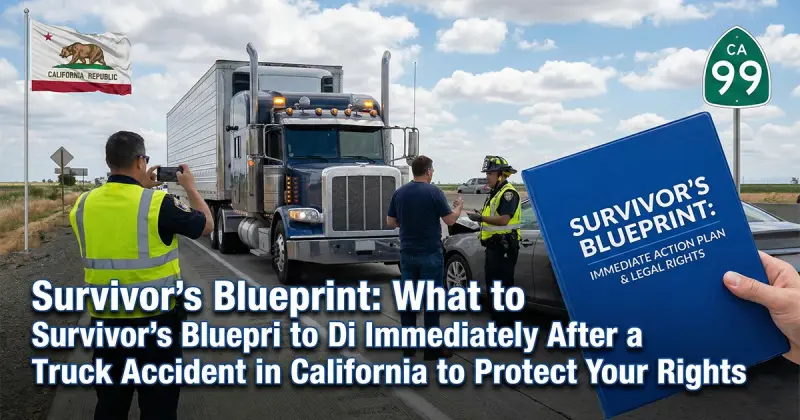
You’re sitting in your car, the world still spinning. The deafening roar of grinding metal has been replaced by a terrifying silence, broken only by the hiss of a radiator and the pounding of your own heart. In front of you—or perhaps on top of you—is an 80,000-pound commercial "big rig."
In the wake of a collision of this magnitude, your brain is flooded with adrenaline. You are likely in shock, feeling a mix of profound relief to be alive and a paralyzing fear about what comes next. At bestattorneyus.com, we know that the decisions you make in the next 30 minutes, and the next 48 hours, will dictate the trajectory of your physical recovery and your legal future.
Knowing what to do after a truck accident in California is not just about following a checklist; it is about building a wall between your family and the multi-billion-dollar trucking corporations that are already deploying investigators to the scene to minimize your claim. This guide provides the high-authority, empathetic, and scannable guidance you need during this crisis.
1. The Critical First 15 Minutes: Scene Management and Safety
The immediate moments after a crash are the most dangerous. Large trucks often carry hazardous materials, and secondary collisions are common on California’s high-speed freeways like the I-5 or I-10.
-
Move to Safety (If Possible): If your vehicle is functional and not pinned, move to the shoulder. However, in major truck accidents, vehicles are often disabled. If you cannot move the car, stay buckled until you are certain it is safe to exit.
-
Call 911 Immediately: Even if the truck driver asks to "settle it privately," you must involve law enforcement. In California, a police report from the California Highway Patrol (CHP) or local police is the foundational evidence for your case.
-
Check for Injuries: Do not say "I'm fine." Adrenaline is a powerful anesthetic that masks internal bleeding and spinal trauma. Simply state that you are "shaken up" or "need a medical evaluation".
2. Evidence Collection: Be Your Own Advocate
While the police will write a report, they are looking for traffic violations, not necessarily building a personal injury case for you. You need to capture details that can vanish within hours.
-
Identify the "Dot" and Company Name: Every commercial truck is required to display a USDOT number on the side of the cab. Photograph this. Also, note the company name on the trailer—these are often different entities, and both may be liable.
-
Photograph the "Black Box" Environment: Capture skid marks, the final resting positions of the vehicles, and any dash-cam or electronic logging device (ELD) equipment visible in the truck cab.
-
Identify Witnesses: In the chaos, witnesses often stop, look, and then drive away. Get names and phone numbers immediately. Their neutral perspective is worth more than a dozen expert testimonies later.
The Golden Rule:
"Never give a recorded statement to a trucking company’s insurance adjuster. They are trained to lead you into admitting partial fault or downplaying your injuries. Simply tell them: 'I am focused on my medical recovery and will have my legal representative contact you.' In California, even a seemingly innocent comment like 'I'm sorry' can be used to reduce your compensation under comparative negligence laws."
3. Understanding the Legal Shift: Truck vs. Car Accidents
A truck accident is not just a "big car accident." It is a different legal species altogether. The insurance limits are higher, the regulations are federal, and the number of potentially liable parties is much larger.
| Feature |
Standard Passenger Car Accident |
Commercial Truck Accident |
| Minimum Insurance in CA |
$15,000 per person / $30,000 total |
$750,000 to $5,000,000+ |
| Liability Rules |
Usually limited to the driver |
Driver, Carrier, Mechanic, Loader |
| Regulatory Oversight |
CA Vehicle Code (CVC) |
Federal Motor Carrier Safety (FMCSA) + CVC |
| Evidence Complexity |
Photos and Witness statements |
ELD Logs, Black Box data, Maintenance records |
| Defense Strength |
Single insurance adjuster |
Dedicated "Rapid Response" corporate legal teams |
4. The Adrenaline Trap: Why You Need Medical Care Now
One of the top "pain points" for victims is the "delayed onset" of symptoms. In California, if you wait three days to see a doctor, the insurance company will argue that your injuries were caused by something else that happened in those intervening 72 hours.
-
Visit the ER or Urgent Care: Insist on a neurological and spinal screening. Whiplash and Traumatic Brain Injuries (TBIs) often take 24–48 hours to manifest.
-
Follow the Treatment Plan: If the doctor prescribes physical therapy, go to every session. Insurance companies track "gaps in treatment" to prove you aren't actually hurt.
-
Keep a Pain Journal: Document how the injury affects your daily life. Can you lift your child? Can you sleep through the night? **
5. California Nuances: The SR-1 and Statutes of Limitations
California has specific, non-negotiable rules for reporting accidents. Failure to comply can lead to the suspension of your driver's license, even if you weren't at fault.
The 10-Day DMV Rule (SR-1 Form)
Under California Vehicle Code § 16000, you or your attorney must file a Form SR-1 with the DMV within 10 days if the accident caused injury, death, or property damage exceeding $1,000. This is independent of the police report.
The Two-Year Window
Under California Code of Civil Procedure § 335.1, you generally have two years from the date of the accident to file a lawsuit for personal injury. However, if the truck was owned by a government entity (like a city-owned garbage truck or a state vehicle), you may have as little as six months to file a formal claim notice.
6. The "Spoliation" Threat: Why Speed is Everything
In the trucking industry, records like the driver’s hours-of-service logs and maintenance files are only required to be kept for a limited time. If your attorney does not immediately send a "Spoliation of Evidence" letter, the trucking company may legally destroy the very data that proves they were at fault—such as evidence the driver was fatigued or the brakes were faulty.
An expert attorney will demand preservation of:
-
The ECM (Black Box): Shows speed, braking, and engine status at impact.
-
ELD Logs: Proves if the driver violated "Hours of Service" safety rules.
-
Maintenance Files: Shows if the truck was a "ticking time bomb" of mechanical neglect.
7. California’s Pure Comparative Negligence Rule
California follows Civil Code § 1714, which is a "pure comparative negligence" system. This is a double-edged sword. It means you can recover compensation even if you were 99% at fault. However, the trucking company will use this to try to shift even a small percentage of blame onto you (e.g., "You weren't wearing a seatbelt" or "You didn't signal early enough") to reduce your payout by that same percentage.
Example: If your damages are $1,000,000 but you are found 10% at fault, you receive $900,000. This is why aggressive legal representation is vital to minimize your perceived liability.
Conclusion: Take the First Step Toward Justice
Surviving a truck accident is a miracle; navigating the aftermath shouldn't require one. The road ahead is complex, filled with aggressive insurance adjusters and technical state statutes. You have already endured the trauma of the crash—you shouldn't have to endure the trauma of the legal system alone.
At bestattorneyus.com, we provide the expertise and authoritativeness needed to level the playing field. By following these steps—securing safety, seeking medical care, and acting quickly to preserve evidence—you are reclaiming control of your future.
Are you or a loved one suffering after a truck accident in California? Don't let the 10-day DMV deadline or the trucking company's investigators beat you. Contact a qualified California truck accident attorney today for a comprehensive case evaluation to ensure your rights are protected and your recovery is prioritized.
Authoritative Sources for Further Reading: