Learn how to request a police report for a car accident in California. Get step-by-step instructions for online and in-person requests to support your claim.
The moments immediately following a traffic collision are often a blur of adrenaline, confusion, and anxiety. For the thousands of Californians involved in accidents each year, the physical shock is quickly replaced by an administrative burden: dealing with insurance companies, establishing liability, and securing the official record of the event. Securing a Traffic Collision Report is not merely a procedural box to check; it is the definitive document that anchors your insurance claim and potential legal defense.
While the process may seem opaque—hidden behind varying jurisdictional protocols and vehicle codes—understanding your rights and the specific mechanisms for release can significantly reduce the stress of the aftermath. This guide provides a high-authority, step-by-step breakdown of how to request your report from the California Highway Patrol (CHP) and major municipal agencies, ensuring you obtain the evidence you need without unnecessary delay.
Can You Sue Your Employer in Texas? Read more ...
Hit By Truck in Texas? Read More ...
After a Truck Accident in California to Protect Your Rights? Read More ...
The "Golden Rule" of Accident Reporting
Before diving into the procedural mechanics, every California driver should adhere to one critical strategic principle regarding police reports:
The Golden Rule: Trust, but Verify—Immediately.
Never assume the police report is an infallible "gospel truth" of the accident. Officers are human professionals working under high-pressure conditions; they may rely on translations from biased witnesses, arrive after vehicles have been moved, or simply misinterpret physical evidence.
Actionable Tip: Do not wait for your insurance adjuster to obtain the report, as this can take weeks. Request the report yourself as soon as the agency’s administrative window opens (typically 5–10 business days). Review the "Primary Collision Factor" (PCF) and the officer's narrative immediately. If there are factual errors or a determination of fault you dispute, you must file a Supplemental Report right away to ensure your version of events is attached to the official record.
Understanding Jurisdiction: Who Holds Your Report?
California does not have a single, centralized database for all accident reports accessible to the public. Instead, reports are held by the specific agency that investigated the collision. Sending your request to the wrong entity is the most common cause of delay.
-
California Highway Patrol (CHP): Investigates accidents on all freeways (Interstates and State Routes), on-ramps/off-ramps, and roads in unincorporated county areas (where there is no local police department).
-
Local Police Departments (PDs): Investigate accidents occurring on surface streets within specific city limits (e.g., LAPD for Los Angeles, SFPD for San Francisco, SJPD for San Jose).
-
County Sheriffs: Often handle contract cities or transit bureaus, but less common for standard traffic collisions than CHP or City PDs.
Comparative Protocols: CHP vs. Major Local Agencies
The following table outlines the distinct requirements for the state’s largest jurisdictions, highlighting the variance in fees and access methods.
How to Request a Report from the California Highway Patrol (CHP)
The CHP processes the highest volume of collision reports in the state. Because they are a state-level agency, their process is standardized across all Area Offices.
1. Eligibility: The "Proper Interest" Standard
Under California Vehicle Code (CVC) § 20012, accident reports are confidential. They are not public records. To obtain one, you must be a "party of interest," defined as:
-
Drivers involved in the crash.
-
Registered owners of involved vehicles.
-
Parents/guardians of a minor driver.
-
Authorized representatives (attorneys, insurance adjusters).
-
Any person injured in the accident.
2. The CHP 190 Form
All requests—whether mailed or submitted in person—require the CHP 190: Application for Release of Information. This document serves as a sworn declaration of your eligibility.
-
Required Data: Date of incident, location (specific highway/cross-street), and name of the driver/owner.
-
Identification: You must attach a photocopy of a valid government-issued ID (Driver’s License/Passport) to verify your signature. If you lack an ID or are mailing the request from out of state, some offices may require the form to be notarized.
3. Submission Methods
-
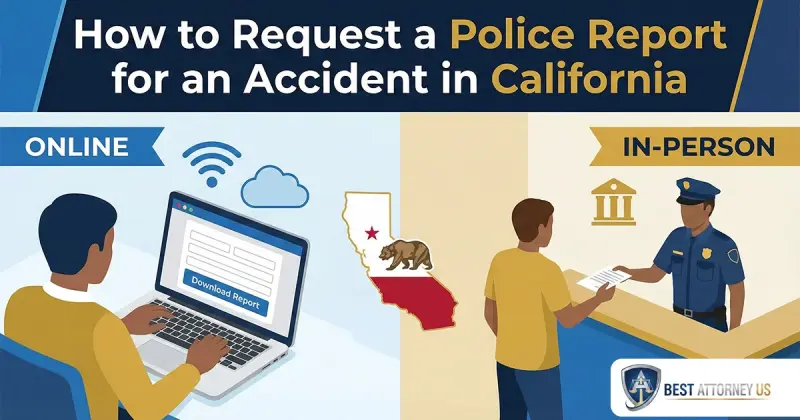
Online: The CHP Crash Portal allows you to create an account, search for the collision, and pay via credit card. Note: Reports involving arrests, fatalities, or juveniles often cannot be released online and require a mail-in request.
-
In-Person: A significant advantage of the CHP system is network connectivity. You can visit any CHP Area Office in California to request a report, even if the accident occurred in a different county. If the report is finalized in the system, any office can print it.
-
Mail: Send the CHP 190, ID copy, and a check (payable to "California Highway Patrol") to the Area Office where the crash occurred. Since fees are based on page count ($10 for 1-25 pages, $20 for 26-50), it is advisable to write "Not to Exceed $20" on the check or call ahead for the page count.
Requesting Reports from Local Police Departments
Local agencies operate independently, and their procedures can be idiosyncratic.
Los Angeles Police Department (LAPD)
For accidents on Los Angeles surface streets, the LAPD utilizes a mix of online and mail-in options.
-
Fee: $29.00. This is one of the higher fees in the state.
-
Exemptions: Victims of domestic violence, identity theft, sexual assault, and stalking are entitled to free copies of their reports.
-
Online Limitations: Like the CHP, the LAPD online portal restricts reports involving arrests, fatalities, or juveniles. These must be requested via US Mail to the Records & Identification (R&I) Division.
San Francisco Police Department (SFPD)
San Francisco is unique among major California cities in that it does not charge parties of interest for collision reports.
-
Protocol: Requests are processed through the SFPD GovQA portal.
-
Documentation: The system is strict about identity verification. Users must upload a valid ID. Attorneys must upload a photo of their business card (showing State Bar number) and a written retainer agreement or letter of representation signed by the client.
San Diego Police Department (SDPD)
-
Online: SDPD uses the third-party service LexisNexis eCrash. While convenient, this service typically charges a "convenience fee" (approx. $10) on top of the department's $12 report fee.
-
Mail/In-Person: You can avoid the convenience fee by mailing a request with a $12 check to the SDPD Records Division or visiting in person at the Broadway location.
Sacramento Police Department
-
Online: Sacramento PD offers an online portal for report retrieval.
-
Fee: The fee for online crash reports is relatively low at $5.00.
-
Timeline: Reports are generally available 5–10 days post-collision.
Legal Nuances: What You Need to Know
Admissibility in Court (CVC § 20013)
A common misconception is that the police report is the ultimate evidence in a trial. However, CVC § 20013 explicitly states: "No such accident report shall be used as evidence in any trial, civil or criminal, arising out of an accident".
-
Why? The law encourages drivers to be honest with officers at the scene without fear that their statements will be used against them in civil litigation.
-
The Exception: While the report itself is inadmissible, the officer can testify to their observations (skid marks, position of vehicles), and their testimony is evidence. The report acts as a tool to refresh the officer's memory.
Witness Privacy and the Paniagua Ruling
Previously, agencies would heavily redact witness names and contact information from reports released to involved parties. However, the landmark case State of California v. Superior Court (Paniagua) (2022) ruled that under CVC § 20012, parties with a proper interest are entitled to the entire contents of the report, including witness information.
The DMV Requirement (Form SR-1)
Obtaining a police report does not satisfy your obligation to the DMV. If the accident resulted in injury, death, or property damage exceeding $1,000, you must file a Report of Traffic Accident Occurring in California (Form SR-1) with the DMV within 10 days. This is a separate administrative requirement, independent of the police investigation.