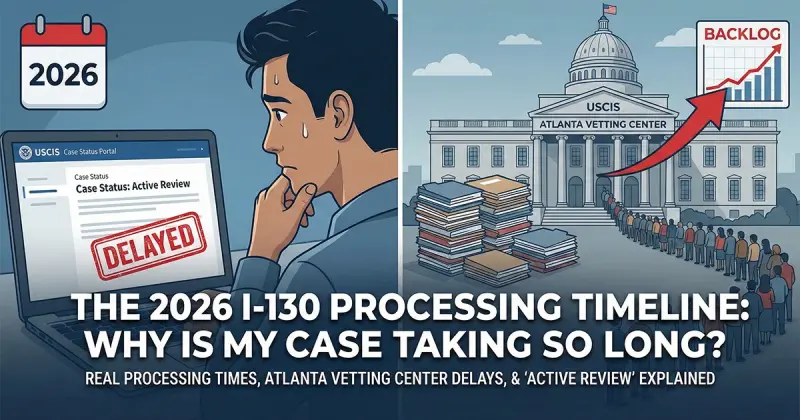
Is your I-130 stuck in "Active Review"? Check 2026 processing times and learn how the new Atlanta Vetting Center might be stalling your case.
You check your phone every morning. You log into your USCIS account. You see the same message you’ve seen for months: “Case Is Being Actively Reviewed By USCIS.”
If you feel like your life is on pause, you are not alone. In 2026, the wait times for family petitions (Form I-130) have reached historic highs. Whether you are waiting for a spouse, a parent, or a sibling, the system feels slower than ever.
Why is this happening? And more importantly, when will your case actually move?
This guide breaks down the real 2026 I-130 processing timeline, explains the "Two-Wait System" that confuses most families, and offers steps you can take if your case is unreasonably delayed.
The "Two-Wait" System: Why You Are Confused
Most people think there is only one line. In reality, there are two. Understanding this is the key to knowing why your case is taking so long.
Wait #1: USCIS Processing (The Petition)
This is the part where USCIS checks if your relationship is real. They look at your marriage certificate, birth certificates, and photos.
Wait #2: Visa Availability (The Ticket)
Once USCIS says "Yes, your relationship is real," you might still have to wait for a "Visa Number" (a ticket) to become available.
-
The Problem: Congress limits the number of Green Cards issued per year. If 100,000 people apply but there are only 25,000 spots, a line forms.
-
Who waits here: Spouses of Green Card holders (F2A), Siblings (F4), and Adult Children.
Note: If you are a US Citizen petitioning for a Spouse, Parent, or Unmarried Child (Under 21), you skip Wait #2. You only have to deal with Wait #1.
2026 Processing Timelines by Category
Here is the realistic breakdown of how long cases are taking right now, based on January 2026 data.
1. Immediate Relatives (Spouse/Parent of US Citizen)
-
Average Wait: 10 to 15 months.
-
The 2026 Trend: While these used to take 5-8 months, they are now pushing over a year.
-
Why? A new layer of security vetting introduced in late 2025 has slowed down approvals, even for straightforward marriage cases.
2. Spouses of Green Card Holders (F2A Category)
-
Average Wait: 30 to 40 months (Total).
-
The 2026 Trend: This category is currently "Backlogged." Even if USCIS approves your I-130 in 12 months, you cannot get your Green Card until your "Priority Date" is current in the Visa Bulletin.
-
Reality Check: You may be separated for 3+ years unless the petitioner becomes a US Citizen.
3. Siblings of US Citizens (F4 Category)
-
Average Wait: 15 to 20+ years.
-
The 2026 Trend: This line moves the slowest. For applicants from countries with high demand (like Mexico, India, or the Philippines), the wait is often over two decades.
Comparison: The "New Normal" vs. The Past
To show you how much things have changed, look at this comparison of average processing times.
| Category |
Beneficiary Relationship |
2022 Average |
2026 Current Average |
| Immediate Relative |
Spouse of US Citizen |
6-9 Months |
11-15 Months |
| F2A |
Spouse of Green Card Holder |
12-18 Months |
35-40 Months (w/ Visa Wait) |
| F1 |
Unmarried Son/Daughter of US Citizen |
6-7 Years |
8-9 Years |
| F4 |
Sibling of US Citizen |
14 Years |
16-22 Years |
[Internal Link: Check the Latest Visa Bulletin Updates Here]
Why Is 2026 So Slow? (The Atlanta Factor)
Clients often ask us, "Why is my case taking longer than my friend's case from last year?"
There are three main reasons for the 2026 slowdown:
-
The "Atlanta Vetting Center": USCIS has established a new centralized vetting hub in Atlanta. Many cases that used to be approved quickly at local field offices are now being routed there for "enhanced security screening." This adds 3-6 months to the timeline.
-
Humanitarian Crisis Impact: USCIS officers who normally process family petitions have been temporarily reassigned to handle asylum claims and humanitarian parole cases.
-
The "Post-COVID" Bubble: The massive surge of applications filed in 2023 and 2024 is now clogging the system. It is like a traffic jam; even if the accident is cleared, the cars are still backed up for miles.
What Does "Actively Being Reviewed" Really Mean?
This is the most frustrating status message.
Myth: An officer is sitting at a desk looking at your file every day.
Fact: Your file is sitting on a shelf (digital or physical) waiting for an officer to pick it up.
"Actively Being Reviewed" usually means your case has been scanned into the system and background checks have started. It does not mean a decision is imminent. It is common for a case to stay in this status for 8-10 months without a single update.
What Can You Do? (3 Action Steps)
You don't have to sit and wait forever. Here is how to take action in 2026.
1. Check the "Outside Normal Processing Time" Date
Go to the USCIS website and check the processing time for your specific Service Center (e.g., Texas, California, Potomac). If your case is pending longer than the date listed, you can file an "e-Request" online.
2. Contact Your Congressperson
If your case is well beyond the average wait time, you can contact your local US Representative. They have dedicated staff who can send a formal inquiry to USCIS. This sometimes "nudges" a file out of the pile.
3. The Writ of Mandamus (The Nuclear Option)
If you have been waiting for an unreasonable amount of time (usually 2+ years for a marriage case), you can sue the government. This is called a Writ of Mandamus. It forces a judge to order USCIS to make a decision on your case.
[Internal Link: Is a Writ of Mandamus Right for You? Read Our Guide]
Conclusion: Patience vs. Action
The 2026 I-130 processing timeline is discouraging, but understanding why it is happening gives you power.
If you are a US Citizen filing for a spouse, expect a 12-15 month wait. If you are a Permanent Resident, check the Visa Bulletin monthly. And if your case is stuck in the "Atlanta Black Hole," it might be time to stop waiting and start asking for help.
Do you need to check if your case is "abnormally" delayed?
Don't guess. Use our free case evaluation tool or contact us to see if you qualify for an expedited request.
References & Resources