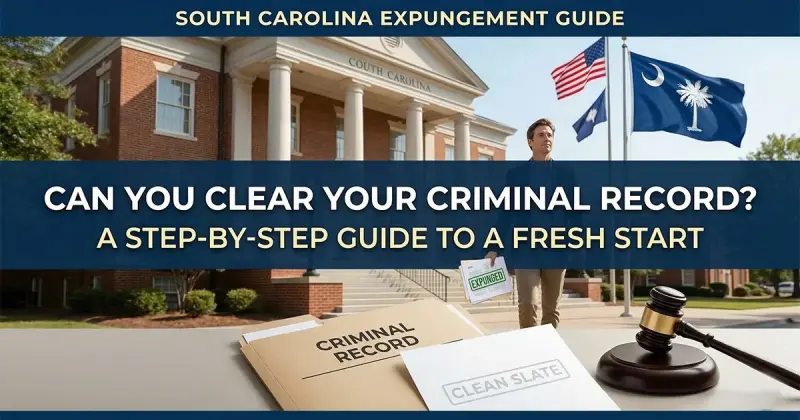
Looking to clear your criminal record in SC? Read our complete guide to South Carolina expungement, including eligibility requirements and how to apply.
Imagine this scenario: You are sitting in the parking lot before a major job interview, gripping the steering wheel, and your heart is pounding. You are perfectly qualified for the position, but a single thought is paralyzing you: What if they run a background check?
I have sat across the desk from countless clients who have broken down in tears over this exact fear. They have served their time, paid their fines, and completely turned their lives around. Yet, a mistake from five, ten, or even twenty years ago continues to slam doors in their faces. You might be feeling that same exhaustion and confusion right now.
We understand how heavy this burden is, and more importantly, we know how to help you lift it. If you are wondering how to Clear Your Criminal Record in South Carolina, you have come to the right place.
In this comprehensive guide, I will walk you through the specific, limited circumstances under which an arrest or conviction can be legally erased in South Carolina. We will break down the complex legal jargon into clear, actionable steps, so you can finally take control of your future.
The Reality of Criminal Records in South Carolina
In today’s digital age, a criminal record is essentially a public billboard of your past. Even if your charges were completely dismissed, the record of your arrest and booking can still show up on a routine background check.
This visibility creates devastating roadblocks for housing, professional licensing, and employment. South Carolina lawmakers recognize that a functional society must offer a path to redemption.
That is why the state established the legal process of expungement. An expungement is a powerful court order that forces government agencies—including the police, the jail, the courts, and the South Carolina Law Enforcement Division (SLED)—to destroy or seal their records of your arrest or conviction.
Once an expungement is granted, you are legally restored to the status you held before the arrest. **
The Golden Rule of South Carolina Expungements Securing an expungement order forces government agencies to destroy your records, but it does not automatically erase data held by private background check companies. Because private companies rely on outdated data scrapes, you must proactively send a certified copy of your final expungement order to these private businesses to force them to clear your name. Furthermore, South Carolina strictly limits the expungement of most convictions to a "once in a lifetime" opportunity.
Expungement vs. Pardon: What is the Difference?
One of the top pain points clients face is confusing an expungement with a pardon. They are entirely different legal mechanisms with vastly different results.
If your specific charge does not qualify for an expungement under South Carolina law, seeking a pardon might be your only alternative.
Here is a clear breakdown of how they compare:
What Can Actually Be Expunged in South Carolina?
South Carolina law is incredibly rigid regarding what can and cannot be erased. If your specific offense is not explicitly listed in the state statutes, it cannot be expunged—no matter how much time has passed.
Let's dive deep into the specific categories of charges that are eligible for a clean slate.
1. Dismissed, Nolle Prossed, and Not Guilty Charges
If you were arrested but the case was ultimately dismissed, "nolle prossed" (dropped by the prosecutor), or you were found not guilty at trial, you are eligible for an expungement.
Key Takeaway: You can apply for this type of expungement an unlimited number of times in your life. If your case was dismissed without a plea agreement, you do not even have to pay the standard administrative fees to the Solicitor or SLED.
2. Pre-Trial Diversion Programs
South Carolina offers several diversion programs designed to prioritize rehabilitation over punishment for first-time offenders.
If you successfully complete one of these programs, your charges are dismissed and become eligible for expungement.
-
Pre-Trial Intervention (PTI): A rigorous program requiring community service and restitution.
-
Alcohol Education Program (AEP): Designed for minor alcohol-related offenses.
-
Traffic Education Program (TEP): For minor traffic infractions.
3. Minor Misdemeanors (The 30-Day / $1,000 Rule)
Under SC Code Section 22-5-910, certain low-level convictions in magistrate or municipal court can be expunged. The crime must carry a maximum statutory penalty of no more than 30 days in jail and/or a $1,000 fine.
The Catch: You must maintain a spotless criminal record for three full years from the date of your conviction. If the conviction was for third-degree Criminal Domestic Violence (CDV), the waiting period is extended to five years.
4. The Youthful Offender Act (YOA)
We all make foolish mistakes when we are young. The Youthful Offender Act (YOA) was created specifically to ensure a bad decision between the ages of 17 and 25 does not ruin a young adult's entire life.
To expunge a YOA conviction, you must have been specifically sentenced under the YOA by the judge. After completing your entire sentence (including probation or parole), you must wait five years without any new convictions.
5. Specific Drug Offenses
Drug expungements in South Carolina depend heavily on the severity of the charge.
-
Conditional Discharge: If you received a conditional discharge for first-offense simple possession, the record can be expunged immediately upon successful completion of your probation terms.
-
Simple Possession: A standard first-offense conviction for simple possession of illegal or prescription drugs requires a three-year clean waiting period after your sentence is completed.
-
Possession with Intent to Distribute (PWID): In rare cases, a first-offense PWID conviction can be expunged, but it requires a staggering 20-year waiting period with absolutely no other drug or felony convictions.
What CANNOT Be Expunged in South Carolina?
I always want to be completely honest with my clients. Some charges simply cannot be erased under current state law, and applying for them will only result in lost money and a rejected application.
You cannot expunge:
-
DUIs and DUACs: South Carolina has a zero-tolerance policy for erasing driving under the influence charges. These are permanent.
-
Violent Crimes: Murder, armed robbery, and other severe felonies cannot be expunged.
-
Sex Offenses: Any crime requiring you to register as a sex offender is ineligible.
-
Traffic and Wildlife Violations: Standard speeding tickets or hunting out-of-season charges are permanently on your record.
The Step-by-Step Expungement Process
Filing for an expungement is not a simple matter of checking a box online. It requires navigating a highly bureaucratic maze.
Here is exactly how the process works in South Carolina:
Step 1: Obtain Your Certified Dispositions You cannot use an online printout or a SLED rap sheet. You must go to the specific court that handled your case and request an official, certified disposition proving the final outcome of your charge.
Step 2: Submit the Application and Fees You must submit a formal application to the Solicitor's Office in the county where you were arrested. **
For most convictions, you must include three separate U.S. Postal Money Orders (fees are non-refundable):
Step 3: State Agency Review The Solicitor's Office will review your entire criminal history across multiple databases to ensure you meet all waiting periods. They will then forward the order to SLED for a secondary background verification.
Step 4: Judicial Signature and Destruction Once SLED approves, the paperwork is sent to an Administrative Circuit Court Judge for a signature. Finally, the Solicitor mails the signed order to all arresting agencies, legally forcing them to destroy your records.
Common Pitfalls: Why Applications Get Denied
The state does not offer refunds. If you make a mistake on your application, you will lose your $250 administrative fee immediately.
The top reasons for denial include:
-
Applying for an ineligible offense, such as a DUI or a traffic ticket.
-
Miscalculating the waiting period. Filing even one day before your three-year or five-year waiting period is over will trigger a denial.
-
Unpaid fines or restitution. If you still owe the court money from your original sentence, your expungement will be blocked.
-
Violating the "Once in a Lifetime" rule. If you have already used your one lifetime conviction expungement, you cannot apply for a second one.
Employer Immunity: Your Right to Privacy
One of the greatest fears my clients have is lying on a job application. "Do I have to tell them about my arrest if it was expunged?"
The answer is a resounding NO.
In December 2018, South Carolina passed Section 17-22-960, a crucial law that protects employees. Under this law, it is illegal for an employer to use expunged information adversely against you.
To protect businesses, the state also grants employers immunity from being sued for negligent hiring if an employee's past expunged record later comes to light. This law was designed to give you a true, unburdened fresh start.
Frequently Asked Questions (FAQs)
1. How long does the expungement process take in South Carolina? Because the paperwork must be routed through multiple state agencies, the process is notoriously slow. You should expect it to take up to six months from the date your complete application is received.
2. How much does it cost to get an expungement? For most eligible convictions and plea-bargained dismissals, the state statutory fees total $310 ($250 to the Solicitor, $25 to SLED, $35 to the Clerk). If your charge was dismissed without a plea agreement, the Solicitor and SLED fees are typically waived.
3. Do I legally need to hire an attorney to get an expungement? No, you are not legally required to have an attorney; you can file the paperwork yourself. However, because the laws are complex and the fees are strictly non-refundable, many people hire a defense attorney to ensure the application is flawless and avoid costly denials.
4. Will my expunged record still show up on a private background check? It might, which is why you must be proactive. Expungement orders only force government agencies to delete their files. You must manually send a copy of your signed expungement order to private background check companies so they update their independent databases.
5. Can I expunge a criminal record from another state if I live in SC? No. South Carolina laws only apply to arrests and convictions that occurred within the borders of South Carolina. To clear an out-of-state record, you must apply under the specific expungement laws of that state.
Conclusion: Take the First Step Toward Your Fresh Start
Carrying the weight of a past criminal record is exhausting, stressful, and deeply unfair when you have worked so hard to rehabilitate your life. You do not have to let a past mistake dictate your future income, your housing, or your peace of mind.
While the process to Clear Your Criminal Record in South Carolina is filled with bureaucratic red tape, strict deadlines, and non-refundable fees, you do not have to navigate this maze alone.
A successful expungement requires precision, patience, and a deep understanding of state statutes. Let us handle the heavy lifting so you can focus on building the life you deserve.
Ready to finally clear your name? Do not risk a denied application and lost fees. Contact us today at bestattorneyus.com for a comprehensive, confidential case evaluation. We will review your record, determine your eligibility, and fight to get you the clean slate you have earned.