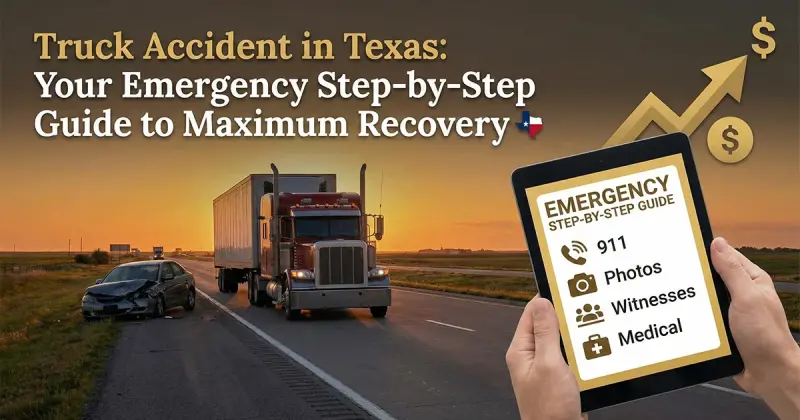
Hit by a truck in Texas? Follow this immediate step-by-step guide to protect your rights and maximize your financial recovery. Don't make costly mistakes.
You’re sitting on the side of the I-10 or deep in the Permian Basin oilfields, the world still spinning. The deafening roar of grinding metal has been replaced by a terrifying silence, broken only by the hiss of a radiator and the pounding of your own heart. In front of you—or perhaps on top of you—is an 80,000-pound commercial "big rig."
In the wake of a collision of this magnitude, your brain is flooded with adrenaline. You are likely in shock, feeling a mix of profound relief to be alive and a paralyzing fear about what comes next. At bestattorneyus.com, we know that the decisions you make in the next 30 minutes, and the next 48 hours, will dictate the trajectory of your physical recovery and your legal future.
Knowing what to do immediately after a truck accident in Texas is not just about following a checklist; it is about building a wall between your family and the multi-billion-dollar trucking corporations that are already deploying "Rapid Response" teams to the scene to minimize your claim. This guide provides the high-authority, empathetic, and scannable guidance you need during this crisis.
1. The Critical First 15 Minutes: Survival and Scene Management
The immediate moments after a crash are the most dangerous. Large trucks often carry hazardous materials, and secondary collisions are common on Texas’s high-speed thoroughfares.
-
Stop and Move to Safety: Under Texas Transportation Code Sec. 550.021, you are legally required to stop. If your vehicle is functional and not pinned, move it to the shoulder to avoid being hit again. If you cannot move the car, stay buckled until you are certain it is safe to exit.
-
Call 911 Immediately: In Texas, you're legally required to report accidents involving injury, death, or property damage exceeding $1,000. An 18-wheeler accident almost always exceeds that threshold. A formal police report from the Texas Highway Patrol or local police is the foundational evidence for your case.
-
Check for Injuries: Do not say "I'm fine." Adrenaline masks internal bleeding and spinal trauma. Simply state that you are "shaken up" and need a professional medical evaluation.
2. Evidence Lockdown: Be Your Own Advocate at the Scene
While the police will write a report, their focus is often on traffic violations, not necessarily building a complex personal injury case for you. You need to capture details that can vanish within hours.
-
Identify the "DOT" and Company Name: Every commercial truck must display a USDOT number on the cab. Photograph this. Note the company name on the trailer—these are often different entities (the carrier vs. the shipper), and both may be liable.
-
Photograph the Environment: Capture skid marks, debris fields, and the final resting positions of all vehicles. In Texas, the weather can change in minutes; capture the visibility and road conditions as they were at the moment of impact.
-
Identify Witnesses: In the chaos of a Texas highway, witnesses often stop and then drive away. Get names and phone numbers immediately. Their neutral perspective is worth more than a dozen expert testimonies later.
The Golden Rule:
"Never apologize or admit fault, even casually. Statements like 'I didn't see you' or 'I'm sorry' will be recorded by trucking company adjusters and used to push your liability over the 51% threshold. In Texas, even a polite apology can be legally interpreted as an admission of negligence that bars you from recovery."
3. Understanding the Legal Shift: Why Texas is a "Modified" State
Texas follows the Proportionate Responsibility Act (Chapter 33 of the Texas Civil Practice and Remedies Code). This is a "modified comparative negligence" system, often called the 51% Bar Rule. It is the single most important law affecting your recovery.
| Scenario |
Texas (Modified Comparative) |
California (Pure Comparative) |
| You are 10% at Fault |
You recover 90% of damages |
You recover 90% of damages |
| You are 50% at Fault |
You recover 50% of damages |
You recover 50% of damages |
| You are 51% at Fault |
YOU RECOVER $0 |
You recover 49% of damages |
| Recovery Bar |
Strict 51% "Cliff" |
No bar; can recover at 99% fault |
This "cliff effect" is why insurance adjusters fight so hard to shift even a small percentage of blame onto you. They don't need to prove they were innocent; they only need to prove you were slightly more at fault than they were to end their financial obligation to you permanently.
4. The HB 19 Factor: How Texas Law Protects Trucking Companies
In 2021, Texas passed House Bill 19 (HB 19), which radically changed how these cases are litigated. Under this law, a trucking company can request a "bifurcated" or split trial.
-
Phase One: The jury only hears about the driver's actions. The trucking company’s safety record, history of violations, and corporate policies are hidden from the jury.
-
Phase Two: Only if the driver is found negligent can you then proceed to sue the company for "negligent hiring" or "punitive damages."
This law makes it significantly harder to show the full picture of corporate neglect early in the case. This is why you need a Senior Legal Analyst who knows how to use exceptions in HB 19—such as maintenance violations or lack of medical certification—to get corporate evidence in front of the jury sooner.
5. The Spoliation Threat: Why You Must Act Within 48 Hours
In the trucking industry, critical data is volatile. Electronic Logging Device (ELD) data shows if the driver was fatigued or over their "Hours of Service." Black Box (ECM) data shows speed and braking at the moment of impact.
Trucking companies are only required to keep certain records for six months, and black boxes often overwrite data in 30 days or less. If your attorney does not immediately send a "Spoliation of Evidence" letter, the company may legally destroy the very proof you need.
An expert legal team will demand preservation of:
-
ECM Data: Objective proof of speeding or failure to brake.
-
Driver Qualification Files: Proving if they hired a driver with a dangerous history.
-
Maintenance Records: Revealing if the truck was a "ticking time bomb" due to faulty brakes.
6. Managing the Adrenaline Trap: Medical Documentation
A top "pain point" for victims is the "delayed onset" of symptoms. In Texas, if you wait more than 72 hours to see a doctor, insurance adjusters will argue your injuries were caused by an unrelated event.
-
Visit the ER or Urgent Care: Insist on a spinal and neurological screening. Whiplash and Traumatic Brain Injuries (TBIs) often manifest days later.
-
Follow the Plan: If you skip one physical therapy session, the insurer will document it as a "gap in treatment" to prove you aren't actually hurt.
-
Pain Journaling: Document how the injury affects your ability to work or care for your children. Contemporaneous records are highly persuasive to Texas juries.
7. Texas Statutes of Limitations: The Two-Year Clock
Under Texas Civil Practice and Remedies Code § 16.003, you generally have two years from the date of the accident to file a lawsuit. However, this is the "final deadline," not a suggested start date.
-
Wrongful Death: If you are filing for a loved one, the two-year clock starts on the date of death, not the date of the accident.
-
Government Entities: If you were hit by a city-owned vehicle or a TxDOT truck, you may have a municipal notice deadline as short as 45 to 90 days. Missing this notice can kill your case before it ever starts.
Conclusion: Reclaiming Your Future After a Collision
Surviving a truck accident is a miracle; surviving the legal aftermath requires a strategy. Between the 51% recovery bar and the hurdles of HB 19, Texas is one of the most challenging states in the nation for accident victims. You have already endured the trauma of the crash—you shouldn't have to endure the trauma of a corporate legal machine alone.
At bestattorneyus.com, we provide the expertise and authoritativeness needed to level the playing field. By following these steps—prioritizing safety, seeking immediate care, and preserving evidence—you are reclaiming control of your future.
Are you or a loved one suffering after a truck accident in Texas? Don't let the 51% rule or the "Rapid Response" adjusters beat you. Contact a qualified Texas truck accident attorney today for a comprehensive case evaluation to ensure your rights are protected and your recovery is prioritized.
Authoritative Sources for Further Reading: