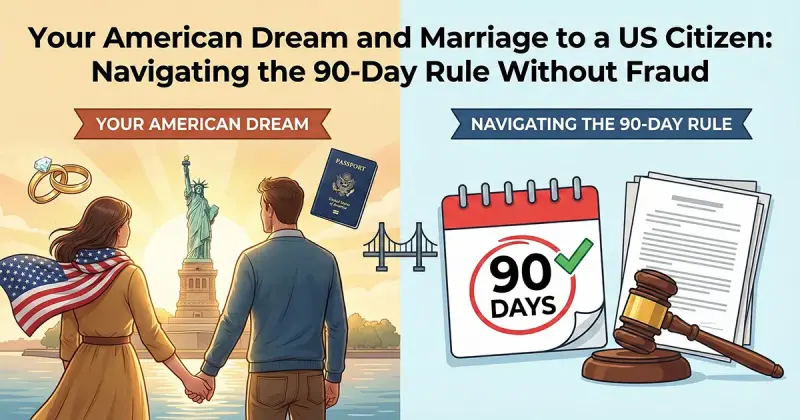
Marrying a US citizen? The USCIS 90-Day Rule is critical. Missteps can lead to visa fraud charges. Learn how to navigate this rule safely and protect your American dream.
You came to the United States with a backpack, a student visa, and a vision for your education. But then, the unexpected happened: you fell in love. Now, you’re looking at a future that includes a marriage to a US citizen, but you’re also staring at a complex web of immigration laws that seem designed to second-guess your heart.
The most common question we hear from F-1 students at bestattorneyus.com is, "If I get married now, will the government think I lied to get my visa?" In the current 2026 legal climate, where enforcement has intensified and AI-driven vetting is the new norm, the answer depends entirely on your timing. Specifically, it depends on the "90-Day Rule."
Falling in love isn't a crime, but "preconceived intent"—entering the U.S. on a temporary visa with a secret plan to stay permanently—can lead to a lifetime bar from the United States. This guide provides the expert-level clarity you need to transition from student to spouse without triggering a "fraud" finding that could end your American journey before it truly begins.
The Foundation of the Law: What is the 90-Day Rule?
The "90-day rule" is a critical guideline used by U.S. Citizenship and Immigration Services (USCIS) and the Department of State (DOS) to evaluate the honesty of non-immigrants. It creates a legal "rebuttable presumption." If you engage in conduct inconsistent with your non-immigrant status—such as a marriage to a US citizen or filing for a Green Card—within 90 days of your last entry into the U.S., the government assumes you misrepresented your original intentions.
Technically, the F-1 visa is a "single intent" visa. This means when you stood before the consular officer in your home country, you swore that your sole purpose for travel was to study and that you intended to return home afterward. If you marry shortly after arrival, the government may view your F-1 application as a fraudulent "bridge" to get into the country for immigration purposes rather than education.
The Danger of a "Fraud" Finding in 2026
In early 2026, the stakes for visa misrepresentation have never been higher. Under the current administration's "continuous vetting" protocols, federal officers are utilizing the Gemini 3 AI system to cross-reference travel records, social media activity, and even engagement announcements to find inconsistencies in "immigrant intent".
If an officer finds that you willfully misrepresented a material fact to obtain a visa, you are subject to INA § 212(a)(6)(C)(i)—a permanent bar from entering or staying in the United States. While a waiver (the I-601 waiver) exists, it is exceptionally difficult to win and requires proving "extreme hardship" to a U.S. citizen relative.
Comparison: Single Intent vs. Dual Intent Visas
Understanding which "intent" category your visa falls into is the first step in assessing your risk. Not all visa holders are treated with the same level of suspicion when they pursue a Green Card.
| Feature |
Single Intent (F-1, B-1/B-2, J-1) |
Dual Intent (H-1B, L-1, O-1) |
| Primary Requirement |
Must intend to return home |
May intend to stay permanently |
| 90-Day Rule Impact |
High risk of fraud presumption |
Generally exempt from rule |
| Engagement Risk |
Proposal within 90 days is a red flag |
Freedom to get engaged/married anytime |
| Travel Rights |
Travel while AOS is pending is risky |
Travel allowed with valid visa |
| Proof of Ties |
Must show strong ties to home country |
No requirement to maintain foreign home |
The Engagement Trap: Why Timing Matters Before the Wedding
One of the most dangerous pitfalls we see in 2026 is what we call the "Engagement Trap." Many couples believe they are safe if they wait until Day 91 to have their wedding ceremony. However, if you get engaged, announce it on social media, or begin booking wedding venues within the first 90 days of your entry, that evidence can be used to prove you had "immigrant intent" the moment you crossed the border.
The government's logic is simple: if you proposed or accepted a proposal within weeks of arriving on a student visa, your plan to stay was likely formed before you arrived.
The Golden Rule:
"Wait. For F-1 students, the safest path is to wait at least 90 calendar days after your most recent entry into the U.S. before you marry, get engaged, or even begin the public planning of your life together. In the eyes of USCIS, patience is the best evidence of your honesty."
Status vs. Visa: The 2026 "Grounded" Risk
It is vital to distinguish between your F-1 status (the right to be here) and your visa stamp (the "key" to the door). If the government suspects intent issues, they may trigger a "Prudential Revocation" of your visa stamp.
If your visa is prudentially revoked while you are inside the U.S., you are generally allowed to stay and continue your authorized studies until your I-94 expires. However, you are effectively "grounded." If you leave the country for a funeral or family emergency, your visa "key" is broken, and you will be forced to undergo an intensive, high-stakes interview at a consulate abroad before you can return.
Step-by-Step: How to Protect Your Adjustment of Status
If you are an F-1 student moving forward with a marriage to a US citizen, follow these steps to minimize your risk:
-
Check Your I-94: Calculate 90 days from your most recent entry date, not your original entry date from years ago. Every time you leave and return, the clock resets.
-
Maintain Your Studies: Do not drop out of school the moment you get married. If your Green Card application is denied for any reason and you have stopped attending classes, you will be out of status and potentially subject to immediate detention.
-
Collect "Change of Mind" Evidence: If you must marry within the 90-day window due to an emergency (such as a military deployment or pregnancy), you must be prepared to prove that your intent changed after you arrived. This might include evidence of unexpected life events that made the marriage urgent.
-
Strategic Filing: You can file the I-130 (Marriage Petition) at any time, but it is the I-485 (Adjustment Application) that usually triggers the "90-day" scrutiny. **
State Nuances: Marriage Laws in 2026
While immigration is federal, the "validity" of your marriage depends on the law of the state where it was celebrated. In 2026, we see a wide divergence:
-
Michigan and Washington: Require a 3-day waiting period between getting your license and the ceremony.
-
New Jersey: Requires a 72-hour wait before the license is even issued.
-
Virginia: Allows you to get married the same day the license is issued.
USCIS will scrutinize "quickie" marriages in states with no waiting periods more heavily if they occur within that first 90-day window.
Conclusion: Don't Let a Deadline Break Your Heart
Transitioning from an F-1 student to a permanent resident through marriage to a US citizen is a beautiful step, but it is one that requires precision. In an era of AI vetting and 27-month backlogs, a single mistake in your timeline can lead to years of legal battles.
The "90-day rule" isn't a wall; it’s a guide. By understanding your intent, respecting the clock, and maintaining your legal status, you can build your life in America on a foundation of honesty and security.
Are you an F-1 student planning a future with your U.S. citizen partner? Don't leave your status to chance. Contact the legal analysts at bestattorneyus.com today for a comprehensive case evaluation. We will help you navigate the "90-day" minefield and ensure your American dream remains intact.
Authoritative Sources for Further Reading: