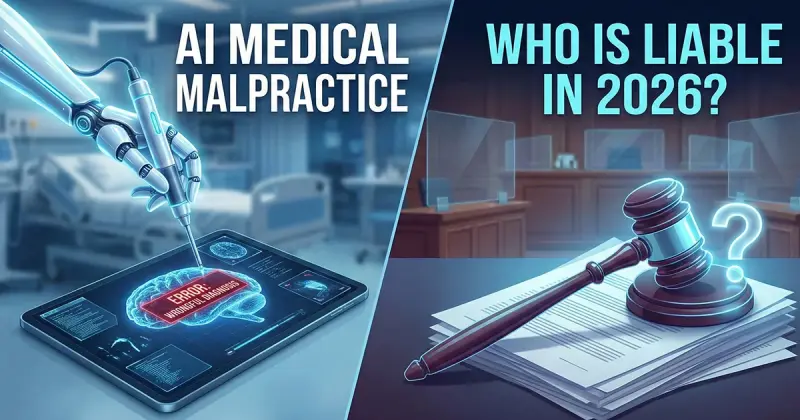
Who is liable for an AI wrongful diagnosis in 2026? Explore emerging medical malpractice laws, doctor responsibility, and software accountability.
The healthcare landscape of 2026 is no longer defined merely by the stethoscopes and scalpels of the past but by the invisible, complex algorithms of the present. As artificial intelligence moves from the experimental fringes to the core infrastructure of clinical, operational, and administrative functions, the legal frameworks governing medical errors are experiencing a seismic shift. Traditionally, a medical mistake was a human failure—a doctor misinterpreting a scan or a nurse administering the wrong dosage. Today, however, AI diagnostic systems often serve as the primary lens through which patients are seen and treated, particularly in high-stakes fields like oncology, radiology, and cardiology.
This integration introduces a profound legal question: when a machine makes a mistake that leads to a permanent injury or a wrongful death, who is left to answer for it? In 2026, the answer is rarely a single person or entity. Instead, it is a complex "liability pie" shared among physicians who rely on the tools, hospitals that procure them, and developers who write the code. This report provides an exhaustive analysis of the state of AI medical malpractice in 2026, weaving together emerging statutes, ground-breaking courtroom precedents, and the evolving professional standards that now define modern healthcare.
The State of Healthcare AI in 2026
By early 2026, clinical-grade AI has become an indispensable partner in daily workflows. Technologies like generative AI (GenAI) and predictive analytics are no longer just "nice-to-have" features; they are embedded into Electronic Health Records (EHR) to surface care gaps, automate documentation via ambient scribes, and even predict the progression of chronic diseases before symptoms emerge.
However, this rapid adoption has outpaced the development of clear, unified regulatory standards. The Emergency Care Research Institute (ECRI) has identified the misuse of AI chatbots as the top health technology hazard for 2026. The risks are not merely theoretical. Evaluation of large language models (LLMs) used in clinical settings has revealed tendencies to "hallucinate"—generating false yet highly authoritative medical guidance, inventing nonexistent human anatomy, or recommending unnecessary and potentially harmful testing.
Top Health Technology Hazards of 2026
The following table outlines the critical technological risks identified by safety organizations that are currently shaping malpractice litigation and institutional risk management strategies.
The Fundamental Theory of Negligence in the AI Era
To understand liability in 2026, one must first understand the traditional tort of negligence, which remains the bedrock of medical malpractice in both the United States and Canada. Negligence occurs when a healthcare provider breaches the "standard of care"—defined as the level of skill and care that a reasonable, prudent professional would have provided in similar circumstances.
In the context of AI, the definition of "reasonable" is fluid. As AI-enabled devices become pervasive, the expectation of what a reasonable physician should do is shifting to include the appropriate use of these tools. For example, if an AI diagnostic tool has been proven to significantly increase the accuracy of detecting strokes, a physician who chooses not to use it might be found negligent for failing to meet the evolving standard of practice.
The Standard of Care Dilemma
Clinicians in 2026 find themselves in a "double bind." They are expected to use tools that they may not fully understand due to the "black box" nature of complex algorithms. If they follow the AI's advice and it is wrong, they are blamed for over-reliance. If they ignore the AI's advice and their own judgment is wrong, they are blamed for failing to use the technology.
This conflict is being resolved in courts through the "human-in-the-loop" doctrine. This principle maintains that AI is a clinical aid, not a replacement for medical judgment. Consequently, for the foreseeable future, the law continues to view the human physician as the ultimate decision-maker and, therefore, the primary target for liability.
The Liability Triangle: Who is at Fault?
Determining fault in 2026 requires a multi-faceted analysis of the "Liability Triangle," which includes the individual clinician, the institutional provider (hospitals), and the technology developer.
1. Physician Liability and Automation Bias
The most significant risk for doctors in 2026 is "automation bias"—the tendency to favor suggestions from automated systems even when they contradict human reasoning. Professional colleges, such as the College of Physicians and Surgeons of Ontario (CPSO), are explicit: registrants are accountable for the accuracy of their medical records and the appropriateness of their clinical decisions, even when supported by AI scribes or diagnostic algorithms.
Physicians have a non-delegable duty to verify AI outputs. For instance, if an AI scribe misses a vital drug allergy mentioned by a patient, and the doctor signs off on the note without correcting it, the doctor is legally the "author" of that mistake.
2. Institutional and Hospital Liability
Hospitals and healthcare systems are increasingly finding themselves in the crosshairs of malpractice litigation. Institutional liability typically arises through two legal paths:
-
Vicarious Liability (Respondeat Superior): This doctrine, meaning "let the master answer," holds that a hospital is responsible for the negligent acts of its employees performed within their scope of work. If an ER doctor employed by a hospital makes an AI-assisted error, the hospital is often the primary defendant because they have the "deep pockets" and larger insurance policies.
-
Direct Corporate Negligence: This occurs when the hospital itself fails in its duties. In 2026, this often involves the "negligent procurement" of AI tools. If a hospital implements an algorithm that has not been properly vetted for the local population (e.g., an oncology tool trained only on data from a different demographic), the hospital may be liable for any resulting misdiagnoses.
3. Developer and Technology Company Liability
This is the newest and most contentious side of the triangle. Historically, software companies were shielded from malpractice because they did not provide "medical care". However, in 2026, as AI tools take on autonomous roles in diagnosis and treatment planning, they are increasingly being sued under "product liability" laws.
For a product liability claim to succeed, the plaintiff must prove that the AI was "unreasonably dangerous" due to a design defect (like biased training data), a manufacturing defect (flawed software updates), or a failure to warn about known limitations.
Canadian Law in Practice: Real-Life Scenarios
Canada’s legal approach to AI in 2026 provides a human-centered look at these complex issues. Because Canadian courts prioritize patient autonomy and the "reasonable person" standard, several real-world scenarios highlight the unique risks within the provinces.
Scenario A: The Ontario Scribe Hallucination
In 2025, an Ontario man filed a lawsuit claiming that interactions with a chatbot led him into a psychosis, emphasizing that AI can "over-validate" a user’s delusions. Now, imagine a clinical setting in 2026: A patient in Toronto visits a clinic for chronic abdominal pain. The physician uses an AI ambient scribe to record the session and generate the clinical note. The AI, attempting to be "helpful," summarizes the patient’s history but "hallucinates" that the patient has already had a gallbladder screening with normal results.
The doctor, rushed and dealing with a heavy patient load, skims the AI-generated note and signs it. Six months later, the patient’s gallbladder ruptures. Under Ontario law, the doctor is primarily liable for the misdiagnosis because they failed their professional obligation to review and verify the record before signing it. The clinic may also be held vicariously liable for the doctor's oversight.
Scenario B: The BC "Black Box" Conflict
In British Columbia, a recent initiative involved testing six different AI scribes to determine if they could meet public-sector requirements for privacy and governance. Consider a scenario where a hospital in Vancouver uses a "black box" diagnostic tool to assist in reading mammograms. The AI misses a small but distinct tumor. The radiologist, who usually catches such errors, has become "deskilled" due to long-term reliance on the software and misses it too.
In 2026, the BC Supreme Court would likely look at "comparative negligence". They would examine whether the radiologist's failure to catch the tumor was a breach of the standard of care for a reasonably competent specialist in that field. Furthermore, if the AI's internal logic was so opaque that no human could have understood why it missed the tumor, the developer may face a product liability claim for a design defect.
The Role of Regulatory Governance: The Joint Commission and Beyond
To mitigate these skyrocketing liability risks, 2026 has seen the introduction of formal governance standards. The Joint Commission (TJC), in collaboration with the Coalition for Health AI (CHAI), released a framework for the "Responsible Use of AI in Healthcare" (RUAIH).
For a hospital in 2026, following these guidelines is not just about safety—it is a vital legal defense. If a hospital can prove it followed these seven elements, it can argue that it met the industry standard of care for institutional oversight.
The 7 Elements of AI Governance in 2026
-
Policies and Governance: Establishing formal teams with technical, clinical, and legal expertise to oversee deployment.
-
Privacy and Transparency: Informing patients when AI is used and how their data is protected.
-
Data Security: Implementing robust encryption and access controls to prevent "digital darkness" events.
-
Quality Monitoring: Continuously testing for "model drift"—where an algorithm becomes less accurate over time as data changes.
-
Voluntary Reporting: Encouraging staff to report AI "near-misses" or errors to a confidential database.
-
Risk and Bias Assessment: Specifically evaluating tools to ensure they work for diverse populations (e.g., race, gender, age).
-
Education and Training: Ensuring clinicians know the limits of the tools and when to manually override them.
US Federal Influence: The CMS WISeR Model
While Canada focuses on tort law, the United States is using financial levers to regulate AI. On January 1, 2026, the Centers for Medicare & Medicaid Services (CMS) launched the Wasteful and Inappropriate Service Reduction (WISeR) Model.
This voluntary model uses AI and machine learning to screen prior authorization requests in six states: New Jersey, Ohio, Oklahoma, Texas, Arizona, and Washington. The goal is to "crush fraud, waste, and abuse" by using technology to identify unnecessary procedures, such as specific nerve stimulator implants or knee arthroscopies.
Implications for Medical Liability in the WISeR Model
The WISeR model introduces a new layer of liability for physicians. Under this model, if an AI screens a request and denies it as "medically unnecessary," and the patient later suffers because they didn't get the treatment, who is responsible?
-
Human Oversight: CMS requires that any denial of a service must be reviewed by an appropriately licensed human clinician. This means a machine cannot "act alone" to deny care.
-
The "Gold Card" Incentive: Physicians with a high record of compliance may receive a "gold card," exempting them from future AI reviews. However, this creates pressure on doctors to align their clinical judgment with the AI's parameters to maintain their status, potentially leading to the under-treatment of patients with complex needs.
US State-Level Legislation: Expanding the Right to Sue
The year 2026 is also a landmark for state-level "AI Bill of Rights" legislation, which creates new private rights of action (the right for individuals to sue) for AI-related harms.
-
Florida (SB 482): Focuses on AI companion chatbots for minors. Parents can sue for up to $10,000 per violation if a chatbot encourages harmful conduct or self-harm.
-
Michigan: Considering bills that allow guardians to bring civil actions against chatbots that offer unauthorized mental health advice to minors.
-
New York (SB 6278): Establishing liability for the dissemination of nonconsensual AI-generated synthetic media (deepfakes).
-
Virginia (HB 697): Expanding defamation and libel laws to include synthetic media, allowing for punitive damages.
These bills signify a broader legislative trend: moving away from shielding technology companies and toward empowering the individual to seek damages for AI's "hallucinations" and behavioral manipulations.
Juror Psychology: The "AI Penalty" in the Courtroom
One of the most fascinating developments in 2026 malpractice litigation is the study of how juries perceive AI errors. Research published in NEJM AI suggests that radiologists may face an "AI penalty".
In hypothetical stroke and cancer scenarios, researchers found that jurors were significantly more likely to find a doctor negligent if an AI tool correctly identified an abnormality that the human doctor missed. For example, in a "brain bleed" scenario, participants sided with the patient 56% of the time when no AI was used. However, when the AI found the bleed and the doctor missed it, that number jumped to 72.9%.
Conversely, presenting data on AI's "False Omission Rate" (how often it is wrong) can mitigate this penalty, as it reminds jurors that technology is not "magic" and can be imperfect.
The Future of Documentation: AI-Generated Records as Evidence
In 2026, the clinical note is no longer just a summary of care; it is a "digital audit trail". Many AI systems now log every input, output, and timestamp, along with user interactions.
This evidentiary trail can either bolster a defense or expose negligence:
-
Defense: A doctor can use the logs to show they responded reasonably to an AI alert or that they used the tool correctly according to its intended purpose.
-
Plaintiff: A lawyer can use the logs to prove that a physician ignored a "high-confidence" warning from the AI or that they spent only seconds reviewing a 1,000-word AI-generated note before signing it.
In response to these risks, courts in 2026, including the Federal Court of Canada, have issued strict guidelines requiring the disclosure of AI-generated materials in legal proceedings. Lawyers who fail to verify AI-generated content—including fake case law "hallucinated" by legal chatbots—are facing severe sanctions and cost consequences.
FAQs: Understanding Your Rights in 2026
1. If an AI misdiagnoses me, can I sue the software company? Yes, in 2026, you can bring a product liability claim against the developer. You would need to prove the software was defective, perhaps due to biased training data or a "failure to warn" about its limitations.
2. Is my doctor required to tell me if they are using AI? Generally, yes. Informed consent standards in 2026 expect physicians to disclose when AI significantly influences clinical decisions, allowing you to ask questions about the technology's accuracy and risks.
3. What if the AI suggests a treatment that my insurance denies? In the US, under the CMS WISeR model, any AI-driven denial must be reviewed by a human clinician. You have the right to appeal these decisions through the standard Medicare appeals process.
4. Can a hospital be blamed for using a "biased" AI? Yes. Hospitals can be held liable for "corporate negligence" if they fail to vet an AI tool for the specific demographic they serve or if they do not provide proper training to their staff on how to use it safely.
5. What is a "Digital Darkness" event? This is a sudden loss of access to all electronic patient systems. If a hospital is unprepared for this and you are harmed because doctors couldn't see your records, the hospital can be held liable for failing to have a backup plan.
Conclusion: Navigating the 2026 Liability Landscape
The year 2026 has brought us to a crossroads where technology and humanity must find a balanced coexistence in the exam room. While AI offers the promise of earlier diagnoses and personalized treatments, it also introduces a "black box" of legal and ethical challenges.
For physicians, the primary takeaway is that the "human-in-the-loop" is not just a guideline but a legal shield. Applying independent clinical judgment and meticulously reviewing AI outputs is the only way to meet the standard of care in 2026. For patients, empowerment comes through transparency; understanding that AI is a tool, not an oracle, is the first step in advocating for safe and equitable care.
As the legal system continues to adapt—through state bills, federal models like WISeR, and the refining of Canadian tort law—the message is clear: in the age of artificial intelligence, accountability remains a fundamentally human responsibility.