Discover if a real estate attorney is necessary for your home purchase. This 2026 guide covers costs, Attorney Shield apps, quit claim deeds, and expert tips for safe property transfers.
1. Introduction: The Biggest Purchase of Your Life
Buying a house is widely considered one of the most significant milestones in a person's life. It is not just about finding a place to sleep; it is a massive financial investment and a complex legal process. For a student in Class 10, or anyone looking at the adult world of property ownership, the process can seem like a maze of paperwork, confusing terms, and large sums of money. A central question often arises: Is a real estate attorney necessary for buying a house? And, perhaps more importantly for the budget-conscious: What does it cost?
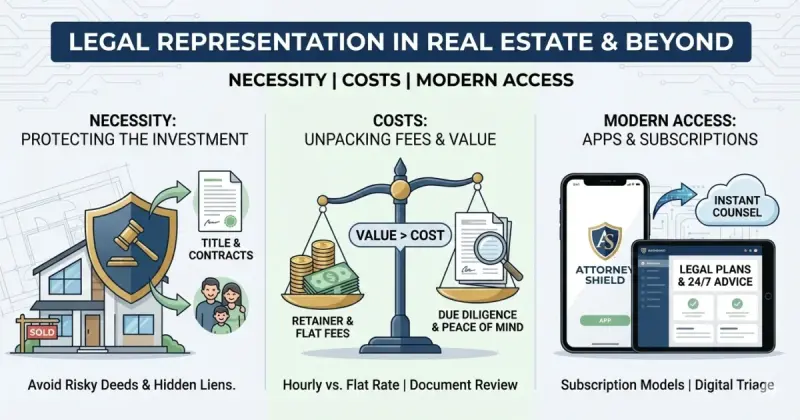
This report is designed to answer these questions in exhaustive detail. However, the role of an attorney extends far beyond just buying a house. To truly understand the value of legal counsel, we must look at the legal profession as a whole. We will explore how lawyers charge for their work (from flat fees to the attorney retainer fee), how modern apps like Attorney Shield are changing the game, and the strict ethical rules—like attorney client privilege—that keep your secrets safe. We will also look at real-world examples, such as Attorney Moin Choudhury, and explain confusing terms like the 907 attorney.
By the end of this comprehensive guide, you will have a nuanced understanding of the legal landscape, written in simple, accessible language suitable for beginners but with the depth of a professional research report.
1.1 The Complexity of Property Transfer
In the United States, you cannot simply hand someone cash and move into their house. The transfer of "real property" (land and buildings) is governed by centuries of law. There are checks to ensure the seller actually owns the land, inspections to ensure the house is safe, and contracts to ensure the bank gets paid.
In some states, a lawyer is required by law to be present. In others, it is optional. But even where it is optional, the risks of going it alone are high. A single mistake in a document can cost thousands of dollars or even ownership of the home. This report will break down these risks and show exactly where a lawyer fits in.
1.2 The Evolution of Legal Access
Traditionally, hiring a lawyer meant walking into a fancy office and paying hundreds of dollars an hour. Today, things are different. We have:
-
Traditional Representation: Hiring a lawyer for a specific job, like buying a house.
-
Subscription Services: Apps that act like a "legal shield," giving you access to advice for a monthly fee.
-
Legal Tech: Online platforms that automate document creation.
We will analyze these different models, comparing the Attorney Shield cost against traditional fees, to see which offers the best value for different situations.
2. Is a Real Estate Attorney Necessary? The Core Analysis
To answer the title question, we must understand what a real estate attorney actually does. It is not just signing papers; it is an investigation.
2.1 The Geography of Legal Requirements
The first thing to understand is that real estate laws change depending on where you live.
-
Attorney States: In states like New York, Delaware, and Georgia, an attorney is legally required to handle the closing (the final meeting where the house is officially sold).
-
Escrow States: In states like California, the process is often handled by an "escrow company" or title company, and lawyers are only brought in if there is a dispute.
However, even in escrow states, the contracts are written by lawyers. If you sign a standard contract without understanding it, you are agreeing to terms that might hurt you later.
2.2 The Attorney’s Job Description
When you hire a real estate attorney, you are paying for protection. Here is a breakdown of their daily tasks during a home purchase:
2.2.1 Contract Review and Negotiation
The "Purchase Agreement" is the rulebook for the sale. It says how much you will pay, when you will move in, and what happens if the roof leaks.
-
The Danger: A standard contract might say you buy the house "as is." This means if the furnace breaks the day after you move in, you have to pay for it.
-
The Lawyer’s Role: An attorney can add a "rider" (an extra page of rules) that says the seller must fix the furnace before you buy. In New York, for example, attorney fees cover this negotiation.
2.2.2 The Title Search: Investigating the History
Before you buy a house, you need to know who really owns it. This is called "Title."
-
The Danger: Imagine the seller inherited the house from their grandmother, but the grandmother also had a long-lost brother who technically owns 50% of it. If you buy the house, that brother could show up later and demand his half.
-
The Lawyer’s Role: The attorney coordinates a "title search" to look at public records going back decades. They ensure the seller has the sole right to sell the property.
2.2.3 The Quit Claim Deed vs. Warranty Deed
This is a critical concept. A "Deed" is the paper that transfers ownership. There are different types, and using the wrong one is a disaster.
-
Warranty Deed: The seller promises, "I own this, and I guarantee no one else has a claim." This is what you want when buying a house.
-
Attorney Quit Claim Deed: In this document, the seller says, "I am giving you whatever interest I have in this property, but I don't promise that I actually own it."
-
Why use it? It is often used between family members (e.g., a father giving a house to a son) or during a divorce to get one name off the title.
-
The Risk: If you buy a house with a quitclaim deed and it turns out the seller didn't own it, you have no legal recourse to get your money back. An attorney ensures you get the right deed for your situation.
2.3 The Consequences of Skipping Legal Counsel
Research shows that trying to save money on legal fees can backfire.
-
Case Study: One buyer decided not to hire an attorney to save $800. Later, they discovered an "easement" (a rule allowing someone else to use your land) that prevented them from building a pool. This mistake reduced the property value by $15,000.
-
Case Study: Another family didn't have a lawyer review a contractor agreement. When the contractor abandoned the job, the family lost $45,000 because the contract didn't protect them.3
Table 1: The Risk/Reward of Hiring a Real Estate Attorney
| Scenario |
Cost of Attorney |
Potential Loss Without Attorney |
Verdict |
| Standard Purchase |
$800 - $1,500 |
Loss of Deposit (approx. $10k - $20k) |
Necessary |
| Buying from Family |
$500 - $1,000 |
Invalid Title (Total Loss of Home Value) |
Highly Recommended |
| Complex Commercial |
$5,000+ |
Liability for Environmental Cleanup (Millions) |
Mandatory |
3. What It Costs: Unpacking Legal Fees
For a student or a first-time buyer, legal fees can be confusing. Do you pay by the hour? Do you pay a flat rate? What is a retainer? Let's break down the vocabulary of legal costs.
3.1 The Flat Fee Model (Residential Real Estate)
Most lawyers engaging in standard house closings charge a flat fee. This is a single price for the whole job.
-
Average Cost: Nationally, this ranges from $800 to $1,500.
-
New York City Cost: Because NYC real estate is complicated (involving Co-op boards and mansions), fees are higher. A standard transaction is $2,500 to $3,500, while luxury deals can go over $5,000.2
-
What it covers: Contract review, title check, and sitting with you at the closing table.
3.2 The Hourly Rate (When Things Go Wrong)
If the transaction gets messy—for example, if the seller refuses to move out or there is a dispute over the property line—the lawyer might switch to an hourly rate.
-
The Rate: This typically ranges from $150 to $500 per hour depending on experience.
-
Why it matters: If a lawyer works for 10 hours at $300/hour, that's $3,000. This is why flat fees are preferred for simple buys; they cap the cost.
3.3 The Attorney Retainer Fee
This term is often misunderstood in movies and TV. An attorney retainer fee is essentially a down payment on future legal work.
-
How it works: You pay the lawyer a lump sum (e.g., $2,000) upfront. This money goes into a special bank account. As the lawyer works, they subtract their hourly rate from this pile of money.
-
Real Estate Context: Most home buyers do not pay a retainer. However, real estate investors or developers who buy houses every month might keep an attorney on retainer. This ensures the lawyer is always available to jump on a new deal immediately.
-
Criminal/Family Law: Retainers are very common here. If you are arrested or getting divorced, you almost always pay a retainer first.
3.4 Who Pays?
In a real estate transaction, the buyer usually pays their own lawyer, and the seller pays their own lawyer.
4. Modern Access: Apps, Subscriptions, and "Attorney Shield"
Not everyone has thousands of dollars for a retainer. This has led to the rise of "Legal Plans" and apps. These services charge a monthly subscription, like Netflix, to give you access to lawyers.
4.1 "Attorney Shield": The Bodyguard in Your Pocket
Attorney Shield is a specific app designed for a very specific problem: interactions with the police.
-
The Concept: If you get pulled over or questioned by law enforcement, you open the app. Within seconds, you are on a video call with a lawyer.
-
The Cost: The Attorney Shield cost is very low compared to hiring a firm. It starts at around $8.00 per month for an individual.
-
Key Features:
-
24/7 Access: Police stops don't just happen during business hours.
-
Video Recording: The app records the interaction, which can be used as evidence later.
-
No Retainer: You don't pay thousands upfront; just the monthly fee.
-
Protection Warranty: If you get fined or towed during a covered event, the service may reimburse you, acting almost like insurance.
4.2 Comparing "Attorney Shield" to "LegalShield"
These two sound similar but are different.
Table 2: Traditional Lawyer vs. App Services
| Feature |
Private Attorney |
Attorney Shield (App) |
LegalShield (Plan) |
| Cost |
High ($150-$500/hr) |
Low (~$8/mo) |
Medium (~$25/mo) |
| Availability |
Appointment needed |
Instant (24/7 Video) |
Hotline/Callback |
| Best For |
Complex Real Estate, Litigation |
Police Stops, Traffic |
Simple Contracts, Wills |
| Relationship |
Personal, Deep Knowledge |
Transactional, Fast |
Network of Lawyers |
4.3 The "Uberization" of Law: Attorney Document Review Jobs
Just as technology changes how we buy legal services, it changes how lawyers work.
-
The Job: Attorney document review jobs are roles where lawyers review thousands of emails and contracts for big lawsuits.
-
The Context: These jobs are often temporary or contract-based. They are crucial for keeping costs down in massive corporate lawsuits. If a law firm paid a senior partner $500/hour to read emails, the client would go broke. Instead, they hire document review attorneys at a lower rate.
-
Relevance to Real Estate: While less common in a single house purchase, this model of "unbundling" legal work is why services like LegalShield can afford to be cheap—they use efficient networks of lawyers to handle simple tasks.
5. Trust and Safety: Regulatory Frameworks
How do you know if a lawyer is honest? Or even a real lawyer? The legal profession is strictly regulated to protect the public.
5.1 The Attorney Registration and Disciplinary Commission (ARDC)
Every state has a board that polices lawyers. In Illinois, for example, this is called the Attorney Registration and Disciplinary Commission (ARDC).
-
Function 1: Registration: They keep a list of every lawyer allowed to practice. If a lawyer is not on this list, they are not authorized to help you.
-
Function 2: Discipline: If a lawyer steals a client's money or lies in court, the ARDC investigates. They can suspend the lawyer's license or disbar them (kick them out of the profession forever).
-
Consumer Tip: Before hiring a lawyer for your house closing, check their name on the ARDC website (or your state's equivalent). It will tell you if they have been in trouble before.
5.2 Attorney Reviews by Clients
In the age of the internet, attorney reviews by clients are a powerful tool. However, they must be read carefully.
-
What to look for: Look for patterns. If one person complains, it might just be a grumpy client. If ten people say "He never calls me back," that is a red flag.
-
Specific Examples: Reviews for Attorney Moin Choudhury often mention that his team is "professional," "kind," and "stress-free". In family law and real estate, "stress-free" is the highest compliment because these processes are naturally stressful.
-
Verification: Good review sites often verify that the reviewer was actually a client, preventing fake positive reviews.
5.3 Decoding the "907 Attorney"
Sometimes, searching for a lawyer can be confusing because of codes and slang. The term "907 attorney" is a perfect example of why you need to be careful.
-
Meaning A: The Geography (Alaska): 907 is the area code for Alaska. A "907 attorney" might be a lawyer at a firm like "907 Legal" who helps with car accidents in Anchorage.
-
Meaning B: The Immigration Form (I-907): In immigration law, "Form I-907" is a request for "Premium Processing." An attorney filing this form is trying to get a visa approved in 15 days.
-
The Lesson: Context matters. If you are buying a house in New York, a "907 attorney" from Alaska cannot help you. Always check the jurisdiction (location) where the lawyer is licensed.
6. Secrets and Ethics: The Attorney-Client Privilege
One of the coolest and most important parts of the law is attorney-client privilege. This is the rule that says your lawyer cannot tell your secrets to anyone—not the police, not the judge, not even your parents (usually).
6.1 How it Works in California
The rules vary by state. Attorney client privilege California is very strong. It is written in the "Evidence Code" (sections 950-962).
-
The Rule: If you tell your lawyer something in confidence to get legal advice, they must keep it secret.
-
Dominant Purpose Test: In California, if you ask a lawyer for business advice and legal advice in the same email, the court looks at the "dominant purpose" (the main reason) of the email. If the main reason was legal, the whole email is secret. This is broader protection than in federal courts.
6.2 Attorney Client Privilege Exceptions
However, the shield is not perfect. There are attorney client privilege exceptions where a lawyer must or can speak up.
-
Crime-Fraud Exception: If you go to a lawyer and say, "Help me plan a bank robbery," that conversation is not privileged. The lawyer cannot help you commit a future crime.
-
Prevention of Harm: If a client says, "I am going to kill someone tonight," the lawyer is allowed to tell the police to save the victim's life.
-
Breach of Duty: If a client sues their lawyer for doing a bad job, the lawyer is allowed to reveal secrets to defend themselves in court.
6.3 The Case of Minors
This is interesting for students. In California, if a lawyer represents a minor (someone under 18), the lawyer generally has to keep the minor's secrets, even from the parents, if it's about the case. However, if the minor is being abused, the lawyer has complex rules on how to report it without hurting the client's trust.
7. Profiles in Practice: Who Are These Lawyers?
To understand the profession, let's look at a specific example of a working attorney found in our research.
7.1 Profile: Attorney Moin Choudhury
Attorney Moin Choudhury is a prime example of a modern, multi-talented lawyer.
-
Location: He operates primarily in Queens, New York.
-
Practice Areas: He doesn't just do one thing. His firm handles:
-
Immigration: Helping people get visas and Green Cards.
-
Real Estate: Helping people buy homes in the busy NYC market.
-
Personal Injury: Helping people hurt in accidents.
-
Distinctions: He is admitted to the U.S. Supreme Court, which is a high honor. He also gives back to the community by funding the "Moin Choudhury Scholarship" at Touro Law School to help students from underrepresented backgrounds become lawyers.
-
Why this matters: When looking for a real estate lawyer, finding someone like Moin Choudhury who is deeply embedded in the community (serving on local boards, funding scholarships) is often a good sign. It shows they care about their reputation and their neighbors.
7.2 The Importance of Specialization
While Moin Choudhury handles multiple areas, he has teams for each. You wouldn't want a lawyer who only does speeding tickets to handle your million-dollar house purchase.
-
Real Estate Specialists: They know the local "customs." In some towns, it is custom for the seller to pay for the survey. In others, the buyer pays. A local specialist knows this. A generic lawyer might not.
8. Conclusion: The Verdict
So, is a real estate attorney necessary?
-
If you are buying a simple house in a rural "Escrow State": Maybe not legally "necessary," but still a very good idea to have one review the contract.
-
If you are buying in a city like New York or Chicago: Yes, absolutely necessary. The process is too complex to navigate alone.
-
If you are buying a commercial building or investing: Yes. You might even need an attorney on retainer.
The Cost-Benefit Analysis:
Paying $1,500 for a lawyer seems like a lot of money to a student. But when you are buying a house for $300,000, that lawyer's fee is only 0.5% of the total cost. In exchange for that 0.5%, you get:
-
Certainty: Knowing you actually own the house (Title search).
-
Protection: Knowing the contract doesn't have hidden traps (Contract review).
-
Peace of Mind: Knowing that if something goes wrong, you have a professional fighter in your corner.
Whether you are using a high-tech app like Attorney Shield for $8/month to protect your civil rights, or hiring a seasoned pro like Moin Choudhury for a life-changing transaction, the lesson is the same: The law is complicated, and having a guide is worth the price.
Glossary of Key Terms
-
Retainer Fee: A down payment for legal services.
-
Quit Claim Deed: A transfer of ownership with no guarantees (risky for buyers).
-
Title Search: Investigating the history of a property's ownership.
-
Privilege: The legal right to keep conversations with your lawyer secret.
-
ARDC: The police force for lawyers (Attorney Registration and Disciplinary Commission).
-
907 Attorney: Can refer to an Alaska lawyer or an Immigration expedited filing.
By understanding these terms and the systems behind them, you are already ahead of 90% of adults in navigating the legal world.