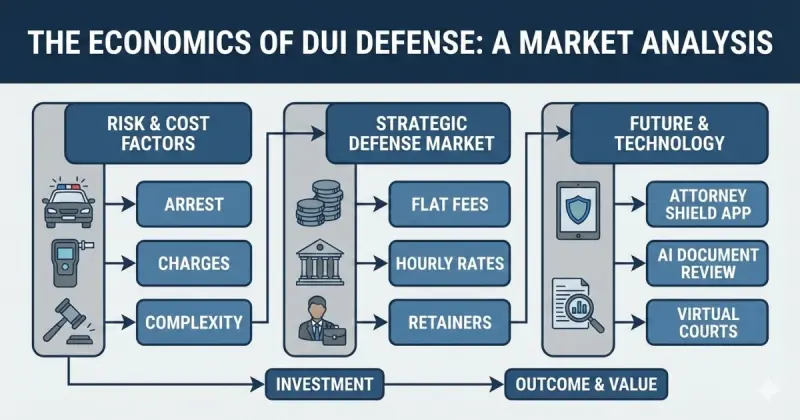
Analyze the 2026 DUI defense market. This report breaks down attorney fees, retainer models, major cost drivers, and how tech like Attorney Shield is reshaping legal strategies and pricing.
1. Introduction: The High-Stakes Marketplace of Criminal Defense
The legal defense market for Driving Under the Influence (DUI) in the United States functions as a complex micro-economy where financial cost, legal strategy, and regulatory oversight intersect. For the consumer, the navigation of this marketplace is often precipitated by crisis—an arrest occurs, and the immediate need for counsel clashes with a lack of transparency regarding pricing and quality. This report provides an exhaustive analysis of the DUI defense ecosystem in 2026. It moves beyond simple fee averages to explore the structural determinants of cost, the nuances of attorney-client relationships, the geographic disparities in legal practice, and the disruptive influence of legal technology.
The analysis is rooted in the understanding that a DUI charge is not merely a traffic infraction but a pivotal legal event with potential long-term consequences ranging from incarceration to professional licensure revocation. Consequently, the "price" of a lawyer is a derivative of the risk mitigation they offer. By dissecting fee structures—from the ubiquitous attorney retainer fee to the emergence of subscription-based services like Attorney Shield—this document elucidates how value is defined, delivered, and billed in modern criminal law. Furthermore, it examines the critical backend operations, such as attorney document review jobs, that silently drive up litigation costs, and the ethical boundaries that govern asset-based payments involving instruments like the attorney quit claim deed.
2. The Financial Framework of Legal Representation
Understanding the cost of a DUI lawyer requires a granular examination of the billing models that dominate the industry. Unlike consumer goods with fixed prices, legal services are priced based on projected labor, expertise, and the "fear premium"—the value clients place on avoiding jail time.
2.1 The Dichotomy of Billing: Flat Fees vs. Hourly Rates
The legal market has largely bifurcated into two primary billing models for criminal defense: the predictability of flat fees and the granularity of hourly rates.
2.1.1 The Prevalence of Flat Fees
In the context of DUI defense, the flat fee model is the industry standard, particularly for first-time offenses. This preference stems from the client's desire for cost certainty. A DUI defendant, already facing potential fines and insurance hikes, requires a capped figure for their legal defense.
-
Entry-Level Representation ($1,500 - $3,000): This tier typically covers the procedural basics: arraignment, review of the police report, and negotiation of a standard plea deal. Attorneys operating at this price point often rely on high volume. The economic logic here is efficiency; the attorney anticipates that the case will not proceed to trial. The "flat fee" effectively acts as a bulk payment for a standardized service package.1
-
Mid-Tier Representation ($3,000 - $5,000): At this level, the scope of work expands. The fee includes a more rigorous analysis of discovery, potential pre-trial motions (such as challenging the traffic stop's probable cause), and more leverage in plea negotiations. This is the median cost for a competent defense that seeks to minimize penalties rather than just process the paperwork.1
-
Premium/Trial-Ready Representation ($5,000 - $15,000+): This tier involves a fundamental shift in strategy. The higher fee subsidizes the immense labor required for trial preparation—jury selection, expert witness coordination, and days spent in court. In complex cases involving felony DUI or vehicular manslaughter, fees can exceed $20,000. Here, the flat fee protects the client from the "runaway costs" of an hourly trial bill, while ensuring the attorney is compensated for the intense workload.2
2.1.2 The Hourly Rate and the "Attorney on Retainer"
While less common for standard DUIs, the hourly model persists in complex litigation.
-
Hourly Rates: Rates in 2025/2026 generally oscillate between $200 and $500 per hour, though top-tier partners in major metros may charge significantly more. This model aligns the attorney's compensation strictly with the time invested.1
-
The Misconception of "Attorney on Retainer": The public often confuses the concept of an attorney on retainer. In corporate law, this might imply a monthly fee for on-call access. In criminal defense, specifically for a DUI, having an attorney on retainer typically refers to the payment of an advance deposit (the retainer) against which hourly work is billed. Once the retainer is depleted, the client must replenish it. This structure shifts the financial risk to the client, as an aggressive prosecution can quickly drain the initial funds.1
2.2 The Mechanics of the Attorney Retainer Fee
The attorney retainer fee is the financial bedrock of the attorney-client relationship. It serves two purposes: it ensures the attorney is paid, and it signals the client's commitment to the case.
-
Trust Accounting (IOLTA): When a client pays a retainer, the money does not immediately belong to the lawyer. It is deposited into an Interest on Lawyers Trust Account (IOLTA). The lawyer effectively "earns" this money only as they perform work. This regulatory safeguard prevents attorneys from spending unearned fees.
-
"Earned Upon Receipt": In some jurisdictions and specific flat-fee agreements, lawyers may designate the retainer as "earned upon receipt," meaning it goes directly into the firm's operating account. However, this is subject to strict ethical rules regarding refunds if the representation is terminated early.
-
Replenishment Clauses: A critical component of hourly retainer agreements is the "evergreen" or replenishment clause, requiring the client to maintain a minimum balance in the trust account. For a DUI case that drags on for months due to court backlogs, this can result in total costs far exceeding the initial estimate.1
| Billing Model |
Typical Cost Range |
Pros |
Cons |
| Flat Fee (Plea) |
$1,500 - $3,000 |
Cost certainty; Lower upfront |
Incentivizes quick resolution over fighting |
| Flat Fee (Trial) |
$5,000 - $15,000 |
Covers intense labor of trial |
High upfront cost; No refund if charges dropped early |
| Hourly Rate |
$200 - $500/hr |
Pay only for actual work done |
Costs can spiral; Uncertainty |
| Public Defender |
$0 - Minimal |
Free/Low cost |
High caseloads; Limited time per client |
Table 1: Comparative Analysis of Fee Structures in DUI Defense.
3. Cost Drivers: Anatomy of a Legal Bill
Why does one DUI cost $2,000 and another $12,000? The variance is driven by specific "cost drivers" that increase the complexity and labor intensity of the defense.
3.1 Aggravating Factors and Case Complexity
The complexity of a case is the primary multiplier for legal fees.
-
Scientific Disputation: If the defense strategy hinges on challenging the breathalyzer calibration or the blood draw chain of custody, the case moves from procedural to technical. This requires the attorney to possess specialized knowledge and often engage expert witnesses, driving up costs.
-
Injuries and Felonies: A DUI involving an accident with injuries is almost invariably charged as a felony. The stakes—years in prison vs. probation—demand a rigorous defense. The attorney document review jobs required to sift through medical records, accident reconstruction reports, and witness statements in these cases represent a significant backend cost.
-
Prior Offenses: A third DUI charge often carries mandatory minimum jail sentences. The "value" of the lawyer here is defined by their ability to navigate alternative sentencing (e.g., house arrest, rehabilitation) to avoid incarceration. This negotiation expertise commands a premium.
3.2 The Hidden Labor: Attorney Document Review Jobs
In the modern era of policing, a single DUI arrest generates a massive digital footprint. This data explosion has created a specific niche within the legal profession: attorney document review jobs.
-
The Data Deluge: A standard case now includes body-worn camera footage from multiple officers, dash-cam video, booking room video, 911 call audio, and digital breathalyzer logs. In complex cases, there may be gigabytes of data.
-
The Review Process: Reviewing this evidence is time-consuming. Attorney document review jobs are often filled by contract attorneys or junior associates whose sole responsibility is to watch hours of footage to identify procedural errors (e.g., was the suspect read their Miranda rights? Was the field sobriety test administered according to NHTSA standards?).
-
Cost Implication: If a firm bills hourly, the cost of a document review attorney (even at a lower rate than the partner) adds up. In flat fee arrangements, the anticipated cost of this review is baked into the initial price. The thoroughness of this review often differentiates a "cheap" lawyer (who may only glance at the police report) from a "premium" lawyer (who finds the 5-second gap in body cam footage that gets the case dismissed).
4. Operational & Geographic Dynamics
The cost of legal services is also a function of where the law is practiced. The contrast between high-density urban markets and remote jurisdictions illustrates the profound impact of geography on legal economics.
4.1 The "907 Attorney": A Case Study in Alaskan Legal Economics
The 907 attorney—referring to legal practitioners in Alaska's single area code (907)—operates in a unique market environment that serves as an extreme example of geographic cost factors.
-
Logistical Overhead: Unlike a lawyer in Chicago who takes a subway to court, a 907 attorney based in Anchorage or Fairbanks may need to charter a flight to reach a remote courthouse in a bush community. These travel costs (flights, hotels, per diem) are often passed directly to the client or factored into a significantly higher retainer.
-
Supply and Demand: The density of legal talent in Alaska is lower than in the contiguous U.S. This scarcity allows established 907 attorneys to maintain higher fee structures due to a lack of competition. The "market clearing price" for a competent DUI defense is higher because the alternative—a public defender or a less experienced lawyer—is often the only other option.
-
Communication Challenges: Services like "Goodcall" market specifically to the 907 area code to help businesses manage the 24/7 availability required in a state that spans two time zones and vast distances. For a DUI lawyer, missing a call from a client in a remote holding cell can mean losing the case, necessitating robust (and expensive) communication infrastructure.
4.2 Urban vs. Rural Fee Variances
-
Urban Markets (NYC, LA, Chicago): High overhead costs (rent, salaries) drive base fees up, but intense competition can create a "race to the bottom" for entry-level DUI cases, resulting in a wide spread between "mill" firms and elite boutique firms.
-
Rural Markets: Lower overhead allows for lower fees, but the "good ol' boy" network is a tangible factor. A local attorney who golfs with the judge may charge a premium for their "influence" and local knowledge, which an out-of-town lawyer cannot replicate.
5. Regulatory Oversight and Consumer Trust
The legal profession is not a free market; it is a regulated monopoly. The Attorney Registration and Disciplinary Commission (ARDC) plays a pivotal role in maintaining the integrity of this market and, by extension, justifying the fees charged by attorneys.
5.1 The Role of the Attorney Registration and Disciplinary Commission
The Attorney Registration and Disciplinary Commission (ARDC) acts as the watchdog for the legal profession. While the specific name may vary by state (e.g., State Bar of California, Grievance Committee in NY), the function is universal.
-
Licensure and Legitimacy: Attorneys must register annually and pay fees to the ARDC. This registration is the consumer's primary verification tool. Before paying a $5,000 attorney retainer fee, a savvy client checks the ARDC database to ensure the lawyer is active and authorized to practice.
-
Disciplinary Transparency: The ARDC investigates complaints regarding professional misconduct, such as neglecting a case after taking a fee or mishandling trust funds. The public availability of these records allows the market to "price in" reputation. An attorney with a clean ARDC record commands higher trust and, consequently, higher fees than one with a history of suspensions or censure.
-
Client Protection Funds: Part of the fees paid to the ARDC often go into a Client Protection Fund, which reimburses clients who have lost money due to the dishonest conduct of their attorneys. This systemic insurance underpins the financial safety of the high-cost retainer model.
5.2 Vetting via Attorney Reviews by Clients
In the digital age, the ARDC's formal records are supplemented by the informal court of public opinion: attorney reviews by clients.
-
The Reputation Economy: Platforms like Avvo, Google Reviews, and Yelp have commoditized trust. A lawyer with 100+ 5-star reviews detailing specific outcomes ("Got my license back," "Reduced to reckless driving") can charge a premium.
-
Analyzing Reviews: Prospective clients look for patterns in attorney reviews by clients. Reviews that mention "responsiveness" and "transparency" regarding fees often correlate with higher satisfaction than those that simply say "good lawyer." Conversely, negative reviews often cite "hidden fees" or "unreachable after payment," highlighting the friction points in the retainer model.
6. The Shield of Privilege and Its Exceptions
The high cost of legal counsel buys more than just advocacy; it buys secrecy. The attorney-client privilege is a commodity in itself. However, clients must understand the boundaries of this protection, particularly the attorney client privilege exceptions, to avoid compromising their own defense.
6.1 The Core of Privilege
The privilege ensures that communications made in confidence for the purpose of seeking legal advice are permanently protected from disclosure. This encourages full candor, allowing the attorney to build the best defense based on the truth of the event.
6.2 Navigating Attorney Client Privilege Exceptions
The privilege is not absolute. Misunderstanding these exceptions can be disastrous.
-
The Crime-Fraud Exception: This is the most critical exception in criminal defense. If a client uses the attorney's services to commit future crime or fraud, the privilege evaporates.
-
The "Prevention of Harm" Exception: This varies significantly by state.
-
Attorney Client Privilege California (Evidence Code § 956.5): California law has a specific carve-out. An attorney may (but is not strictly required to) disclose confidential information if they reasonably believe it is necessary to prevent a criminal act likely to result in death or substantial bodily harm.
-
DUI Context: If a client leaves the attorney's office visibly intoxicated and states an intention to drive home immediately, the attorney faces an ethical crisis. Under attorney client privilege California rules, the attorney might be permitted to call the police to prevent potential vehicular manslaughter, overriding the duty of confidentiality. This is a rare but potent exception that clients should be aware of.
7. Alternative Payment Modalities: Assets and Tech
As legal fees rise, the market has adapted with new payment methods and technological solutions, some of which carry significant risks.
7.1 The Perils of the Attorney Quit Claim Deed
When defendants lack liquid cash for a $5,000 retainer, discussions often turn to assets. The concept of an attorney quit claim deed arises here, often in a confused context between legal fees and bail collateral.
-
Legal Fees vs. Real Estate: Ethics rules generally discourage attorneys from taking a proprietary interest in the cause of action or the subject matter of litigation. While a house is rarely the "subject" of a DUI case, accepting a deed as payment is fraught with conflict of interest. The lawyer must ensure the transaction is fair and reasonable, often requiring independent counsel for the client to review the deal. It is not a standard practice and is often a red flag for desperation on either the client's or attorney's part.
-
Bail Bond Collateral: The term is more frequently associated with bail. However, statutes like Florida Statute 648.442 explicitly forbid bail bond agents from accepting a quitclaim deed as collateral. They require a mortgage or deed of trust—a security interest that can be foreclosed, rather than a direct transfer of title. This distinction protects the homeowner's equity and due process rights. A client who simply "signs over the deed" via a quitclaim is at immense risk of losing their property without proper legal safeguards.
7.2 Technological Disruption: Attorney Shield and Subscription Law
The "Uberization" of legal services has arrived with apps like Attorney Shield.
-
Attorney Shield Cost and Model: This service represents a high-volume, low-cost alternative for immediate legal guidance.
-
Cost: Pricing is accessible, typically around $60/year or $7/month.
-
Function: The app provides 24/7 video access to an attorney during a police stop. The goal is "legal triage"—preventing the user from incriminating themselves during the critical first moments of an encounter.
-
Value Proposition: For the price of a streaming subscription, a user gets "on-demand" counsel. This contrasts sharply with the thousands of dollars required for a traditional attorney on retainer. However, it is crucial to note the limitation: Attorney Shield is for the stop, not the courtroom. It does not replace the need for a DUI defense lawyer if an arrest is made, but it may make the defense lawyer's job easier (and potentially cheaper) by preventing damaging admissions.
-
LegalShield and Prepaid Plans: These services bridge the gap. For a monthly fee (~$25-$50), members get access to advice and discounted rates (e.g., 25% off) on hiring a lawyer for trial. This "legal insurance" model effectively lowers the barrier to entry for professional defense.
8. Practitioner Profiles: The Hierarchy of Counsel
The market for DUI defense is segmented by expertise and status. Comparing different "archetypes" of attorneys reveals how credentials translate to costs.
8.1 The Elite Specialist: Attorney Moin Choudhury
Attorney Moin Choudhury exemplifies the "Elite Credential" segment of the market.
-
Credentials: His admission to practice before the United States Supreme Court and the United States Court of International Trade signals a level of appellate and federal competence that is rare among standard DUI practitioners.
-
Market Positioning: An attorney with this pedigree, often serving as "Of Counsel" to major firms, commands fees commensurate with "bet-the-company" or "bet-the-life" litigation. While a standard DUI might not require Supreme Court admission, clients hiring at this level are paying for the capacity to handle extreme complexity—such as constitutional challenges to a traffic stop that could theoretically go up on appeal. This contrasts with the local "plea mill" lawyer whose expertise is strictly limited to the local county courthouse.
8.2 The Generalist vs. The Specialist
-
The Generalist: Often handles divorces, wills, and DUIs. Fees are generally lower, but they may lack deep knowledge of the specific science of toxicology.
-
The Specialist: Focuses 100% on DUI/Criminal Defense. They invest in ongoing training (e.g., ACS-CHAL Forensic Lawyer-Scientist). Their higher fees reflect this hyper-specialization.
9. Conclusion: The Calculus of Defense
The question "How much does a DUI lawyer cost?" has no single answer because legal defense is not a commodity—it is a service tailored to risk.
-
The Baseline: The market has settled on a range of $1,500 - $3,000 for standard plea-based representation and $5,000 - $10,000+ for trial-level defense.
-
The Multipliers: Geography (the 907 attorney premium), complexity (felony charges, document review volume), and attorney prestige (Moin Choudhury level credentials) act as multipliers on this base cost.
-
The Strategic Investments:
-
Pre-Arrest: Investing in Attorney Shield (low cost) to mitigate risk during stops.
-
Post-Arrest: Investing in a high attorney retainer fee to secure a lawyer who can navigate attorney client privilege exceptions and leverage document review to find exonerating evidence.
-
The Warnings: Consumers must be wary of "creative" financing like the attorney quit claim deed and rely on objective verification through the Attorney Registration and Disciplinary Commission and attorney reviews by clients.
In the final analysis, the cost of a DUI lawyer must be weighed against the "total cost of conviction"—which includes not just court fines, but years of increased insurance premiums, lost employment opportunities, and the intangible cost of a criminal record. In this light, the "expensive" lawyer who secures a dismissal or reduction often proves to be the most economically rational choice.
10. Future Outlook: The Digital Transformation of Defense
Looking toward 2030, the DUI defense market is poised for further disruption.
-
AI in Document Review: The cost of attorney document review jobs may decrease as AI tools become better at scanning body cam footage for procedural errors, potentially lowering the cost of complex defense.
-
Virtual Courts: The normalization of Zoom hearings (post-2020) helps mitigate the geographic premiums of the 907 attorney, potentially flattening fee structures across vast regions like Alaska.
-
Subscription Defense: The success of models like Attorney Shield suggests a future where "legal protection" is a standard monthly utility, much like auto insurance, fundamentally changing how retainers are structured and paid.