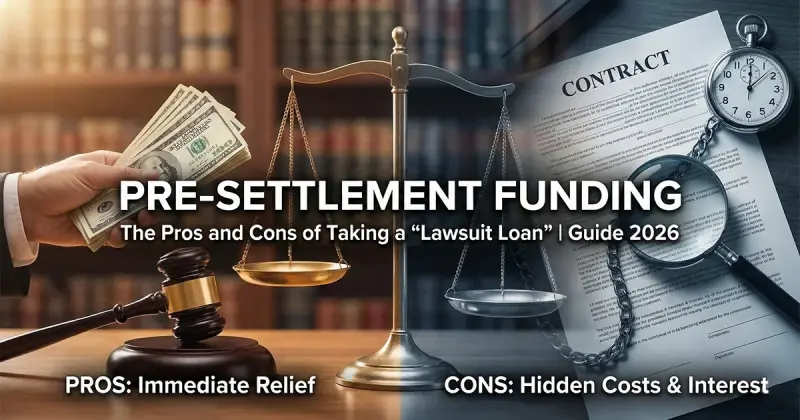
Thinking about a lawsuit loan? Discover the hidden costs, interest rates, and benefits of pre-settlement funding in 2026. Read this before signing anything.
Imagine you are in a race. You were injured because someone else tripped you, and now you are suing them to pay for your medical bills. You know you are going to win the race eventually, but the race is taking years to finish. Meanwhile, you have to pay for rent, groceries, and gas today. You are running out of money.
This is where Pre-Settlement Funding steps in.
You might see commercials on TV promising "Cash Now" for your lawsuit. It sounds like a lifeline, but financial experts often call it a double-edged sword. In the legal world of 2026, taking out a "lawsuit loan" is a massive decision that can save you from bankruptcy or cost you a huge chunk of your future money.
This guide will break down exactly what pre-settlement funding is, the good and the bad, and what you need to know before you sign on the dotted line.
What is Pre-Settlement Funding?
First, let’s clear up a common name. Most people call this a "lawsuit loan," but legally, it is usually not a loan.
A loan (like for a car or house) is money you must pay back, usually with monthly payments. Pre-settlement funding is different. It is a cash advance against your future settlement.
Here is the simple definition: A company buys a piece of your future lawsuit winnings. They give you cash today. In exchange, you agree to pay them back a specific amount only if you win your case.
The "Non-Recourse" Rule
This is the most important legal term you need to learn today: Non-Recourse.
Most pre-settlement funding is "non-recourse." This means if you lose your lawsuit and get zero money, you do not have to pay the funding company back. They take the risk with you. Because they take a big risk, they charge a very high price for their money.
The Pros: Why Do People Take Lawsuit Loans?
If these advances are expensive, why are they so popular in 2026? Because the legal system is slow, and life is expensive.
1. Immediate Financial Relief
The biggest benefit is speed. Personal injury lawsuits can take months or even years to settle. Insurance companies know this. They often drag out the process, hoping you will get desperate and accept a lowball offer just to pay your bills. Pre-settlement funding puts cash in your pocket to cover rent, medical bills, and food immediately.
2. Buying Time for a Better Settlement
This is a strategic benefit. If you are broke, you might feel forced to say "yes" to the first $50,000 the insurance company offers, even if your case is worth $100,000. By taking a small advance (say, $5,000) to keep the lights on, you give your lawyer the time they need to fight for the full $100,000.
3. No Monthly Payments
Unlike a credit card or a bank loan, you don't write a check every month. The money is paid back in one lump sum by your lawyer at the very end of the case.
4. No Risk if You Lose
As mentioned earlier, if the judge rules against you, you owe nothing. The funding company loses their investment, not you.
The Cons: The High Price of "Easy" Money
While the benefits sound great, the downsides can be financially devastating if you aren't careful.
1. Astronomical Interest Rates
Because these aren't technically "loans," they often aren't regulated by the same laws that stop banks from charging crazy interest. In 2026, interest rates for lawsuit funding can range from 27% to over 100% per year.
The Math Trap: Imagine you borrow $10,000.
-
Bank Loan (10% interest): After a year, you owe about $11,000.
-
Lawsuit Funding (50% compounding interest): After two years, you could owe $25,000 or more.
We have seen cases where the interest ate up the entire settlement, leaving the injured person with nothing after the lawyer and the funding company were paid.
2. Compounding Interest
Many funding companies use "compounding interest." This means they charge interest on top of the interest you already owe. It causes the amount you owe to snowball incredibly fast.
3. Not All Cases Qualify
You can't just walk in and get money. The funding company will review your medical records, police reports, and talk to your lawyer. If they think your case is risky, they will deny you. According to (), companies only fund cases they are almost certain will win.
4. Lack of Regulation
While states like New York and California have passed laws to protect consumers, in many states, this industry is still like the "Wild West." Predatory lenders can hide fees in the fine print.
How the Process Works in 2026
If you decide the pros outweigh the cons, here is what the process looks like:
-
Application: You apply online or over the phone.
-
Attorney Cooperation: You must have a lawyer. The funding company will contact your lawyer to discuss the case details. (Note: Many lawyers hate these loans because they eat up their client's money).
-
Underwriting: The company's team (often using AI tools in 2026) evaluates the likelihood of you winning.
-
The Contract: You receive a contract detailing the "purchase price" of your settlement. Read this carefully.
-
Funding: Money is wired to your bank account, often within 24-48 hours.
Alternatives to Lawsuit Loans
Before you pay 50% interest, explore every other option:
-
Negotiate with Creditors: Ask your landlord or medical providers if they can wait for payment until your case settles. Many doctors work on a "lien" basis (getting paid later).
-
Personal Loans: If you have good credit, a regular bank loan might have an interest rate of 10-15%, which is much cheaper.
-
Borrow from Family: It might be awkward, but paying your uncle back with zero interest is better than paying a company double.
-
0% APR Credit Cards: Some cards offer a year of no interest. Just be sure to pay it off before the rate hikes up.
Conclusion: Is It Worth It?
Pre-settlement funding should be your last resort. It is a survival tool, not a convenience tool.
If you are about to lose your home or cannot buy food, a lawsuit loan is a valid lifeline. However, never take more than you absolutely need. If you need $2,000 for rent, do not take $5,000 just to have extra cash. That extra $3,000 could cost you $10,000 of your final settlement.
Always consult with your attorney before signing. They can help you find a reputable company and might even negotiate a lower rate for you. In 2026, protecting your future assets is just as important as winning your case.