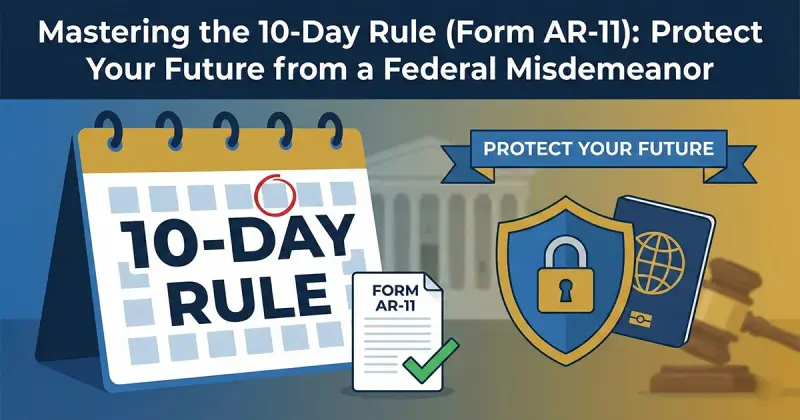
Moved recently? Non-citizens must file Form AR-11 with USCIS within 10 days. Failure to comply is a federal misdemeanor. Protect your future and learn how to file.
You’ve finally finished the move. The boxes are unpacked, the Wi-Fi is connected, and you’ve even remembered to tell the post office to redirect your mail. You feel a sense of relief—the chaos of moving is behind you. But for a non-U.S. citizen, there is one critical task left on the checklist that, if forgotten, can turn your "dream move" into a legal nightmare. Did you update your address with the Department of Homeland Security?
Under federal law, nearly every non-citizen in the United States is required to notify the government of a change of residence within a strict 10-day window. While it sounds like a minor administrative hurdle, failing to file Form AR-11 is actually a federal misdemeanor. In the current 2026 legal climate, where enforcement has reached unprecedented levels, this "small" oversight is being used as a ground for deportation and a permanent "red flag" on citizenship applications.
At bestattorneyus.com, we have seen countless hardworking individuals face unnecessary legal peril simply because they didn't realize the clock started ticking the moment they turned the key in their new door. This guide will walk you through the high stakes of the 10-day rule and show you exactly how to stay compliant.
The Legal Reality: Why "Moving House" is a Criminal Matter
Most people assume that if they don't have a pending application with U.S. Citizenship and Immigration Services (USCIS), the government doesn't care where they live. This is a dangerous misconception. The requirement to update your address is rooted in 8 U.S.C. § 1305, a statute that applies to almost all non-citizens, including Green Card holders and those on temporary work or student visas.
The "teeth" of this law are found in 8 U.S.C. § 1306(b). This section explicitly states that any alien who fails to provide written notice of a change of address is guilty of a misdemeanor. While for decades this rule was rarely prosecuted, the landscape changed significantly in early 2025. Following Executive Order 14159, the Department of Homeland Security (DHS) began strictly enforcing these underutilized statutes as part of a broader "continuous vetting" initiative.
The 10-Day Rule: Calendar Days, Not Business Days
The law gives you exactly 10 days from the date of your move to notify USCIS. A common pitfall we see is clients assuming this means "business days." It does not. The 10-day rule counts weekends and holidays. If you move on a Friday, the following Monday is already Day 3.
Furthermore, the definition of a "move" is broader than you might think. If you are moving to a temporary residence for more than 30 days—perhaps for a seasonal job or an extended stay with family—you are legally required to file Form AR-11. Even moving between apartments in the same building requires a new filing to ensure your "unit number" is accurate in the federal database.
The Golden Rule:
"Never rely on the U.S. Postal Service (USPS) to update the government for you. Changing your address with the post office or on your driver's license does NOT notify USCIS. You must file Form AR-11 separately and directly with the Department of Homeland Security."
Comparison: USPS Change of Address vs. USCIS Form AR-11
Many immigrants assume that because they paid for "mail forwarding" at the post office, they are safe. This is the most common reason for missed interview notices and subsequent deportation orders.
| Feature |
USPS Change of Address |
USCIS Form AR-11 |
| Legal Status |
Optional Service |
Mandatory Federal Law |
| Purpose |
Forwards mail to new home |
Updates federal immigration record |
| Deadline |
None (User's choice) |
Within 10 Calendar Days |
| Criminal Penalty |
None |
Misdemeanor Conviction |
| Immigration Impact |
None |
Grounds for Deportation |
| Cost |
Small verification fee |
Free ($0) |
The "Pain Points": Why Failure is Catastrophic in 2026
As a Senior Legal Analyst, I identify three primary "pain points" that clients face when they forget to update your address:
1. The "Notice Black Hole"
If USCIS sends a Request for Evidence (RFE) or an Interview Notice to your old address, and you don't receive it because you failed to file the AR-11, the government will not accept "I moved" as an excuse. They will consider the application "abandoned" and deny it. Reopening a denied case is significantly more expensive than the free five-minute filing of an AR-11. **
2. The "Good Moral Character" Bar
To become a U.S. citizen, you must prove you are a person of "Good Moral Character" (GMC). A misdemeanor conviction for failing to update your address—or even the documented evidence that you willfully ignored the law for years—can lead to a denial of your naturalization application. In the eyes of an immigration officer, if you can't follow a simple address-reporting rule, you aren't demonstrating the respect for law required for citizenship.
3. Immediate Detention Risk
Under the Interim Final Rule that went into effect on April 11, 2025, the penalties for registration and address violations were "modernized." Fines that were once $200 can now reach **$5,000**, and jail time can extend up to six months for willful failure to register or provide biometrics. For those with a pending application, an unrecorded address change is often the "hook" ICE uses to initiate removal proceedings during routine traffic stops or employer audits.
Step-by-Step: How to Properly Update Your Address
The good news is that the process is free and relatively simple if done correctly. We recommend the following workflow:
-
Use the E-COA Tool: USCIS now prefers the Enterprise Change of Address (E-COA) tool available through your online account. This is the fastest method and provides a digital "receipt" instantly.
-
Separate Filings for Family: Each member of your household must have their own notification. If a family of four moves, you must submit four separate address updates—one for each person, regardless of age.
-
The "Pending Case" Exception: If you have an active application (like a pending I-485 or I-765), you must not only file the AR-11 but also ensure the address is updated for each specific receipt number. The E-COA tool usually allows you to link these, but you must verify that every pending case is included.
-
Save the Confirmation: Download the PDF confirmation page immediately. Do not rely on an email that might get caught in spam. This PDF is your "insurance policy" if a government agent ever questions your compliance.
State Nuances: The 5-Day "Immigration Court" Rule
While the AR-11 is a federal requirement, there is a much stricter rule if you are currently in "removal proceedings" (meaning you have a case in front of an Immigration Judge).
In this scenario, you do not use the standard AR-11. Instead, you must file Form EOIR-33/IC with the Executive Office for Immigration Review. Crucially, the deadline for this is even shorter: you must notify the court within 5 working days of your move. Failure to do so often results in an "In Absentia" order of removal—meaning the judge orders you deported because you didn't show up to a hearing you never received the notice for.
Conclusion: Small Steps, Big Protection
The 10-day rule is a classic example of how "the small things" in immigration law can have the biggest impact. In an era of high-tech vetting and digital enforcement, your address is more than just a place to live—it is a critical data point that determines whether you receive the notices that protect your legal status.
Do not let a simple move jeopardize years of hard work and thousands of dollars in filing fees. If you find yourself confused by the E-COA system, or if you are worried that a past failure to update your address might haunt your upcoming citizenship interview, you shouldn't face the system alone.
Are you worried about your immigration compliance? Contact the experts at bestattorneyus.com today for a comprehensive case evaluation. We will help you audit your records, correct any past errors, and ensure your path to the American dream remains on solid ground.
Authoritative Sources for Further Reading: