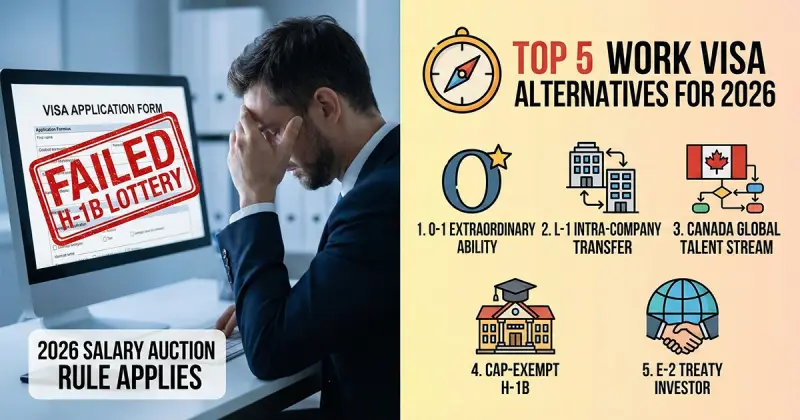
Missed the 2026 H-1B lottery? With new salary auction rules, you need a Plan B. Explore 5 proven alternatives like O-1, L-1, and Canada to save your career.
The email you dreaded has arrived: "Not Selected."
If you are one of the thousands of skilled professionals who recently found out they missed the H-1B lottery, you are likely feeling a mix of panic and frustration. You are not alone. In 2026, the situation has become even more complicated.
The H-1B system is changing. It is shifting from a random game of luck to what experts are calling a "Salary Auction." New regulations for the upcoming seasons aim to prioritize applicants with the highest salaries (Wage Level IV), leaving entry-level professionals with significantly lower odds.
Waiting another year just to roll the dice again is not a strategy—it’s a gamble.
The good news? You have options. The US immigration system offers merit-based paths that don't rely on a lottery. Here are the top 5 H1B visa alternatives for 2026 that can keep your American Dream alive.
1. The O-1 Visa: It’s Not Just for Nobel Prize Winners
For years, people believed the O-1 Visa was only for movie stars or Nobel Prize scientists. In 2026, this is the #1 alternative for tech workers, founders, and creatives.
The O-1 is for individuals with "extraordinary ability." While that sounds intimidating, the criteria are more flexible than you think. If you work in STEM (Science, Technology, Engineering, Math), you don’t need to be famous; you just need to prove you are at the top of your specific niche.
Why it’s better than H-1B:
-
No Lottery: It is merit-based. If you qualify, you get it.
-
Unlimited Renewals: Unlike the H-1B’s 6-year limit, the O-1 can be extended indefinitely in 1-year increments.
-
No Cap: There is no limit on how many O-1 visas are issued per year.
Do you qualify?
You generally need to meet 3 out of 8 criteria, such as:
-
earning a high salary compared to peers.
-
Making original contributions to your field (like coding a unique app or writing a patent).
-
Being featured in professional articles or news.
Pro Tip: If you have a PhD or have published research papers, you are already halfway there. Start documenting your achievements now.
[Link to: How to Build Your O-1 Profile from Scratch] (Internal Link Placeholder)
2. Canada Global Talent Stream (GTS): The "Two-Week" Solution
If the US door closes, the Canadian window is wide open. Canada is aggressively recruiting tech talent that the US rejects.
The Global Talent Stream (GTS) is arguably the fastest work visa program in the world. If you have a job offer from a Canadian employer in a tech role (like a software engineer or web designer), your work permit can be processed in as little as two weeks.
Why choose Canada?
-
Speed: You can move and start working in under a month.
-
Stability: Unlike the US, the path to Permanent Residency (PR) in Canada is clear and fast.
-
Time Zone: You can often keep your US job by working remotely for the same company through their Canadian branch.
Many US companies are now opening "nearshore" offices in Toronto or Vancouver specifically to keep employees who lost the H-1B lottery.
3. L-1 Visa: The Corporate Transfer
Do you work for a multinational company? If your company has offices outside the US, the L-1 Visa might be your safety net.
The L-1 allows companies to transfer employees from a foreign office to a US office. There are two main types:
The 2026 Update:
Be aware that scrutiny for L-1 visas has increased this year. Immigration officers are looking closely at "specialized knowledge" claims. You must prove that your knowledge is truly unique to the company and not just general industry skill.
The Strategy:
If you miss the H-1B, you can work for your company’s office in London, Bangalore, or Berlin for one year, and then transfer back to the US on an L-1. It requires a waiting period, but it is a guaranteed route back if you meet the requirements.
[Link to: L-1 vs H-1B: Which is Better for You?] (Internal Link Placeholder)
4. Cap-Exempt H-1B: The Lottery-Free Job
Did you know that not all H-1B visas are subject to the lottery?
The "Cap" (the limit of 85,000 visas) only applies to private, for-profit companies. However, certain employers are Cap-Exempt. This means they can sponsor you for an H-1B visa at any time of the year, without entering the lottery.
Who are these employers?
-
Universities and colleges.
-
Non-profit organizations affiliated with universities (like some hospitals).
-
Non-profit government research organizations.
If you are willing to shift your career slightly—perhaps working as a data analyst for a university hospital instead of a bank—you can bypass the lottery entirely. This is an excellent option for researchers and academic professionals.
5. Day 1 CPT: The Student Route (Proceed with Caution)
This is a common "Plan B," but it comes with risks. Curricular Practical Training (CPT) allows international students to work while studying.
Some universities offer "Day 1 CPT" programs, allowing you to work full-time immediately after starting a new Master’s or PhD program.
The Warning:
While legal, USCIS scrutinizes these programs heavily. If the government believes you are only enrolling in school to work, they may deny your future Green Card applications. Only choose accredited, legitimate universities if you take this route.
Comparison: Choosing Your Best Path
Here is a quick comparison to help you decide which H1B visa alternative fits your profile in 2026.
| Feature |
O-1 Visa |
Canada GTS |
L-1 Visa |
Cap-Exempt H-1B |
| Best For |
High Achievers & Founders |
Tech Workers wanting speed |
Corporate Employees |
Researchers & Academics |
| Lottery? |
No |
No |
No |
No |
| Processing Time |
2-4 Months (15 days with Premium) |
~2 Weeks |
3-6 Months |
2-6 Months |
| Key Requirement |
"Extraordinary Ability" |
Canadian Job Offer |
1 Year Foreign Work |
Work for Non-Profit/Edu |
| Difficulty Level |
High |
Low |
Medium |
Medium |
Conclusion: Don't Panic, Pivot.
Losing the H-1B lottery is a setback, but in 2026, it is not the end of the road. The era of relying on luck is fading. The new "Salary Auction" trends mean you must build a profile based on merit and skill, not just chance.
Whether it’s building your O-1 portfolio, asking your boss for a transfer to Canada, or finding a job at a university, you have power over your next step.
What should you do next?
Stop refreshing the lottery page. Start gathering your documents. If you believe you qualify for the O-1 or want to explore the Canada option, consult with an immigration attorney immediately to review your specific case.
References & Further Reading