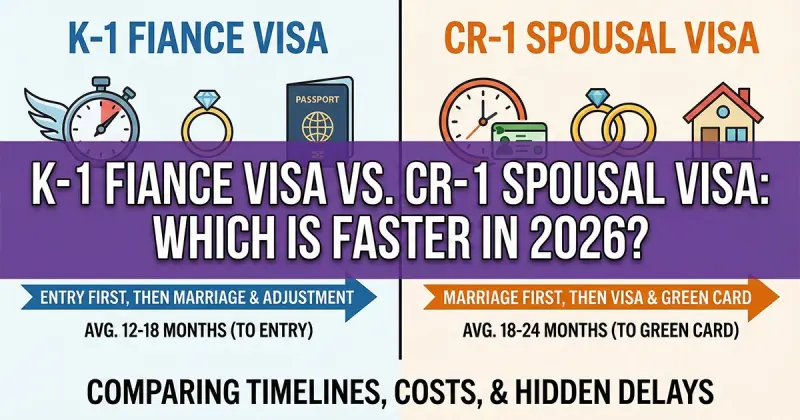
Torn between K-1 and CR-1? We compare 2026 processing times, costs, and hidden delays to help you decide if the "faster" option is worth the price.
You found the right person. You have the ring (or maybe you’re about to buy it). Now comes the unromantic part: The paperwork.
The most common question we get from couples is simple: "Which visa gets us together faster?"
In the past, the answer was always the K-1 Fiance Visa. But in 2026, the gap has narrowed, and the "faster" option comes with a heavy price tag—both in money and stress.
If you are trying to decide between the K-1 Fiance Visa and the CR-1 Spousal Visa, you need to look beyond just the initial wait time. This guide breaks down the real 2026 timelines to help you make the smartest choice for your future.
The "Speed" Trap: Defining Your Goal
Before we look at the months and dates, you have to ask yourself one question:
Is your goal to just enter the US, or to start your life in the US?
-
K-1 Fiance Visa: Designed for speed of entry. You get to the US faster, but you arrive with almost no rights (no job, no travel).
-
CR-1 Spousal Visa: Designed for stability. You wait longer outside the US, but you land as a Permanent Resident with a Green Card in hand.
Option 1: The K-1 Fiance Visa (The "Fast" Lane)
Who is it for? Unmarried couples where the US Citizen wants to bring their fiancé(e) to the US to get married.
The 2026 Timeline:
-
USCIS Processing (Form I-129F): ~9 to 11 months.
-
Embassy Interview: ~2 to 4 months.
-
Total Time to Entry: 11 to 15 months.
The Catch (Adjustment of Status):
This is the part most lawyers forget to emphasize. Once your fiancé arrives, you must marry within 90 days. But the journey isn't over. You then have to file for "Adjustment of Status" (Form I-485) to get the Green Card.
In 2026, Adjustment of Status is taking another 10-14 months. During much of this time, the foreign spouse cannot work and cannot leave the US without special permission.
[Internal Link: The Hidden Costs of the K-1 Visa: What Is Adjustment of Status?]
Option 2: The CR-1 Spousal Visa (The "Smart" Lane)
Who is it for? Couples who are already married (or willing to get married quickly abroad).
The 2026 Timeline:
-
USCIS Processing (Form I-130): ~11 to 14 months.
-
NVC & Embassy Interview: ~3 to 6 months.
-
Total Time to Entry: 14 to 20 months.
The Big Advantage:
Yes, you wait a few months longer outside the US. But the second your spouse’s feet touch American soil, they are a Permanent Resident. They can work the next day. They can travel immediately. They have a Green Card.
The 2026 Showdown: A Side-by-Side Comparison
Here is the raw data you need to compare the two paths in the current immigration climate.
| Feature |
K-1 Fiance Visa |
CR-1 Spousal Visa |
| Marital Status |
Must be Unmarried to apply. |
Must be Married to apply. |
| Time to Enter US |
Faster (~12 Months) |
Slower (~16 Months) |
| Work Status |
Cannot work immediately. Must wait for permit (4-6 months). |
Work Immediately upon arrival. |
| Travel Status |
Stuck in the US until "Advance Parole" is approved (~6 months). |
Can travel internationally immediately. |
| Total 2026 Cost |
High (~$3,500+ in gov fees alone due to dual filing). |
Lower (~$1,300 in gov fees). |
| Green Card |
Received ~1 year after arrival. |
Received upon arrival. |
Pro Tip: In 2026, the K-1 is significantly more expensive because you essentially have to pay for two major immigration processes (The Visa + The Green Card). The CR-1 bundles it all into one.
Which Path Should You Choose?
Choose the K-1 Visa IF:
-
Speed is the only thing that matters. If being apart for even one extra month is unbearable, the K-1 is statistically faster for entry.
-
You cannot marry abroad. Sometimes, for religious, cultural, or safety reasons, you cannot travel to your fiancé’s country to get married.
-
The US Citizen has a high income. Since the foreign spouse can't work for months, the US partner must be able to support the entire household on a single income.
Choose the CR-1 Visa IF:
-
You want to save money. You save thousands of dollars in government filing fees and legal costs.
-
Your spouse wants to work. If your partner is career-driven, sitting at home for 6 months without a work permit can be depressing and financially difficult.
-
You want "One and Done." You do the paperwork once, and you are finished. No more forms to file after they arrive.
[Internal Link: Getting Married Abroad? A Checklist for US Citizens]
Common Questions We Get in 2026
Q: Can we switch from K-1 to CR-1?
A: If you file for a K-1 and then get married before the visa is issued, the K-1 is automatically cancelled. You would have to start over with a CR-1. Do not get married if you have a pending K-1!
Q: Is the K-3 visa an option?
A: Practically, no. The K-3 (Spouse) visa is technically on the books, but USCIS rarely issues them anymore. They almost always convert them to CR-1 cases. Don't waste your time aiming for a K-3.
Conclusion: The "Right" Choice is Personal
If we look strictly at the numbers, the CR-1 Spousal Visa is the superior choice for 2026. The slight delay in entry is worth the freedom of having a Green Card on Day 1.
However, love isn't a spreadsheet. If your heart breaks every time you have to say goodbye at the airport, the "faster" K-1 might be worth the extra cost and hassle.
Need help deciding?
Every couple’s timeline is unique. If you have a criminal record, previous visa denials, or income issues, the "standard" timelines won't apply to you. Let's look at your case together.
[Internal Link: Book a Free Strategy Session with Our Immigration Team]
References & Resources