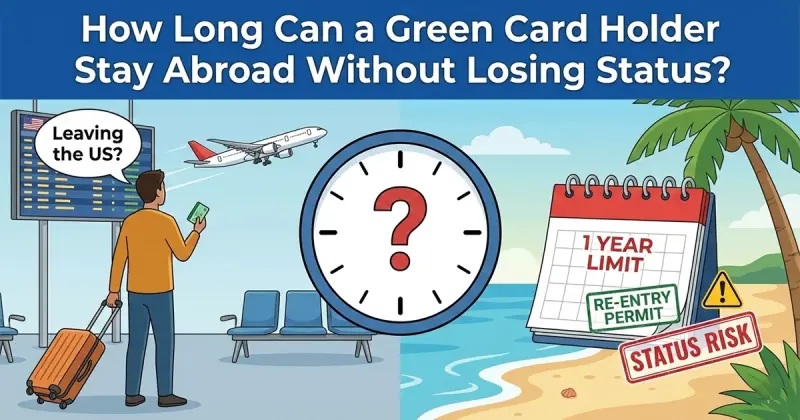
Leaving the US? Learn how long Green Card holders can stay abroad without losing status. Discover re-entry permits and rules for trips over 6 months or 1 year.
You’ve worked for years to secure your Lawful Permanent Resident status. You have a career, a home, and a future in the United States. But life often has other plans. Perhaps an elderly parent back home needs your care, or a unique international business opportunity has appeared on your horizon.
As you prepare to pack your bags, a chilling question keeps you up at night: "How long can I actually stay away?" You’ve heard the rumors at dinner parties—some say six months, others say a year, and some claim you just need to touch U.S. soil once every 365 days to be safe.
The truth is far more nuanced. In the current 2026 immigration landscape, U.S. Customs and Border Protection (CBP) has shifted toward a "subjective intent" model. It isn't just about the number of days you spend outside the country; it’s about whether the government believes you still intend to make the U.S. your permanent home.
At bestattorneyus.com, we see the heartbreak that occurs when a "temporary trip" turns into a revoked Green Card at the airport. This guide provides the expert-level clarity you need to navigate international travel without risking your status.
The Foundation of the Law: It’s About "Residence," Not Just "Presence"
To understand the rules, we must first look at why they exist. Under I.N.A. § 101(a)(20), a Green Card is technically a "Lawful Permanent Resident" card. The keyword is Resident. The U.S. government grants this privilege on the condition that you will actually live in the United States.
When you stay abroad for an extended period, the government begins to suspect that you have "abandoned" your residence. Abandonment isn't a criminal act, but it is an administrative "self-destruct" for your legal status. If a CBP officer determines you’ve moved your life elsewhere, they can ask you to sign Form I-407 (Record of Abandonment) or place you in removal proceedings before an immigration judge.
The Three Critical Thresholds of Time
While intent is the legal standard, the amount of time you spend abroad creates different levels of legal "presumption."
1. Absences of Less Than 6 Months
Generally, trips under 180 days are considered safe. CBP officers will rarely question your residency intent unless you are spending 5 months abroad, returning for one week, and leaving again for another 5 months. This "circling" pattern is a major red flag in 2026.
2. Absences of 6 Months to 1 Year
Once you cross the 180-day mark, the legal burden shifts. CBP will likely pull you into "Secondary Inspection" upon your return. They will look for evidence that your trip was temporary and that you maintained your ties to the U.S. during your absence.
3. Absences of More Than 1 Year
Staying abroad for 365 days or more without prior approval creates a "rebuttable presumption" of abandonment. Your Green Card technically ceases to be a valid travel document for entry. Unless you have a Reentry Permit, you will likely be denied boarding by the airline or denied entry at the border.
The Golden Rule:
"A Green Card is a 'use it or lose it' benefit. Never stay outside the United States for more than 364 days without a valid Reentry Permit in your hand. If you do, you are essentially daring the government to take your status away."
Comparison: Traveling With vs. Without a Reentry Permit
If you know you will be away for more than a year, the Form I-131 Reentry Permit is your most powerful shield. As of January 1, 2026, USCIS has adjusted the filing fees for this document to account for inflation, making it even more important to get the application right the first time.
| Feature |
Travel with Green Card Only |
Travel with Reentry Permit |
| Max Safe Absence |
Generally < 6 months |
Up to 2 years |
| Entry Document |
Valid for 1 year max |
Valid for permit duration |
| Presumption of Intent |
High risk of questioning after 6 months |
Serves as evidence of intent to return |
| Boarding Rights |
Airlines may refuse after 1 year |
Guaranteed boarding during validity |
| Cost |
$0 (included in status) |
USCIS Filing Fee + Biometrics |
| Naturalization Impact |
May break continuous residence |
Still breaks continuous residence* |
*Note: Even with a Reentry Permit, an absence of >1 year still resets your 5-year clock for citizenship unless you qualify for an N-470 exception.
The "Paper Trail" of Ties: How to Prove You Haven't Left
If you are questioned at the Port of Entry after a long trip, the officer is looking for a "preponderance of evidence" that your home is still in the USA. We recommend our clients carry a "Travel Binder" containing:
-
Financial Ties: Recent U.S. tax returns (filed as a resident), active U.S. bank statements, and credit card activity showing local spending.
-
Property Ties: A current lease, mortgage statement, or property tax bill.
-
Employment Ties: A letter from your U.S. employer stating your leave is temporary or that you are working remotely on a specific assignment.
-
Family Ties: Evidence that your spouse or children remained in the U.S. during your trip.
** — Remember that failing to tell USCIS where you are living is another ground for scrutiny during reentry.
Naturalization: The Hidden Trap of International Travel
Many LPRs don't care about the Green Card rules because they plan to become citizens soon. This is a dangerous mistake. To naturalize, you must meet two separate travel requirements:
-
Continuous Residence: You cannot have a single trip that "breaks" your 5-year count. A trip of 6–12 months presumes a break. A trip of >12 months automatically breaks it.
-
Physical Presence: You must have been physically inside the U.S. for at least 30 months (913 days) out of the last 5 years.
Every day you spend abroad is a day subtracted from your citizenship eligibility. If you are close to the 30-month limit, even a two-week vacation could push your eligibility back by years.
What if You are Stuck? The SB-1 Returning Resident Visa
Sometimes, circumstances truly are beyond your control. In 2026, we’ve seen an increase in "Medical Lock-ins" where an LPR undergoes an unexpected surgery abroad and cannot fly for 14 months.
If you have been outside the U.S. for more than a year without a Reentry Permit, you cannot just fly back. You must apply for an SB-1 Returning Resident Visa at the nearest U.S. Consulate.
This process is rigorous. You must prove with "clear and convincing evidence" that:
-
You were an LPR when you left.
-
You intended to return when you left.
-
Your stay was protracted for reasons you could not prevent.
Conclusion: Safeguard Your Seat at the Table
The United States is a land of opportunity, but your Green Card is a fragile privilege that requires active maintenance. Whether you are leaving for a month or a year, you must approach your travel with a "Defense-First" mindset.
Don't let a administrative oversight or a misunderstood deadline cost you the life you’ve built. By securing a Reentry Permit and maintaining documented ties to your community, you ensure that no matter where life takes you, the door to America remains open.
Are you planning an extended stay abroad or worried about a past absence? Don't wait until you're standing in front of a CBP officer. Contact the legal experts at bestattorneyus.com today for a comprehensive travel audit and case evaluation to protect your permanent residency.
Authoritative Sources for Further Reading: