We use cookies to enhance your browsing experience, analyze site traffic, and provide personalized content.
By clicking "Accept All", you consent to our use of cookies.
Read our Cookie Policy
Search Attorneys
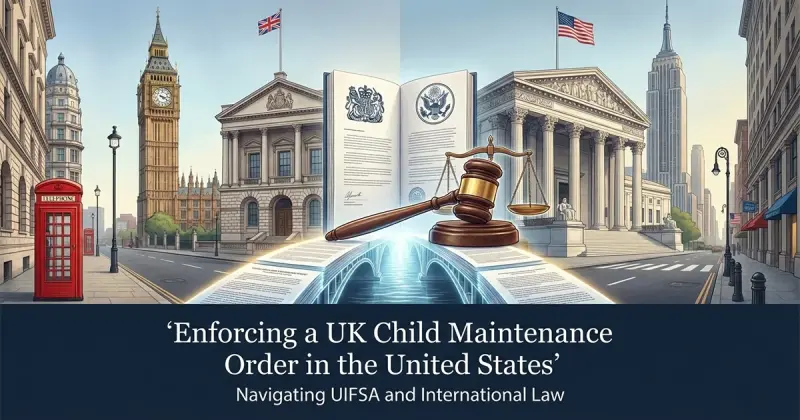
Enforcing a UK Child Maintenance Order in the United States
January 15, 2026
•
5 min read
•
324 views
•
Written By Editorial Team
Moving to the US with a UK court order? Learn how to enforce child maintenance using UIFSA and the Hague Convention to ensure your children’s financial security.
Introduction: The "Piece of Paper" Problem Imagine this scenario: You have just navigated a grueling divorce in London. Your UK family law solicitors fought hard to secure a fair Child Maintenance Order (or Child Arrangements Order with a financial component) to ensure your children’s lifestyle is protected. You relocate to the United States—perhaps for a new job or to return to family—only to discover a harsh reality.
When you show that UK court order to a school registrar, a doctor, or worse, a local police officer when payments stop arriving, they likely won't know what to do with it. In the eyes of US local authorities, a UK court order is often viewed, initially, as just a piece of paper. It has no automatic legal teeth on American soil.
For British expats and international parents, this realization can be terrifying. However, the United States and the United Kingdom have a robust legal framework for "reciprocity." Through a mechanism known as registration, your UK order can be transformed into a binding US court order, enforceable with the full power of American law.
This guide explains the technical process of enforcing UK child maintenance in the US under the Uniform Interstate Family Support Act (UIFSA) and clarifies the distinct roles of the legal professionals involved.
The Legal Framework: UIFSA and the Hague Convention
The bedrock of cross-border child support enforcement between the US and the UK is the 2007 Hague Convention on the International Recovery of Child Support. Because both nations are signatories, they have agreed to recognize and enforce each other's support orders.
In the United States, this treaty is implemented through a state law called the Uniform Interstate Family Support Act (UIFSA). Every US state has adopted UIFSA, creating a standardized process for handling foreign support orders.
Under UIFSA, a "foreign support order" (like one from the Central Family Court in London) is valid and enforceable if it meets basic due process requirements. However, it is not automatically active. You cannot simply garnish your ex-spouse's American wages based on the UK document alone. You must first "domesticate" or "register" the order in the US state where the paying parent (the obligor) lives or has assets.
From Solicitor to Attorney: Translating the Legal Team
One of the most common hurdles for expats is the terminology gap. In the UK, you likely worked with family law solicitors to manage your case and perhaps a barrister to represent you in court. You may be searching for "family law solicitors in the USA" to help you enforce the order.
It is crucial to understand that the role of the "solicitor" does not exist in the US legal system in the same form. Here, the legal profession is fused. You need to hire a Family Law Attorney.
The Solicitor’s Role (UK): Your UK solicitor handles the "outgoing" application. They may work with the UK’s Reciprocal Enforcement of Maintenance Orders (REMO) unit to transmit your documents to the US.
The Attorney’s Role (US): Your US attorney receives those documents and acts as the "incoming" legal force. They perform the specific procedural steps required by the local US court to register the order.
While the titles differ, the objective is the same. A US attorney acts as your solicitor (managing the paperwork and strategy) and your barrister (arguing in court) simultaneously. When hiring, you must ask if they have experience with UIFSA Article 6, which governs the registration of foreign orders.
Step-by-Step: The Registration Process under UIFSA
To enforce your UK maintenance order, your US attorney will generally follow this technical procedure. Note that "self-help" is dangerous here; a procedural error can result in the US court rejecting the order.
1. Gathering Certified Documentation You cannot use a photocopy. Your US attorney will need:
A certified copy of the original UK Child Maintenance Order.
A sworn statement showing the amount of arrears (unpaid support) calculated in US dollars (though the official conversion happens later).
Information regarding the debtor's location and assets.
2. Filing the "Letter of Transmittal" and Petition Your attorney will file a petition to "Register a Foreign Support Order for Enforcement" in the appropriate US tribunal (usually the family court in the county where your ex-spouse resides). This filing essentially asks the US judge to treat the UK order as if it were their own.
3. Notification and the Contest Period Once filed, the US court sends a "Notice of Registration" to the non-paying parent. This is a critical window. The parent has a specific time limit (usually 20 days) to contest the validity of the order. Under UIFSA, the grounds to contest are very narrow. They cannot argue that the amount is too high or that the UK judge was wrong. They can generally only argue:
The UK court lacked personal jurisdiction over them.
The order was obtained by fraud.
They have already paid (full or partial payment).
The statute of limitations has expired.
4. Confirmation of Order If the non-paying parent does not contest the registration within the 20-day window, the order is "confirmed by operation of law." At this moment, the magic happens: Your UK order legally transforms into a US Court Order. It is now domestic.
Enforcement Tools: The US "Hammer"
Once the order is registered and confirmed, your US attorney can unleash enforcement tools that are often more aggressive than those available to UK solicitors. US Family Courts have broad powers to collect child support, including:
Wage Garnishment: An order sent directly to the ex-spouse’s US employer to deduct support from their paycheck before they even see it.
License Suspension: Suspending the debtor’s driver’s license, professional licenses (medical, legal, contractor), or even recreational licenses (hunting/fishing) until arrears are paid.
Passport Denial: For significant arrears (usually over $2,500), the US State Department can revoke or deny a US passport, preventing international travel.
Asset Seizure: Freezing US bank accounts or placing liens on real estate.
The Trap: Modification vs. Enforcement
A critical warning for expats: Registration for enforcement is DIFFERENT from registration for modification.
You generally want to register the UK order only for enforcement. This means you want the US court to collect the money, but not to change the amount.
If you register the order for modification, you open a Pandora’s Box. The US court could apply US state guidelines to the support amount.
Risk: In some US states, child support guidelines are lower than typical London high-net-worth awards (which often include private school fees or "top-up" maintenance).
Protection: Under UIFSA, a US court generally cannot modify the UK order if the UK retains "continuing, exclusive jurisdiction" (CEJ). As long as one parent or the child still resides in the UK, the US court is usually barred from changing the amount. Your US attorney must be vigilant to ensure the court knows it has the power to enforce but not to modify.
Practical Challenges: Currency and Exchange Rates
UK orders are denominated in Great British Pounds (GBP). US employers pay in US Dollars (USD). UIFSA does not set a static exchange rate. Typically, your US attorney will request that the arrears be converted to USD as of the date of registration. For ongoing payments, the order may require the payer to pay the "USD equivalent" of the GBP amount current at the time of payment. This places the currency exchange risk on the payer, not the child.
Conclusion: Don't Go It Alone
Enforcing a UK Child Maintenance Order in the US is a highly technical process involving international treaties (Hague Convention), federal statutes (UIFSA), and state-specific family rules. While you may be used to the term "family law solicitors," your success in the US depends on finding a skilled International Family Law Attorney who understands the nuances of domestication.
Do not let your court order remain just a piece of paper. With the right legal strategy, you can ensure that your children’s financial security crosses the Atlantic with them.
Disclaimer: This article is for informational purposes only and does not constitute legal advice. International family law is complex; please consult with a qualified attorney regarding your specific situation.
Hit by a truck in Texas? Follow this immediate step-by-step guide to protect your rights and maximize your financial recovery. Don't ma...
Legal Disclaimer: Best Attorney USA is an independent legal directory and
information resource. We are not a law firm, and we do
not provide legal advice or legal representation. The information on this website should not be taken as a substitute for professional
legal counsel.
Review Policy: Attorney reviews and ratings displayed on this site are strictly based on visitor feedback and
user-generated content.
Best Attorney USA expressly disclaims any liability for the accuracy, completeness, or legality of reviews posted by third parties.
Cookie Preferences
Manage your cookie settings below
Essential Cookies
These cookies are necessary for the website to function and cannot be disabled.
They enable core functionality such as security, network management, accessibility,
and basic authentication (login, cart, session management).
Always Active
Analytics Cookies
These cookies help us understand how visitors interact with our website by collecting
and reporting information anonymously. We use Google Analytics and Microsoft Clarity
to improve our services and user experience.
Optional
Services: Google Analytics, Microsoft Clarity
Marketing Cookies
These cookies track your browsing habits to deliver personalized advertisements.
They help us show you relevant legal services and attorney recommendations based
on your interests.
Note: You can change your cookie preferences at any time by clicking the cookie icon
at the bottom of any page. For more information, read our
Cookie Policy and
Privacy Policy.