Abused by your spouse? You do not need their sponsorship. Under VAWA, victims can self-petition for a green card. Learn your rights and how to apply safely.
One of the most terrifying weapons an abusive partner can wield is your immigration status. How many times have you heard the threat? "If you leave me, I will have you deported." or "I’m the only one who can get you papers. Without me, you are nothing."
If you are reading this, I want you to take a deep breath and listen closely: They are lying.
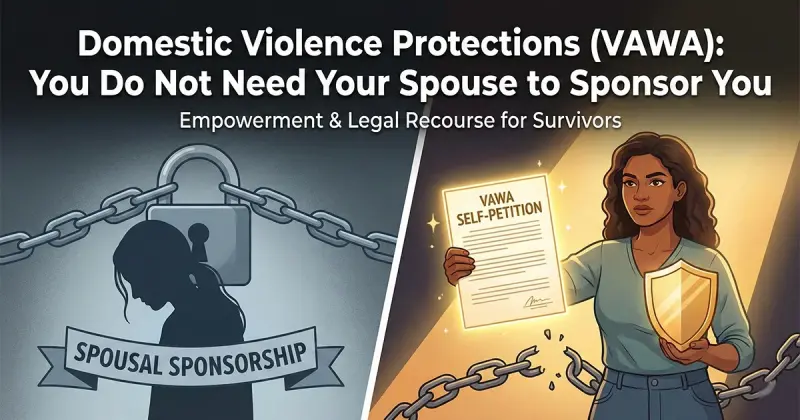
The United States legal system recognizes that no one should be forced to stay in an abusive marriage simply to keep their place in this country. Under the Violence Against Women Act (VAWA), you have the right to "self-petition" for a Green Card. This means you can file for legal status without your spouse's knowledge, consent, or signature.
At Best Attorney US, we have guided countless survivors through this process. It is not just about paperwork; it is about reclaiming your freedom. Here is how the law protects you.
What is the VAWA Self-Petition?
Contrary to its name, the Violence Against Women Act (VAWA) is not just for women. It is a gender-neutral law that protects both men and women who are victims of domestic violence.
A VAWA self-petition (Form I-360) allows you to bypass the traditional requirement of having a U.S. citizen or Lawful Permanent Resident (LPR) spouse sponsor you. Instead, you become your own sponsor. When you file a VAWA petition, you are telling the government: "I am eligible for a Green Card, but my sponsor is abusive, so I am petitioning for myself."
Who Is Eligible?
To qualify for a VAWA self-petition, you must prove:
-
Relationship: You are legally married to a U.S. Citizen (USC) or Lawful Permanent Resident (LPR), or were married to one within the past two years.
-
Abuse: You have been subjected to battery or "extreme cruelty" by your spouse.
-
Residence: You have lived with your spouse at some point.
-
Good Faith: You entered the marriage in "good faith" (for love, not just papers).
-
Good Moral Character: You generally follow the law and have a clean record (though exceptions exist if your criminal record is related to the abuse).
The "Any Credible Evidence" Standard: No Police Report? No Problem.
One of the biggest pain points for our clients is the fear that they have no "proof." Many victims never call 911 because they are afraid the police will arrest them or report them to ICE.
Crucial Legal Standard: USCIS applies the "Any Credible Evidence" standard to VAWA cases. This means a police report is not mandatory.
The law understands that abuse happens behind closed doors. You can prove your case using:
-
Psychological Evaluations: A report from a licensed therapist detailing the trauma you have suffered.
-
Affidavits: Sworn letters from friends, neighbors, religious leaders, or shelter workers who have witnessed the abuse or seen the changes in your behavior.
-
Personal Statement: A detailed, chronological declaration written by you, explaining the history of the relationship and the abuse.
-
Medical Records: Even if you didn’t tell the doctor the injury was caused by your spouse, records of injuries are vital.
Comparison: Traditional Marriage Petition vs. VAWA Self-Petition
Understanding the shift in power is essential. In a traditional case, the petitioner (your spouse) holds all the cards. In a VAWA case, you hold them.
| Feature |
Traditional Marriage Green Card |
VAWA Self-Petition |
| Who Signs the Form? |
The US Citizen/LPR Spouse (Form I-130). |
You, the Victim (Form I-360). |
| Control of Process |
The spouse can withdraw the case at any time. |
The abuser has zero control and cannot withdraw it. |
| Confidentiality |
USCIS sends mail to the shared home. |
USCIS sends mail to a "Safe Address" only. |
| Knowledge |
The spouse must attend the interview. |
The spouse is never notified and does not attend. |
| Work Permit |
Waiting times vary. |
Eligible for work permit upon "Prima Facie" approval. |
Will My Abuser Find Out? (The Safety Net)
This is the most common question we hear. The answer lies in 8 U.S.C. § 1367, a federal statute that imposes strict confidentiality rules on USCIS.
The government is prohibited by law from contacting your abusive spouse about your VAWA case. They cannot call them, email them, or ask them for information. If a USCIS officer violates this, they face severe disciplinary action and fines.
Furthermore, when you file, you will provide a Safe Mailing Address (such as a friend’s house, a P.O. Box, or your attorney’s office). All correspondence regarding your Green Card will go there, ensuring your abuser never sees a USCIS letter in your mailbox.
The Golden Rule:
Secure Your Digital Life First. Before you Google "divorce lawyer" or "VAWA help," use a safe computer (like at a public library) or a burner phone. Abusers often monitor internet history and keystrokes. If you must use your own phone, delete your browsing history immediately. Your safety is the priority; the legal paperwork can wait until you are safe.
The Process: Step-by-Step
-
File Form I-360: This is the petition where you prove the abuse and your eligibility.
-
Prima Facie Determination: Usually within a few months, USCIS will review your case to see if it looks valid on its face. If yes, they send a "Prima Facie" notice. This letter allows you to access certain public benefits in some states without fear of becoming a "public charge."
-
Green Card Application (Form I-485):
-
If your spouse is a US Citizen, you can file for your Green Card concurrently (at the same time) as the I-360.
-
If your spouse is a Permanent Resident, you may have to wait for a visa number to become available, but the I-360 secures your place in line.
-
The Interview: You will attend an interview, but it will be alone (or with your attorney). The officer will be trained in sensitivity toward domestic violence victims.
[Internal Link: The Cost of Hiring an Attorney for Immigration Protection]
Conclusion: You Are Not Alone
Living in the shadow of abuse is isolating, but the law provides a path into the light. You do not need to choose between your safety and your home in the United States. You have rights that your abuser cannot take away.
If you are ready to take the first step toward independence, do not navigate this complex system alone. You need a legal team that acts as both your shield and your sword.
Contact Best Attorney US today for a confidential, safe case evaluation. Let us help you break the cycle and secure your future.
Authoritative Resources for Further Reading