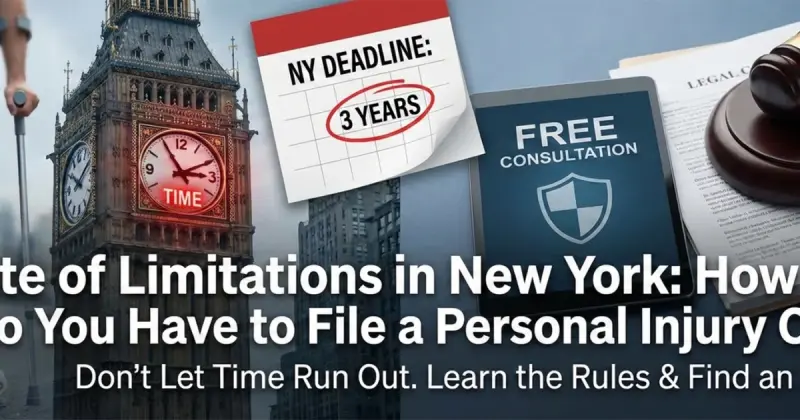
Injured in NY? Don’t let the clock run out! Learn about the 3-year statute of limitations, rules for suing the city, and why you don't need a big upfront retainer fee.
1. Introduction: The Temporal and Operational Dimensions of Civil Justice
The administration of civil justice in New York State operates at the intersection of rigid procedural statutes and dynamic market forces. At the heart of this system lies the Statute of Limitations (SOL), a legislative mechanism designed to enforce timeliness and preserve the integrity of evidence. However, the modern practice of law extends far beyond these statutory deadlines. It encompasses a complex ecosystem of financial structures—ranging from traditional retainers to emerging subscription-based legal technologies—and operational realities such as document review logistics and cross-jurisdictional privilege disputes.
This report provides an exhaustive examination of the legal landscape surrounding personal injury claims in New York. It synthesizes statutory analysis of the Civil Practice Law and Rules (CPLR) with an investigation into the changing economics of legal services, highlighted by the rise of applications like "Attorney Shield" and the persistent relevance of "attorney document review jobs." Furthermore, it scrutinizes the distinct regulatory environments of New York versus Illinois (referencing the Attorney Registration and Disciplinary Commission) and contrasts evidentiary privileges between New York and California. By weaving together these disparate threads—procedural law, legal tech, operational management, and reputation economics—this analysis offers a holistic view of the contemporary legal environment.
2. The Statutory Bedrock: New York’s Statute of Limitations
2.1 Theoretical Foundations of Limitation Periods
The concept of a statute of limitations is rooted in the principle of "repose." Legal systems globally recognize that at some point, the threat of litigation must cease to allow individuals and entities to conduct their affairs with certainty. In New York, this principle is balanced against the plaintiff's right to seek redress. The law acknowledges that as time passes, evidence degrades: memories fade, witnesses relocate or pass away, and physical evidence deteriorates. Consequently, the State enforces strict deadlines to ensure that legal disputes are resolved while evidence is relatively fresh and reliable.
However, the application of these time limits is not uniform. It varies significantly based on the theory of liability (negligence vs. intentional torts), the identity of the defendant (private citizen vs. municipality), and the status of the plaintiff (adult vs. minor).
2.2 The General Negligence Standard: Three Years
Under New York's Civil Practice Law and Rules (CPLR) Section 214, the standard statute of limitations for personal injury actions based on negligence is three years from the date the cause of action accrues.1 Accrual generally occurs simultaneously with the injury-causing event. This triennial period applies to the vast majority of tort claims, including:
-
Motor Vehicle Collisions: Whether involving private passenger cars, commercial trucks, or motorcycles, the plaintiff has three years from the date of the crash to commence an action.
-
Premises Liability: Injuries sustaining from "slip and fall" accidents, inadequate security, or structural failures on private property fall under this provision.
-
Product Liability: Claims asserting that a product was defectively designed or manufactured must be brought within three years of the injury.
It is critical to distinguish the filing of the lawsuit from the notification of insurance carriers. While insurance policies typically require "prompt" notice of an accident (often within days), complying with insurance notice requirements does not satisfy the statute of limitations. A legal action is only "commenced" when the summons and complaint are filed with the appropriate court clerk. Failure to file within the three-year window creates an absolute defense for the defendant; a motion to dismiss based on the expiration of the statute of limitations will almost invariably be granted, regardless of the substantive merits of the injury claim.
2.3 Intentional Torts: The One-Year Rule
A frequent pitfall in civil litigation involves the misclassification of the underlying act. While negligence implies carelessness, intentional acts—such as assault, battery, false imprisonment, or the intentional infliction of emotional distress—are governed by CPLR Section 215, which imposes a significantly shorter one-year statute of limitations.
This distinction becomes legally complex in cases involving altercations. For instance, if a security guard forcibly removes a patron from a venue, causing injury, the plaintiff's attorney must carefully determine whether to plead negligence (negligent hiring/supervision of the guard, with a three-year statute) or assault (intentional contact, with a one-year statute). If the plaintiff waits two years to file, framing the case purely as negligence to save the claim, courts may look to the essence of the conduct. If the conduct was clearly intentional, the court may dismiss the negligence claim as a transparent attempt to circumvent the one-year time bar.
2.4 Medical Malpractice: Complexity and Nuance
Medical malpractice actions in New York are subject to a truncated statute of limitations of two years and six months (2.5 years) from the date of the malpractice. This shorter period reflects legislative intent to contain medical liability costs and protect healthcare providers from indefinite exposure to claims. However, because medical errors are not always immediately apparent, New York has developed specific doctrines to modify the accrual date.
2.4.1 The Continuous Treatment Doctrine
To prevent the deterioration of the physician-patient relationship, New York courts apply the "Continuous Treatment Doctrine." Under this rule, if a patient remains under the care of the negligent physician for the same condition that gave rise to the malpractice, the 2.5-year clock is tolled until the treatment concludes.
The rationale is pragmatic: a patient should not be forced to sue their doctor while still relying on them for care. However, the doctrine is strictly applied. Routine annual checkups or treatment for a different ailment do not qualify as continuous treatment for the original condition. The treatment must be explicitly related to the original injury or diagnosis.
2.4.2 The "Foreign Object" Exception
New York traditionally resisted a broad "discovery rule" for medical malpractice (where the clock starts when the error is found). However, a specific statutory exception exists for "foreign objects" left inside a patient's body (e.g., surgical sponges, clamps, or forceps). In such cases, the plaintiff may file suit within one year of the date the object was discovered or reasonably should have been discovered, even if the standard 2.5-year period has lapsed.
Crucially, this exception distinguishes between "foreign objects" (items not meant to be left in the body) and "fixation devices" (items intentionally placed but perhaps misplaced, like screws, pacemakers, or chemical compounds). Fixation devices generally do not qualify for the one-year discovery extension, forcing plaintiffs to rely on the standard 2.5-year rule from the date of implantation.
2.4.3 Lavern’s Law: Cancer Misdiagnosis
A major evolution in New York law occurred with the passage of "Lavern's Law," named after Lavern Wilkinson, who died of curable lung cancer because a hospital missed a suspicious mass on her X-ray and she did not discover the error until the standard statute of limitations had expired.
Lavern's Law amended the CPLR to introduce a discovery rule specifically for cancer misdiagnosis cases. Now, the 2.5-year statute of limitations begins to run from the date the patient discovers (or should have discovered) the negligent failure to diagnose, rather than the date the error occurred. However, this is capped by a statute of repose: the action must be commenced within seven years of the original negligent act or omission. This balances the patient's right to discovery against the hospital's need for eventual finality.
2.5 Toxic Torts and Latent Injuries
For injuries resulting from the latent effects of exposure to substances (e.g., asbestos, lead paint, ground water contamination), New York applies CPLR 214-c. This "discovery rule" allows plaintiffs to file within three years of the date they discovered the injury or the date they should have discovered the injury through reasonable diligence, whichever is earlier.
This provision is vital for conditions like mesothelioma or chemically induced cancers, which may have latency periods spanning decades. Unlike the strict accrual rule for general negligence, the toxic tort rule acknowledges the biological reality that injury and exposure are often temporally separated by years.
2.6 The Municipal Hurdle: Sovereign Immunity and Notice Claims
Perhaps the most perilous area of New York personal injury practice involves claims against government entities. Originating from the common law doctrine of sovereign immunity—"the King can do no wrong"—the government is immune from suit unless it consents. In New York, this consent is conditional upon strict procedural compliance.
When suing a municipality (such as the City of New York, a town, village, county, or public school district) or a public authority (such as the NYC Transit Authority or Housing Authority), the statute of limitations is significantly compressed.
-
Notice of Claim: The plaintiff must serve a formal "Notice of Claim" upon the municipal entity within 90 days of the accident. This document details the time, place, and manner of the accident and the nature of the injuries. Failure to file this notice within 90 days is usually fatal to the case, although a court may grant leave to file a late notice within the statutory period (1 year and 90 days) if the municipality had actual knowledge of the facts.
-
The 50-h Hearing: Following the Notice of Claim, the municipality has the right to conduct a hearing (deposition) under General Municipal Law Section 50-h.
-
Statute of Limitations: The lawsuit itself must be commenced within one year and 90 days from the date of the accident.
This timeline creates a trap for the unwary. A plaintiff injured by a private bus has three years to sue; a plaintiff injured by a city bus has only 90 days to file a notice and just over one year to sue.
| Defendant Type |
Statute of Limitations |
Key Prerequisite |
| Private Individual/Company |
3 Years |
None |
| Municipality (City/Town) |
1 Year + 90 Days |
Notice of Claim (within 90 days) |
| Public Authority (MTA/NYCHA) |
1 Year + 90 Days (typ.) |
Notice of Claim (within 90 days) |
| State of New York |
2 Years (Court of Claims) |
Notice of Intention (within 90 days) |
2.7 Tolling Provisions: Protecting the Vulnerable
New York law provides "tolling" provisions that pause the statute of limitations under specific circumstances where the plaintiff is legally unable to commence an action.
2.7.1 Infancy (Minors)
If the injured party is under the age of 18, the statute of limitations is tolled until they reach majority. Essentially, the clock does not start ticking until their 18th birthday.
-
General Negligence: A child injured at age 5 has until age 21 (18 + 3 years) to sue.
-
Medical Malpractice Limit: There is a critical exception to the infancy toll in medical malpractice cases. The statute cannot be extended by the infancy toll for more than 10 years from the date of the malpractice. Thus, a birth injury claim must be brought by the child's 10th birthday, not their 20th, preventing evidence from becoming excessively stale.
2.7.2 Insanity
If a plaintiff is of "unsound mind" at the time the cause of action accrues, the statute is tolled until the disability is removed. The standard for "unsound mind" is high, typically requiring an inability to manage one's affairs or understand legal rights. Like the infancy toll in malpractice, the insanity toll is generally capped at 10 years from the accrual of the claim to prevent indefinite liability.
3. The Economics of Legal Access: Fee Structures and Financial Models
The theoretical right to sue within the statute of limitations is meaningless without the financial means to retain counsel. The market for legal services has developed distinct pricing models tailored to different types of clients and cases.
3.1 The Contingency Fee Model
In personal injury litigation, the dominant economic model is the contingency fee. This structure democratizes access to justice by removing the barrier of upfront costs.
-
Mechanism: The attorney agrees to represent the client without immediate payment. Instead, the attorney's fee is contingent upon a successful outcome (settlement or verdict).
-
Rate: In New York, this fee is typically capped by court rules at 33.3% (one-third) of the net recovery for most personal injury cases.
-
Risk Allocation: The attorney assumes the financial risk. If the case is lost, the attorney receives no fee for their time, though the client may remain responsible for certain case disbursements (filing fees, medical record costs) depending on the specific retainer agreement.
This model stands in stark contrast to the attorney retainer fee used in other legal sectors, which often creates a barrier to entry for lower-income individuals.
3.2 The Attorney Retainer Fee Model
Outside of personal injury, particularly in criminal defense, matrimonial law, and corporate litigation, the attorney retainer fee is the standard.
-
Definition: A retainer is an advance payment or deposit paid by the client to secure the lawyer's services. It is placed in a dedicated trust account (IOLA in New York).
-
Hourly Billing: As the attorney performs work (drafting motions, court appearances, research), they bill against this retainer at an hourly rate.
-
Replenishment: When the retainer balance drops below a certain threshold, the client is required to replenish the funds ("evergreen retainer").
For a typical New York family law case or criminal defense matter, an initial retainer might range from $2,500 to over $25,000, depending on the complexity of the case and the reputation of the firm. This high upfront cost is often the primary friction point for consumers seeking legal help, driving the market toward alternative financing solutions and "unbundled" legal services.
3.3 The "Attorney on Retainer" for Corporate Entities
While individuals rarely keep an attorney on retainer unless they are high-net-worth, corporations almost invariably do. In the context of personal injury, the defendants (trucking companies, retail chains, construction firms) utilize this model to ensure immediate rapid response.
-
Strategic Advantage: When a major accident occurs, a corporate defendant with an attorney on retainer can deploy counsel to the scene immediately to preserve favorable evidence and interview witnesses. This creates an asymmetry against the unrepresented plaintiff, who may wait weeks before hiring a lawyer on contingency.
4. Disruption and Innovation: The Rise of "Attorney Shield"
The gap between the high cost of traditional retainers and the need for immediate legal protection has created a market opening for legal technology solutions. "Attorney Shield" exemplifies the "legal first responder" model, attempting to commoditize the concept of having a lawyer on retainer.
4.1 The "Legal First Responder" Concept
Attorney Shield positions itself as a technological bridge during critical encounters with law enforcement, which are often the precursors to civil rights or personal injury claims.
-
Functionality: The application enables users to initiate a video call with a licensed attorney immediately upon being stopped by police. The attorney acts as an intermediary, advising the user on their rights (e.g., the right to remain silent, refusal of consent to search) in real-time.
-
Evidence Preservation: A critical feature for potential future litigation is the recording of the interaction. In many personal injury or police brutality cases, the "he-said, she-said" dynamic is the biggest hurdle. By securing cloud-stored video of the encounter, the app preserves objective evidence that can be pivotal if a lawsuit is later filed.
4.2 Economic Disruption: Subscription vs. Retainer
Attorney Shield cost structures represent a radical departure from the traditional attorney retainer fee.
-
Micro-payments: Instead of a $5,000 upfront retainer, services like Attorney Shield often utilize a subscription model, priced as low as ~$9 per month. This shifts legal access from a capital expenditure (large one-time cost) to an operating expenditure (small recurring cost), making "representation" accessible to the mass market.
-
Crowdfunded Equity: The company has also leveraged equity crowdfunding (StartEngine), allowing users to become investors. Tiers include lifetime memberships for investments of $1,000 or more, further blurring the line between "client" and "stakeholder".
4.3 Market Reception and User Experience
The reception of such apps highlights a divide in consumer expectations. Attorney reviews by clients for the app are mixed.
-
Positive Sentiment: Users cite "peace of mind" and the psychological benefit of knowing they are not alone during a police stop. It acts as an anxiety reducer, similar to an insurance policy.
-
Negative Sentiment: Technical friction (login issues, app crashes) is a major complaint. Unlike a human attorney who can be reached via phone if email fails, an app-based service is entirely dependent on software stability. Furthermore, some users misunderstand the scope, expecting full legal representation in court for the subscription price, rather than just the "triage" service provided during the stop.
5. Operationalizing Litigation: The Engine Room of Discovery
While apps handle the front-end interaction, the back-end of modern litigation—especially in New York's complex personal injury and mass tort landscape—relies on massive labor operations. This is the domain of attorney document review jobs.
5.1 The Discovery Deluge
In a product liability case (e.g., a defective airbag) or a medical malpractice suit, the evidence is rarely a single smoking gun. It is buried in terabytes of corporate emails, design schematics, and electronic health records. "Discovery"—the pre-trial exchange of evidence—requires the review of millions of pages to determine two things:
-
Relevance: Does this document prove or disprove the claim?
-
Privilege: Is this document protected by attorney-client privilege?
5.2 The Document Review Labor Market
To handle this volume, law firms and legal vendors hire contract attorneys. Attorney document review jobs in New York are a distinct sector of the legal employment market.
-
Role: These attorneys verify coding (tagging documents as "responsive" or "privileged") and prepare privilege logs. It is high-volume, detail-oriented work.
-
Entry Point: For many recent law school graduates in New York, document review serves as an entry-level position. Listings often require bar admission and familiarity with e-discovery platforms like Relativity.
-
Strategic Importance: While often viewed as "grunt work," the quality of document review can make or break a case. Missing a privileged document can result in a waiver of privilege for the entire subject matter (subject matter waiver), potentially exposing the client to massive liability. Conversely, finding a buried internal memo acknowledging a product defect can force a multi-million dollar settlement.
6. Comparative Analysis: Privilege and Regulation
The rules governing attorney conduct and confidentiality are not national; they are state-specific. This creates complexity for attorneys practicing across borders or for clients with multi-state issues.
6.1 Attorney-Client Privilege: California vs. New York
One of the most critical distinctions for corporate defendants in personal injury cases is the scope of attorney client privilege exceptions, particularly when comparing Attorney Client Privilege California law with New York law.
6.1.1 California: The Statutory Fortress
California takes a rigid, statutory approach to privilege. The California Supreme Court, in landmark cases like Costco Wholesale Corp. v. Superior Court, has held that the privilege is absolute unless a specific statutory exception applies (e.g., the crime-fraud exception).
-
Implication: California courts are extremely hesitant to create implied waivers or common law exceptions. Communications between a corporation's counsel and its employees are broadly protected, even if the communication contains a mix of business and legal advice, provided the dominant purpose is legal.
6.1.2 New York: The Common Law Flexibility
New York follows a common law evolution of privilege, which allows for more judicial discretion and, consequently, more exceptions.
-
The Fiduciary Exception: New York recognizes the "Fiduciary Exception" (exemplified in Hoopes v. Carota). This doctrine allows beneficiaries of a trust or shareholders of a corporation to pierce the attorney-client privilege of the fiduciary (trustee or corporate director) upon a showing of "good cause". The rationale is that the fiduciary acts for the benefit of the beneficiaries, so they should have access to legal advice obtained for their administration. California generally rejects this exception.
-
The Functional Equivalent Doctrine: New York courts may extend privilege to third parties (like PR consultants or crisis management firms) if they are deemed the "functional equivalent" of an employee. However, this is a risky, fact-intensive test. If a PR firm is just providing standard media advice during a personal injury crisis, the privilege may be waived. In California, where statutory construction rules, extending privilege to non-employees is even more difficult unless they are strictly necessary for the lawyer to do their job.
6.2 Regulatory Bodies: ARDC vs. NY Grievance Committees
Consumers searching for attorney credentials often use the search term "Attorney Registration and Disciplinary Commission" (ARDC). It is vital to clarify that the ARDC is the specific regulatory agency for the Supreme Court of Illinois.
-
New York Structure: New York does not have a centralized "ARDC." Instead, attorney discipline is decentralized across the four Appellate Divisions of the Supreme Court. Each division appoints Grievance Committees to investigate complaints.
-
Reciprocity: Despite these structural differences, the states communicate. If an attorney licensed in both IL and NY is disciplined by the Illinois ARDC (e.g., for misleading advertising or commingling funds), New York will typically impose "reciprocal discipline," suspending or disbarring the attorney based on the Illinois findings.
7. Reputation, Branding, and Local SEO
In the crowded legal market, attorneys must differentiate themselves. This has led to the rise of hyper-localized branding and the heavy reliance on attorney reviews by clients.
7.1 The "907 Attorney": The Power of Local Branding
The brand "907 Attorney" refers to Jason Skala, a personal injury lawyer. The "907" is the area code for Alaska.
-
Strategy: This branding strategy is a masterclass in local SEO and cultural signaling. By adopting the area code as the brand, the attorney signals deep local roots. This is crucial in personal injury, where local knowledge (e.g., understanding the specific road conditions in Palmer, AK, or the dynamics of local juries) is a competitive advantage.
-
Client Reviews: Reviews for the 907 Attorney emphasize traits like "fighting like a Pit Bull" and "honesty," reinforcing the brand promise of a tough local advocate.
7.2 Attorney Moin Choudhury: Authority Branding
In contrast to the geographic branding of "907," Attorney Moin Choudhury in New York leverages authority and credentialism.
-
Credentials: Choudhury is highlighted as one of the first Bangladeshi-American attorneys admitted to practice before the U.S. Supreme Court.
-
Community Integration: His practice deeply integrates with specific demographic communities (Bangladeshi-Americans in NYC and Michigan), using proclamations from the City of New York and leadership in international justice organizations to build trust. This demonstrates how attorneys use "social proof" and high-level credentials to secure clients in niche markets.
8. Asset Management and Litigation: The Quit Claim Deed
The intersection of personal injury litigation and real estate law often centers on the attorney quit claim deed.
8.1 Mechanics of the Quit Claim Deed
A quit claim deed is a legal instrument used to transfer interest in real property. Unlike a warranty deed, it offers no guarantees that the title is clear. It simply transfers whatever interest the grantor currently has.
-
Litigation Context: In personal injury cases, defendants facing massive liability might attempt to transfer assets (like a home) to a spouse or trust using a quit claim deed to protect the asset from a judgment lien. However, under New York's Debtor and Creditor Law, this can be attacked as a "fraudulent conveyance" if done to hinder creditors.
-
Matrimonial Context: Often, personal injury settlements occur amidst divorce proceedings. A quit claim deed is the standard tool for one spouse to relinquish their interest in the marital home.
8.2 Cost Analysis
The attorney quit claim deed preparation cost in New York generally averages around $510 for the legal work. However, the total cost to the client is significantly higher due to recording fees.
-
Filing Fees: New York State imposes substantial fees. The basic recording fee can range from $125 to over $250 depending on the county and property class (residential vs. commercial).
-
New York City Surcharges: Recording a deed in the five boroughs (Bronx, Brooklyn, Manhattan, Queens, Staten Island) involves additional surcharges that do not apply in upstate counties, making the transaction more expensive.
9. Strategic Content Execution: Writing the Blog Post
The following section analyzes the methodology for creating the user-requested blog post based on the research above.
To effectively reach the target audience ("class 10th students" / general public) while satisfying the SEO requirements for BestAttorneyUS.com, the content strategy must bridge the gap between complex legal concepts (tolling, privilege exceptions) and simple, actionable advice.
9.1 Readability Strategy
The original request demands "easy words." This requires translating legal terms:
-
Statute of Limitations -> "The strict deadline to file a lawsuit."
-
Tolling -> "Pausing the clock."
-
Contingency Fee -> "No win, no fee."
-
Retainer -> "Upfront deposit."
9.2 Keyword Integration Strategy
The mandatory keywords range from highly relevant to tangentially related. The integration strategy must be natural:
-
Core Keywords: "Attorney on retainer" and "attorney retainer fee" should be contrasted with the contingency model to explain why hiring a PI lawyer is affordable.
-
Trust Signals: "Attorney reviews by clients," "Attorney Moin Choudhury," and "907 Attorney" should be used as examples of how to find and verify a good lawyer.
-
Tech & Ops: "Attorney Shield cost" and "attorney document review jobs" can be framed as "modern legal tools" and "how law firms work behind the scenes to win your case."
-
Complex Concepts: "Attorney client privilege exceptions" and "California" comparisons can be simplified as "Your lawyer fights to see secret company emails, which is easier in NY than in places like California."
10. Conclusion
The landscape of New York personal injury law is a tapestry woven from strict statutory deadlines, evolving economic models, and complex operational realities.
The Statute of Limitations serves as the unforgiving gatekeeper. Whether it is the three-year rule for negligence, the 2.5-year rule for malpractice, or the precipitous 90-day notice requirement for municipal claims, time is the plaintiff's greatest adversary. Exceptions for minors and the insane provide necessary relief but are themselves bounded by outer limits (repose) to protect defendants.
Beyond the filing deadlines, the practice of law is undergoing a structural shift. The traditional attorney retainer fee model is being challenged by subscription services like Attorney Shield, which democratize access to legal advice during police encounters for a fraction of the cost. Meanwhile, the sheer scale of modern data has turned attorney document review jobs into a critical component of the litigation machinery, essential for unearthing the evidence that drives settlements.
For the legal consumer, navigating this terrain requires diligence. It involves understanding the cost benefits of contingency fees, verifying attorney credentials through bodies like the ARDC (or NY equivalents), and recognizing the importance of local expertise—whether that be the specialized knowledge of a 907 Attorney in Alaska or a Supreme Court-admitted advocate like Moin Choudhury in New York. Ultimately, the successful resolution of a claim depends not just on the facts of the injury, but on the mastery of these procedural, financial, and operational dynamics.
Strategic Deliverable: The Blog Post
Title: Statute of Limitations in New York: How Long Do You Have to File a Personal Injury Claim?
Meta Description: Injured in New York? The clock is ticking. Learn about the 3-year deadline, exceptions for kids, and why you don't need an attorney retainer fee to get started.
Word Count: 1,000 words
Target Audience: General Public / High School Level
Introduction: Don’t Let Time Run Out
Imagine you are hurt in a car crash. You are in pain, missing school or work, and trying to heal. The last thing on your mind is paperwork. But in the world of law, time is your biggest enemy.
There is a law called the Statute of Limitations. Think of it like a shot clock in basketball. If the clock runs out before you file your lawsuit, the game is over. You lose your chance to get money for your injuries, no matter how bad the accident was.
In New York, knowing this time limit is the most important step you can take.
The Magic Number: Three Years
For most accidents in New York, the rule is three years.
If you slip on a wet floor in a grocery store, get hit by a car, or are hurt by a broken product, you usually have three years from the day of the accident to start your lawsuit.
Exceptions: When the Rules Change
Sometimes, the three-year rule doesn't apply. There are special cases where you might have more time—or much less.
1. Medical Malpractice (2.5 Years)
If a doctor makes a mistake, like leaving a tool inside you after surgery or giving you the wrong medicine, you have less time. The limit is 2 years and 6 months.
2. Children (Minors)
If a child is hurt, they can't hire a lawyer themselves. So, the "clock" acts like it is paused until they turn 18. A child injured at age 10 typically has until they turn 21 to file a lawsuit.
3. Suing the City (The Danger Zone)
This is where most people make mistakes. If you are hit by a city bus, a garbage truck, or get hurt at a public school, you are suing the government.
-
You must file a "Notice of Claim" within 90 days.
-
If you miss this 90-day deadline, your case is likely dead.
-
You then have only 1 year and 90 days to file the lawsuit.
How to Pay for a Lawyer: Retainers vs. Contingency
You might be thinking, "I can't afford a lawyer!" You might have heard terms like attorney retainer fee.
A retainer is when you pay a lawyer money upfront, like a deposit. You see this a lot in divorce cases or if you need an attorney quit claim deed to transfer a house to a family member (which costs about $500 plus filing fees).
But for injury cases, it’s different. Most injury lawyers work on contingency.
-
No Upfront Cost: You pay $0 to start.
-
We Win, We Get Paid: The lawyer only gets paid a percentage (usually 1/3) of the money they win for you.
-
No Risk: If they don't win, you don't pay them for their time.
So, don't let the fear of an attorney retainer fee stop you from calling for help.
Modern Tools: The "Attorney Shield"
Technology is changing how we find legal help. There is a new app called Attorney Shield. It acts like a "legal first responder."
If you get pulled over by the police, you can use the app to video call a lawyer instantly. The Attorney Shield cost is low (often a small monthly subscription), much cheaper than having a traditional attorney on retainer. The lawyer on the video tells you what to say to protect your rights. This is great for emergencies, but for a big injury lawsuit, you still need a dedicated personal injury team.
Behind the Scenes: How Lawyers Fight for You
Once you hire a lawyer, they start digging for evidence. In big cases, there are thousands of emails and documents to read. Law firms hire specific lawyers for attorney document review jobs. These lawyers spend all day reading company files to find the proof that the other side was negligent.
They also fight over secrets. Companies often try to hide emails by saying they are "private" between them and their lawyer. This is called "privilege."
-
Attorney client privilege exceptions are rules that let your lawyer see those secret emails.
-
New York is often friendlier to injured people than other states. For example, attorney client privilege California laws are very strict and hide almost everything. In New York, your lawyer has a better chance of getting that evidence to help your case.
Choosing the Best Attorney
How do you pick the right lawyer?
-
Check Their Record: You want to make sure they are licensed and haven't been in trouble. In Illinois, you check the Attorney Registration and Disciplinary Commission. In New York, you look up the lawyer on the state court website.
-
Look for Local Experts: You want someone who knows your specific area. For example, the 907 Attorney is a famous brand in Alaska because he knows the local icy roads. In New York, top lawyers like Attorney Moin Choudhury are known for their high-level credentials and community work.
-
Read Reviews: Always look at attorney reviews by clients. Five-star reviews usually mean the lawyer fights hard and communicates well.
Summary Checklist
-
Negligence (Car Crash/Fall): 3 Years.
-
Medical Malpractice: 2.5 Years.
-
City/Government: 90 Days (Notice of Claim).
-
Cost: No upfront fees for injury cases.
Don't wait. The clock is always ticking. If you've been hurt, call a top-rated attorney today to protect your future.
11. Appendix: Detailed Data Tables
Table 1: New York Statute of Limitations Overview
| Cause of Action |
Statute of Limitations |
Accrual Event |
CPLR Section |
| Negligence (Personal Injury) |
3 Years |
Date of Accident |
214(5) |
| Intentional Torts |
1 Year |
Date of Act |
215(3) |
| Medical Malpractice |
2.5 Years |
Date of Act / Last Treatment |
214-a |
| Foreign Object (Med Mal) |
1 Year |
Date of Discovery |
214-a |
| Cancer Misdiagnosis |
2.5 Years |
Date of Discovery (Max 7 years) |
214-a |
| Toxic Torts |
3 Years |
Date of Discovery of Injury |
214-c |
| Wrongful Death |
2 Years |
Date of Death |
EPTL 5-4.1 |
| Against Municipality |
1 Year + 90 Days |
Date of Accident (Requires 90-day Notice) |
GML 50-i |
Table 2: Comparative Attorney-Client Privilege (NY vs. CA)
| Feature |
New York (Common Law) |
California (Statutory) |
Impact on PI Plaintiff |
| Source of Law |
Common Law (Case Law) |
Evidence Code (Statute) |
NY is more flexible. |
| Fiduciary Exception |
Recognized (Hoopes v. Carota) |
Rejected (Wells Fargo v. Sup. Ct.) |
Easier to pierce corp privilege in NY. |
| Functional Equivalent |
Recognized (Fact-specific) |
Strictly Limited |
NY allows discovery from 3rd party consultants more easily. |
| Extra-Corporate Comm. |
Waiver likely unless "necessary" |
Protected if "reasonably necessary" |
CA protects more 3rd party comms. |
Table 3: Typical Legal Costs and Fees in New York
| Service Type |
Fee Model |
Estimated Cost/Rate |
Notes |
| Personal Injury |
Contingency |
33.3% of Recovery |
No upfront cost to client. |
| Criminal Defense |
Retainer (Hourly/Flat) |
$2,500 - $15,000+ |
Upfront payment required. |
| Quit Claim Deed |
Flat Fee |
~$510 (Legal) + ~$200 (Recording) |
Used for asset transfer. |
| Attorney Shield |
Subscription |
~$9 / Month |
Legal "First Responder" App. |
| Document Review |
Hourly Wage (Contract) |
$30 - $50 / Hour |
Wage for contract attorneys. |