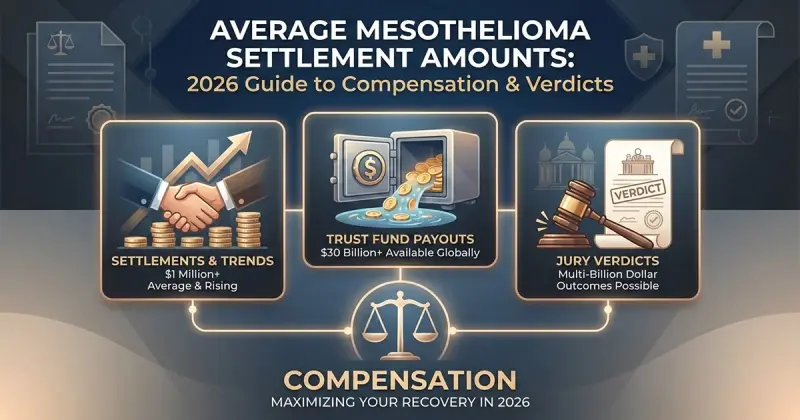
Explore 2026 mesothelioma settlement trends, trust fund payouts, and jury verdicts. Learn what victims can expect, from the $1M average to trial outcomes.
Average Mesothelioma Settlement Amounts: What Victims Can Realistically Expect in 2026
1. The State of Asbestos Litigation in 2026: An Executive Overview
As we navigate the legal and medical landscape of 2026, the environment surrounding mesothelioma compensation has evolved into a complex ecosystem defined by established historical baselines and volatile new trends. For victims and their families, the pursuit of justice for asbestos exposure—a tragedy often set in motion decades prior—remains a critical avenue for financial survival. The overarching narrative of 2026 is one of bifurcation: while the vast majority of cases continue to resolve through stable, negotiated settlements, a resurgence of high-profile "nuclear verdicts," particularly concerning cosmetic talc products, has injected new energy and unpredictability into the tort system.
The data available in early 2026 confirms that the average mesothelioma settlement amount consistently ranges between $1 million and $1.4 million. This figure, derived from the aggregation of payments from solvent defendants and bankrupt trust funds, has tracked with medical inflation, ensuring that compensation remains relevant to the staggering costs of modern oncological care. However, this average tells only part of the story. The chasm between a guaranteed settlement and the potential of a trial verdict has widened. Trial verdicts in 2025 and 2026 have averaged between $5 million and $11.4 million, with exceptional outliers reaching into the billions, fundamentally altering the risk-reward calculus for plaintiffs and defendants alike.
This report serves as an exhaustive guide for victims, families, and legal professionals. It dissects the components of compensation, analyzes the liquidity of the $30 billion asbestos trust system, and explores the digital and regulatory factors—such as the FDA's recent withdrawal of testing rules—that act as invisible hands shaping case values in 2026.
1.1 The "Longest Tort" Continues
Mesothelioma litigation is frequently cited as the longest-running mass tort in United States history. What began in the mid-20th century as a battle against heavy industry—insulation manufacturers, shipyards, and construction firms—has morphed in the 2020s. While traditional occupational exposures remain a significant portion of the docket, 2026 sees a continued dominance of "third-wave" litigation: cases involving cosmetic talc and secondary exposure. The stability of the $1 million to $1.4 million settlement average is a testament to the maturity of this litigation; the legal frameworks are well-worn, and the liability of traditional defendants is often irrefutable. Yet, the entry of new defendants and the discovery of asbestos in consumer goods ensure that this "mature" tort remains dynamic.
1.2 The 2026 Economic Reality
The necessity for substantial settlements is driven not by greed, but by the brutal economics of survival. In 2026, the annual cost of treating mesothelioma can exceed $400,000, a figure that often surpasses the limits of standard health insurance and Medicare coverage. With medical inflation projected to rise by 9% in 2026, driven by high-cost oncology drugs and personalized immunotherapies, the "average" settlement is essentially a medical necessity. Compensation is rarely a windfall; it is a replacement for lost future wages and a funding mechanism for life-extending care that would otherwise be inaccessible.
2. Comprehensive Analysis of Settlement Amounts
The concept of a "settlement" in asbestos litigation is often misunderstood. It is rarely a single check from a single company. Instead, a mesothelioma settlement is typically the aggregate sum of resolving claims against multiple defendants—often 20 to 70 different companies—that played a role in the victim's exposure history.
2.1 The Mathematics of the $1 Million Average
The benchmark range of $1 million to $1.4 million for settlements has proven resilient in 2026. This consistency suggests a market equilibrium where plaintiff attorneys and defense counsel have calibrated the "value" of a diagnosed case.
-
The Component Strategy: A victim exposed to asbestos in a shipyard in 1975 may file suit against the manufacturers of the boilers, the gaskets, the insulation, and the pumps. If 20 solvent companies each agree to settle for an average of $50,000 to avoid trial, the plaintiff secures $1 million.
-
Speed of Resolution: The primary driver for settlements is time. Mesothelioma is an aggressive cancer with a median survival rate often measured in months, not years. Settlements provide liquidity quickly. In 2026, data indicates that many families begin receiving their first settlement checks in as few as 90 days after filing. This rapid infusion of capital is critical for families facing immediate income loss and treatment deposits.
2.2 Settlements vs. Verdicts: A Risk Assessment
The decision to settle or proceed to trial is the most significant strategic choice a plaintiff makes. In 2026, the disparity between the two outcomes is stark.
The "Trial Penalty" for defendants is severe. Companies know that if they lose at trial, the verdict will likely far exceed the settlement demand. Conversely, the "Trial Risk" for plaintiffs is total loss. If a jury determines the defendant was not responsible, the victim receives nothing. This mutual risk creates the pressure that resolves 99% of cases before a verdict is read.
2.3 Factors Influencing Settlement Valuation
Not all settlements fall within the average. Values can range from $100,000 in weak cases to over $5 million in strong settlements. Several variables dictate this variance:
-
Strength of Identification: Can the plaintiff prove they worked with that specific brand of product? In 2026, with many victims being in their 70s or 80s, memory recall and the availability of co-workers to testify are crucial evidence.
-
Number of Defendants: A case involving exposure to products from 50 solvent companies is worth significantly more than a case involving exposure to products from only one or two bankrupt entities.
-
Economic Loss: A 50-year-old victim with dependent children and high future earning potential presents a higher "economic loss" calculation than an older retiree. Settlements for younger victims are often higher to compensate for decades of lost wages.
3. The Resurgence of "Nuclear Verdicts" in 2026
While settlements represent the statistical norm, 2026 has been defined by a series of headline-grabbing jury verdicts that have shaken the legal landscape. These "nuclear verdicts"—awards that exceed $10 million, often reaching hundreds of millions—are primarily driving the negotiation posture of defendants in the settlement phase.
3.1 The Johnson & Johnson Paradigm Shift
The most significant legal event of early 2026 occurred on January 6, 2026, when a Maryland jury awarded $1.57 billion to a single woman diagnosed with mesothelioma.
-
Case Profile: The plaintiff was a non-profit worker with no traditional industrial exposure. Her only link to asbestos was the habitual use of talc-based baby powder.
-
Punitive Damages: A massive portion of this award—$1 billion from J&J and $500 million from its subsidiary—was punitive. This signals that juries in 2026 are deeply hostile toward corporate concealment of safety data.
-
Impact on Settlements: Such verdicts act as a "Sword of Damocles." Defense attorneys for cosmetic companies are under immense pressure to settle cases to avoid facing a similarly angry jury. This drives up the average settlement value for talc cases, potentially pushing them above the traditional industrial average.
3.2 Other Notable 2025-2026 Verdicts
The J&J verdict was not an isolated incident. The litigation timeline for late 2025 and 2026 shows a pattern of high-value awards:
-
November 2025 (Connecticut): A judge increased a jury's $15 million award to $25 million by adding punitive damages, punishing J&J for "reckless disregard".
-
October 2025 (Portland): A $34.2 million verdict was handed down against John Crane, a gasket manufacturer. This confirms that industrial cases still command massive verdicts when negligence is clear.
-
July 2025 (Massachusetts): A $42 million verdict for a user of baby powder.
These verdicts demonstrate that the upper ceiling of mesothelioma compensation remains uncapped in the trial setting. However, victims must understand that these amounts are often reduced on appeal or settled for a lower amount post-verdict to avoid years of appellate litigation.
4. The Asbestos Trust Fund Ecosystem: A $30 Billion Safety Net
When asbestos companies file for Chapter 11 bankruptcy protection, they are immune from standard lawsuits. In exchange, they must establish trust funds to compensate current and future victims. In 2026, this system holds an estimated $30 billion in assets and is a primary source of compensation for nearly every mesothelioma victim.
4.1 Understanding Payment Percentages
A common misconception is that victims receive the full value of their claim from a trust. Because the trusts must remain solvent for decades to compensate future victims, they pay only a fraction of the claim's value, known as the "Payment Percentage."
-
Scheduled Value: The base amount the trust assigns to a disease (e.g., $350,000 for Mesothelioma).
-
Payment Percentage: The portion of that value actually paid out (e.g., 5%).
4.2 2026 Trust Fund Data Analysis
The following table provides a detailed snapshot of the solvency and payout potential of major trusts in 2026. This data is critical for setting realistic expectations.
| Trust Fund |
Mesothelioma Scheduled Value |
Payment Percentage (2026) |
Estimated Actual Payout |
| Johns-Manville |
$350,000 |
5.1% |
~$17,850 |
| W.R. Grace (WRG) |
$180,000 |
30.1% |
~$54,180 |
| U.S. Gypsum (USG) |
$155,000 |
11% |
~$17,050 |
| Armstrong World Industries |
$110,000 |
10.8% |
~$11,880 |
| Owens-Illinois (Paddock) |
$100,000 |
50.0% |
~$50,000 |
| Babcock & Wilcox |
$90,000 |
4.7% |
~$4,230 |
| NARCO |
$75,000 |
100% |
$75,000 |
| Pittsburgh Corning |
$175,000 |
19.0% |
~$33,250 |
| ASARCO |
$170,000 |
35.0% |
~$59,500 |
15
4.3 The Aggregate Power of Trusts
While a single check for $4,230 from Babcock & Wilcox may seem small, the power of the trust system lies in aggregation. A skilled mesothelioma attorney will identify every bankrupt company whose products the victim encountered. It is common for a single plaintiff to file claims with 10, 20, or even 30 different trusts.
-
Average Total: By stacking these payments, the average total compensation from trust funds alone ranges from $300,000 to $400,000 per victim.
-
Administrative Ease: Unlike lawsuits, trust claims rarely require depositions or court appearances. They are administrative processes where evidence is submitted, and if it meets the criteria, a check is issued. This makes trust funds the fastest source of compensation.
5. The Interaction of Regulatory Shifts and Litigation
The legal landscape does not exist in a vacuum; it is heavily influenced by federal regulation. In late 2025, a major regulatory shift occurred that is impacting cases in 2026.
5.1 The FDA Asbestos Testing Rule Withdrawal
In November 2025, the FDA formally withdrew a proposed rule that would have standardized testing methods for detecting asbestos in talc-containing cosmetics.
-
The Proposed Rule: The rule would have mandated specific testing protocols (PLM and TEM) to detect asbestos.
-
The Withdrawal: The FDA cited "unintended consequences" and the need for further assessment as reasons for the withdrawal.
-
Litigation Impact: For plaintiffs in 2026, this is paradoxically beneficial. A standardized federal rule might have set a "safe harbor" threshold or used less sensitive testing methods that companies could hide behind. With the rule withdrawn, plaintiff experts are free to use the most rigorous, sensitive scientific methods available to prove contamination in court. This lack of a federal "ceiling" on safety standards arguably strengthens the plaintiff's position in talc lawsuits, contributing to the high verdicts seen in early 2026.
6. Medical Realities and Settlement Valuation
The value of a settlement is intrinsically linked to the severity of the medical diagnosis. In 2026, the specificity of the diagnosis drives the "Scheduled Value" in both trusts and lawsuits.
6.1 Diagnosis Hierarchy
-
Malignant Mesothelioma: Commands the highest value. Within this, Peritoneal (abdominal) mesothelioma sometimes sees higher verdicts due to the younger average age of victims and the intense suffering involved. Pleural (lung lining) is the most common and has a standardized high value.
-
Lung Cancer: Values are generally lower than mesothelioma because lung cancer has multiple causes (smoking, radon). However, if an attorney can prove "synergy"—that asbestos exposure multiplied the risk caused by smoking—settlements can still be substantial.
-
Asbestosis: As a non-cancerous scarring of the lungs, these claims are valued significantly lower, often in the low five-figure range, unless the impairment is severe (Level IV).
6.2 The Cost of Innovation
In 2026, settlement demands are rising to match the cost of cutting-edge treatments.
-
Immunotherapy: Dual checkpoint inhibitors (Opdivo/Yervoy) are now standard of care but are incredibly expensive.
-
Targeted Therapies: New drugs like the TEAD inhibitor VT3989, granted Orphan Drug designation in 2025, and Volrustomig represent the new frontier of treatment. These experimental and targeted therapies often fall outside standard insurance coverage, necessitating higher settlement amounts to ensure patient access.
-
Tumor Treating Fields (TTFields): Wearable devices like Optune Lua add thousands of dollars to monthly care costs.
When attorneys negotiate settlements in 2026, they present "Life Care Plans" that project these costs. A settlement of $1.4 million is often calculated to ensure the victim can afford 2-3 years of these advanced, life-extending treatments without bankrupting their family.
7. Damages: Economic vs. Non-Economic
The calculation of a settlement is a forensic accounting exercise. It is split into two main categories: economic and non-economic damages.
7.1 Economic Damages: The Hard Numbers
These are quantifiable financial losses.
-
Medical Bills: Past and future projected costs.
-
Lost Wages: If a victim is diagnosed at age 55 and intended to work until 70, the settlement must replace 15 years of lost income. This is why younger victims often receive higher settlements.
-
Household Services: Forensic economists calculate the value of the work the victim performed around the home (mowing the lawn, repairs, childcare) that the family must now hire someone to do.
7.2 Non-Economic Damages: The Human Cost
These are subjective and often constitute the bulk of a verdict.
-
Pain and Suffering: Compensation for the physical agony of the disease and the side effects of treatment.
-
Loss of Consortium: Compensation for the spouse for the loss of companionship, intimacy, and support. In many 2026 verdicts, the loss of consortium award for the spouse is nearly as high as the pain and suffering award for the victim.
-
Punitive Damages: As seen in the Evan Plotkin case ($10 million punitive addition), these are designed solely to punish the defendant. While rare in settlements, the threat of them drives settlement values up.
8. The Legal Process: From Filing to Payout
Understanding the timeline is essential for victims who are often dealing with urgent medical prognosis.
8.1 The Discovery Phase
Once a lawsuit is filed, the "Discovery" phase begins. This is where the case is won or lost.
-
Depositions: The victim provides sworn testimony about their work history. In 2026, video depositions are standard, preserving the victim's testimony for trial even if they pass away before the court date.
-
Product Identification: The legal team uses the victim's history to pinpoint specific products (e.g., "I used Gold Bond powder" or "I installed Unibestos pipe covering").
8.2 The Settlement Negotiation
Most defendants prefer to settle after the deposition but before the trial begins.
-
The "Inventory" Settlement: Large law firms often settle hundreds of cases at once with a specific defendant. For example, a brake manufacturer might agree to pay $5 million to settle 100 pending cases from a specific law firm.
-
Individual Settlement: For high-value cases (e.g., a young person with mesothelioma), attorneys will negotiate individually to ensure the unique damages are covered.
8.3 The Timeline to Cash
-
Settlements: Funds typically arrive 30-90 days after the release is signed.
-
Trust Funds: Can be as fast as 3-4 months for Expedited Review.
-
Verdicts: If a plaintiff wins at trial, the defendant usually appeals. This can delay payment for 1-3 years. This delay is a major reason why even successful plaintiffs often agree to settle for a slightly lower amount post-verdict to secure immediate funds.
9. Jurisdictional Strategy: "Judicial Hellholes"
Where a case is filed is a strategic decision made by the attorney. Some courts are known to be more favorable to plaintiffs, termed "Judicial Hellholes" by tort reform advocates. Filing in these jurisdictions can pressure defendants into higher settlements.
9.1 Key Jurisdictions in 2026
-
Madison & St. Clair Counties, Illinois: These remain the epicenter of asbestos litigation, handling nearly half of all filings nationwide. The docket is known for moving cases quickly and producing high settlements.
-
Philadelphia (PA) & New York City (NY): Both cities continue to see increases in filings (7-9% increases) and are known for large jury awards.
-
Los Angeles, CA: The recent $1 billion+ verdicts have propelled LA to the top spot for high-stakes talc litigation.
-
South Carolina: A new entrant to the list in 2026, seeing a doubling of asbestos filings due to favorable rulings for plaintiffs regarding evidence standards.
10. Financial Implications: Taxation and Estate Planning
A settlement is a significant financial event. Understanding the tax implications is crucial to preserving the value of the award.
10.1 The General Rule: Tax-Free Status
Under Section 104(a)(2) of the Internal Revenue Code, damages received on account of personal physical injuries or physical sickness are excluded from gross income.
10.2 The Exceptions
-
Punitive Damages: If a jury awards money specifically to punish the defendant (not to compensate the victim), that money is taxable as ordinary income.
-
Interest: Any interest earned on the settlement money before it is paid out is taxable.
-
Previously Deducted Medical Expenses: If the victim claimed a tax deduction for medical bills in a previous year and the settlement reimburses those bills, that portion of the settlement is taxable (the "Tax Benefit Rule").
10.3 Structured Settlements
To manage these funds, many victims in 2026 utilize structured settlements. Instead of a lump sum, the money is placed into an annuity that pays out over time. This can provide tax-free growth and ensure a steady income stream for a surviving spouse, mimicking the lost wages the victim would have provided.
11. Veterans: A Distinct Class of Victims
Veterans represent approximately 30% of all mesothelioma cases in the U.S., a legacy of the military's heavy use of asbestos for fireproofing ships and bases until the late 1970s.
11.1 The Double Recovery Avenue
Veterans have a unique advantage: they can access two distinct streams of compensation that do not offset each other.
-
Civil Lawsuits: Veterans cannot sue the U.S. government (due to sovereign immunity), but they can sue the private companies that manufactured the asbestos products used by the military. These settlements average the standard $1 million+.
-
VA Benefits: A veteran with mesothelioma caused by service is eligible for a 100% Disability Rating. In 2026, this results in a monthly tax-free payment of over $4,000 for a married veteran.
-
Additional Benefits: Aid & Attendance (A&A) can add substantial amounts for home care.
-
DIC: Dependency and Indemnity Compensation provides monthly payments to the surviving spouse after the veteran's death.
11.2 High-Value Veteran Verdicts
Juries are often particularly sympathetic to veterans who served their country only to be poisoned by corporate negligence.
12. The Business of Law: SEO and Marketing in 2026
To understand the legal landscape, one must understand the "business" of mesothelioma law. It is one of the most competitive marketing environments on the planet.
12.1 The Most Expensive Clicks on the Web
In 2026, law firms pay astronomical sums to be visible to victims.
-
CPC (Cost Per Click): Keywords like "Mesothelioma attorney specialized" can cost $1,000 per click in Google Ads auctions.
-
Why? A single case can generate $400,000+ in legal fees (standard 33-40% contingency on a $1M+ settlement). Therefore, paying $1,000 for a click that might convert into a client is economically viable.
12.2 Digital Strategy and Patient Access
This high competition means that victims searching for help online in 2026 will encounter highly sophisticated content.
-
Hyper-Specificity: Firms now target specific queries like "Navy boiler room asbestos settlement" or "Johnson & Johnson baby powder lawsuit 2026" to capture high-intent traffic.
-
Trust Signals: Websites heavily feature their past verdict amounts (e.g., "$10 Billion Recovered") to build immediate trust (E-E-A-T) with users who are often skeptical of legal advertising.
13. Conclusion and Future Outlook
As 2026 progresses, the path for mesothelioma victims is clear but arduous. The financial mechanisms—settlements, trust funds, and verdicts—are functioning with high liquidity, ensuring that victims can access the $1 million to $1.4 million average compensation necessary for their care.
The resurgence of high-profile verdicts against companies like Johnson & Johnson signals a shift in the moral weight of these cases, moving from industrial negligence to consumer betrayal. This shift is driving settlement values upward for non-occupational cases, a trend likely to continue as the FDA withdrawal of testing rules leaves the courtroom as the primary venue for safety debates.
For the victim, the key takeaway is the importance of a multi-pronged strategy: filing claims with the $30 billion trust system for immediate funds, pursuing solvent defendants for a comprehensive settlement, and, for veterans, securing maximum VA benefits. While no amount of money can undo the damage of asbestos, the 2026 legal system is robustly designed to ensure that corporate assets are transferred to the families who have paid the ultimate price for corporate silence.
Summary Table: 2026 Compensation Expectations
| Compensation Source |
Estimated Value |
Timeframe |
Notes |
| Civil Settlement |
$1M - $1.4M |
3 - 12 Months |
Tax-free; Guaranteed |
| Jury Verdict |
$5M - $11.4M+ |
2 - 5 Years |
High risk; Appeals likely |
| Asbestos Trusts |
$300k - $400k |
3 - 6 Months |
Aggregate of multiple claims |
| VA Disability |
~$4,000/month |
3 - 4 Months |
Lifetime benefit; Tax-free |
The ecosystem of 2026 offers a stable, well-funded path to justice, provided victims navigate the complexity with experienced, specialized counsel.