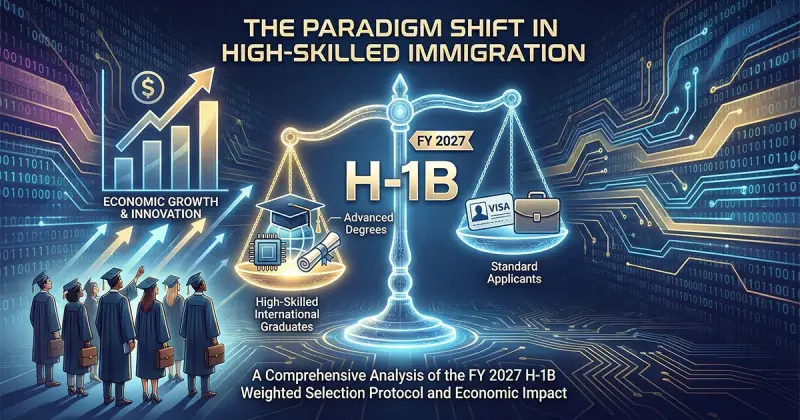
FY 2027 H-1B changes are here. Analyze the Weighted Selection Protocol and its critical economic impact on high-skilled international graduates and employers.
Executive Summary
The United States employment-based immigration system is currently navigating its most profound structural transformation in decades. With the onset of the Fiscal Year (FY) 2027 H-1B cap season, the Department of Homeland Security (DHS) and U.S. Citizenship and Immigration Services (USCIS) have effectively dismantled the traditional egalitarian lottery model—a system where every valid registration held an equal probability of selection regardless of compensation or seniority. In its place, a merit-centric, wage-weighted selection process has been codified, fundamentally realigning the incentives for U.S. employers and altering the trajectory for hundreds of thousands of international graduates.
Effective February 27, 2026, the new regulatory framework prioritizes H-1B registrations based on the Department of Labor’s (DOL) Occupational Employment and Wage Statistics (OEWS) wage levels. This shift is not merely procedural; it is an economic policy instrument designed to artificially elevate the wage floor for foreign professionals, thereby protecting the domestic workforce from low-cost labor substitution while consolidating the H-1B program around "the best and the brightest" global talent.
Concurrent with this lottery overhaul is the imposition of a $100,000 supplemental entry fee for specific categories of petitions, introduced via Presidential Proclamation in September 2025. This fiscal barrier creates a bifurcated risk landscape: while domestic Change of Status (COS) applicants—primarily F-1 students—are largely shielded from the fee, the procedural nuances of "Consular Notification" and "Cap-Gap" travel restrictions introduce potentially catastrophic financial liabilities for the unwary.
This report provides an exhaustive examination of the FY 2027 H-1B ecosystem. It dissects the mathematical mechanics of the weighted lottery, the legal and financial intricacies of the new fee structure, the compliance minefield of "Double RFEs," and the specific, granular impacts on the international student population transitioning from academia to the workforce.
1. The Regulatory Architecture of the FY 2027 H-1B Cap
The transition to the FY 2027 cap season, commencing with the registration period in March 2026, represents the culmination of years of regulatory maneuvering aimed at rigorous H-1B reform. The final rule, published by DHS on December 29, 2025, and effective February 27, 2026, serves as the statutory bedrock for the new selection methodology.
1.1 The End of Randomization: Policy Objectives
Historically, the H-1B lottery was a game of pure chance. Whether an employer offered a salary of $60,000 or $200,000, the statistical probability of selection remained identical, provided the position met the baseline specialty occupation criteria. Critics of this model, including the current administration, argued that it incentivized the "flooding" of the lottery with entry-level, lower-wage positions, thereby crowding out higher-skilled experts and suppressing wages in the technology and professional services sectors.
The new weighted selection process is explicitly designed to reverse this dynamic. By correlating lottery "entries" directly to wage levels, DHS aims to:
-
Prioritize Economic Value: Use salary as an objective proxy for skill, experience, and market demand.
-
Protect U.S. Labor Standards: Disincentivize the hiring of foreign workers for roles that could be filled by entry-level domestic workers at lower price points.
-
Enhance Program Integrity: Reduce the prevalence of speculative registrations filed by outsourcing consultancies that rely on high volumes of low-wage petitions.
1.2 The Registration Timeline and Logistics
For FY 2027, USCIS has established a compressed and rigid timeline for the electronic registration process. All prospective petitioners must utilize the "MyUSCIS Organizational Account" infrastructure, which allows for collaborative management of registrations between company signatories and legal counsel.
Critical Deadlines for FY 2027:
Financial Requirements: The cost of entry has risen dramatically. The registration fee has increased from the nominal $10 of previous years to $215 per beneficiary. This fee is non-refundable, regardless of selection outcome, adding a new layer of sunk costs for employers considering large-volume filings.
2. The Weighted Selection Mechanism: Mathematical Realities
The core innovation of the FY 2027 rules is the "beneficiary-centric weighted selection" model. This system does not merely separate applicants into buckets; it mathematically weights their presence in the selection pool based on the offered wage relative to the prevailing wage for their specific occupation and location.
2.1 The Four-Tier Entry Allocation Model
The Department of Labor categorizes prevailing wages into four levels, each representing a specific stratum of the workforce within a given Standard Occupational Classification (SOC). The new rule assigns lottery "entries" or "chances" based strictly on these levels.
Table 1: Wage Level Definitions and Lottery Allocations
This linear weighting system creates a profound skew. A Level IV registration is mathematically four times more "present" in the random generator than a Level I registration.
2.2 Probability Shifts and the Demise of Level I Selection
While the lottery remains technically random, the weighting dramatically alters the selection probability distributions. DHS modeling and independent legal analysis project a bifurcation of outcomes, where Level I petitions face near-elimination odds while Level IV petitions approach near-certainty.
Table 2: Projected Selection Probabilities vs. Historical Baseline
Note: Historical rates fluctuate based on total volume; the ~29.6% figure is a baseline used in DHS regulatory impact analyses.
The data indicates that Level I candidates are effectively facing a coin toss where the coin is weighted against them. A 15% selection rate renders reliance on the H-1B lottery for entry-level talent a high-risk strategy for employers, potentially driving a shift toward alternative staffing models or higher starting salaries to breach the Level II threshold. Conversely, Level III and IV candidates now possess a significant competitive advantage, incentivizing employers to "up-title" and "up-pay" wherever defensible.
2.3 The "Lowest Wage Level" Rule: Preventing System Gaming
A critical, often overlooked component of the new rule is the mechanism for handling beneficiaries with multiple registrations. In previous years, beneficiaries with multiple offers (or collusive multiple registrations) had a higher chance of selection simply by virtue of volume. The "Beneficiary-Centric" model introduced in FY 2025 capped this by counting each person once.
The FY 2027 rule adds a nuanced layer: The Lowest Wage Level Rule.
If a unique beneficiary has multiple registrations submitted on their behalf by different employers (or the same employer for different roles), USCIS will assign the lowest wage level among all those registrations to the beneficiary for the purpose of the lottery.
-
Scenario: A highly sought-after graduate student, "Candidate A," receives two job offers.
-
Outcome: If both employers register Candidate A, the lottery system will treat Candidate A as a Level I beneficiary (1 entry), effectively nullifying the advantage of the Level III offer.
This provision is an aggressive anti-gaming measure designed to prevent beneficiaries from accepting "backup" low-wage offers that would dilute the integrity of the merit-based system. It places a premium on candidates engaging only with employers willing to offer higher wage levels and potentially declining offers that would drag down their lottery odds.
3. Economic Logic: Prevailing Wages, SOC Codes, and Strategic Arbitrage
The "wage level" is not an arbitrary number but a derivative of the Standard Occupational Classification (SOC) code and the Metropolitan Statistical Area (MSA) of employment. This creates a complex matrix of "prevailing wages" where the same salary can yield vastly different lottery weights depending on what the job is called and where it is located.
3.1 The Mechanics of Wage Level Determination
To determine the appropriate wage level for registration, employers must compare their offered salary against the OEWS data for the specific SOC code and geo-location.
-
Step 1: Identify the SOC Code (e.g., 15-1252 for Software Developers).
-
Step 2: Identify the Area of Intended Employment (e.g., San Jose-Sunnyvale-Santa Clara, CA).
-
Step 3: Compare offered salary to the four OEWS tiers.
-
Step 4: Select the highest level that the salary meets or exceeds.
Private Survey Caveat: Employers using private wage surveys (rather than OEWS data) must be careful. If the private survey wage is lower than the Level I OEWS wage, the registration defaults to Level I (1 entry). If the private survey supports a higher wage, the employer must still map that wage to the corresponding OEWS band to determine lottery entries.
3.2 Geographic Arbitrage: The Location Impact
The disparity in prevailing wages across the United States creates opportunities for "geographic arbitrage." A salary that is considered "Entry Level" in Silicon Valley might be "Fully Competent" (Level IV) in a lower-cost region, drastically changing selection odds.
Table 3: Comparative Wage Benchmarks for Software Developers (SOC 15-1252) Data Sources:
| Location |
Level I (1 Entry) |
Level II (2 Entries) |
Level III (3 Entries) |
Level IV (4 Entries) |
| San Jose, CA (High Cost) |
$134,830 |
$171,610 |
$208,270 |
$239,200+ |
| New York, NY (High Cost) |
~$85,197 |
~$109,283 |
~$133,390 |
~$157,000+ |
| Huntsville, AL (Lower Cost - Est.) |
~$65,000 |
~$82,000 |
~$99,000 |
~$116,000 |
Analysis: An employer offering $140,000 for a Software Developer role:
-
In San Jose: Qualifies only as Level I (1 Entry).
-
In New York: Qualifies as Level III (3 Entries).
-
In Huntsville: Qualifies as Level IV (4 Entries).
This reality forces employers to consider the strategic placement of roles. Moving a position from a Tier 1 city to a Tier 2 city could increase the selection probability by over 100% without changing the actual compensation cost. For grad students, this suggests that flexibility regarding work location is now a primary lever for visa success.
3.3 The Role of SOC Code Selection
The selection of the SOC code is equally critical. "Marketing Specialist" (SOC 13-1161) generally has lower prevailing wage thresholds than "Marketing Manager" (SOC 11-2021). However, the job duties must align. Attempting to classify a complex role under a lower-wage SOC code to artificially boost the "wage level" relative to that lower benchmark is a compliance violation that invites scrutiny. Conversely, classifying a role too ambitiously (e.g., "Data Scientist" instead of "Data Analyst") might result in the offered salary falling into a lower wage tier for that higher-paid profession, reducing lottery odds.
4. The $100,000 Supplemental Entry Fee: A New Barrier to Entry
Perhaps the most controversial development for the FY 2027 cycle is the implementation of a $100,000 supplemental fee, mandated by the Presidential Proclamation of September 19, 2025. This fee is distinct from standard filing fees and is designed as a deterrent against the "importation" of foreign labor, effectively functioning as a tariff on H-1B visas issued abroad.
4.1 Trigger Conditions: Consular Notification vs. Change of Status
The fee is not universal. Its applicability hinges on the procedural posture of the beneficiary and the petition.
Table 4: Applicability of the $100,000 Fee
4.2 The "National Interest" Exception
The Proclamation allows for a discretionary waiver of the $100,000 fee if the Secretary of Homeland Security determines that the admission of the worker is in the "national interest". However, the bar for this exception is set deliberately high. Guidance suggests it is reserved for "extraordinarily rare" cases, such as those involving national security, critical medical care in underserved areas, or urgent government research. An email channel ([email protected]) has been established for pre-filing exception requests, but relying on this for standard commercial roles is ill-advised.
4.3 Litigation Landscape
The $100,000 fee is currently the subject of aggressive litigation.
-
Chamber of Commerce v. DHS: Business groups argue the fee violates the Immigration and Nationality Act (INA), which mandates fees be tied to cost recovery, not punitive deterrence.
-
Judicial Status: As of early 2026, lower courts have denied preliminary injunctions, citing the President's broad authority under INA § 212(f) to suspend entry of aliens detrimental to U.S. interests.
-
Appellate Fast-Track: The D.C. Circuit Court of Appeals has expedited the case, with a potential ruling expected in February 2026—just weeks before the registration window. Employers must plan as if the fee will remain in force while monitoring legal alerts daily.
5. Impact on the International Graduate Student (F-1) Pipeline
For the approximately 200,000 international students currently utilizing OPT or STEM OPT, the convergence of the weighted lottery and the $100,000 fee creates a precarious environment.
5.1 The Level I Trap for New Graduates
The most immediate threat is the weighted lottery. Recent graduates typically enter the workforce with limited experience, naturally falling into the Level I wage category. Under the new rules, these registrations face a ~15% selection chance—a statistical cliff that threatens to sever the "education-to-employment" pipeline.
Universities and policy institutes argue this system unfairly penalizes early-career talent who possess high potential but lack the years of experience required for Level III or IV designation. While STEM graduates often command higher market salaries, even a six-figure salary can be classified as Level I in hyper-competitive markets like San Francisco or Seattle, neutralizing their wage advantage.
5.2 Cap-Gap Risks and the "Travel Ban" Effect
The "Cap-Gap" regulation allows F-1 students with a pending or approved H-1B petition to remain in the U.S. and work after their OPT expires, until the H-1B start date of October 1. However, the interaction between Cap-Gap and the $100,000 fee creates a de facto travel ban for many students.
-
The Mechanism of Risk: If an F-1 student travels internationally while a Change of Status (COS) petition is pending, DHS considers the COS request "abandoned".
-
The Financial Consequence: If the COS is abandoned, USCIS may still approve the H-1B petition, but it will be for "Consular Notification." This approval automatically triggers the $100,000 fee requirement.
-
The Outcome: The employer receives an invoice for $100,000. If unpaid, the student cannot re-enter on H-1B status. Most employers will likely withdraw the offer rather than pay the fee, leaving the student stranded abroad.
Advisory: International students are strongly advised to remain physically present in the U.S. from the moment of registration until their H-1B status is fully active on October 1, 2026, to safeguard their COS eligibility and avoid the fee.
6. Compliance, Scrutiny, and the "Double RFE"
The transition to a wage-based system has armed USCIS with new adjudicatory tools. The information submitted during registration—specifically the SOC code and wage level—is now a "binding commitment" that dictates the parameters of the subsequent petition.
6.1 Binding Commitments and Anti-Fraud Measures
USCIS has explicitly stated that it will deny petitions where the facts do not align with the registration data. An employer cannot register a candidate at Level III to win the lottery and then file the LCA and petition at Level I to save costs. The petition must support the wage level claimed in the lottery.
Furthermore, FDNS (Fraud Detection and National Security) site visits are expected to increase, with officers specifically verifying that the beneficiary's day-to-day duties match the complexity level asserted in the registration.
6.2 The "Double RFE" Phenomenon
Legal practitioners are bracing for a surge in complex Requests for Evidence (RFEs), specifically the "Double RFE" which traps the petitioner in a logical paradox.
-
Prong 1 (Specialty Occupation): USCIS challenges a Level I petition by arguing that if a job is truly "entry-level" (Level I), it is simple enough that it doesn't require a bachelor's degree, thus failing the "Specialty Occupation" test.
-
Prong 2 (Wage Level Consistency): If the employer responds by detailing complex, specialized duties to prove it is a Specialty Occupation, USCIS counters that such complex duties require a Level II or III wage, and thus the Level I wage offered is insufficient.
Defense Strategy: Overcoming this requires expert opinion letters from industry peers or academics who can attest that the specific entry-level duties of the role are inherently complex and require a degree, consistent with DOL standards.
7. Strategic Workforce Planning for Employers
In light of these seismic shifts, employers must abandon the "file and hope" strategy of previous years. FY 2027 requires a calibrated, data-driven approach to immigration sponsorship.
7.1 "Stress-Testing" Job Descriptions
Before registration, HR and legal teams must audit every job description. The goal is to identify roles where the duties can legitimately support a Level II or III classification without crossing into "material change" territory that might trigger an amendment later.
7.2 Alternative Visa Pathways
With Level I H-1B odds plummeting to ~15%, reliance on the lottery for junior talent is unsustainable. Employers are pivoting to alternatives:
-
O-1A (Extraordinary Ability): For STEM talent with published research, high salaries, or critical roles. No cap, no lottery.
-
L-1B (Specialized Knowledge): For transferring employees from overseas branches. Note: If the employee is currently outside the U.S., the L-1 petition may also be subject to the $100,000 fee under broadly interpreted consular notification rules (verify current guidance).
-
H-1B Cap-Exempt Employment: Partnering with universities or non-profit research entities who are exempt from the lottery entirely.
7.3 Compensation Analysis as Recruitment Tool
Recruitment teams must now integrate OEWS data into the hiring process. When making offers to international candidates, the "prevailing wage" is no longer just a compliance check—it is a determinant of hireability. Offering a salary that sits just $1,000 below the Level II threshold could doom the candidate's visa chances. A slight adjustment to meet the next tier could double their probability of selection.
Conclusion
The FY 2027 H-1B cap season represents a watershed moment in U.S. immigration policy. The era of the "blind" lottery is over, replaced by a system that explicitly commodifies the visa allocation process based on economic input. For international graduate students, the path to U.S. employment has narrowed and steepened, demanding higher entry-level value and strategic navigation of wage tiers. For employers, the H-1B program has evolved from a game of chance into a rigorous exercise in compensation strategy and compliance planning.
As the March 4, 2026, registration window approaches, stakeholders must operate with precision. The interactions between the weighted lottery, the lowest-wage rule for multiple registrations, and the $100,000 fee create a matrix of risks that penalize the unprepared. Success in this new environment will belong to those who can align their talent acquisition strategies with the government's mandate for high-wage, high-skill prioritization.