We use cookies to enhance your browsing experience, analyze site traffic, and provide personalized content.
By clicking "Accept All", you consent to our use of cookies.
Read our Cookie Policy
Search Attorneys
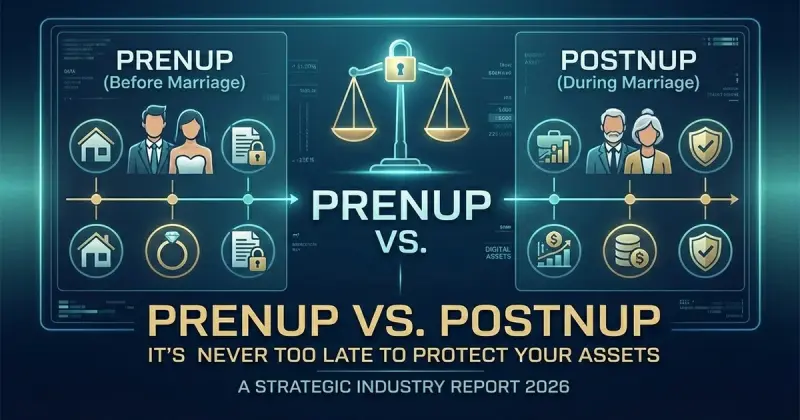
Prenup vs. Postnup: It’s Never Too Late to Protect Your Assets — A Strategic Industry Report (2026)
January 26, 2026
•
10 min read
•
200 views
•
Written By Editorial Team
Stay ahead of 2026 family law trends. This strategic report breaks down the critical differences between prenups and postnups, asset protection for digital wealth, and why it’s never too late to secure your financial future through post-marital planning.
Executive Summary
The domain of marital law and financial planning has undergone a fundamental transformation by the year 2026. No longer relegated to the realm of the ultra-wealthy or the cynical, marital agreements—specifically prenuptial (prenups) and postnuptial (postnups) agreements—have emerged as essential instruments of modern financial wellness. This shift is driven by a convergence of economic volatility, technological disruption in asset classes, and evolving sociological norms regarding marriage and divorce.
This comprehensive research report serves as a definitive guide for legal professionals, financial planners, and industry analysts. It provides an exhaustive analysis of the legal, economic, and technological landscapes defining the "Prenup vs. Postnup" dichotomy in 2026. While the core user query seeks to understand the differences between these two instruments, this report goes significantly further, exploring the second- and third-order effects of these agreements on "Grey Divorce," the student loan crisis, the valuation of cryptocurrency, and the emerging role of Artificial Intelligence (AI) in family law.
Furthermore, aligned with the directive to apply Search Engine Optimization (SEO) logic, this document analyzes the digital footprint of the modern legal consumer. It identifies the shifting search behaviors, keyword clusters, and content strategies that define how individuals seek legal protection in an era of digital ubiquity. By synthesizing data from legal statutes, market trends, and technological forecasts, this report establishes that protecting assets is not merely a legal tactic, but a critical component of holistic relationship health.
Chapter I: The Paradigm Shift — Marriage as a Modern Economic Partnership
1.1 From Stigma to Strategy: The Cultural Rebranding
Historically, prenuptial agreements were shrouded in stigma, often viewed as unromantic preconditions that anticipated the failure of a union before it had even begun. Postnuptial agreements fared even worse, frequently seen as the desperate last gasp of a failing marriage. However, by 2026, a significant cultural pivot has occurred, reshaping the public consciousness regarding these legal instruments.
Data indicates that the stigma surrounding marital agreements has largely dissipated, replaced by a narrative of "financial self-care" and "transparency." A 2022 Harris Poll foreshadowed this trend, noting a rise in prenup usage from 3% in 2010 to 15%—a trajectory that has accelerated sharply into 2026. This shift is particularly evident among Millennials and Gen Z cohorts, who view financial clarity not as an adversary to romance, but as a foundational element of a secure, sustainable partnership. The narrative has moved from "planning for divorce" to "planning for marriage," with the agreement serving as a roadmap for financial expectations.
The erosion of the "unromantic" label is driven by the practical realities of modern relationships. Couples in 2026 are marrying later in life, often bringing established careers, significant independent assets, or substantial debt loads into the union. Consequently, the prenup—and increasingly, the postnup—is viewed as a pragmatic financial planning tool, akin to life insurance or a will. It is a protective measure against the unpredictability of life, rather than a prediction of relationship demise.
1.2 The "Financial Wellness" Movement
In 2026, marital agreements are frequently categorized under the broader umbrella of "financial wellness." Just as individuals engage in physical health routines, couples are encouraged to engage in financial fitness exercises, of which marital contracts are a core component.
Corporate benefit programs and financial planning apps now routinely include modules on marriage contracts alongside retirement planning and student loan management. This institutionalization of marital planning normalizes the conversation, stripping away the emotional volatility that previously hindered these discussions. The wellness-centric approach frames the postnup not as a "divorce document" but as a "stay-together document." By resolving festering financial disputes—whether regarding spending habits, debt allocation, or risk tolerance in business ventures—a postnup can remove a primary source of marital conflict, potentially stabilizing a rocky relationship and preventing divorce altogether.
1.3 Women as Financial Initiators
A critical demographic shift underpinning this trend is the rise of women as initiators of marital agreements. Historically, prenups were often associated with wealthy men protecting assets from less wealthy female spouses. In 2026, this dynamic has equalized, and in many sectors, reversed. Women are entering marriages with more substantial assets, higher earning potential, and established businesses than ever before.
Driven by increased financial literacy and a desire for autonomy, women are proactively seeking prenups and postnups to protect their hard-earned wealth and intellectual property. This "feminization" of the marital contract has contributed significantly to its destigmatization, reframing the agreement as an act of empowerment and mutual respect rather than coercion or distrust.
Chapter II: Legal Architecture — The Prenup vs. Postnup Dichotomy
2.1 Defining the Instruments
At their fundamental level, both prenuptial and postnuptial agreements serve the same primary function: they allow a couple to supersede state default laws regarding the division of assets, debts, and spousal support in the event of divorce or death. They are private contracts that replace public policy defaults. However, the temporal distinction—execution before versus after the marriage—creates divergent legal standards, negotiating dynamics, and practical applications.
Prenuptial Agreements (Prenups): These are executed prior to the legal marriage. In legal terms, the marriage itself often serves as the "consideration"—the benefit bargained for—that validates the contract. They are forward-looking documents designed to establish a baseline before marital property laws take effect. The "pre" in prenup signals a clean slate, defining rights before they legally attach.
Postnuptial Agreements (Postnups): These are executed after the couple is legally married. Because the marriage has already occurred, the "consideration" cannot be the act of marrying. This necessitates a different legal standard, often requiring mutual promises regarding property rights or, in some jurisdictions, specific considerations regarding the continuation of the marriage. They are often reactive documents, created in response to a change in circumstances or a need to redefine the marital economic partnership.
2.2 The Critical Distinction: Timing and Fiduciary Duty
The timing of the agreement dictates the legal scrutiny it faces. This is the most crucial distinction for legal practitioners and clients to understand.
Prenup Context: Parties negotiating a prenup are technically legal strangers. While they may have a relationship, they do not yet owe each other the strict fiduciary duties of spouses. They are negotiating at "arm's length," although principles of fairness still apply.
Postnup Context: Postnups are signed by parties who are already married and therefore owe each other fiduciary duties. This includes a duty of highest good faith and fair dealing. Consequently, postnups are subject to much higher scrutiny by courts. Any hint of hiding assets, unfair dealing, or taking advantage of a spouse's trust is treated severely. The presumption in some jurisdictions is that an agreement advantaging one spouse over the other was obtained via undue influence, shifting the burden of proof to the beneficiary to prove its fairness.
2.3 Enforceability and the "Consideration" Conundrum
A recurring theme in 2026 legal analysis is the complexity of "consideration" in postnuptial agreements. In contract law, a promise is only binding if something of value is exchanged.
Marriage as Consideration: For a prenup, the exchange is clear: "I sign this agreement, and you agree to marry me."
The Postnup Problem: Since the couple is already married, "staying married" is not always valid consideration, as spouses arguably already have a duty to the marriage. Therefore, valid consideration in a postnup usually involves a mutual exchange of property rights—e.g., "I waive my interest in your business in exchange for you waiving your interest in the marital home".
Legal Requirements:
Written Instrument: Oral agreements regarding marital property are universally unenforceable. The Statute of Frauds requires these contracts to be in writing.
Voluntary Execution: Both parties must sign without coercion, duress, or undue pressure. The definition of "duress" can be subtle, including threats to divorce or financial blackmail.
Full and Fair Disclosure: A comprehensive "marital balance sheet" detailing all assets, liabilities, and income sources is mandatory. Hiding assets is the fastest route to invalidation. In the postnup context, the duty to disclose is absolute.
Legal Representation: While not strictly mandatory in every single jurisdiction for validity, the absence of independent counsel (one lawyer for each spouse) is a significant red flag. In 2026, courts increasingly view the lack of independent counsel as a sign of potential overreaching, making it nearly impossible to enforce a contested postnup.
Fairness/Conscionability: The agreement must not be "unconscionable" (shockingly unfair) at the time of signing. Some states also test for unconscionability at the time of enforcement.
2.4 Use Cases: When to Choose Which?
The choice between a prenup and a postnup is often dictated by life stage and specific triggers.
Prenup Triggers: Ideal for couples with pre-marital assets, children from prior relationships, or family inheritances they wish to keep separate from the outset. It sets the "ground rules" before the game begins.
Postnup Triggers: Utilized when circumstances change during the marriage. This includes the sudden acquisition of wealth (inheritance, business success), the accumulation of unexpected debt (student loans, gambling), or a reconciliation process after a period of marital strife. The postnup is a tool for course correction.
Table 1: Comparative Legal Framework (2026)
Feature
Prenuptial Agreement
Postnuptial Agreement
Execution Timing
Prior to marriage license/ceremony.
After legal marriage is finalized.
Legal Consideration
The marriage itself.
Mutual exchange of property/rights; sometimes "forbearance of divorce."
Fiduciary Standard
Arms-length (generally).
Fiduciary (highest duty of good faith).
Scrutiny Level
Moderate; presumed valid if formalities met.
High; presumption of undue influence in some states.
Primary Risk Factor
Timing duress (presented too close to wedding).
Lack of consideration; breach of fiduciary duty.
Disclosure Requirement
High.
Absolute and ongoing.
Cost Complexity
Lower (Standardized inputs).
Higher (Requires complex tracing of commingled assets).
Chapter III: The Economic Catalysts of 2026
3.1 The "Change in Circumstances" Catalyst
The primary driver for the surge in postnuptial agreements in 2026 is the extreme dynamism of the modern economic lifecycle. Unlike the static agrarian or industrial economies of the past where wealth accumulation was linear, the 2026 digital economy is characterized by rapid, non-linear fluctuations in net worth.
Career Volatility: The "career shift" is a common trigger. One spouse may leave a stable corporate job to launch a high-risk startup. A postnup can insulate the other spouse from the potential business debt while outlining the division of future equity if the startup becomes a unicorn. This separation of risk allows the entrepreneurial spouse to take chances without endangering the family's core assets.
The Great Wealth Transfer: The massive transfer of wealth from Baby Boomers to younger generations is in full swing. When a spouse receives a significant inheritance, a postnup is often used to clarify that these funds remain separate property. Without such an agreement, commingling (mixing inheritance with marital funds) often occurs inadvertently, converting separate property into marital property. A postnup acts as a "firewall" for inherited wealth.
3.2 Inflation and Cost of Living Pressures
The economic landscape of 2026, marked by persistent inflation and high costs of living, has exacerbated financial stress within marriages.
Budgeting with Teeth: Couples are increasingly using postnups as binding budgeting tools. These agreements can define spending limits, savings obligations, and financial responsibilities. By legalizing the "family budget," couples prevent the ambiguous arguments that often lead to separation.
Asset Protection: In an environment where the cost of raising a child has skyrocketed (projected at over $400,000 by 2025/2026), protecting existing assets becomes paramount. Postnups allow couples to ring-fence savings for specific goals (education, retirement) against the spending impulses of a partner.
Chapter IV: The Student Loan Crisis and Marital Liability
4.1 The $1.76 Trillion Shadow
Student loan debt remains a pervasive and crushing issue in 2026, influencing marital dynamics more profoundly than perhaps any other single economic factor. With total debt reaching staggering levels, the "negative dowry"—bringing debt rather than assets into a marriage—has become a normalized, albeit stressful, reality.
Credit Score Impact: While one spouse's credit score is not automatically merged with the other's, the debt-to-income ratio of a spouse heavily influences the couple's ability to secure joint mortgages or loans. This "borrowing drag" is a frequent source of marital friction.
Lender Liability: The question of "Am I responsible for my spouse's student loans?" is one of the most common queries driving postnup consultations. In community property states, creditors may aggressively target marital assets to satisfy the debts of one spouse, even if those debts were incurred prior to marriage.
4.2 Strategic Debt Allocation via Postnups
Postnuptial agreements have emerged as the primary defense mechanism against the contagion of student debt.
Defining Separate Debt: Couples use postnups to explicitly classify student loans as the "separate debt" of the borrower. This agreement can stipulate that the borrower is solely responsible for repayment and that the non-borrowing spouse is entitled to reimbursement if marital funds are used for payments.
The "Reimbursement" Clause: If a couple uses their joint bank account to pay down $50,000 of one spouse's law school debt, the community estate may have a claim for reimbursement. A postnup can waive this claim (treating payments as a gift) or codify it (treating payments as a loan to the student spouse), providing clarity and preventing resentment.
Protection from Private Lenders: While federal loans have specific statutory rules, private student loans are governed by contract law. A postnup can attempt to shield the non-student spouse’s income and separate assets from aggressive private collection actions, though the effectiveness depends on state law and the timing of the debt.
Confirm separate nature; waive community reimbursement for payments made during marriage.
Loans Incurred During Marriage
Often marital debt (community property states) or shared liability if for "family benefit."
Classify as separate debt of the student; indemnify non-student spouse.
Parent PLUS Loans
Marital debt if incurred for child of the marriage.
Define allocation percentages between spouses; clarify if child is expected to repay.
Refinancing During Marriage
Refinancing creates a new loan, often joint if co-signed.
Prohibit co-signing; strictly define liability if refinancing occurs.
Chapter V: The Digital Asset Frontier — Crypto, NFTs, and Disclosure
5.1 The Volatility Challenge
By 2026, digital assets like Bitcoin, Ethereum, and Non-Fungible Tokens (NFTs) have moved from niche curiosities to standard components of marital investment portfolios. However, their extreme volatility presents unique challenges for legal agreements.
The Valuation Date Problem: In a standard divorce, assets are valued at the time of filing or trial. For a volatile asset like crypto, a portfolio could swing from $100,000 to $50,000 or $200,000 in the span of weeks. This uncertainty makes settlement negotiations chaotic.
The Postnup Solution: Postnups are increasingly used to set fixed "valuation dates" or specific methodologies for calculating the value of crypto assets. For example, a clause might state that "Crypto assets will be valued at the average daily closing price for the 30 days preceding the filing." This bypasses the lottery-like uncertainty of spot prices.
Speculative Carve-Outs: If one spouse wishes to invest heavily in high-risk speculative digital assets (e.g., meme coins), a postnup can designate those specific investments—and their associated risks and gains—as separate property. This protects the risk-averse spouse from potential ruin while allowing the investor spouse to reap the full rewards (or consequences) of their gamble.
5.2 The Disclosure and Tracing Dilemma
Cryptocurrency is inherently designed to be semi-anonymous and decentralized, making it a prime vehicle for hiding assets in a divorce—a growing practice termed "crypto-divorce fraud".
Hiding in Plain Sight: Savvy spouses may use "tumblers" or "mixers" to obscure transaction trails, or hold assets in "cold wallets" (offline hardware devices) that are difficult to discover without physical access to the device and the passkey. Unlike a bank account, there is no central branch to subpoena for records.
Forensic Necessity: The 2026 legal landscape sees a boom in forensic accounting specifically for blockchain. Postnups are now drafted with specific clauses requiring the disclosure of public keys (wallet addresses) and exchange login credentials.
The "Digital Asset Rider": Modern postnups often include a mandatory "Digital Asset Rider." This requires the listing of all wallets. Failure to disclose a wallet on this rider constitutes a material breach of the agreement's "full disclosure" requirement. If a hidden wallet is discovered years later, this breach can render the entire postnup voidable, reopening the divorce settlement.
5.3 NFTs and Intellectual Property
Non-Fungible Tokens (NFTs) introduce further complexity because they often carry ongoing royalties via smart contracts. A digital artist spouse might create an NFT that generates resale royalties in perpetuity.
Royalty Division: A postnup must address not just the asset's current value, but the future income streams (royalties). Are these royalties marital income (like a salary) or separate property income (like dividends from pre-marital stock)? Explicitly defining this in a postnup prevents future litigation over "smart contract" revenue.
5.4 State-Specific Approaches
States like New York and California—hubs for both finance and technology—have developed evolving case law regarding digital assets.
Equitable Distribution (NY): Courts attempt to divide the value fairly. This might mean ordering the liquidation of crypto to pay out a share in fiat currency, or offsetting the crypto value against other assets (e.g., one spouse keeps the house, the other keeps the Bitcoin).
Community Property (CA): The presumption is a 50/50 split of the assets themselves. This can be logistically complex with crypto if private keys are lost or withheld. Postnups provide the flexibility to opt out of these default rules and create a custom division plan that makes logistical sense for the couple.
Chapter VI: The Grey Divorce Phenomenon — Unraveling Decades
6.1 The Demographic Shift
"Grey divorce"—divorce among adults aged 50 and older—is rising even as the overall divorce rate declines. By 2026, this demographic shift has become a major driver of postnuptial agreement activity, fundamentally altering the retirement landscape for millions.
Retirement Anxiety: For Baby Boomers and Gen Xers, a divorce late in life is a financial catastrophe. It splits the retirement "nest egg" in half precisely when there is little time left to rebuild it through earnings. 35% of Boomers report that divorce would derail their retirement plans.
The "Longevity Risk": Divorce exacerbates "longevity risk"—the risk of outliving one's assets. Two households are significantly more expensive to maintain than one. Postnups in this demographic focus heavily on preservation rather than accumulation.
6.2 Postnups as Stabilization Mechanisms
Interestingly, postnups are frequently used in the grey demographic to prevent divorce.
The "Sleep Aid" Contract: A couple facing friction over disparate retirement spending habits or estate planning goals may use a postnup to settle the dispute legally. By agreeing on who gets what and how money is spent, they remove the conflict, allowing the marriage to continue. The postnup acts as a "financial sleep aid," calming the anxiety that drives spouses to separate.
Inheritance Protection: Older couples often have adult children from prior relationships. A major source of conflict in second marriages is the fear that assets will pass to the new spouse rather than the children. A postnup can clarify that specific assets are "separate property" destined for the children, resolving this tension and protecting the inheritance.
6.3 Social Security and Health Considerations
Postnup negotiations in grey divorce scenarios must carefully consider complex federal rules.
The 10-Year Rule: A divorced spouse is eligible for Social Security benefits based on their ex-spouse's earnings only if the marriage lasted at least 10 years. Postnups cannot alter federal law, but they can structure spousal support payments to bridge the gap if a divorce occurs just shy of this milestone.
Health Insurance: Access to health insurance is a critical asset for older adults. Postnups often include clauses regarding the maintenance of long-term care insurance or the division of Health Savings Accounts (HSAs), prioritizing healthcare security over other assets.
Chapter VII: Technology Transforming Family Law
7.1 Artificial Intelligence in Legal Practice
By 2026, Artificial Intelligence (AI) has permeated every aspect of family law, democratizing access to high-level legal tools while introducing new ethical complexities.
Drafting and Research: Advanced AI tools like "CoCounsel" (based on large language models) allow lawyers to draft complex postnuptial clauses in seconds and research obscure case law regarding asset tracing across jurisdictions. This efficiency lowers the cost of legal services, making prenups and postnups more accessible to the middle class.
Predictive Justice: AI models can now analyze thousands of past divorce judgments in a specific jurisdiction to predict how a judge might rule on alimony or asset division. This "predictive justice" incentivizes settlement. If an AI predicts a 90% chance of a specific outcome, parties are more likely to agree to a postnup that reflects that reality rather than gamble on a trial.
Tone Analysis in Communication: High-conflict couples are increasingly using AI-powered tools (e.g., "ToneMeter" in apps like OurFamilyWizard) to screen their communications. The AI flags aggressive, sarcastic, or passive-aggressive language in emails and texts, suggesting more neutral phrasing before the message is sent. This creates a "technological buffer" that reduces the hostility often fueling divorce proceedings.
7.2 The Virtual Courtroom and Online Dispute Resolution (ODR)
The COVID-19 pandemic accelerated the adoption of virtual hearings, and by 2026, they are a permanent and refined fixture of the legal system.
Online Dispute Resolution (ODR): Platforms now allow couples to negotiate and finalize uncontested divorces or postnups entirely online, often without stepping foot in a courthouse. These asynchronous platforms allow parties to review proposals in their own time, reducing the pressure of live negotiation.
Virtual Reality (VR) Pilots: While still emerging, VR is being tested in legal settings. In family law, VR is being piloted for "Virtual Mediation," where avatars meet in a neutral, calming virtual environment (e.g., a garden or library) rather than a sterile conference room. Early data suggests this can lower cortisol levels and lead to more amicable settlements.
Accessibility: Virtual hearings address the "access to justice" gap, allowing parties in rural areas or those with mobility issues to participate fully in the legal process without the burden of travel.
7.3 Co-Parenting Apps and Gamification
Apps like OurFamilyWizard, TalkingParents, and Cozi have evolved into sophisticated platforms that serve as the "system of record" for co-parenting.
Court Admissibility: Messages sent through these apps are unalterable, timestamped, and often accessible by the court or a Parenting Coordinator. This creates a "Panopticon effect" where parents behave better because they know they are being recorded.
Gamification and AI Coaching: Some apps now use "Coparent Coach AI" to guide parents through conflicts, acting as a digital mediator. They may even "gamify" cooperation, providing positive reinforcement (badges, streaks) for timely responses or adherence to the schedule, subtly modifying behavior toward cooperation.
Chapter VIII: The Human Element — Psychology and Wellness in Law
8.1 Recognizing Divorce as Trauma
The legal system in 2026 increasingly views divorce not just as a legal event but as a psychological trauma. "Trauma-informed courts" and legal practices are becoming the standard, shifting the focus from adversarial combat to holistic resolution.
Parallel Parenting: For high-conflict cases, the trend is moving away from forced "co-parenting" (which requires collaboration) toward "parallel parenting." In this model, parents disengage and follow a strict, detailed plan with minimal direct contact. This is seen as a harm-reduction strategy for children, protecting them from the crossfire of parental conflict.
The Divorce Doula: A new profession has emerged to fill the gap between the lawyer and the therapist: the "divorce doula" or "divorce coach." These professionals provide emotional and logistical support, guiding clients through the non-legal aspects of separation (organizing moves, managing emotions, handling social circles). This allows the attorney to focus on the law while the doula handles the emotional turmoil, leading to more efficient and less expensive legal proceedings.
8.2 Mental Health Integration
California's CARE Court expansion and similar initiatives reflect a broader integration of mental health services into the justice system. In family law, this manifests as courts ordering "reunification therapy" or mandating mental health evaluations as part of custody determinations. Courts are recognizing that a legal order is useless if the underlying mental health issues driving the conflict are not addressed.
Chapter IX: SEO & Marketing Strategy for the Family Law Market
9.1 The "User Journey" in 2026
For legal professionals, understanding the SEO landscape is critical. The user journey has evolved from simple transactional searches to complex informational queries.
The "Problem-Aware" Phase: Users rarely search for "postnup lawyer" immediately. They search for their problem: "spouse gambling debt responsibility," "student loans in divorce," or "crypto hidden assets divorce."
The "Solution-Aware" Phase: Once they understand the problem, they search for solutions: "postnuptial agreement benefits," "DIY postnup validity," "cost of postnup 2026."
The "Provider-Aware" Phase: Finally, they search for specific attorneys: "best crypto divorce lawyer NY," "female family law attorney for narcissist spouse."
9.2 Keyword Clusters and Trends
To capture traffic in 2026, content strategies must align with these high-intent clusters.
High-Volume, Low-Competition: Long-tail queries like "Is a DIY postnup valid in?" or "Can a postnup stop a divorce?" offer high conversion rates because they indicate a user ready to act.
Niche Authority: Keywords related to "Grey Divorce" and "Crypto Asset Division" are burgeoning niches. Firms that establish topical authority (E-E-A-T) in these specific areas by creating "hub" pages will outrank generalist firms.
Local SEO: "Family law attorney [City]" remains crucial, but optimization now requires Google Business Profile enhancements with specific "products" listed, such as "Postnuptial Drafting" and "High-Net-Worth Divorce".
9.3 Content Strategy for Trust
The most successful firms act as media companies, producing content that answers specific questions and builds trust before the first consultation.
Interactive Tools: "Alimony Calculator 2026" or "Asset Division Simulator" pages attract high traffic and keep users on the site longer, signaling quality to search engines.
Video Content: Short-form video (TikTok/Reels style) explaining legal concepts ("3 things to put in your prenup") drives awareness among Gen Z. These videos often serve as the "top of funnel" entry point, leading users to the firm's website for more detailed guides.
Chapter X: Enforceability and Risk Management — The "DIY" Danger
10.1 The Perils of Online Templates
With the rise of "LegalZoom" style services and AI drafters, there is a proliferation of Do-It-Yourself (DIY) postnups. In 2026, this poses a significant risk to enforceability.
Missing Formalities: Postnups have strict execution requirements that vary by state (notarization, witness signatures, specific waiting periods). DIY forms often miss state-specific nuances (e.g., specific waiver language required in California regarding spousal support), rendering the document void.
The "Unfairness" Trap: A DIY agreement that is heavily one-sided is easily overturned by a judge. Without legal counsel to advise on "fairness" and "equitable distribution," couples often draft agreements that fail the "conscionability" test. A judge may look at a lopsided DIY postnup and rule it unconscionable, tossing the entire contract.
10.2 The Disclosure Pitfall
The most common reason for a postnup to be invalidated is a failure to disclose assets.
Trivial Assets Matter: Laypeople often fail to disclose assets they consider "trivial" or "separate" (like a small crypto wallet or a future inheritance). However, the law generally requires full disclosure. Any failure to disclose can be used by an opposing lawyer to argue that the entire agreement was based on fraud or lack of information, invalidating the whole document.10.3 Case Law Warnings
High-profile cases serve as cautionary tales. The McCourt divorce (owners of the LA Dodgers) remains a seminal lesson where conflicting copies of a postnup and lack of clarity led to its invalidation and years of litigation. In 2026, courts continue to cite cases like In re Marriage of Burkle and MacFarlane v. Rich to emphasize that spouses held to a fiduciary standard cannot treat a postnup negotiation like a ruthless business deal; transparency is non-negotiable.
Chapter XI: Conclusion — The Era of Strategic Transparency
As we navigate the complexities of 2026, the "Prenup vs. Postnup" debate is no longer a binary choice between romance and cynicism. It has evolved into a sophisticated conversation about strategic transparency. Whether executed before the wedding or years into the marriage, these agreements serve as the architectural blueprints for a couple’s financial life, providing stability in an unstable world.
The convergence of "grey divorce" risks, the unprecedented volatility of digital assets, and the crushing weight of student debt has made the laissez-faire approach to marital finances obsolete. Technology, from AI drafters to blockchain forensics, has provided the tools to manage this complexity, while the "wellness" movement has provided the social license to discuss it openly.
For the modern couple, the message is clear: It is never too late to protect your assets, because protecting your assets is, fundamentally, about protecting the clarity, trust, and sustainability of your future—whether that future is shared or separate.
Table 3: Summary of Key Trends and Strategic Responses (2026)
Trend
Strategic Response
Impact
Rise of Grey Divorce
Postnups focusing on retirement/estate protection.
Secures "longevity" assets; protects inheritance for children.
Crypto Volatility
"Digital Asset Riders" & Fixed Valuation Dates.
Prevents litigation over price swings; ensures full disclosure.
Hit by a truck in Texas? Follow this immediate step-by-step guide to protect your rights and maximize your financial recovery. Don't ma...
Legal Disclaimer: Best Attorney USA is an independent legal directory and
information resource. We are not a law firm, and we do
not provide legal advice or legal representation. The information on this website should not be taken as a substitute for professional
legal counsel.
Review Policy: Attorney reviews and ratings displayed on this site are strictly based on visitor feedback and
user-generated content.
Best Attorney USA expressly disclaims any liability for the accuracy, completeness, or legality of reviews posted by third parties.
Cookie Preferences
Manage your cookie settings below
Essential Cookies
These cookies are necessary for the website to function and cannot be disabled.
They enable core functionality such as security, network management, accessibility,
and basic authentication (login, cart, session management).
Always Active
Analytics Cookies
These cookies help us understand how visitors interact with our website by collecting
and reporting information anonymously. We use Google Analytics and Microsoft Clarity
to improve our services and user experience.
Optional
Services: Google Analytics, Microsoft Clarity
Marketing Cookies
These cookies track your browsing habits to deliver personalized advertisements.
They help us show you relevant legal services and attorney recommendations based
on your interests.
Note: You can change your cookie preferences at any time by clicking the cookie icon
at the bottom of any page. For more information, read our
Cookie Policy and
Privacy Policy.