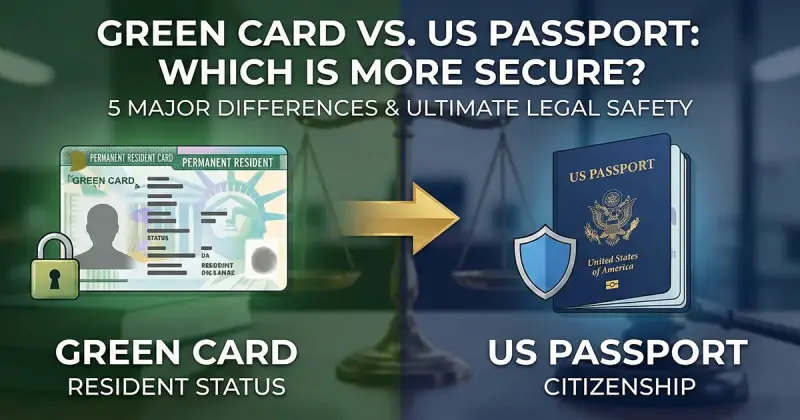
Is a Green Card enough? Discover the 5 major differences between a Green Card and US Citizenship, and why a passport offers the ultimate legal safety.
The Illusion of "Permanent" Residency
When you have a Green Card, you are a Lawful Permanent Resident (LPR). This means you have the right to live and work in the U.S. indefinitely. It feels great, right? You can buy a house, start a career, and build a life.
However, a Green Card is actually a conditional privilege, not a right. Think of it like a long-term lease on an apartment. As long as you follow the rules, you can stay. But if you break the lease—by staying away too long or getting into legal trouble—the landlord (the government) can evict you.
A U.S. Passport, on the other hand, represents Citizenship. This is like owning the building. You don't have a "lease" to follow. You belong there, and the government cannot kick you out except in the most extreme cases of fraud.
1. The Freedom to Travel (Without the Stress)
One of the biggest differences is how you travel.
The Green Card Trap
If you have a Green Card, the government expects the U.S. to be your "actual home". If you leave for more than six months, a border officer might start asking questions about whether you actually live here. If you stay away for more than a year without a special "Re-entry Permit," your Green Card can be considered abandoned and effectively cancelled.
The Passport Power
Once you have a U.S. Passport, you can travel wherever you want, for as long as you want. You could move to a tropical island for ten years, and your citizenship would still be waiting for you when you get back. You never have to worry about "abandoning" your status because you are part of the country.
2. Criminal Law: The Safety Net
This is a scary topic, but it is important. Even "good" people can make mistakes or find themselves in the wrong place at the wrong time.
-
For Green Card Holders: Certain crimes—even some that seem minor in state court—can lead to "Removal Proceedings" (deportation). Crimes like "Aggravated Felonies" or "Crimes Involving Moral Turpitude" can end your residency and get you sent back to a country you haven't lived in for decades.
-
For Citizens: A U.S. citizen cannot be deported. Even if a citizen commits a serious crime, they go through the U.S. justice system (like prison or fines), but they are not kicked out of the country.
3. The "AR-11" Headache vs. Total Freedom
Did you know that Green Card holders are legally required to tell the government every time they move?
Under the law, any non-citizen must file Form AR-11 within 10 days of moving . It sounds like a small chore, but forgetting it is technically a misdemeanor. More importantly, if the government sends you an important notice and it goes to your old house, you could miss a deadline and lose your status by accident .
U.S. citizens don't have to report their address to the immigration office. They just live their lives.
4. Voting and Government Jobs
A Green Card lets you work almost anywhere, but it doesn't let you vote in federal elections. Voting is the primary way people change the laws of the country. By becoming a citizen, you get a seat at the table. Additionally, many high-level government jobs and law enforcement positions require a U.S. Passport for security clearance.
Comparison Table: Green Card vs. U.S. Passport
Real-Life Scenarios: Lessons from the North
To understand how fragile permanent residency can be, let’s look at a few "human" stories involving Canadian Permanent Residency (PR), which works very similarly to the U.S. system.
The "Arjun" Scenario: The Residency Math
Arjun was a Canadian PR who moved to Toronto but kept traveling back to his home country to care for his aging parents. He thought that because he still had a bank account and paid taxes in Canada, he was safe. However, Canada has a "730-day rule"—you must be physically in the country for at least two years out of every five. When Arjun went to renew his PR card, the officer counted his days and found he only had 600 days. Because he didn't meet the math requirement, he faced a legal battle to keep his status.
The Lesson: Residency is about being physically present. If you aren't there, you risk losing it. A citizen would never have to count their days.
The "Poonam" Scenario: The Stranded Traveler
Poonam McMullin, a resident of Ottawa, lost her PR card while on vacation in Mexico . She thought her British passport would be enough to get her home. She was wrong. Airlines are not allowed to let "residents" board a plane without their specific residency card or a special travel document. She was stuck in Mexico for weeks, lost her wages, and racked up $\$40,000$ in debt just trying to get back to her own home .
The Lesson: As a resident, you are often treated like a "visitor" by other countries and airlines until you prove otherwise. A U.S. or Canadian Passport is a "golden ticket" that ensures you can always get home immediately.
When Should You Make the Switch?
Most Green Card holders can apply for citizenship (Naturalization) after five years of living in the U.S. (or three years if married to a U.S. citizen). This process uses Form N-400.
While it costs money and takes time to study for the civics test, the "peace of mind" is worth it. Once you take the Oath of Allegiance, you no longer have to worry about travel logs, address changes, or the risk of being separated from your family due to a legal mistake.
Frequently Asked Questions (FAQs)
1. Can I have a U.S. Passport and a passport from my home country?
Yes! The United States allows "dual citizenship". You don't have to give up your original identity to gain the protections of a U.S. citizen.
2. Does my Green Card expire if I don't renew the plastic card?
Your card expires every 10 years, but your status as a resident doesn't end just because the card is old. However, without a valid card, you cannot work or travel, so you should always renew it using Form I-90.
3. If I become a citizen, do I still have to pay U.S. taxes if I live abroad?
Yes. Both Green Card holders and U.S. citizens are required to report their global income to the IRS. This is one of the few things that stays the same regardless of which status you have.
4. Can the government take away my citizenship?
It is extremely rare. It only happens through "denaturalization" if the government proves you lied about something major (like a criminal past or a fake identity) during your original citizenship application.
5. Can I live in Canada and keep my U.S. Green Card?
It is very difficult. Because the U.S. requires you to make America your "actual home," living in Canada full-time usually counts as "abandoning" your U.S. residency. If you want to live in both, citizenship is the only way to do it safely.
Final Thoughts
The journey from a Green Card to a U.S. Passport is the final step in the immigration marathon. While a Green Card gives you a great life, it comes with a list of "dos and don'ts" that can be stressful. Citizenship is the ultimate goal because it changes your status from an "invited guest" to a "member of the family."
If you are a Green Card holder, keep your ties strong, file your AR-11 on time, and consider taking that final step toward naturalization. It’s the best way to ensure your future in the U.S. is truly permanent.
References for Further Reading: