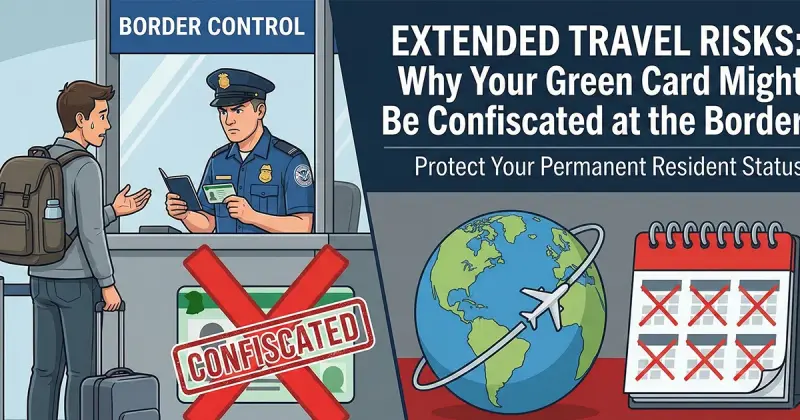
A comprehensive guide for US Permanent Residents traveling abroad for 6+ months. Learn about abandonment risks, CBP border procedures, Re-entry Permits (I-131), and how to protect your status. Includes a detailed comparison with Canadian residency laws.
1. Executive Summary
Holding a United States Permanent Resident Card, commonly known as a Green Card, is often viewed as the final step in a long immigration journey—a "golden ticket" that guarantees entry to the US forever. However, this assumption is legally dangerous. A Green Card does not grant the absolute right of entry that citizenship does; rather, it serves as proof of a status that is contingent upon actually residing in the United States. For Lawful Permanent Residents (LPRs) who engage in extended travel—specifically trips exceeding six months and, more critically, one year—the risk of losing this status is profound.
The United States immigration system operates on a subjective "intent-based" model. This means that maintaining status is not merely about counting days but about demonstrating a continuous, unbroken intention to make the US your permanent home. When an LPR is absent for extended periods, the burden of proof shifts. After six months, the government presumes residence may have been broken. After one year, the Green Card itself becomes legally invalid for re-entry without additional documentation, such as a Re-entry Permit or an SB-1 Returning Resident Visa.
This report provides an exhaustive analysis of the mechanisms of residency abandonment. It details the statutory triggers that alert Customs and Border Protection (CBP) officers, the aggressive tactics used at Ports of Entry (including the solicitation of "voluntary" abandonment via Form I-407), and the specific evidence required to defend one's status. Furthermore, to provide a practical "human touch" and context, this report contrasts the rigid US system with the objective "physical presence" model used by Canada, highlighting how differently these two neighbors handle the concept of permanent residence. By understanding the granular details of US immigration law, tax implications, and border protocols, LPRs can implement strategic compliance measures to protect their status during long-term international travel.
2. The Nature of Permanent Residence: Privilege vs. Right
To navigate the risks of extended travel, one must first dismantle the common misconception that a Green Card is a "super-visa." It is not a travel document in the traditional sense; it is an identity document that attests to a specific legal status: that of a resident.
2.1 The Concept of Animus Revertendi
At the heart of US residency law lies the Latin legal concept of animus revertendi, or the "intention to return." This is the foundational principle that immigration judges and CBP officers use to determine if a person is still a resident.
Unlike a mathematical test where you simply count days, animus revertendi is a subjective evaluation of your state of mind, evidenced by your actions. The law requires that any absence from the United States be "temporary." For a visit to be considered temporary, it must have a fixed end point. The traveler must have a specific purpose for the trip (e.g., a semester abroad, a temporary work assignment, caring for a sick relative) and a clear intention to return to their US residence once that specific purpose is accomplished.
If a trip is open-ended—for example, "I am going to live in France until I feel like coming back" or "I will stay abroad until I find a job in the US"—the absence is not considered temporary. In the eyes of the law, the traveler has abandoned their US residence and established a new residence abroad, regardless of whether they kept a house or bank account in the US. This nuance is where many LPRs fail; they believe that as long as they return once a year, they are safe. This is arguably the most dangerous myth in US immigration.
2.2 The Green Card is Not a Membership Card
Many LPRs treat their Green Card like a gym membership: as long as they pay their dues (taxes) and visit occasionally, they expect to be let in. However, the Immigration and Nationality Act (INA) treats LPRs returning from abroad differently depending on how long they have been away.
The Supreme Court and Board of Immigration Appeals (BIA) have ruled that an LPR returning from a brief, casual, and innocent trip is not "seeking admission" but is simply a resident returning home. In this scenario, the government bears a heavy burden to prove the LPR should be kept out. However, once a trip becomes "meaningfully interruptive" of residence, the LPR is treated as a new applicant for admission. This means the LPR effectively stands at the border with the same legal vulnerability as a tourist or a new immigrant, and the burden falls on them to prove they are entitled to enter.
2.3 The Three Critical Timelines
The risks of travel are stratified into three specific timeframes, each triggering a different set of legal presumptions and CBP protocols:
-
0 to 180 Days (0 to 6 Months): The Safety Zone.
-
181 to 364 Days (6 to 12 Months): The Danger Zone (Rebuttable Presumption).
-
365+ Days (1 Year and beyond): The Critical Failure Zone (Statutory Invalidation).
Understanding which zone your travel falls into is the first step in risk management. A trip of 179 days is legally distinct from a trip of 181 days, and the consequences of crossing that threshold can be life-altering.
3. The 6-Month Threshold: The Rebuttable Presumption
When an LPR stays outside the United States for more than 180 days but less than one year, they enter a legal gray area. The Green Card is technically still valid for entry, but the status of the holder is under scrutiny.
3.1 Statutory Basis: INA 101(a)(13)(C)
Under Section 101(a)(13)(C) of the Immigration and Nationality Act, an LPR is generally not considered to be seeking admission upon return. However, there are exceptions. One of the most important exceptions is if the LPR "has been absent from the United States for a continuous period in excess of 180 days."
Once the 180-day mark is passed, the legal shield that protects residents dissolves. The LPR is now considered an "applicant for admission." This shift is significant for several reasons:
-
Admissibility Checks: The LPR is subject to all grounds of inadmissibility again, including health-related grounds and certain criminal grounds that might not have triggered deportation if they had stayed in the US.
-
Burden of Proof: The presumption shifts. Instead of the government having to prove you abandoned your residence, you may have to prove you kept it.
3.2 The CBP "Soft" Inquiry
In practice, a return after 7 or 8 months usually triggers a "soft" inquiry at Primary Inspection. The officer scanning the passport will see the exit date and the current entry date.
-
The Warning: The officer may ask, "Why were you gone so long?" If the answer is reasonable (e.g., "I was finishing a study abroad program"), the officer may simply stamp the passport and say, "Don't stay away so long next time."
-
The Annotation: Even if admitted, the officer may type a note into the TECS (Treasury Enforcement Communications System) database. This note will be visible to the next officer. If the LPR repeats this behavior—staying away for 7 months, returning for 1 month, and leaving again—the next officer will see a pattern of "residency abuse".
3.3 Evidence of Retention
If the officer decides to push harder, the LPR may be sent to Secondary Inspection to prove they have not abandoned residence. The officer is looking for evidence that the US is the primary home. This evidence must go beyond mere statements.
Critical Evidence includes:
-
Employment: A letter from a US employer stating the LPR is currently employed and expected back at work.
-
Taxes: Copies of the most recent IRS Form 1040 (Resident Tax Return).
-
Family: Evidence that the spouse and children remained in the US (e.g., school report cards).
-
Assets: Current utility bills (water, electricity) showing usage at the US address, not just ownership of a vacant house.
LPRs traveling in this 6-12 month window do not need a Re-entry Permit to enter, but having one can be helpful as evidence of intent, though it is not strictly required for admissibility.
4. The 1-Year Cliff: Automatic Invalidation of the Green Card
Crossing the one-year mark of continuous absence is the single most critical error an LPR can make. It fundamentally alters the validity of the Green Card itself.
4.1 8 CFR § 211.1(a)(2): The Regulatory limit
Federal regulations state that a Permanent Resident Card (Form I-551) is valid for re-entry only if the holder is returning from a temporary absence of less than one year. Once the absence hits 365 days, the card effectively "expires" as a travel document for the purpose of entry, even if the expiration date printed on the front of the card is years away.
This is a hard rule. It is not about intent at this stage; it is a documentary requirement. Without a valid entry document, an airline is legally prohibited from boarding the passenger, and CBP is legally authorized to deny entry.
4.2 The Role of Airlines
Airlines are the first line of enforcement for US immigration. They face heavy fines if they board passengers who lack valid entry documents.
-
Boarding Denial: When an airline agent swipes a Green Card or checks the passport stamps, they can see the date of last departure. If it was more than a year ago, their system or training manual will instruct them to deny boarding.
-
The "I-551 is Invalid" Message: The passenger is often left stranded at a foreign airport, confused because their card says "Valid until 2030." The agent will explain that the card is valid, but not for this trip.
4.3 Exceptions for Military and Government Employees
There is a narrow exception to the one-year rule for the civilian spouse and children of a member of the US Armed Forces or US Government civilian employees stationed abroad pursuant to official orders. In these cases, the time spent abroad is not considered "absence" in the same way, and the Green Card remains valid for entry even after years abroad. However, the LPR must carry the official orders and proof of relationship to the service member.
4.4 Discretionary Waivers (Form I-193)
If an LPR manages to reach a US Port of Entry (for example, by driving across the Canadian or Mexican border where no airline checks occur), they face a CBP officer. The officer will immediately see the absence exceeds one year.
-
The Waiver: The officer has the discretion to waive the documentary requirement by filing Form I-193 (Application for Waiver of Passport and/or Visa).
-
The Cost: This is not a free pass. It involves a substantial fee (often over $500), a rigorous interrogation, and it is entirely discretionary. The officer can simply say "No" and move to confiscate the card. Relying on an I-193 waiver is a high-stakes gamble that should never be a primary strategy.
5. The Re-entry Permit (Form I-131): The Essential Shield
For any LPR who anticipates being out of the US for one year or more, or who worries about the cumulative effect of multiple long trips, the Re-entry Permit is the only reliable preventative measure.
5.1 What is a Re-entry Permit?
A Re-entry Permit is a passport-style booklet issued by USCIS. It serves two vital functions:
-
Travel Document: It functions as a valid entry document after absences of more than one year (up to two years). It replaces the Green Card for the specific purpose of boarding flights and entering the US.
-
Presumption of Intent: Legally, it establishes that the US government accepted your intention to remain a resident before you left. It prevents CBP from asserting that you abandoned your residence solely based on the duration of your absence.
5.2 The Application Process (Logistics are Key)
The logistics of applying for a Re-entry Permit are strict and often trip up travelers.
-
Physical Presence: You must be physically present in the United States when you file Form I-131. You cannot mail it from abroad.
-
Biometrics: After filing, USCIS will schedule a biometrics (fingerprinting) appointment, usually 3-6 weeks later. You must attend this appointment in the US.
-
Departure Risk: You can file the form and leave the US, but you must return for the biometrics appointment. If you leave and miss the appointment, the application is denied. Once biometrics are taken, you can leave again, and the permit can be mailed to a US Embassy or Consulate abroad for pickup.
5.3 Validity and Non-Renewability
-
Duration: The permit is valid for two years from the date of issuance.
-
No Extensions: It cannot be renewed or extended. If you stay abroad for 2 years and 1 day, the permit expires, and you are back to square one (invalid document). You must return to the US before it expires to apply for a new one.
-
Diminishing Returns: If an LPR stays abroad for many years and keeps applying for permits, USCIS may eventually restrict the validity to one year or deny it entirely, arguing that the LPR is effectively living abroad permanently.
6. The SB-1 Returning Resident Visa: The "Hail Mary"
If an LPR stays outside the US for more than a year without a Re-entry Permit (or beyond the validity of their permit), their only formal recourse to regain entry status is the SB-1 Returning Resident Visa. This is a special immigrant visa applied for at a US Consulate abroad.
6.1 The "Beyond Control" Standard
The SB-1 visa is notoriously difficult to obtain. It is not enough to prove you want to return; you must prove that your extended stay was caused by reasons beyond your control.
Examples of "Beyond Control" (Success cases):
-
Medical Incapacitation: The applicant fell into a coma or had a severe stroke preventing travel.
-
Political Unrest: War or civil strife closed the airports or made travel to the airport life-threatening.
-
Pandemic Restrictions: Strictly enforced border closures where no flights were leaving (common during early COVID-19, but less accepted now).
-
Kidnapping/Detention: The applicant was held against their will.
Examples of "Choice" (Denial cases):
-
Employment: "I had to stay because my job contract was extended." (This is a choice).
-
Family Care: "My mother was sick and I had to care for her." (Consulates often argue you could have hired help or returned briefly; unless you are the only possible caregiver and the situation was unexpected, this often fails).
-
Education: "I wanted to finish my degree." (Choice).
6.2 The Consequences of Denial
If the SB-1 visa is denied (which happens frequently), the applicant essentially loses their LPR status. The consulate will not return the Green Card; the status is considered abandoned. The individual must then start the entire immigration process from scratch (e.g., have a spouse file a new I-130 petition), which can take years. This high denial rate makes the Re-entry Permit absolutely critical for prevention.
7. The Border Encounter: CBP Protocols and Your Rights
When an LPR returns after a long absence, the interaction at the border is the deciding moment. Understanding what happens in the inspection booth can prevent panic and accidental waiver of rights.
7.1 Primary Inspection: The "Sniff Test"
At the first booth, the officer's job is to screen for obvious issues. They scan the passport and Green Card.
-
The Computer Alert: If the absence is >180 days or >1 year, the system flags it.
-
The Referral: The officer will likely not argue extensively. They will place the documents in a colored folder (often red or yellow) and direct the traveler to a separate area: Secondary Inspection.
7.2 Secondary Inspection: The Interrogation
Secondary Inspection is a waiting room where officers conduct in-depth interviews. Travelers may wait for hours. Officers here are trained to detect abandonment.
Common Questions & Traps:
7.3 The Search of Belongings
CBP has broad authority to search luggage and electronic devices at the border without a warrant. They look for evidence contradicting the claim of residence:
-
Foreign Leases/Deeds: Documents showing the purchase of a permanent home abroad.
-
Employment Contracts: Long-term foreign labor contracts.
-
Absence of Keys: If you claim to live in Chicago, do you have the keys to your house in your pocket?
-
Calendar Appointments: Alerts on a phone for "Start new job in Paris".
8. The Dreaded Form I-407: Voluntary Abandonment
The most controversial tool in the CBP arsenal is Form I-407, Record of Abandonment of Lawful Permanent Resident Status.
8.1 The Coercion Tactic
LPRs often report feeling pressured to sign this form. An officer might say:
This creates a high-pressure environment where exhausted travelers often sign just to get out of the airport.
8.2 The Legal Reality: Do Not Sign!
Crucial Advice: Form I-407 is voluntary. An LPR cannot be forced to sign it.
-
If you sign: You are formally stating that you voluntarily give up your status. The Green Card is taken, and you are admitted as a tourist (B-2). It is extremely difficult to undo this later, as you signed a legal document stating you didn't want the status anymore.
-
If you refuse to sign: CBP cannot deport you on the spot for abandonment. Only an Immigration Judge can strip an LPR of their status.
-
The NTA: If you refuse, the officer must issue a Notice to Appear (NTA). They may confiscate the plastic card as evidence, but they must admit you into the US (usually paroled in) to await a court hearing. You get to go home, hire a lawyer, and fight for your Green Card in court.
8.3 The Hearing Process
At the immigration court, the government has the burden of proving by "clear, unequivocal, and convincing evidence" that you abandoned your status. This is a high standard. If you have kept ties (taxes, house, family), you have a strong chance of winning in court, unlike the summary judgment of a border officer. Refusing to sign I-407 is often the only way to save the Green Card.
9. Taxation and Immigration: The "Smoking Gun"
One of the most common ways LPRs accidentally abandon their status is through tax filings. The intersection of US tax law and immigration law is a trap for the unwary.
9.1 The "Resident" Requirement
As a Green Card holder, you are a "US Tax Resident" for IRS purposes, regardless of where you physically live. You must report your worldwide income to the IRS every year.
-
The Trap: Many LPRs living abroad hire local accountants who tell them, "You don't live in the US, so we will file a Non-Resident return (1040NR) to save you money."
-
The Consequence: USCIS regulations explicitly state that filing a "Non-Resident" tax return is a rebuttable presumption of abandonment. It is essentially a sworn statement to the US government that you do not reside in the US. This is often the "smoking gun" evidence CBP uses to confiscate Green Cards.
9.2 The Exit Tax (Expatriation Tax)
If you lose your Green Card (either by signing I-407 or by a judge's order), you may be subject to the Exit Tax (IRC § 877A).
-
Who is at risk? "Long-Term Residents" (LTRs)—anyone who has held a Green Card in at least 8 of the last 15 tax years.
-
Covered Expatriate: You become a "Covered Expatriate" if:
-
Your net worth is over $2 million.
-
Your average annual net income tax liability for the 5 years prior is over a certain threshold (approx. $201,000, inflation-adjusted).
-
Crucially: You fail to certify that you have been tax compliant for the last 5 years (Form 8854).
-
The Cost: The IRS treats you as if you sold everything you own in the world on the day before you lost your status. You pay capital gains tax on the "deemed sale" of your assets.
-
Strategy: Many LPRs rush to file I-407 to "fix" their immigration problem, not realizing they just triggered a massive tax bill. Tax planning must precede immigration actions.
10. Comparative Analysis: United States vs. Canada
To truly understand the severity of US law, it is helpful to compare it with its neighbor, Canada. While both countries seek to ensure residents actually reside, their methods are philosophically opposite. This comparison offers a "human touch" by illustrating how different policies affect real lives.
10.1 Intent vs. Physical Presence
-
USA (Intent-Based): The US system is subjective. You can lose your Green Card after one day if you move to London with the intent to stay forever. Conversely, you can keep it for years if you prove the intent to return. This creates uncertainty and relies on the discretion of officers.
-
Canada (Presence-Based): Canada uses a strict mathematical test. To maintain Permanent Resident (PR) status, you must be physically present in Canada for 730 days (2 years) out of every 5-year rolling period.
-
Advantage: Certainty. You don't need to prove your "state of mind." You just need to show your calendar. If you have been in Canada for 730 days, you are safe, even if you work abroad the rest of the time.
10.2 The Spousal Exception: Canada's "Super-Rule"
Canada offers a massive exemption that the US does not, which saves many families.
10.3 The "Soft Landing"
-
Canada: New immigrants often do a "soft landing"—they fly to Toronto, activate their PR status, stay for a weekend, and return home to wrap up their affairs for a year or two. This is accepted practice because they have 5 years to accumulate their 730 days.
-
USA: Doing a "soft landing" in the US is risky. If a new immigrant activates their Green Card and immediately leaves for a year, CBP can argue they never effectively established residence in the first place. New immigrants needing to settle affairs abroad should apply for a Re-entry Permit immediately upon arrival.
10.4 Residency Appeals
Both countries offer appeals, but the data shows different outcomes.
-
US: Appeals go to Immigration Court. The focus is on ties and intent.
-
Canada: Appeals go to the Immigration Appeal Division (IAD). The IAD can consider "Humanitarian and Compassionate" (H&C) grounds even if the person legally failed the residency test. For example, if a PR missed the 730 days because they were caring for a sick parent, the IAD can say, "You broke the rule, but we will let you stay anyway because it's the right thing to do." The US system is generally less flexible regarding equitable relief for strict residency breaches.
10.5 Comparison Table: Residency Risks
| Feature |
United States (Green Card) |
Canada (Permanent Resident) |
| Residency Test |
Subjective: "Intent to return" (Animus Revertendi). |
Objective: Physical presence (730 days in 5 years). |
| Absence Limit |
>6 months triggers scrutiny; >1 year invalidates card. |
No specific trip limit, as long as 5-year total is met. |
| Spouse Exception |
Limited to US Gov/Military employees abroad. |
Broad: Any PR accompanying a Canadian Citizen spouse abroad counts as resident. |
| Re-entry Permit |
Required for trips >1 year. Valid for 2 years. |
Not required. PR Card is valid for 5 years. |
| Loss of Status |
Can happen at border via Form I-407 or Judge. |
Happens via removal order; appeal to IAD available. |
| Taxation |
Worldwide income taxed regardless of residence. |
Taxed on worldwide income only if resident. Non-residents taxed only on Canadian income. |
| Border Risk |
High interrogation risk for long absences. |
Low risk if 730-day threshold is met. |
11. Practical Strategies for Compliance
For LPRs who must travel for extended periods, hope is not a strategy. A proactive defense is required.
11.1 The "Ties to the US" Checklist
You must curate evidence of your life in the US. Before traveling, ensure you have:
-
Residence: A physical US address. Do not sell your house if possible. If you rent, consider subletting rather than canceling the lease.
-
Financials: Keep US bank accounts active. Use US credit cards occasionally while abroad (showing you are still part of the US financial system).
-
Driver’s License: Renew your US driver’s license before it expires.
-
Professional: Maintain memberships in US professional organizations.
-
Social: Keep memberships in US religious or community groups.
11.2 The "Paper Trail" Strategy
-
Return Ticket: Never travel on a one-way ticket. Always have a return flight booked, even if you might change it. It shows intent to return.
-
Tax Compliance: Always file Form 1040. Never file 1040NR. Keep copies of your tax returns in your carry-on luggage.
-
Correspondence: If you are abroad for a specific purpose (e.g., a work contract), keep emails or letters that define the end date of that purpose.
11.3 Border Protocol
-
Be Honest but Brief: Answer questions directly. "I have been away for 8 months to care for my sick father. I am now returning to my home in New York."
-
Don't Volunteer Negatives: Do not say, "I moved all my furniture to France."
-
Know the I-407 Script: "Officer, I understand your concerns, but I am a permanent resident and I intend to live in the US. I will not sign Form I-407. I request a hearing if you wish to challenge my status."
12. Frequently Asked Questions (FAQs)
Q1: Can I just return to the US every 5 months for a week to "reset the clock"? A: This is a dangerous myth known as "toe-dipping." CBP officers look at the pattern of travel. If you spend 5 months abroad, 1 week in the US, and 5 months abroad repeatedly, they will conclude that your actual residence is abroad and you are just visiting the US. You will likely be charged with abandonment.
Q2: Does my Green Card expire if I am away for more than a year?
A: The physical card might not expire, but it becomes invalid for entry. You cannot use it to board a plane or enter the US. You would need a Re-entry Permit or an SB-1 visa.
Q3: What if I have a Re-entry Permit but I decide to stay longer than 2 years?
A: You are in trouble. The permit cannot be extended. You must return to the US before it expires. If you don't, you fall back into the "1-year rule" territory and may need an SB-1 visa.
Q4: Can I mail my Re-entry Permit application from abroad?
A: No. You must be physically in the US when the application is received by USCIS. If the postmark or courier record shows it was sent from abroad, it will be denied. You also must be in the US for the biometrics appointment.
Q5: Will I lose my Green Card if I file US taxes as a non-resident?
A: Very likely. Filing Form 1040NR is considered a voluntary abandonment of residence for tax purposes, which USCIS accepts as evidence of abandonment of immigration status.
13. Conclusion
The path to maintaining a US Green Card during extended travel is paved with strict regulations and potential pitfalls. Unlike the clear-cut physical presence rules of Canada, the US system demands a constant, demonstrable intent to reside. The risks of the 1-year invalidation rule, the burden of proof after 6 months, and the severe tax implications of abandonment require LPRs to be vigilant.
The most effective strategy is avoidance: avoid absences of more than a year without a Re-entry Permit, avoid filing non-resident tax returns, and avoid giving CBP any reason to doubt your commitment to the US. If you find yourself in the crosshairs at the border, remember that the Green Card is yours until a judge says otherwise—never sign it away voluntarily on Form I-407. By understanding the rules of the game, you can ensure that your "Permanent" Residence truly lives up to its name.
(Disclaimer: This report is for informational purposes only and does not constitute legal advice. Immigration laws are complex and subject to change. For specific legal counsel, consult a qualified immigration attorney.)