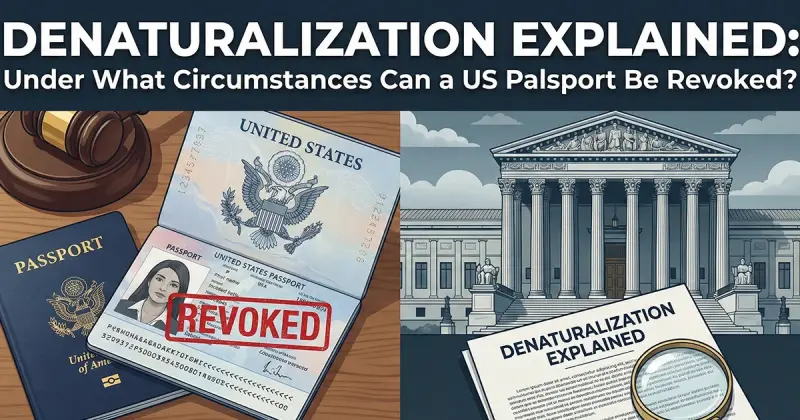
Can your US passport be revoked? Yes. Learn the specific grounds for denaturalization, including fraud and treason, and how to protect your citizenship status.
1. Introduction: Is Citizenship Really "Forever"?
We often think of citizenship as a permanent shield—a status that, once earned, cannot be taken away. We imagine that unlike a visa or a green card, which have expiration dates and conditions, citizenship is the finish line of the immigration marathon. It is the "right to have rights." But the reality is more complicated, and frankly, a bit more fragile.
For millions of naturalized citizens in the United States and Canada, citizenship is secure, but it is not absolute. If the government discovers that the foundation of your citizenship—the application, the interview, or the documents you submitted—was flawed, they have the power to tear the whole house down. This process is called denaturalization in the United States and citizenship revocation in Canada.
In recent years, this topic has moved from obscure legal textbooks to the front pages of newspapers. With initiatives like "Operation Janus" in the US using digital fingerprinting to find old deportation orders , and high-profile marriage fraud cases in Canada like Tan v. Canada , the government is watching more closely than ever.
This guide is written for you—whether you are a naturalized citizen, an immigration student, or just someone concerned about your rights. We will break down the complex legal jargon into plain English (targeting a 10th-grade reading level), explain the difference between losing your passport and losing your nationality, and tell the real human stories behind the court rulings.
1.1 The Big Confusion: Passport vs. Citizenship
Before we dive into the deep end, we need to clear up a common misunderstanding. Losing your passport is not the same as losing your citizenship.
-
Passport Revocation: This is like having your driver’s license suspended. You are still a citizen, but you cannot travel internationally. The government does this for things like owing a lot of taxes or child support.
-
Denaturalization: This is the "capital punishment" of immigration law. It means the government declares you are not, and effectively never were, a citizen. You lose your right to vote, your protection from deportation, and you usually go back to being a foreign national.
In this report, we will cover both. We will start with the heavy stuff—denaturalization—and then look at why the State Department might cancel your passport.
2. The United States: How the Government Can "Undo" Citizenship
In the United States, the power to strip someone of citizenship comes from the Immigration and Nationality Act (INA). Specifically, Section 340 of the INA gives the government the authority to file a lawsuit against a naturalized citizen to take their status away.
The U.S. government takes this very seriously. Because citizenship is such a precious right, the Supreme Court has said the government has a "heavy burden" of proof. They have to prove their case with "clear, unequivocal, and convincing evidence". This is a higher standard than a normal civil lawsuit (where you just need to be 51% sure), but slightly lower than a criminal murder trial (beyond a reasonable doubt).
2.1 The Two Main Paths to Denaturalization
There are two ways the U.S. government can come after your citizenship: Civil and Criminal.
2.1.1 Civil Denaturalization (The Lawsuit)
This is the most common method. The United States Attorney’s Office files a lawsuit in Federal District Court.
-
No Time Limit: There is no "statute of limitations" for civil denaturalization. This is scary but true. The government can sue you 10, 20, or even 40 years after you became a citizen if they find evidence of fraud. We have seen cases where people in their 80s were denaturalized for lies they told in their 20s.
-
The Goal: The goal isn't to put you in jail; it is to strip you of your status. If they win, your Certificate of Naturalization is cancelled, and you usually revert to being a Green Card holder (Lawful Permanent Resident). But, because you were found to have committed fraud, they will usually start deportation proceedings immediately after.
2.1.2 Criminal Denaturalization (The Conviction)
This happens when you are charged with a crime for "knowingly procuring naturalization in violation of law" under 18 U.S.C. § 1425.
-
Automatic Loss: If a jury finds you guilty of this crime, the judge must revoke your citizenship as part of the sentence. It happens automatically.
-
Time Limit: Unlike the civil route, criminal charges usually have a 10-year statute of limitations. This means they have to catch you and charge you within 10 years of the offense.
2.2 The Legal Grounds: Why Would They Do This?
The government can't just take your citizenship because they don't like you. They need a specific legal reason. These reasons generally fall into two buckets: Illegal Procurement and Concealment of a Material Fact.
2.2.1 Illegal Procurement (You Were Never Eligible)
This sounds technical, but it means "Strict Compliance." To become a citizen, you have to meet every single requirement strictly. If you failed to meet even one requirement—even if it was an innocent mistake—your citizenship was "illegally procured".
Imagine you need to be physically present in the U.S. for 30 months to qualify. If you were only here for 29 months and 29 days, but the officer made a mistake and approved you anyway, you were technically not eligible. Years later, if an audit finds this error, you could theoretically be denaturalized because you didn't strictly comply with the law.
The "Good Moral Character" Trap:
One of the requirements for citizenship is having "Good Moral Character" (GMC). Certain crimes bar you from having GMC.
-
Scenario: Let's say you committed a crime (like theft) before your interview, but you weren't caught or convicted until after you became a citizen.
-
The Trap: The government argues that because you committed the act during the statutory period (the 5 years before naturalization), you lacked Good Moral Character at the time you applied. Therefore, you were ineligible. Your citizenship was illegally procured.
2.2.2 Concealment of a Material Fact (The Lie)
This is the most common reason for denaturalization. It involves lying or hiding the truth to get your citizenship. To win this case, the government must prove four things :
-
You misrepresented or concealed a fact. (You lied or didn't speak up).
-
It was willful. (You did it on purpose, not by accident).
-
The fact was material. (The lie mattered. If you lied about your favorite color, it doesn't matter. If you lied about an arrest, it matters).
-
You got citizenship because of the lie. (The lie helped you get approved).
What is "Material"? This is a big legal debate. The Supreme Court (in a case called Maslenjak v. United States) ruled that the lie must have played a real role in your approval. For example, if you lied about being a member of a terrorist organization, that is definitely material because it would have stopped you from becoming a citizen.
2.3 Operation Janus: The Ghost of Fingerprints Past
You might be wondering, "How would they even know about a lie I told 20 years ago?" The answer lies in technology.
In the past, immigration records were on paper. If someone was ordered deported under the name "John Smith," but then applied for citizenship under the name "John Doe" in a different state, the systems often didn't talk to each other.
Enter Operation Janus. In 2010, the Department of Homeland Security (DHS) realized that about 315,000 fingerprint records from old deportation cases were missing from their digital databases. They started a massive project to digitize these old paper fingerprint cards.
-
The Result: When they uploaded the old prints, the computer system found matches. They discovered over 1,000 people who had been ordered deported under one identity but had later become naturalized citizens under a different identity.
-
The First Case: In January 2018, a man named Baljinder Singh became the first person denaturalized under this operation. He had arrived in the U.S. in 1991 without travel documents. He was ordered deported in 1992 under the name "Davinder Singh." He didn't leave. Instead, he married a U.S. citizen and naturalized in 2006 under the name "Baljinder Singh." Operation Janus connected the fingerprints of "Davinder" (the deportee) with "Baljinder" (the citizen). His citizenship was revoked because he concealed the prior deportation order and identity.
2.4 New Priorities: Who is Being Targeted Now?
Historically, denaturalization was rare—used mostly for Nazis or war criminals found hiding in the U.S. But recently, the scope has expanded. In 2024 and 2025, the Department of Justice (DOJ) released memos outlining new priorities. If you fall into these categories, you are at higher risk:
-
National Security: Terrorists, spies, or people involved with totalitarian parties within 5 years of naturalization.
-
Human Rights Violators: People who committed torture, genocide, or war crimes in other countries and hid it to get into the U.S.
-
Sexual Offenders: Especially those with crimes involving minors.
-
Gang Members: People who furthered the interests of criminal gangs or cartels.
-
Fraudsters: People who committed massive financial fraud against the government or private individuals.
-
"CIMT" Crimes: People who committed "Crimes Involving Moral Turpitude" (like fraud or theft) before naturalization but didn't disclose them.
Real Life Scenario: The Case of Sammy Chang In 2015, a naturalized citizen named Sammy Chang was denaturalized. He wasn't a terrorist or a Nazi. He ran a business. However, the government found evidence that he had been forcing women from South Korea to work for him in conditions that amounted to sex trafficking. Although he was naturalized, the court found that these acts occurred before he became a citizen. Because he was engaging in this criminal behavior during the time he was supposed to have "Good Moral Character," his citizenship was revoked for illegal procurement.
3. Passport Revocation: When You Can't Travel (But Are Still a Citizen)
Now, let's pivot to something that affects more people but is less "fatal" legally: Passport Revocation.
The U.S. Department of State has the power to cancel your passport or refuse to give you a new one. This doesn't mean you aren't an American. It just means you are stuck in America.
3.1 The "FAST Act" and Tax Debt
Do you owe money to the IRS? If the amount is large enough, the IRS can tell the State Department to revoke your passport. This was created by a law called the Fixing America’s Surface Transportation (FAST) Act.
-
The Threshold: You must have a "seriously delinquent tax debt." This number changes with inflation, but in 2025 terms, it is generally debt over $62,000 (including interest and penalties).
-
The Process: The IRS sends a certification to the State Department. The State Department then sends you a letter giving you 90 days to resolve it.
-
How to Fix It: You don't necessarily have to pay it all off at once. You can:
-
Pay it in full.
-
Set up an installment agreement (payment plan) with the IRS.
-
Get an "Offer in Compromise" accepted.
-
Prove "innocent spouse relief." Once you make a deal with the IRS, they notify the State Department, and your passport rights are restored.
Important SEO Note: If you are searching for "lose citizenship for taxes," the answer is generally NO. You lose your passport for taxes. You lose citizenship for fraud. However, if you committed tax fraud (lied on your returns) during the time you were applying for citizenship, that could theoretically be used as evidence that you lacked "Good Moral Character," leading to denaturalization. It's a subtle but dangerous difference.
3.2 Other Reasons for Passport Revocation
-
Child Support: If you owe more than $2,500 in child support, the Department of Health and Human Services (HHS) will certify you, and you cannot get a passport. This is a much lower threshold than the tax debt!
-
Criminal Court Orders: If you are out on bail, a judge might order you to surrender your passport so you don't flee the country.
-
Felonies: Using a passport to commit a crime (like drug smuggling) can get the passport revoked.
4. The Canadian Experience: A Humanized Look at Revocation
While the U.S. focuses on "Illegal Procurement," Canada's system is laser-focused on Fraud and Misrepresentation. Canada has also gone through a rollercoaster of changes in how it handles these cases, moving from administrative decisions to court hearings.
In Canada, the law governing this is the Citizenship Act. Specifically, Section 10 says the Minister can revoke citizenship if it was obtained by "false representation or fraud or by knowingly concealing material circumstances".
To understand how this feels for a real person, let's look at two major recent cases. These stories highlight the human cost and the "Sword of Damocles" that hangs over naturalized citizens.
4.1 Real-Life Story: The "Marriage of Convenience" (Tan v. Canada)
This case, decided in 2024, is a terrifying example of how a past relationship can destroy a current life.
The Story:
Ms. Tan came to Canada and married a Canadian man in 2004. Because of this marriage, she got permanent residence and later, in 2009, she became a Canadian citizen. She eventually divorced that man, remarried, had children, and built a whole life in Canada. She worked as a caregiver and was an established member of society.
The "Ghost" Returns:
Years later, the Canada Border Services Agency (CBSA) investigated her first husband. Under pressure, the ex-husband signed a "statutory declaration" (a sworn statement) admitting that the 2004 marriage was fake—he said Ms. Tan had paid him to marry her so she could get papers.
The Legal Battle:
Ms. Tan fought back. She denied the fraud. She argued that her ex-husband was lying. More importantly, she argued that she had lived in Canada for nearly 20 years, had a family, and was a good citizen. She asked for "Humanitarian and Compassionate" (H&C) relief.
The Outcome:
The Federal Court ruled against her. The judge said that "humanitarian relief is not lightly warranted" when the citizenship itself was based on fraud. Essentially, the fraud was a "poison pill." Because the initial entry (the marriage) was fraudulent, everything that came after it—the permanent residence, the citizenship, the years of hard work—was fruit of the poisonous tree. Her citizenship was revoked.
The Lesson:
In Canada, building a good life after the fraud does not fix the fraud. The government views citizenship obtained by fraud as something that never legally existed.
4.2 Real-Life Story: The "Delay" Defense (Nermine Magdi Ibrahim)
If Tan shows the government's power, Ibrahim shows the government's limits. This case gives hope to those facing revocation.
The Story:
Nermine Magdi Ibrahim, a pharmacist, became a Canadian citizen in 2007. The government suspected she had lied about her residency (how many days she actually lived in Canada).
The Delay:
The government had suspicions, but they sat on the case. They waited nearly nine years before notifying her and starting the revocation process.
The Defense:
When they finally came for her citizenship, Ibrahim argued that the delay was unfair. How could she defend herself about where she was 15 years ago? Old passports were lost, receipts were faded, and memories were gone. She argued the delay breached "procedural fairness."
The Outcome:
An Ontario judge (and the Federal Court) sided with her. They ruled that the nine-year delay was "unreasonable." It prejudiced her ability to mount a defense. The revocation was set aside.
The Lesson:
While there is no strict "statute of limitations" for fraud in Canada, the government cannot sit on its hands. If they know about the fraud, they must act reasonably quickly, or the courts may stop them to protect the individual's rights.
5. Comparative Analysis: US vs. Canada
How do these two neighbors compare? Both are cracking down, but the rules are different.
5.1 The Comparison Table
*Note: In Canada, recent changes (Bill C-6) made the Federal Court the decision-maker for fraud cases, replacing a system where a Minister's delegate could just decide on their own. This was a big win for due process.
5.2 Deep Dive: The Statelessness Trap
This is a critical human rights issue. "Statelessness" means you belong to no country. You have no passport, no protection, and often cannot work or travel.
-
The International Rule: The 1961 Convention on the Reduction of Statelessness generally forbids countries from stripping citizenship if it leaves a person stateless.
-
The Canadian Loophole: Canada signed this treaty, but included a nasty exception. If the citizenship was obtained by fraud, Canada reserves the right to revoke it, even if the person becomes stateless. The logic is: "You were never really a citizen, so we aren't making you stateless; you essentially did this to yourself".
-
The US Stance: The US never signed the 1961 Convention. Therefore, US law does not explicitly protect against statelessness in denaturalization cases.
6. Consequences and Ripple Effects
What actually happens when the gavel bangs and citizenship is revoked? It is not just a piece of paper. The consequences ripple out to destroy families and futures.
6.1 Deportation and Removal
In almost all cases (US and Canada), when you lose citizenship, you revert to the status you had before—usually a Permanent Resident (Green Card holder).
-
The Catch-22: The reason you lost citizenship (e.g., fraud, misrepresentation, a hidden crime) is almost always a valid reason to deport a Permanent Resident.
-
The Sequence: First, the government revokes citizenship. Second, they place you in removal proceedings. You are now fighting to stay in the country you might have called home for 30 years.
6.2 The "Derivative Citizenship" Nightmare (US Specific)
This is one of the cruelest aspects of US law. Under INA § 340(d), if a parent is denaturalized for "concealment of a material fact," any child who got citizenship through that parent (derivative citizenship) loses it too.
-
Scenario: A father lies on his application in 1995. He naturalizes. His 10-year-old daughter automatically becomes a citizen. In 2025, the father is denaturalized for the 1995 lie. The daughter, now 40 years old with her own kids, loses her citizenship too because it was dependent on his valid status. This creates a domino effect of tragedy.
6.3 The "Ghost Consultant" Scandal (Canada Specific)
In Canada, a major trend is the crackdown on "Ghost Consultants"—unlicensed immigration agents who fake residency documents for clients.
-
The Impact: When the CBSA raids a ghost consultant, they seize the hard drives. They then reopen the files of every single client that consultant ever helped. Innocent clients who may have just followed bad advice are caught in the net. They receive "Procedural Fairness Letters" accusing them of misrepresentation because their agent submitted fake proofs. This mass revocation strategy has affected hundreds of families.
7. Frequently Asked Questions (FAQ)
Q: If I made a mistake on my taxes, will I lose my citizenship? A: Generally, no. Simple tax debt or mistakes lead to passport revocation, not denaturalization. However, if you committed intentional tax fraud and lied about it during your naturalization interview (answering "Yes" to "Have you always paid your taxes?"), the government could argue you lacked "Good Moral Character," which is grounds for denaturalization. But this is rare compared to marriage or identity fraud.
Q: I became a citizen 25 years ago. Am I safe?
A: In the US, there is no statute of limitations for civil denaturalization. If fraud is discovered today (like via Operation Janus), you can still be denaturalized. In Canada, while there is no time limit, you might have a defense if the government unreasonably delays the case after finding the proof (like in the Ibrahim case).
Q: Can I just give up my citizenship (renounce) to stop the investigation? A: It's complicated. You can try to renounce, but the U.S. Attorney General can refuse to accept it if they believe you are doing it to avoid prosecution, taxes, or military service. Plus, renouncing doesn't stop them from deporting you afterward.
Q: What if my marriage failed? Is that marriage fraud? A: No. A failed marriage is not fraud. Fraud is when the marriage was entered into for the primary purpose of immigration, with no intention of a genuine life together. The government looks for evidence like money changing hands (as in Tan v. Canada) or lack of shared life (living in different houses).
Q: What is a "Material" lie?
A: A lie is material if telling the truth would have arguably disqualified you.
-
Not Material: Lying about your weight on a driver's license application.
-
Material: Lying about a previous arrest, a different name, or membership in the Communist party. If the truth would have made the officer deny you or investigate further, the lie is material.
8. Conclusion: The Value of Truth
The laws of denaturalization serve a clear purpose: they ensure that the privilege of citizenship is reserved for those who follow the rules. However, the expansion of these laws—through digitized dragnets like Operation Janus and broad interpretations of "fraud"—means that naturalized citizens must be vigilant.
For those applying today, the lesson is simple but critical: Full Disclosure. The consequences of a "little white lie" can resurface decades later to dismantle a life.
For those who are already citizens, understanding the difference between passport revocation (usually fixable with money) and denaturalization (an existential threat) is vital. While the stories of Ms. Tan and Mr. Singh are frightening, they also illustrate that the system is based on evidence.
Citizenship is a fortress, but like any fortress, it is only as strong as its foundation.