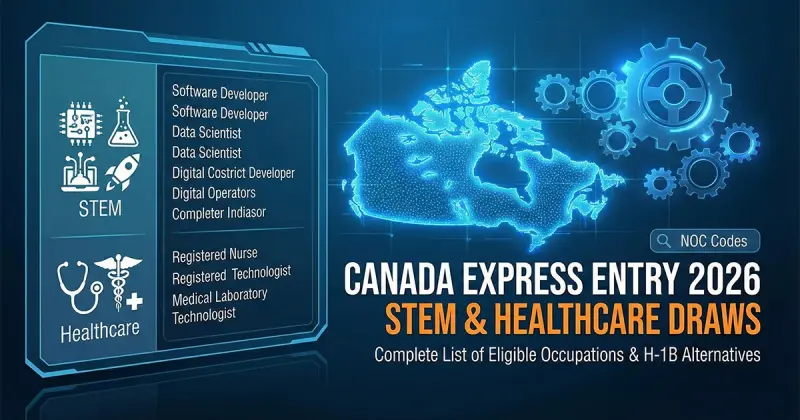
Missed the H-1B lottery? Discover the complete 2026 list of eligible occupations for Canada's Express Entry STEM and Healthcare category-based draws. Includes NOC codes, strategies, and exact requirements
Part 1: The Geopolitical Talent Shift
1.1 Introduction: The Closing Door and the Opening Window
The year 2026 marks a definitive inflection point in the history of North American labor migration. For decades, the narrative was singular: global talent moved to the United States to capture the economic upside of the American Dream. The H-1B visa was the primary vehicle for this journey, a coveted ticket that allowed tens of thousands of engineers, doctors, and scientists to contribute to the US economy. However, as we stand in the first quarter of 2026, the geopolitical and regulatory landscape has fundamentally fractured.
The implementation of restrictive measures in the United States, culminating in the Presidential Proclamation of late 2025 which introduced a staggering $100,000 supplementary fee for new H-1B petitions, has acted as a profound shock to the system. This policy, designed ostensibly to prioritize American workers, has created an insurmountable financial barrier for many employers and practically ended the viability of the H-1B route for entry-level and mid-level talent from abroad. When combined with a lottery selection rate that had already plummeted to between 25% and 30% in previous fiscal years , the message to global talent is clear: the door is closing.
Conversely, north of the 49th parallel, a different narrative is unfolding. Canada has not only kept its borders open but has engaged in a strategic, data-driven overhaul of its immigration system to capture exactly the talent that the United States is shedding. The Canadian government’s Immigration Levels Plan for 2026 targets the admission of 500,000 permanent residents, a stabilization figure intended to balance economic growth with housing capacity.
Central to this strategy is the Express Entry Category-Based Selection system. No longer a passive intake model based solely on generic points, the Canadian system now aggressively recruits specific professionals. If you are a software engineer, a data scientist, a registered nurse, or a physician, Canada has built a fast lane for you. This report provides an exhaustive analysis of these pathways, specifically detailing the Science, Technology, Engineering, and Mathematics (STEM) and Healthcare categories that are defining the 2026 immigration landscape.
1.2 The User Reality: "10th Class" Simplicity in a Complex World
While immigration law is dense with jargon—NOC codes, TEER categories, CRS scores, LMIA exemptions—the core reality is simple enough for a high school student to understand. It comes down to a tale of two neighbors:
-
Neighbor A (USA): Has made it extremely expensive and risky to enter. The "ticket" to the party costs $100,000 and you might not even get in because of a random lottery.
-
Neighbor B (Canada): Is actively handing out invitations to specific people (STEM and Healthcare workers) because they desperately need help building apps and curing patients. They have removed the randomness for these specific groups.
This report is written for the professional—the engineer in Seattle, the doctor in Delhi, the student in Boston—but it breaks down these complex mechanisms into actionable, plain-English insights. We will navigate the noise of legal statutes to provide a clear checklist of what you need to do to secure your future in 2026.
Part 2: The Trigger – The H-1B Crisis of 2026
2.1 The $100,000 "Proclamation Fee"
To understand the urgency of the Canadian option, one must fully grasp the deterioration of the US option. On September 19, 2025, a Presidential Proclamation was signed that fundamentally altered the economics of the H-1B program.
Effective September 21, 2025, a $100,000 fee must accompany new H-1B petitions. This is not a processing fee; it is a tariff.
-
Who pays? The petitioning employer.
-
Who is affected? Primarily beneficiaries outside the United States or those requiring consular processing to enter.
-
Who is exempt? Crucially, the guidance issued by USCIS in October 2025 clarified that current H-1B holders inside the US extending their status with the same employer are generally exempt.
However, the ripple effects are catastrophic for new entrants. Small to mid-sized tech companies, which historically utilized the H-1B program to access global talent, simply cannot absorb a $100,000 sunk cost on top of legal fees and the risk of lottery failure. This has led to a "freeze" in new H-1B filings for FY 2026, forcing international students on OPT (Optional Practical Training) and professionals abroad to look for immediate alternatives.
2.2 The Lottery Mathematics
Even without the fee, the math is punishing. In the FY 2025 lottery, USCIS received nearly 480,000 registrations for just 85,000 spots. The selection rate hovered near 25-30%.
-
The Psychological Toll: For an H-1B hopeful, life is lived in one-year increments. You cannot buy a house, your spouse often cannot work (unless they have an H-4 EAD, which takes years to get), and you cannot plan a future.
-
The Canadian Contrast: Express Entry is not a lottery. It is a meritocracy. If you meet the criteria and the score cutoff, you will be invited. There is no randomness involved in the selection of the highest-ranking candidates.
Part 3: The Solution – Canada’s Category-Based Selection
3.1 Evolution from CRS to Categories
Prior to mid-2023, Canada’s Express Entry system was purely points-based. Candidates were ranked by their Comprehensive Ranking System (CRS) score, derived from age, education, language fluency, and work experience. A high-scoring marketing manager would be invited over a lower-scoring nurse.
Recognizing that this did not address critical labor shortages, the government amended the Immigration and Refugee Protection Act to allow the Minister to invite candidates based on specific attributes. This birthed Category-Based Selection.
In 2026, the categories are confirmed as:
-
STEM Occupations
-
Healthcare Occupations
-
French-Language Proficiency
-
Trades Occupations
-
Transport Occupations
-
Agriculture and Agri-Food Occupations
-
NEW: Physicians with Canadian Work Experience.
3.2 How It Works in Practice
When IRCC holds a draw, they can now say: "We are only inviting candidates with 6 months of experience in the last 3 years in a STEM profession."
-
General Draw Cutoff: Might be 530 CRS (Very hard to achieve without Canadian experience).
-
STEM Draw Cutoff: Might be 485 CRS (Achievable for a skilled professional with a Master's degree).
-
Healthcare Draw Cutoff: Might be 440 CRS (Achievable for most qualified medical professionals).
This price differentiation—offering a "discount" on the required points for specific jobs—is the core mechanic that makes 2026 the year of the specialist.
Part 4: Complete List of Eligible STEM Occupations (2026)
4.1 The "Digital Lifeboat" for Tech Workers
The STEM category is Canada's direct answer to the US H-1B restrictions. By prioritizing these codes, Canada is attempting to build a "North American Tech Hub" that spans Toronto, Vancouver, and Montreal.
Below is the definitive, searchable table of NOC 2021 Codes eligible for STEM draws in 2026. If your job title matches or closely aligns with the duties of these codes, you are eligible for the priority draws.
Table 1: 2026 STEM Category Eligibility Checklist
| NOC Code |
Occupation Title |
Role Description & 2026 Demand Context |
| 20012 |
Computer and information systems managers |
IT Managers, CTOs, VP Engineering. High demand in Toronto banking sector. |
| 21210 |
Mathematicians, statisticians and actuaries |
Critical for the insurance industry in Waterloo and Toronto. |
| 21211 |
Data scientists |
Top Priority. AI/ML specialists needed for Canada's AI strategy (Montreal hub). |
| 21220 |
Cybersecurity specialists |
High demand due to banking regulations and privacy laws. |
| 21221 |
Business systems specialists |
SAP consultants, technical BAs bridging business and IT. |
| 21222 |
Information systems specialists |
IT Auditors, QA analysts. |
| 21223 |
Database analysts and data administrators |
Data warehousing, SQL experts, cloud data architects. |
| 21230 |
Computer systems developers and programmers |
Back-end developers, C++/Java systems programmers. |
| 21231 |
Software engineers and designers |
#1 Volume Code. Full Stack, DevOps, Cloud Engineers. (Standard H-1B role). |
| 21232 |
Software developers and programmers |
App developers, frontend (React/Angular), game devs (huge in Vancouver). |
| 21233 |
Web designers |
UX/UI specialists with technical implementation skills. |
| 21234 |
Web developers and programmers |
Web stack specialists. |
| 21300 |
Civil engineers |
Critical for housing infrastructure projects across Canada. |
| 21301 |
Mechanical engineers |
HVAC, automotive manufacturing (Ontario). |
| 21310 |
Electrical and electronics engineers |
Power systems, hardware design. |
| 21311 |
Computer engineers (except software) |
Hardware architecture, embedded systems, firmware. |
| 21320 |
Chemical engineers |
Oil & Gas sector (Alberta), process engineering. |
| 21321 |
Industrial and manufacturing engineers |
Supply chain optimization, factory automation. |
| 21322 |
Metallurgical and materials engineers |
Mining sector (Northern Ontario/BC). |
| 21330 |
Mining engineers |
Resource extraction planning. |
| 21331 |
Geological engineers |
Geotechnical analysis for construction and mining. |
| 22300 |
Civil engineering technologists |
Support roles in construction management and drafting. |
| 22301 |
Mechanical engineering technologists |
CAD drafting, manufacturing support. |
| 22302 |
Industrial engineering technologists |
Process technicians. |
| 22310 |
Electrical and electronics engineering technologists |
Circuit testing, power grid maintenance. |
4.2 Insight: The "Software Engineer" vs. "Developer" Nuance
In the United States, job titles like "Software Engineer" and "Software Developer" are often used interchangeably. In Canada, the term "Engineer" is legally regulated. To call yourself a "Professional Engineer" (P.Eng), you must be licensed by a provincial body.
-
Implication for Immigration: For Express Entry, it does not matter if you are licensed. You can apply under NOC 21231 (Software Engineer) if you perform the duties of the role, even if you don't hold the Canadian license yet. However, once you arrive in Canada, you may need to use the title "Software Designer" or "Developer" until you get your P.Eng license, though this is rarely enforced strictly in the private tech sector.
4.3 Second-Order Insight: The "Remote Work" Loophole
Many H-1B holders fear losing their US salary. However, a growing trend in 2026 is the "Near-shore" model. US companies are retaining their talent by moving them to Canada (as Permanent Residents) and employing them through a Canadian subsidiary or a PEO (Professional Employer Organization).
-
Why this matters: If you secure PR through a STEM draw, you can theoretically live in Vancouver, work remotely for your US company (if they set up the payroll correctly), and keep a salary that is closer to US standards than typical Canadian local rates.
Part 5: Complete List of Eligible Healthcare Occupations (2026)
5.1 Addressing the Demographic Crisis
While STEM attracts capital, Healthcare prevents collapse. Canada’s population is aging rapidly, and the healthcare system is under immense strain. The federal government has prioritized these NOC codes above almost all others, evidenced by the lower CRS cut-offs observed in 2025.
Table 2: 2026 Healthcare Category Eligibility Checklist
| NOC Code |
Occupation Title |
2026 Demand & Context |
| 31100 |
Specialists in clinical and laboratory medicine |
Pathologists, Radiologists. |
| 31101 |
Specialists in surgery |
General, Cardiac, Orthopedic surgeons. |
| 31102 |
General practitioners and family physicians |
New Priority. High demand in rural areas and all provinces. |
| 31110 |
Dentists |
Private practice and public health. |
| 31112 |
Audiologists and speech-language pathologists |
Rehab services, school systems. |
| 31200 |
Psychologists |
Mental health crisis support. |
| 31201 |
Chiropractors |
Private practice wellness. |
| 31202 |
Physiotherapists |
Rehab, sports medicine, geriatric care. |
| 31203 |
Occupational therapists |
Helping patients regain daily living skills. |
| 31204 |
Kinesiologists |
Human movement specialists. |
| 31300 |
Nursing coordinators and supervisors |
Healthcare management roles. |
| 31301 |
Registered nurses (RNs) and RPNs |
Highest Volume. The backbone of the category. Huge shortage. |
| 31302 |
Nurse practitioners |
Advanced practice, prescribing capability. |
| 31303 |
Physician assistants, midwives |
Growing role in Canadian ERs and maternity care. |
| 32101 |
Licensed practical nurses (LPNs) |
Long-term care facilities, hospitals. |
| 32102 |
Paramedical occupations |
EMTs, Paramedics. |
| 32120 |
Medical laboratory technologists |
Diagnostic testing. |
| 32121 |
Medical radiation technologists |
X-Ray, MRI, CT Scan techs. |
| 32122 |
Medical sonographers |
Ultrasound technicians. |
| 33102 |
Nurse aides, orderlies |
Patient support services. Critical for senior care. |
| 33103 |
Pharmacy technical assistants |
Support roles in retail and hospital pharmacies. |
5.2 The New "Physicians" Category
In 2026, IRCC introduced a separate focus for "Physicians with Canadian Work Experience". This addresses a longstanding flaw where doctors on temporary visas struggled to transition to PR due to the specific structure of their employment (often "fee-for-service" which counted as self-employment, traditionally ineligible for certain points).
5.3 The Licensing Barrier (Crucial Warning)
Unlike tech, healthcare is regulated. Getting the visa (PR) is only step one. Getting the license to practice is step two, and it is often harder.
-
Recommendation: If you are an international nurse (IEN), look at provinces like Nova Scotia or British Columbia which have streamlined their licensing for international applicants. Do not wait until you arrive to start the NNAS (National Nursing Assessment Service) process. Start it while your visa is processing.
Part 6: Provincial Nominee Programs (PNP) – The "Backdoor"
If your CRS score is too low even for category draws (e.g., below 450), the Provincial Nominee Program (PNP) is your safety net. A nomination gives you +600 points, effectively guaranteeing PR.
6.1 Ontario Immigrant Nominee Program (OINP)
Ontario is the economic engine of Canada.
-
Tech Draws: These occur under the Human Capital Priorities stream. Ontario scans the federal pool for candidates with specific tech NOCs (like 21231, 21211) and sends them a Notification of Interest (NOI).
-
Strategy: You must select "Ontario" as a destination in your Express Entry profile to be visible to them.
6.2 British Columbia PNP (BC PNP Tech)
BC operates a "Tech" stream that is distinct because it is faster and predictable.
-
The Mechanism: BC holds Tech draws almost every week (usually Tuesdays).
-
The Catch: You generally need a valid job offer from a BC employer for at least one year.
-
Who is this for? This is perfect for H-1B holders who can convince their company to transfer them to a BC satellite office, or who can interview remotely and land a job before moving.
6.3 Alberta Advantage Immigration Program (AAIP)
Alberta (Calgary/Edmonton) offers the "Accelerated Tech Pathway".
-
The Pitch: Low cost of living, high salaries (oil & gas money flowing into tech), and a government desperate to diversify away from energy.
-
Eligibility: You need a job offer or to be working for an Alberta employer in a tech industry. The CRS requirements here have historically been extremely low (sometimes as low as 300-350 for candidates with job offers).
Part 7: Step-by-Step Technical Guide for 2026
This section is the "how-to" manual for the 10th-grade understanding but with professional detail.
Step 1: Education Credential Assessment (ECA)
You cannot just upload your US or Indian degree. You need it evaluated.
-
Authority: World Education Services (WES) is the most common.
-
Time: 4-6 weeks.
-
Cost: ~$240 CAD.
-
Tip: If you have a US Master's degree, this is gold. It equates to a Canadian Master's, giving you significantly more points than a Bachelor's.
Step 2: Language Testing (IELTS/CELPIP)
Even if you are a native English speaker or have lived in the US for 10 years, you must take a test.
Step 3: Profile Creation
Go to the IRCC website and create a profile. It is free.
-
NOC Code Selection: Be very careful here. Read the "Lead Statement" and "Main Duties" of the NOC 2021 codes. Your reference letter from your employer must match these duties, not just the job title.
-
Provinces of Interest: Check "All Provinces and Territories" (or at least ON, BC, AB) to maximize PNP chances.
Step 4: The Wait & The Invitation
Once submitted, you are in the "Pool".
-
Check Draws: Watch for "Category-Based" rounds.
-
Receive ITA: If you meet the cutoff, you get an Invitation to Apply (ITA). You have 60 days to submit all documents (Medicals, Police Certificates, Proof of Funds).
Part 8: Comparative Analysis – US vs. Canada (2026)
To make an informed decision, one must look at the hard data comparing the two jurisdictions in the current 2026 context.
Table 3: The Immigrant Experience Comparison
| Feature |
United States (H-1B System) |
Canada (Express Entry System) |
| Selection Method |
Lottery. Random chance (approx. 25% odds). |
Meritocracy. Points-based. Highest scores/Targeted jobs get invited. |
| Cost to Employer |
High. $4,000 + $100,000 (New 2025 Fee for new petitions). |
Low. ~$230 Compliance Fee + ~$1,000 LMIA (if needed). |
| Spouse's Right to Work |
Restricted. H-4 EAD takes years and can be revoked. |
Automatic. Spouses get Open Work Permits immediately. |
| Path to Permanency |
Decades. For Indian/Chinese nationals, the Green Card backlog is 50+ years. |
Months. PR is usually granted within 6 months of application. |
| Job Mobility |
Low. Tied to specific employer. Transferring is risky/complex. |
High. Once PR, you can work for anyone, anywhere (or start a business). |
| Healthcare |
Private. Tied to employment. High deductibles/premiums. |
Public. Provincial coverage (OHIP, MSP) funded by taxes. |
| Citizenship |
Hard. Requires Green Card first (see backlog). |
Fast. Eligible after physically residing for 3 out of 5 years. |
Part 9: Real-Life Scenarios (Humanized Examples)
These narratives illustrate how the 2026 laws apply to real people.
Scenario A: The "Tech Lead" in Limbo
The Person: Ravi, 29, Senior Software Engineer (NOC 21231) in Seattle. The Situation: His H-1B is maxing out. His employer loves him but refuses to pay the new $100,000 renewal/extension fee because he needs to travel internationally for client work (triggering the fee upon re-entry). The Move: Ravi calculates his CRS. He has a Master's, 3 years of US experience, and max English scores. His CRS is 495. The Outcome: He enters the Express Entry pool. A STEM Category draw occurs in March 2026 with a cutoff of 488. He receives an ITA. He moves to Vancouver, keeps his US job remotely (using a PEO), and gets PR in 5 months.
Scenario B: The "Waiting" Nurse
The Person: Elena, 32, Registered Nurse (NOC 31301) in Dubai.
The Situation: She wants to move to the US, but the EB-3 visa retrogression means a 3-year wait.
The Move: Elena applies to the College of Nurses of Nova Scotia for a credential check. She takes the IELTS. Her CRS is 445.
The Outcome: A Healthcare Category draw happens in April 2026 with a cutoff of 435. She is invited. Because Nova Scotia needs nurses, her licensing is expedited upon arrival. She is working in a Halifax hospital by December.
Scenario C: The "Unlucky" Student
The Person: Liam, 24, recent Computer Science grad in Texas.
The Situation: He missed the H-1B lottery twice. His OPT is expiring. He has no "foreign" work experience (only US student work), so his CRS score is low (420).
The Move: Liam realizes he cannot compete in the STEM draw (cutoff 480+). He spends 6 months intensively learning French. He achieves a CLB 7 in French.
The Outcome: This boosts his score slightly, but more importantly, makes him eligible for the French-Language Proficiency category. The cutoff there is only 405. He gets invited, moves to Montreal (a tech hub), and leverages his bilingualism for a higher salary.
Part 10: Strategic Roadmap for H-1B Holders
If you are reading this from a desk in the US, worried about your status, here is your checklist:
-
Immediate Action: Calculate your CRS score today. Use the official IRCC tool.
-
The "Gap" Analysis: If you are below 480, you need to either learn French or get a Provincial Nomination (PNP).
-
The Document Hunt: Request your FBI Police Clearance now. It takes time.
-
Talk to Your Boss: Can they transfer you? An Intra-Company Transfer (ICT) to Canada is exempt from the "Labour Market Impact Assessment" (LMIA) and exempt from the US $100k fee. It is the smoothest corporate move.
-
Look for the "Open Work Permit": In 2023, Canada launched a pilot giving 10,000 open work permits to H-1B holders. Rumors suggest a 2026 version may launch. Keep your documents ready to apply the second it opens.
Part 11: Frequently Asked Questions (FAQs)
Q1: Can I apply for Express Entry if I am currently unemployed in the US? A: Yes. Express Entry looks at your past work experience. As long as you have 1 year of continuous skilled work experience in the last 10 years (for FSW) or 1 year in Canada in the last 3 years (for CEC), you are eligible. The category-based selection requires 6 months of specific experience in the last 3 years.
Q2: Will the STEM draws continue throughout 2026? A: Yes. The Ministerial Instructions for 2026 confirm that STEM remains a priority category. However, the frequency may vary. In 2025, there was a lull in STEM draws mid-year, followed by a surge. Consistency is not guaranteed, but the category is permanent for the year.
Q3: Does the US $100,000 fee apply to me if I just want to renew my H-1B? A: If you are staying with the same employer and strictly extending your status without leaving the US, you are generally exempt. The fee triggers primarily on new petitions or when re-entering via consular processing if the petition is deemed "new" under the proclamation's strict definitions. Always consult a US immigration attorney.
Q4: I am a doctor. Can I start working immediately after getting PR?
A: No. Immigration and Licensing are separate. You will likely need to pass the MCCQE (Medical Council of Canada Qualifying Examination) and complete a residency or practice-ready assessment. PR gives you the right to live here; the College of Physicians gives you the right to work as a doctor.
Q5: What is the "French Cheat Code"? A: If you can score a CLB 7 (Intermediate) in French, you qualify for the French-Language Proficiency category. The CRS cut-offs for this category are historically much lower (around 399-410) than STEM or Healthcare. It is the single most effective way to bypass a low CRS score.