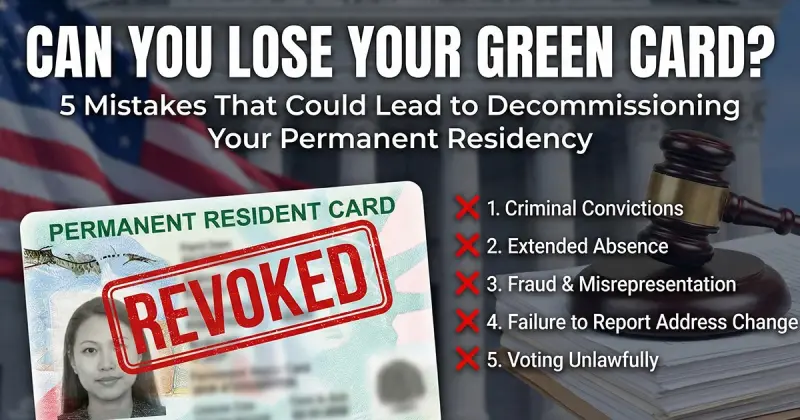
Can you lose your Green Card? Yes. Avoid these 5 critical mistakes that could jeopardize your permanent residency and lead to deportation. Protect your status.
The acquisition of Lawful Permanent Resident (LPR) status, colloquially known as holding a Green Card, represents one of the most significant milestones in the trajectory of a foreign national within the United States. It provides the legal right to reside and work indefinitely, serves as a bridge to potential citizenship, and offers a level of security that temporary visas cannot match. However, a pervasive misconception exists that once a Green Card is granted, it is an irrevocable right. Legal reality dictates otherwise; permanent residency is a conditional privilege that requires ongoing compliance with a complex web of federal statutes and administrative regulations. The decommissioning of this status—whether through abandonment, rescission, or removal—is a process often triggered by avoidable administrative lapses or a fundamental misunderstanding of the obligations inherent in the status. This analysis examines the five primary errors that jeopardize U.S. permanent residency, provides a comparative framework with Canadian residency obligations, and details the evidentiary standards required to safeguard one's legal standing.
The Legal Framework of Permanent Resident Status
Lawful Permanent Resident status is anchored in the Immigration and Nationality Act (INA), which defines an LPR as an individual who has been "lawfully accorded the privilege of residing permanently in the United States as an immigrant in accordance with the immigration laws, such status not having changed". The phrase "not having changed" is the pivot upon which the entire legal standing of a resident turns. The status is maintained until the individual naturalizes, voluntarily surrenders the card, or is subject to a final administrative or judicial order of removal.
The oversight of this status falls under the Department of Homeland Security (DHS), primarily through U.S. Citizenship and Immigration Services (USCIS), which handles benefits and adjudications, and Customs and Border Protection (CBP), which manages the entry of residents at ports of entry. When a resident returns from abroad, they are subject to inspection. If an officer determines that the individual has not complied with the requirements of their status, the process of decommissioning that status may begin.
Rescission and Removal Proceedings
The government utilizes two distinct pathways to terminate residency. Rescission is a specialized proceeding that occurs if USCIS determines, within the first five years of granting a Green Card, that the individual was not actually eligible for the status at the time of adjustment. This can happen due to a discovery of prior fraud or a simple bureaucratic error where the law was misapplied. Removal proceedings, on the other hand, are broader and apply when a resident commits an act that makes them deportable or inadmissible, such as a criminal conviction or abandonment of residence.
Mistake 1: The Abandonment of Residence Through Extended Travel
The most common pitfall leading to the loss of a Green Card is the failure to maintain the United States as a primary, permanent home. Many residents mistakenly believe that as long as they return to the U.S. once every six months or once a year, their status is secure. In legal practice, the duration of absence is merely a metric used to gauge a much more important factor: the resident’s intent.
The Thresholds of Absence
The U.S. government uses specific timeframes to determine how a returning resident is treated at the border. Absences of less than six months (180 days) rarely trigger intense scrutiny regarding abandonment, provided there is no evidence the resident is living abroad. However, once an absence exceeds 180 days but remains under one year, a "rebuttable presumption" is created that the individual has disrupted the continuity of their residence. This means the burden shifts to the resident to prove they did not intend to abandon their home.
An absence of one year or more is even more critical. Under 8 C.F.R. 211.1(a)(2), a Green Card generally becomes invalid for re-entry after 365 days abroad. In such cases, the individual must apply for a Returning Resident Visa (SB-1) at a U.S. consulate, a process that requires demonstrating that the stay abroad was due to reasons beyond their control.
The Judicial Definition of "Temporary"
Courts have struggled to define what constitutes a "temporary" visit abroad. The Ninth Circuit and the Board of Immigration Appeals (BIA) have established that a visit is temporary only if there is a reasonable possibility at the outset that it will end within a short period, or if the visit is tied to a specific event that has a clear end date. A "touchdown" strategy—where a resident lives and works abroad but flies to the U.S. for a few days twice a year—is often viewed as a sham. CBP officers have access to detailed travel history and can conclude that the resident's "actual home" is in another country, leading to a referral to immigration court.
The Role of Intent and Ties
When assessing whether a resident has abandoned their status, officers look at "objective intent." This is inferred from the strength of ties the person maintains in the U.S. versus those they have abroad. If a person sells their U.S. home, terminates their employment, and moves their family overseas, their objective intent suggests abandonment, regardless of what they claim to feel.
Mistake 2: Failing to Update Residential Address (Form AR-11)
A seemingly minor administrative requirement that frequently leads to severe consequences is the obligation to report a change of address. Under section 265 of the INA, every non-citizen in the U.S. (with very few exceptions) must notify USCIS of a move within 10 days. This is done via Form AR-11, Alien's Change of Address Card.
The Legal and Practical Penalties
Failing to report an address change is a misdemeanor under federal law. It can result in a fine of up to $\$200$, up to 30 days in jail, and potentially, removal from the United States. While the government has historically been lenient with first-time offenders, there has been a significant shift toward stricter enforcement of existing laws.
The practical risks are often more immediate than the legal ones. If a resident has a pending application—such as a Green Card renewal (Form I-90) or a naturalization petition (Form N-400)—and moves without updating USCIS, they will likely miss critical notices. If USCIS sends a Request for Evidence (RFE) or an interview notice and the resident does not respond because the mail went to an old address, the application can be denied due to "abandonment". Furthermore, USCIS mail is often not forwarded by the U.S. Postal Service (USPS), making the AR-11 the only way to ensure correspondence is received.
Digital vs. Paper Filing
Modernization has streamlined this process. Filing the AR-11 online through a USCIS account allows for an immediate update to the agency’s systems. In contrast, paper forms mailed to the agency can take weeks to process, during which time important mail may still be sent to the previous residence. For residents with active cases, the online tool is the only reliable way to ensure all pending petitions are updated simultaneously.
Mistake 3: Criminal Convictions and Crimes Involving Moral Turpitude
A Green Card is not a "get out of jail free" card; in fact, it carries significant legal vulnerabilities regarding criminal behavior. Certain types of crimes can lead to the revocation of permanent residency and the initiation of removal proceedings.
Deportable Offenses and Aggravated Felonies
Immigration law classifies crimes differently than state criminal courts. An offense that might be considered a minor misdemeanor in a local court can be classified as an "aggravated felony" under federal immigration statutes. These often include crimes involving violence, theft, fraud, or drug trafficking. Once a resident is convicted of an aggravated felony, they are almost certainly subject to mandatory deportation with very few avenues for legal relief.
Crimes Involving Moral Turpitude (CIMTs)
A "Crime Involving Moral Turpitude" (CIMT) is a broad and somewhat vague category that includes offenses involving dishonesty, baseness, or depravity. Common examples include theft, forgery, and certain types of assault. Generally, a resident can be placed in removal proceedings if they are convicted of one CIMT within five years of admission (if the crime carries a potential sentence of one year or more) or two or more CIMTs at any time.
Drug Offenses and Domestic Violence
The U.S. government takes an extremely strict stance on drug-related crimes. Any conviction related to a controlled substance (other than simple possession of a small amount of marijuana for personal use) can result in the loss of a Green Card. Similarly, convictions for domestic violence, stalking, or child abuse are grounds for removal, reflecting a policy focus on protecting public safety and community standards.
Mistake 4: Fraud and Material Misrepresentation
The integrity of the U.S. immigration system is protected by strict rules against dishonesty. If USCIS determines that an individual obtained their Green Card through fraud or by concealing important facts, the status can be revoked at any time—even decades later.
Marriage Fraud and "Sham" Relationships
One of the most common targets for fraud investigation is marriage-based residency. If the government discovers that a marriage was entered into solely for the purpose of obtaining immigration benefits, the Green Card will be revoked. USCIS officers are trained to look for "red flags," such as a lack of joint financial assets, inconsistent stories during interviews, or couples who do not live together.
Misrepresentation on Applications
Fraud is not limited to marriage. It includes any "material misrepresentation"—lying about one’s criminal history, prior immigration violations, or even educational background to qualify for a specific visa category. If it is found that the resident provided false information that "materially" affected the decision to grant the Green Card, the status is voidable. This includes "willful misrepresentation," where the individual intentionally withheld information they knew would lead to a denial.
Mistake 5: Missing Deadlines for Conditional Green Cards
Some permanent residents are granted a "conditional" status that is only valid for two years. This typically applies to individuals who obtained residency through a marriage that was less than two years old at the time of approval, or through the EB-5 investment program.
The Two-Year Trap
To keep their status, conditional residents must file a petition to "remove conditions" during the 90-day window before their card expires. For marriage-based residents, this is Form I-751; for investors, it is Form I-829. Failing to file these forms on time results in the automatic termination of residency. The individual is then considered out of status and is subject to removal proceedings.
The Burden of Proof for Removal of Conditions
When filing to remove conditions, the resident must provide extensive evidence that the reason they received the card is still valid. In marriage cases, this means proving the marriage is "bona fide" (genuine) by submitting joint tax returns, bank statements, and leases. If the couple has divorced, the resident may still be able to remove conditions, but the process becomes significantly more complex and usually requires a waiver of the joint filing requirement.
Comparative Analysis: Residency Obligations in the United States and Canada
For many immigrants, the choice between settling in the United States or Canada is influenced by the relative ease of maintaining status. While both countries require that a resident actually live in the country, their methods of measurement and enforcement differ.
Canada’s 730-Day Rule
Canada employs a quantitative, data-driven approach to residency. To maintain Permanent Resident (PR) status, an individual must be physically present in Canada for at least 730 days (two years) within every rolling five-year period. These days do not need to be continuous.
This rule offers more clarity than the U.S. "intent-based" system. In Canada, as long as the 730-day count is met, the resident's "intent" to stay or leave is largely irrelevant. However, Canada also provides specific exceptions where time spent outside the country can count toward the 730 days, such as accompanying a Canadian citizen spouse or working abroad for a Canadian company.
Comparative Residency Metrics
Causal Implications for Dual Residents
Individuals attempting to maintain residency in both countries face a "legal squeeze." Because the U.S. requires the country to be the primary domicile, spending 730 days in Canada (to satisfy Canadian law) means spending nearly two years outside the U.S.. This length of absence from the U.S. almost certainly triggers a presumption of abandonment of the Green Card. Thus, it is mathematically and legally difficult to hold both statuses simultaneously without specific authorizations like a U.S. Re-entry Permit.
The Financial Burden of Maintaining Status
The decommissioning of status often begins with financial choices. One of the most critical errors a Green Card holder can make is failing to file U.S. taxes properly. As an LPR, the individual is considered a U.S. tax resident regardless of where they live in the world.
Tax Filing and Abandonment
If a resident files a tax return as a "non-resident" (Form 1040-NR) to save money on taxes, they are making a formal declaration to the U.S. government that they do not live in the United States. This declaration is frequently used by CBP and USCIS as definitive evidence that the resident has abandoned their Green Card.
Furthermore, the costs of fixing residency mistakes are substantial. Filing for a Re-entry Permit costs hundreds of dollars in government fees, and hiring an attorney to fight a removal case can cost thousands. In a recent policy shift, some specialized immigrant programs have seen filing fees and "gift" requirements reach as high as $\$1$ million, reflecting a trend toward prioritizing high-net-worth individuals while increasing the financial stakes for all residents.
Real-Life Scenarios: How Status is Lost in Practice
The human element of residency loss is best understood through narratives of those who navigated the system incorrectly.
Scenario A: The Indian Family and the Bureaucratic Ghost
A common issue involves "system errors" that come to light years after residency is granted. In one documented case, an Indian family’s Green Cards were revoked three years after they were approved because USCIS discovered that the underlying family petition (Form I-130) had never been fully adjudicated. Because the initial approval was technically "invalid," the residents were placed in rescission proceedings. This highlights that residency is a continuous state of eligibility; any flaw in the foundation of the case can lead to collapse years later.
Scenario B: The Travel Nightmare of Poonam McMullin
Poonam McMullin, a resident of Ottawa, faced a catastrophic situation while on a trip to Mexico. She lost her Canadian PR card and assumed her British passport would allow her to return to Canada. She was mistaken. Airlines are forbidden from boarding individuals who claim to be residents but lack the proper card or travel document. She was stranded for weeks, accruing over $\$40,000$ in debt from lost wages, hotel stays, and legal fees. This scenario is a stark warning for U.S. residents as well: the Green Card is the only document that guarantees the right to board a commercial carrier back to the U.S..
Scenario C: Arjun’s Residency Obligation Failure
Arjun, a newcomer to Canada, assumed that frequent trips back to his home country to care for family would not impact his status. However, when he applied to renew his PR card, a review of his travel journal revealed he had only spent 600 days in Canada over the five-year period—well short of the required 730. Because he did not fit any of the exceptions (like working for a Canadian firm abroad), his renewal was denied and his status was put under review for revocation.
Actionable Strategies to Safeguard Residency
Maintaining a Green Card requires a proactive, defensive strategy. Residents must assume that their status will be scrutinized every time they cross the border.
The Re-entry Permit (Form I-131)
For any absence intended to last more than six months, filing for a Re-entry Permit is the best defense.
-
Mechanism: It acts as a formal permit from USCIS to remain abroad for up to two years without being accused of abandonment.
-
Validity: It is usually valid for two years and allows for re-entry without an SB-1 visa.
-
Requirement: The resident must be physically in the U.S. to file the application and attend the biometrics appointment.
Documenting Ties to the United States
Residents who spend significant time abroad should carry a "tie file" when returning to the U.S.. This file should contain:
-
A valid U.S. Driver's License.
-
Recent U.S. income tax transcripts.
-
A copy of a current lease or property deed.
-
Proof of employment or a letter from an employer explaining the temporary nature of the assignment abroad.
-
Evidence of active U.S. bank and credit card accounts.
The Naturalization Path
The only way to completely eliminate the risk of decommissioning is to become a U.S. citizen. Once naturalized, the individual is no longer subject to residency obligations or removal for crimes (with very few exceptions for fraud during the naturalization process).
Mathematical Analysis of Physical Presence
Calculating physical presence is critical for both the 730-day Canadian rule and the U.S. naturalization requirement. For U.S. residents, naturalization generally requires 30 months (913 days) of physical presence in the U.S. over a five-year period.
If $T_{total}$ is the total time since becoming a resident, and $A_i$ is the duration of each individual absence:
$$P_{total} = T_{total} - \sum_{i=1}^{n} A_i$$
For U.S. citizenship: $P_{total} \geq 913$ days AND $\max(A_i) < 180$ days.
For Canadian residency: $P_{total} \geq 730$ days within any 5-year window.
The divergence in these formulas explains why a resident might satisfy Canada’s requirements but fail the U.S. "continuity" test, which is much more sensitive to the length of a single trip ($A_i$) than it is to the total sum of days.
Emerging Trends in Status Revocation
The immigration landscape is shifting toward increased automation and inter-agency data sharing.
Enhanced Border Scrutiny
CBP officers now utilize advanced data analytics to track "circular migration" patterns. If the system flags a resident who spends 70% of their time abroad over a three-year period, the officer is prompted to conduct a secondary inspection. This automated flagging has led to a rise in residents being asked to sign Form I-407 to voluntarily give up their status.
The "Leaky Bucket" Phenomenon
Reports indicate that highly skilled immigrants are leaving North America at higher rates than in previous decades. This "onward migration" is often driven by the "false promise" of professional recognition, where foreign-trained doctors or architects find their degrees are not accepted, forcing them into entry-level work. When these professionals leave, they often neglect the administrative steps to properly renounce or preserve their status, leading to complicated legal situations if they ever attempt to return.
Frequently Asked Questions
1. Does an expired Green Card mean I am no longer a permanent resident?
No. An expired card is a document issue, not a status issue. You remain a resident until a judge orders you removed or you voluntarily give up the status. However, an expired card prevents you from working or traveling.
2. Can I live in Canada and keep my U.S. Green Card?
It is extremely difficult. The U.S. requires that you treat America as your "actual home". If you live and work in Canada to meet their 730-day rule, you are, by definition, not living in the U.S.. You would need a Re-entry Permit and a very strong explanation to convince CBP that your stay in Canada is "temporary".
3. What happens if I forget to file Form AR-11?
Technically, you are in violation of federal law and could be deported. In practice, you risk missing important mail from USCIS, which can lead to the denial of your applications. You should file the form immediately, even if it is late, to show a "good faith" effort to comply.
4. How long can I stay outside the U.S. without a Re-entry Permit?
You can generally stay away for up to one year, but any trip over six months creates a risk. If you stay away for more than one year without a permit, your Green Card is no longer valid for entry, and you will need to apply for an SB-1 visa.
5. Can I lose my Green Card for a traffic ticket?
Most minor traffic tickets do not affect residency. However, if the ticket is for a serious offense like a DUI (especially with multiple offenses) or hit-and-run, it could potentially be classified as a Crime Involving Moral Turpitude or an aggravated felony depending on the circumstances.
Final Conclusions
The decommissioning of permanent residency is rarely a sudden event; it is usually the culmination of small administrative oversights or a gradual shifting of one’s life center away from the United States. To maintain the status, a resident must be as diligent as a citizen is patriotic. This involves physical presence, financial transparency, and administrative punctuality. The "contract" of residency requires the holder to remain connected to the U.S. social and economic fabric. Failure to do so—whether through extended travel, failing to update an address, or criminal activity—renders the Green Card a liability rather than an asset. Proactive measures, such as obtaining re-entry permits and maintaining a robust "tie file," are the only reliable defenses against the loss of what is often a hard-won legal standing.