Get mesothelioma compensation without a lawsuit. Learn how to access $30B in Asbestos Trust Funds in 2026 with our simple guide for victims and families.
Imagine finding out that a company knew its product was dangerous, sold it anyway, and then, when people started getting sick, they closed their doors and declared bankruptcy to avoid being sued. It sounds like a story where the bad guys get away with it, right?
In the story of asbestos, that is exactly what happened—but with a twist. The US courts said, "Not so fast."
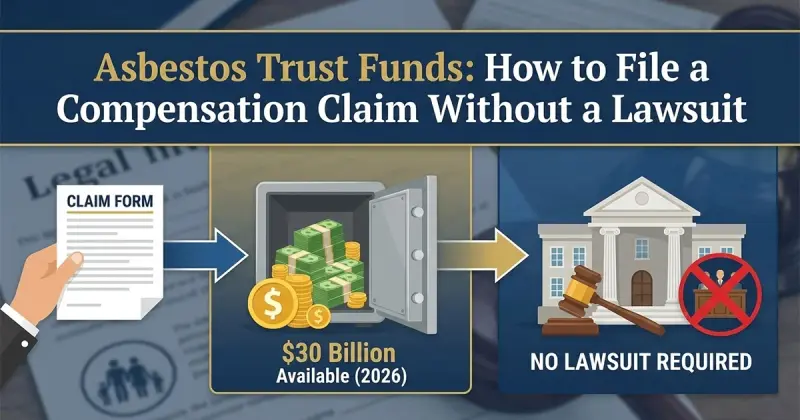
When major asbestos manufacturers like Johns-Manville and W.R. Grace went bankrupt to protect themselves from lawsuits, the courts forced them to leave behind massive piles of money. These are called Asbestos Trust Funds. In 2026, there is approximately $30 billion sitting in these accounts, waiting to pay victims of mesothelioma and other asbestos-related diseases.
The best part? You do not have to file a lawsuit to get this money. You don't have to go to court, you don't have to sit in front of a jury, and you don't have to sue the military (if you are a veteran).
This guide will explain exactly how these funds work, how much you can realistically expect in 2026, and how to file a claim, all in simple terms.
What Exactly Is an Asbestos Trust Fund?
Think of an asbestos trust fund like a mandatory savings account.
Decades ago, companies used asbestos in everything from insulation to baby powder. When people started getting sick with mesothelioma (a cancer caused only by asbestos), they sued these companies. The companies realized they would run out of money if they fought every single case in court. So, they filed for Chapter 11 Bankruptcy.
Usually, bankruptcy means a company is broke. But in this case, it was a legal strategy. The courts let these companies stay in business only if they put enough money into a special trust fund to pay every person who got sick—past, present, and future.
Once a trust is set up, you are legally not allowed to sue that specific company in regular court. Instead, you file a claim directly with the trust. It’s more like filing an insurance claim than fighting a legal battle.
The "Big Number" in 2026
As of January 2026, there are over 60 active trust funds holding an estimated $30 billion in assets. This money is locked away specifically for victims. It cannot be used for the company's other bills or bonuses.
How Much Money Can You Actually Get?
This is the most common question. The answer involves a little bit of math, but we’ll keep it simple.
Every trust has a "Scheduled Value" for mesothelioma. This is the sticker price they put on the disease. However, because the trusts have to make sure the money lasts for decades, they don't pay the full sticker price. They pay a percentage of it, known as the Payment Percentage.
The "Payment Percentage" Explained
Imagine a trust has a Scheduled Value of $100,000 for mesothelioma.
-
If they paid everyone $100,000, they might run out of money in 5 years.
-
So, they set a "Payment Percentage"—let's say 10%.
-
This means you receive $10,000 from that specific trust.
It might sound low, but remember: most people were exposed to products from many different companies. You don't just file one claim; you might file 20 or 30 claims against different trusts.
2026 Payout Examples
Here is real data on what some of the biggest trusts are paying out in 2026:
| Company Trust Fund |
Scheduled Value (Meso) |
Payment % (2026) |
You Receive (Approx.) |
| Johns-Manville |
$350,000 |
5.1% |
$17,850 |
| W.R. Grace |
$180,000 |
30.1% |
$54,180 |
| U.S. Gypsum (USG) |
$155,000 |
11% |
$17,050 |
| Owens-Illinois (Paddock) |
$100,000 |
50.0% |
$50,000 |
| Babcock & Wilcox |
$90,000 |
4.7% |
$4,230 |
When you add all these small checks together, the average total payout from trust funds alone typically falls between $300,000 and $400,000.
Why Choose a Trust Fund Claim Over a Lawsuit?
Filing a trust fund claim is very different from filing a lawsuit against a company that is still solvent (not bankrupt). Here is why many families choose this route or do it alongside other claims.
1. Speed
A lawsuit can take 1 to 3 years to resolve, especially if it goes to trial. Trust fund claims are processed administratively. In 2026, many victims receive their first checks in as little as 90 days (3 months) after filing.
2. Lower Burden of Proof
In a lawsuit, you have to convince a jury that the company was negligent (careless). In a trust fund claim, you just have to prove:
3. No Court Appearances
For many sick patients, the idea of traveling to a courthouse and testifying is too exhausting. Trust fund claims are paperwork-only. You almost never have to leave your house.
4. Veterans Can "Double Dip"
If you are a veteran, you cannot sue the US military. However, the military didn't make the asbestos; private companies did. You can file claims against these private trust funds AND receive your VA disability benefits (which are over $4,000/month in 2026). The two do not cancel each other out.
Step-by-Step Guide: How to File a Claim
Even though this isn't a "lawsuit," the process is strict. If you fill out the forms wrong, you get denied.
Step 1: Confirm Your Diagnosis
You need a pathology report and a doctor's statement confirming you have Mesothelioma, Lung Cancer, or severe Asbestosis. The trusts have different payout rates for different diseases. Mesothelioma pays the highest because it is the most severe.
Step 2: Build Your "Exposure Resume"
This is the hardest part. You have to prove you were around specific products.
-
Wrong: "I think I worked with insulation in the 1980s."
-
Right: "I worked at the Brooklyn Navy Yard from 1980 to 1982, where I installed Johns-Manville pipe covering."
You will need work records, military service records (DD214), or affidavits (sworn statements) from old coworkers.
Step 3: Choose Your Review Type
When you submit your claim, you have two choices:
-
Expedited Review: This is the "Fast Lane." You accept the standard payout amount (like the ones listed in the table above). The trust doesn't look too closely at your file, and you get paid quickly.
-
Individual Review: This is the "Slow Lane." If your case is special—for example, you are very young (under 50) or have many dependents—you can ask the trust to look at your specific situation. You might get more money, but it takes longer, and they might decide to pay you the standard amount anyway.
Step 4: Submission and Liquidation
Once submitted, the trust administrators review your file. If approved, the claim is "liquidated," which is a fancy way of saying they calculate the check amount.
Step 5: Payment
The trust sends the check. Unlike lawsuit settlements which can be taxed if they include "punitive damages," trust fund payouts are generally considered compensation for physical injury, meaning they are usually tax-free.
Do I Need a Lawyer for This?
You might be thinking, "If it's just paperwork and not a lawsuit, can I do it myself?"
Technically, yes. Practically, no.
Here is why: There are over 60 different trusts, each with its own 50-page rulebook, evidence requirements, and deadlines. If you file the wrong evidence, your claim gets rejected forever.
Also, figuring out which trusts to sue requires a massive database. Experienced asbestos law firms have databases containing millions of invoices and job site records. They can look up "Ford Motor Plant, 1975" and see exactly which asbestos products were used there, proving your case for you.
Cost: Asbestos lawyers work on a contingency fee. They only get paid a percentage (usually 25-40%) of the money they get for you. If you get nothing, they get $0. You never pay out of pocket.
Summary: Realistic Expectations for 2026
If you or a loved one has been diagnosed with mesothelioma, here is the realistic financial picture for 2026:
-
Trust Fund Claims: $300,000 – $400,000 total (Tax-Free).
-
Time to get paid: 3 – 6 months.
-
Effort required: Gathering old records (your lawyer does the heavy lifting).
-
Risk: Very low. Since the money is already set aside, it’s not a gamble like a jury trial.
Asbestos trust funds are not a lottery ticket; they are justice for corporate negligence. They exist to help families pay for the incredibly high cost of cancer treatment (often over $400,000 a year) and to provide security for the future.
References for Further Information
If you want to read more about the specific trusts, the laws, or find support, here are authoritative resources:
-
Mesothelioma Veterans Center: For specific info on how veterans can access trusts and VA benefits.
-
Asbestos.com (The Mesothelioma Center): Offers detailed guides on legal options and medical treatments.
-
Simmons Hanly Conroy: One of the major firms with data on trust fund percentages and historical payouts.
-
Mesothelioma Lawyer Center: Provides updated lists of trust fund payment percentages.
-
Mesothelioma Hope: Great for understanding the financial assistance aspect and patient advocacy.
-
CancerCare: Non-profit offering professional support services and financial assistance information.
-
Sokolove Law: Contains historical data on litigation trends and settlements.
8. Best Attorny USA:if you need to hire any attorny for your settlements you can hire from here