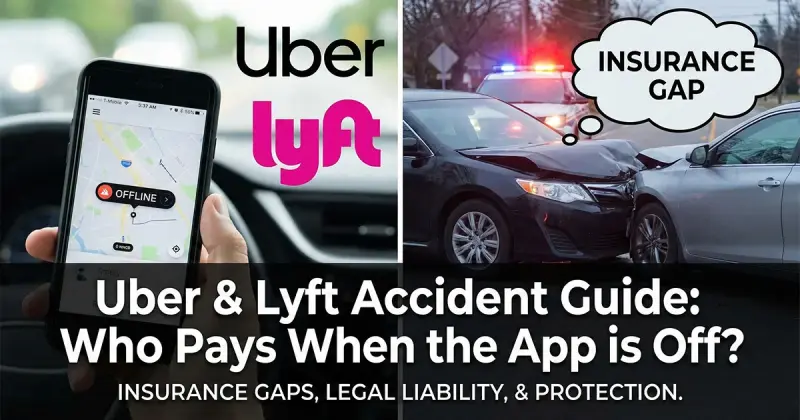
Discover the hidden risks of rideshare accidents when the app is offline. Learn about insurance gaps, legal liability, and how to protect yourself if coverage is denied. A complete guide for drivers and passengers.
The Gig Economy's Hidden Risk: A Comprehensive Guide to Rideshare Liability
The rise of the gig economy has fundamentally transformed how we navigate our cities. Companies like Uber and Lyft have replaced the traditional taxi hail with a simple tap on a smartphone screen, creating a seamless connection between passengers needing a ride and drivers using their personal vehicles to earn extra income. This revolution has brought convenience and economic opportunity, but it has also introduced a complex web of legal and financial risks that remain largely invisible until disaster strikes. The most critical, and often the most devastating, of these risks centers on a single, seemingly simple question: Who pays for an accident when the rideshare app is turned off?
For many, the assumption is that insurance is a safety net that is always there. Passengers assume the multi-billion dollar corporations behind the apps will cover them. Drivers assume their personal auto insurance will protect them when they aren't actively driving a passenger. Unfortunately, the reality is a legal minefield where coverage can vanish in an instant based on the specific status of a digital toggle switch. When the app is off, or even when it is on but no passenger has been accepted, drivers and victims often find themselves falling into a "coverage gap"—a financial black hole where neither the rideshare company nor the personal insurance provider is willing to pay.
This comprehensive report serves as a definitive guide for drivers, passengers, and accident victims. It is designed to explain, in clear and accessible language, exactly how rideshare insurance works, why claims are denied, and what legal options exist when the app is off. We will explore the "Three-Period System" that dictates liability, the dangerous "Period 0" where coverage is nonexistent, the role of digital forensics in proving driver status, and the real-world legal battles that are shaping the future of rideshare liability. By understanding these mechanisms, you can better navigate the aftermath of a crash and ensure that you are not left bearing the financial burden of someone else's negligence.
The Architecture of Liability: Understanding the "Period" System
To understand why an "App Off" accident is so legally treacherous, one must first understand how Uber and Lyft classify their drivers' time. Unlike a taxi driver who is insured 24 hours a day while driving a company cab, a rideshare driver's insurance status changes dynamically based on their activity within the app. This is known in the industry as the Three-Period System (or sometimes the Four-Period System). This system is the "operating system" of rideshare liability; it determines which insurance policy is active, what limits apply, and crucially, who is left holding the bill if things go wrong.
The system was designed to partition liability between the driver's personal life and their commercial work. However, in practice, it creates rigid boundaries that insurance companies exploit to deny claims. A driver can transition from being fully insured by a commercial policy to being completely uninsured in the span of a single second—the second they tap "Go Offline."
Period 0: The "App Off" Phase – The Danger Zone
The focus of our inquiry is Period 0, often referred to as the "App Off" phase. This is the state where the driver is in their vehicle, the engine is running, but the Uber or Lyft application is closed or toggled to "offline" status. In the eyes of the rideshare companies, a driver in Period 0 is not an employee, not a contractor, and not their responsibility. They are simply a private citizen driving a private car.
In this phase, the rideshare company provides zero insurance coverage. There is no liability coverage for injuries to others, no collision coverage for the driver's car, and no uninsured motorist protection from the corporate policy. The TNC (Transportation Network Company) effectively washes its hands of the driver entirely. The logic is that if the driver is not available to accept rides, they are not working, and therefore the TNC has no vicarious liability for their actions.
This leaves the driver reliant on their Personal Auto Policy (PAP). However, this is where the trap lies. Personal auto insurance is priced and written for personal use—commuting to a regular job, grocery shopping, or road trips. It is not designed for commercial activity. Most personal policies contain a specific clause known as the "Commercial Use Exclusion" or "Livery Conveyance Exclusion." This clause states that the policy does not cover accidents that occur while the vehicle is being used to transport people or goods for a fee.
Here is the nightmare scenario for Period 0: A driver uses their car 90% of the time for Uber. They log off the app to drive home (Period 0). On the way, they cause a serious accident. They file a claim with their personal insurer. The insurer investigates and finds out the car is primarily used for rideshare (perhaps they see an Uber sticker in the window or check the mileage). Even though the app was off at the time of the crash, the insurer may argue that the primary purpose of the vehicle is commercial, which violates the terms of the personal policy. They may deny the claim or even rescind (cancel retroactively) the entire policy for "material misrepresentation".
The result? The TNC pays nothing because the app was off. The personal insurer pays nothing because the car is a commercial vehicle. The driver is left personally liable for all damages, and the victim is left with no insurance pool to sue.
Period 1: The "Gap" – App On, Waiting
While not strictly "App Off," Period 1 is often confused with it because the coverage is so low that it feels like a gap. In Period 1, the driver has logged into the app and is waiting for a ride request. They are "trolling" for work.
During this phase, the driver's personal insurance usually denies coverage because the driver is arguably "working" (available for hire). Recognizing this gap, states have passed laws requiring TNCs to provide Contingent Liability Coverage. This coverage typically provides:
-
$50,000 for bodily injury per person.
-
$100,000 for bodily injury per accident.
-
$25,000 for property damage.
The critical word here is "Contingent." This means the TNC insurance only pays if the driver's personal insurance denies the claim first. This creates a bureaucratic nightmare where the driver must file a claim with their own insurer, get a formal denial letter, and then file with Uber or Lyft.
Furthermore, in Period 1, TNCs generally provide NO collision coverage for the driver's own car. If a driver in Period 1 is distracted by the app and hits a tree, Uber will not pay to fix their car. If their personal insurer also denies the claim due to the commercial exclusion, the driver must pay for repairs out of pocket.
Periods 2 & 3: The "Safe" Zones
For context, it is important to see what "App Off" is being compared to.
In these periods, the TNC provides a $1 million commercial liability policy. This covers injuries to passengers, pedestrians, and other drivers. It also usually includes $1 million in Uninsured/Underinsured Motorist (UM/UIM) coverage and contingent collision coverage (with a deductible, often $2,500).
The stark contrast between the $1 million protection in Period 2/3 and the zero protection in Period 0 is why the determination of app status is the single most important factor in any rideshare accident case.
The Legal Reality of "App Off" Accidents
When a victim is injured by a rideshare driver who appears to be "off the clock," the legal battle is often uphill. The system is designed to shield the TNCs from liability, placing the burden squarely on the driver. However, the driver is often "judgment proof"—meaning they do not have the assets to pay a large judgment. This leaves victims and their attorneys scrambling to find a pocket deep enough to cover medical bills and lost wages.
The "Scope of Employment" Defense
The primary legal defense used by Uber and Lyft in "App Off" cases is that the driver was not acting within the "scope of employment." Since rideshare drivers are classified as independent contractors rather than employees, the TNCs argue they have no control over the driver when they are not actively engaged in a ride.
Legal precedents, such as the case of Campo v. Uber Technologies, Inc., have reinforced this defense. In Campo, a driver struck and killed a pedestrian while his app was offline. The plaintiff argued that the driver might have been "positioning" himself for a ride or monitoring surge pricing, and therefore Uber should be vicariously liable. The court rejected this, ruling that "inference stacking" (guessing about the driver's intent) was not enough. Since the digital evidence showed the app was off, Uber was not liable.
This creates a rigid barrier. Unless an attorney can prove the app was actually on, the TNC is legally untouchable in most jurisdictions.
The Personal Insurance Battle
If the TNC is out of the picture, the battle shifts to the driver's personal insurer. As mentioned, the "Commercial Use Exclusion" is the weapon insurers use to deny claims. However, denials are not always automatic.
-
Investigation: The insurer will investigate the "nature" of the trip. Was the driver actually commuting home? Or were they driving to a "surge zone" to log back in? If the latter, the insurer may argue the trip was business-related Period 0 activity and deny coverage.
-
Rescission: In extreme cases, if the driver failed to tell their insurer they were driving for Uber at all, the insurer might declare the policy void from the beginning (rescission), returning the premiums and refusing to pay any claims. This is fraud on the driver's part, but the victim is the one who suffers most.
The Role of Uninsured Motorist (UM) Coverage
For a victim hit by a Period 0 driver who suffers a "double denial" (TNC says no, personal insurer says no), the last line of defense is their own Uninsured Motorist (UM) coverage.
If the at-fault driver effectively becomes uninsured due to these denials, the victim's own insurance policy steps in to act as the liable party. The victim makes a claim against their own insurance company, which then pays for the medical bills and pain and suffering up to the policy limits. The insurance company then gains the right of subrogation—meaning they can sue the at-fault driver personally to try and get their money back.
This highlights a critical lesson for everyone: Always carry high limits of Uninsured Motorist coverage. In the gig economy, the roads are full of drivers who may be technically uninsured at any given moment.
Digital Forensics: The Truth Behind the Toggle
In many cases, the driver's status is disputed. The driver may claim they were working (to get Uber's coverage), while Uber claims they were offline (to avoid paying). Or, a driver might panic after a crash and swipe the app "off" to hide their activity from their personal insurer. In these "he said, she said" scenarios, digital forensics becomes the judge.
The "Black Box" of Data
Uber and Lyft collect massive amounts of telemetry data. Every time a driver logs in, accepts a ride, brakes hard, or moves via GPS, it is recorded.
-
Audit Logs: These logs show the precise second the app was toggled on or off. If a driver hits a pedestrian at 10:05:00 PM and the log shows they went offline at 10:05:30 PM, the TNC is on the hook.
-
GPS Data: Even if the app status is disputed, GPS data can show the driver's behavior. Were they driving aimlessly in circles in a busy downtown area? That suggests "trolling" for rides (Period 1 behavior) rather than driving home (Period 0 behavior).
Subpoenas and Preservation
Attorneys dealing with these cases must move fast. They issue preservation letters to the TNC immediately to prevent data from being deleted. They then use the discovery process to subpoena the raw data.
-
The "Switching" Tactic: Experienced attorneys look for patterns where a driver toggles the app off immediately after an impact. This is a common evasion tactic. Forensic experts can correlate the time of the 911 call with the app logs to expose this deception.
-
Ghost Apps: Forensics can also reveal if the driver was using unauthorized third-party apps to manage rides, which might complicate the coverage picture but prove commercial intent.
State-Specific Laws: A Patchwork of Protection
Where you live determines how much protection you have. While the TNC business model is global, insurance regulation is state-based.
California: The Gold Standard
California has been a pioneer in regulating TNCs (Assembly Bill 2293). It requires TNCs to provide primary insurance during Period 1 ($50k/$100k/$30k), preventing the "contingent" nightmare found in other states. If you are hit by a waiting Uber driver in Los Angeles, you deal directly with Uber's insurer, not the driver's personal one.
New York: The Exception
New York City operates under a completely different model. The Taxi and Limousine Commission (TLC) requires all rideshare vehicles to be commercially licensed and insured 24/7. There is no "Period 0" gap in NYC because the car is insured as a commercial vehicle at all times. If you are hit by an Uber in Manhattan, there is commercial insurance available, regardless of app status.
Florida and Texas: The Standard Model
States like Florida and Texas follow the standard model described above. They mandate TNC coverage for Period 1 ($50k/$100k/$25k) and Period 2/3 ($1M). However, for Period 0, they rely on the driver's personal liability. Florida's "No-Fault" (PIP) laws add another layer, where the victim's own insurance pays the first $10,000 of medical bills regardless of who caused the crash.
The Solution: Rideshare Endorsements
The single most effective way to close the "App Off" liability gap is for drivers to purchase a Rideshare Endorsement (often called "Gap Coverage"). This is an add-on to a personal auto policy.
What It Does
-
Period 0 Protection: It acknowledges the driver uses the car for business, preventing the insurer from denying claims or canceling the policy due to the "Commercial Use Exclusion."
-
Period 1 Extension: It often extends the driver's full personal policy limits (which might be higher than the TNC's $50k/$100k) to Period 1.
-
Deductible Gap: Some endorsements pay the difference between the driver's deductible (e.g., $500) and Uber's deductible ($2,500), saving the driver $2,000 in a Period 2/3 crash.
Cost Analysis
The cost is surprisingly low—typically $10 to $20 per month added to the premium. Major insurers like Allstate, Progressive, State Farm, and USAA offer these products. For a driver, this small cost is the only thing standing between them and bankruptcy in a Period 0 or Period 1 accident.
| Insurance Company |
Avg. Annual Cost (No Endorsement) |
Avg. Annual Cost (With Endorsement) |
Cost Difference |
| Allstate |
Varies |
+$15 - $20 / year |
Minimal |
| State Farm |
$3,060 |
Varies (approx 15-20%) |
Moderate |
| Progressive |
$2,418 |
Included in quote |
Varies |
| USAA |
$1,992 |
+$6 - $8 / month |
Low |
| Erie |
Varies |
+$9 - $15 / month |
Low |
Step-by-Step: What to Do After an "App Off" Accident
If you are involved in an accident with a driver you suspect is a rideshare operator (look for the trade dress sticker in the window), the actions you take at the scene are critical for navigating the upcoming insurance battle.
1. Secure Evidence Immediately
Do not rely on the driver's word.
-
Photograph the Windshield: Get a clear picture of the Uber/Lyft sticker.
-
Photograph the Phone: If safe, glance at their dashboard. Is there a phone mount? Is the app open? Take a picture of the dashboard through the window if possible. This is physical evidence of potential Period 1 activity.
-
Witnesses: Ask bystanders if they heard the "ping" of a ride request.
2. File a Police Report
Always call the police. The official report acts as a neutral record. Ensure the officer notes if the driver admitted to driving for Uber or Lyft, even if they claim they were "off duty".
3. Report to Everyone
-
Your Insurer: Notify them immediately to trigger UM/UIM investigations.
-
The TNC: Report the accident to Uber or Lyft via their "Critical Safety Response" line or app. Even if they deny it later, this creates a record. They will lock the driver's account and preserve data.
4. Do Not Accept "Cash Deals"
Drivers in Period 0 or 1 often know they are uninsured or underinsured. They may offer cash to "leave insurance out of it." Never accept. The "commercial exclusion" means their insurance might not pay, and without a police report, you have no leverage.
5. Consult a Specialist Attorney
General car accident lawyers may not understand the nuance of the "Period" system. You need an attorney who knows how to subpoena TNC audit logs and fight the "commercial exclusion" denial. The search keywords "Uber accident attorney" or "rideshare liability lawyer" can help find specialists.
Real-World Case Studies
To understand the stakes, we can look at how these rules apply in real courtrooms.
Case Study 1: The "Offline" Defense (Campo v. Uber)
In this tragic Florida case, an Uber driver who had been offline for months hit and killed a pedestrian while running an errand. The victim's family sued Uber, arguing the driver was "part of the system." The court ruled firmly for Uber: no app activity equals no liability. This case sets a hard precedent that "being an Uber driver" generally doesn't matter; only "being an Uber driver right now" matters.
Case Study 2: The Self-Driving Tragedy (Herzberg)
When an Uber self-driving car killed Elaine Herzberg in Arizona, the "safety driver" was streaming a TV show on her phone. The car was in autonomous mode (Period 3 equivalent). Because the liability was clear (Uber's vehicle, Uber's software), the case settled quickly. TNCs settle Period 3 cases to avoid bad press; they fight Period 0 cases to avoid setting costly precedents.
Conclusion
The question "Who pays when the app is off?" exposes the dark underbelly of the gig economy. The system is designed to maximize flexibility for the companies, often at the expense of security for drivers and the public. When the app is off, the multi-billion dollar safety net vanishes, leaving behind only personal policies that may not pay and drivers who cannot pay.
For the general public, the lesson is vigilance. Be aware that the "Uber" sticker on the car next to you does not guarantee corporate insurance is active. For drivers, the message is urgent: Get the endorsement. Driving without it is a gamble with your financial future that you are statistically destined to lose. And for victims, the path to justice requires tenacity, digital evidence, and often, the shield of your own Uninsured Motorist coverage.
The gig economy is here to stay, but the laws governing it are still catching up. Until they do, the toggle switch on a driver's phone remains one of the most powerful determinants of financial destiny on the modern road.
Disclaimer: This report is for informational purposes only and does not constitute legal advice. Insurance policies and state laws vary and are subject to change. Always consult with a qualified attorney or insurance professional for specific guidance.