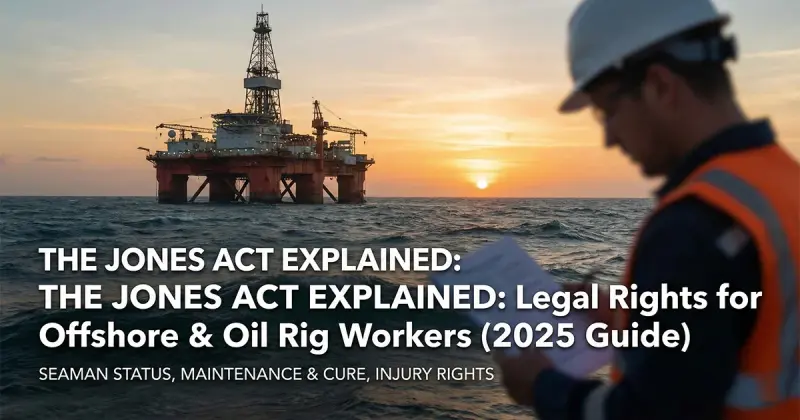
A comprehensive guide for offshore workers and students. Learn about the Jones Act, seaman status, maintenance and cure, and legal rights after an oil rig injury. Written in plain English.
1. Introduction: The Law of the Sea
The ocean is not like the land. It is a place where the laws of physics—and the laws of man—operate differently. For the thousands of men and women who work on offshore oil rigs, jack-up barges, and drillships, the daily reality involves heavy steel, high pressure, and the unpredictable fury of the sea. It is a world where a simple slip can lead to catastrophic injury, and where help is often a helicopter ride away. In this unique environment, the laws that protect workers are not the standard "workers' compensation" rules that apply to an office clerk or a factory hand. Instead, they are governed by a specialized, historic, and powerful set of federal laws known collectively as Maritime Law.
At the very center of this legal universe stands the Merchant Marine Act of 1920, famously known as the Jones Act. For over a century, this statute has served as the shield and sword for American workers injured at sea. But what exactly is it? Why does it exist? And most importantly for the roughnecks, roustabouts, and drillers of the energy sector, how does it protect their livelihood when disaster strikes?
This report serves as an exhaustive guide to the Jones Act. It is written to be understood by anyone with a 10th-grade education, yet detailed enough to serve as a professional resource. We will strip away the confusing legal jargon and explain the "who, what, where, and why" of maritime rights, backed by the latest trends, safety statistics, and court rulings.
1.1 The History: Why the Jones Act Was Born
To truly understand the Jones Act, we must look back to the world of 1920. The First World War had just ended. The conflict had proven that a nation without a strong fleet of merchant ships—vessels that carry cargo and fuel—was vulnerable. The United States Congress, led by Senator Wesley Livsey Jones of Washington, wanted to ensure that America would always have a vibrant shipping industry and a skilled workforce to man it.
However, there was a problem. At that time, life at sea was brutal, and the law was cruel. If a sailor was injured because his captain was negligent (careless), the Supreme Court had ruled in a 1903 case called The Osceola that the sailor could not sue the shipowner for negligence. They were entitled only to basic medical care. This left injured seamen and their families destitute.
Congress realized that to build a strong merchant marine, they had to protect the "human element"—the sailors themselves. They passed the Jones Act to give seamen the same rights that railroad workers already had under the Federal Employers' Liability Act (FELA). This was a revolutionary change. It meant that for the first time, a worker at sea could sue their employer for negligence and have their case heard by a jury of their peers.
1.2 The "Wards of the Court" Doctrine
One of the most fascinating concepts in maritime law is the idea that seamen are "wards of the court." This sounds old-fashioned, but it is a powerful legal principle that is still alive today.
Courts have long recognized that seamen are different from other workers. They are often isolated on ships for months at a time, subject to the strict orders of their captains, and exposed to the "perils of the sea"—storms, piracy, and sinking. Because they are vulnerable and often unable to protect their own interests while at sea, judges have decided that maritime laws should be interpreted liberally to protect them. This means that when the law is unclear, the tie often goes to the worker. This doctrine is the heartbeat of the Jones Act.
2. The Golden Ticket: Who Qualifies as a "Seaman"?
The Jones Act is an exclusive club. It does not cover everyone who works on the water. It protects only those who qualify as "Seamen." This distinction is the single most important issue in any offshore injury case. If you are a seaman, you have the right to sue for millions of dollars in damages. If you are not, you are likely stuck in a workers' compensation system with strict caps on how much money you can receive.
Because the stakes are so high, employers and insurance companies often fight tooth and nail to prove that an injured worker is not a seaman. So, how does the law decide?
2.1 The Chandris Test: The Two-Step Verification
The Supreme Court finally cleared up decades of confusion in a famous 1995 case called Chandris, Inc. v. Latsis. They created a two-part test that a worker must pass to be considered a seaman. Think of it as a checklist:
-
The Contribution Test: Does the worker contribute to the function of the vessel or the accomplishment of its mission?
-
Explanation: This bar is set very low. Almost everyone on a boat contributes to its mission. On a cruise ship, a blackjack dealer contributes to the "mission" of entertainment. On an oil rig, a cook contributes to the mission of drilling by feeding the crew. A roughneck contributes by handling the pipe. Unless you are just a passenger, you likely pass this test.
-
The Connection Test: does the worker have a connection to a vessel (or a fleet of vessels) that is substantial in terms of duration and nature?
2.2 The 30% Rule: The Magic Number
How long do you have to work on a boat to be a seaman? The courts have established a guideline known as the 30% Rule.
The Rule: A worker who spends less than 30% of their working time in the service of a vessel in navigation generally does not qualify as a seaman.
Let's look at a few examples to see how this works in the real world of the oil patch:
-
Case A: The Roughneck. He works 14 days on, 14 days off, exclusively on the Deepwater Titan, a floating drillship. He spends 100% of his work time on a vessel. Verdict: Seaman.
-
Case B: The Yard Welder. She works at a shipyard on land. Occasionally, she goes onto a barge tied to the dock to do repairs, perhaps 10% of her time. The rest is in the fabrication shop. Verdict: Not a Seaman (She is likely a Longshoreman).
-
Case C: The Coil Tubing Specialist. He is a contractor. He spends 15% of his time on a floating rig, 15% of his time on a fixed platform (which is not a vessel), and 70% of his time in the shop. Because his vessel time is only 15%, he fails the test. Verdict: Not a Seaman.
Important Exception: The 30% rule is just a guideline. If a worker gets a new job assignment that permanently changes their duties to a vessel, they can become a seaman immediately. For example, if the Yard Welder from Case B is promoted to Chief Engineer on a tugboat, she becomes a seaman on Day 1 of the new job. She doesn't have to wait until she builds up "30%" of her career history. If she slips and falls on her first hour on the tugboat, she is covered by the Jones Act.
2.3 The "Fleet Doctrine": Working for Multiple Rigs
Many offshore workers are nomads. They don't work on just one rig; they bounce around. A wireline operator might spend two days on a Chevron rig, three days on a BP rig, and two days on a Shell rig. Does this count?
The law says you can add up (aggregate) your time on multiple vessels only if they are part of the same Fleet.
-
What is a Fleet? A fleet is a group of vessels that are under common ownership or control.
-
The Trap: If you work for a service company and are sent to rigs owned by five different oil companies, those rigs are not a fleet. Therefore, you might not have a substantial connection to any single vessel or fleet. This is a common legal defense used to deny Jones Act rights to service hands. However, if you work for a drilling contractor like Transocean, and you move between different Transocean rigs, that is a fleet, and your time counts.
3. The Battlefield: What is a "Vessel"?
You cannot be a seaman unless you work on a Vessel. This sounds like a simple question—"Is it a boat?"—but in the oil and gas industry, it is incredibly complex. Technology has created strange structures that blur the line between land and sea.
3.1 The "In Navigation" Requirement
To be a Jones Act vessel, the structure must be "in navigation." This does not mean it has to be moving at the exact moment of the accident. A ship tied to a dock is still in navigation. A ship at anchor is in navigation. However, a ship that is in a drydock for major repairs that take months, with no crew on board and no engines running, might be considered "out of navigation." If it is out of navigation, it is just a piece of metal, and the Jones Act does not apply.
3.2 Floating Rigs vs. Fixed Platforms
The Supreme Court settled the definition of a vessel in a case called Stewart v. Dutra Construction Co. (2005). They ruled that a vessel is any watercraft that is "used, or capable of being used, as a means of transportation on water."
This definition splits offshore rigs into two camps:
Group A: The Vessels (Jones Act Applies)
These structures float and can move (or be moved) from one drill site to another.
-
Jack-Up Rigs: These are barges with long legs. They are towed to a site, and then the legs are jacked down to the seafloor to lift the hull out of the water. Even though they stand on the bottom while drilling, they are designed to move. Therefore, they are vessels.
-
Semi-Submersibles: These are massive floating cities sitting on pontoons. They are anchored or held in place by thrusters. They are definitely vessels.
-
Drillships: These are ships with a derrick in the middle. They are self-propelled and are classic vessels.
-
Tension Leg Platforms (TLPs): These float but are tethered to the bottom. Most courts consider them vessels.
Group B: The Artificial Islands (Jones Act Does NOT Apply)
These structures are permanently attached to the earth.
-
Fixed Platforms: These are built on steel jackets piled deep into the seabed. They are not designed to move. Once installed, they stay there until the oil field runs dry (often 20-30 years). The law treats these as Artificial Islands.
-
The Consequence: If you work on a fixed platform, you are essentially working on "land" surrounded by water. You are not a seaman. You are covered by a different law called the Outer Continental Shelf Lands Act (OCSLA).
Table 1: Vessel Status Cheat Sheet
| Rig Type |
Characteristics |
Legal Status |
Applicable Law |
| Drillship |
Self-propelled, ship-shaped |
Vessel |
Jones Act |
| Semi-Submersible |
Floating, moored/thrusters |
Vessel |
Jones Act |
| Jack-Up Rig |
Towed, legs rest on seabed |
Vessel |
Jones Act |
| Tension Leg Platform |
Floating, tethered to bottom |
Vessel (Usually) |
Jones Act |
| Spar Platform |
Floating cylinder, moored |
Debatable (Fact-dependent) |
Jones Act / OCSLA |
| Fixed Platform |
Piled into seabed, permanent |
Not a Vessel |
OCSLA / LHWCA |
4. The Three Pillars of Recovery: What You Can Claim
If you qualify as a seaman and are injured on a vessel, the Jones Act system provides three distinct ways ("causes of action") to get help. You don't have to pick just one; your lawyer will typically file for all three simultaneously.
Pillar 1: Jones Act Negligence (The "Featherweight" Burden)
This is the most famous part of the law. It allows you to sue your employer if their negligence caused your injury.
-
The "Featherweight" Standard: In a normal car accident lawsuit, you have to prove that the other driver was the main cause of the crash (Proximate Cause). Under the Jones Act, the burden of proof is much lower. It is described as "featherweight." You only have to prove that your employer's negligence played "any part, no matter how small" in causing your injury. If the employer was only 1% at fault and that 1% contributed to your accident, they are liable.
-
Comparative Fault: What if the accident was partly your fault? Under the Jones Act, you can still recover money. If the jury decides you suffered $1 million in damages but you were 40% at fault, you still get $600,000. Your mistake does not kill your case.
Pillar 2: Unseaworthiness (Strict Liability)
This claim is unique to maritime law. It is brought against the Vessel Owner (who might be different from your employer).
-
The Guarantee: The vessel owner has an absolute duty to provide a ship that is "reasonably fit for its intended purpose." This is a strict liability standard. This means it doesn't matter if the owner knew about the problem. If a piece of equipment breaks and hurts you, the vessel was unseaworthy, and the owner must pay.
-
Examples: A ladder with a missing rung; a winch that jams; a slippery deck with no non-skid paint; or even an incompetent crew member. If a captain is untrained and causes a crash, the vessel is unseaworthy because the crew is part of the vessel.
Pillar 3: Maintenance and Cure (The Safety Net)
This is an ancient right that dates back to the Laws of Oleron in the medieval ages. It applies to any seaman who gets hurt or sick while in the service of the ship, regardless of whose fault it is. You could trip over your own shoelaces or have a heart attack while sleeping; you are still covered.
-
Maintenance: This is a daily check to cover your living expenses on land while you recover. It is meant to replace the food and shelter you would have received on the ship.
-
The Reality Check: Many companies try to pay a low rate, like $15 or $30 a day. However, the law says they must pay your actual expenses. If your rent, electricity, and food cost $85 a day, you can demand that amount. You have to prove your expenses with receipts.
-
Cure: This is the payment of your medical bills. You have the right to choose your own doctor. The company must pay for all reasonable medical treatment until you reach Maximum Medical Improvement (MMI).
-
MMI: This is the point where doctors say, "You are as good as you are going to get." Once you reach MMI, the payments stop, even if you are still disabled. At that point, any further compensation must come from your lawsuit for negligence.
5. The "Twilight Zone": Jones Act vs. LHWCA vs. OCSLA
The offshore world is a legal puzzle. Depending on exactly where you are standing when you get hurt, a different law applies. Lawyers call the area where these laws overlap the "Twilight Zone." Understanding the difference is critical because the financial outcomes are vastly different.
5.1 The Longshore and Harbor Workers' Compensation Act (LHWCA)
This is a federal workers' compensation law. It covers maritime workers who work on the water but are not seamen.
-
Who is covered? Longshoremen (who load ships), harbor workers, shipbuilders, and repairmen.
-
The Trade-Off: Like state workers' comp, the LHWCA is a "grand bargain." You get automatic benefits (medical care and about 66% of your wages) without having to prove fault. In exchange, you cannot sue your employer. You are barred from seeking damages for "pain and suffering."
-
Financial Impact: A severe back injury under LHWCA might result in a few hundred thousand dollars in benefits over a lifetime. The same injury under the Jones Act (where you can sue for pain and suffering and lost future earnings) could result in a multi-million dollar verdict.
5.2 The Outer Continental Shelf Lands Act (OCSLA)
This law covers operations on the "Outer Continental Shelf" (federal waters, usually 3+ miles out). It specifically applies to Fixed Platforms.
-
How it works: OCSLA adopts the LHWCA as the remedy for platform workers. This means if you are hurt on a fixed platform, you generally get LHWCA benefits. You cannot be a Jones Act seaman on a fixed platform (because it's not a vessel).
-
The Third-Party Loophole: While you cannot sue your own employer under OCSLA, you can sue a third party. On a rig, there are many companies working together (catering, casing, wireline, cement). If you work for the drilling company, but a Catering hand leaves a box in the hall and you trip, you can sue the Catering company for negligence. This allows you to recover pain and suffering damages, similar to a Jones Act claim, but against the third party rather than your boss.
Table 2: Compensation Comparison
| Feature |
Jones Act (Seaman) |
LHWCA / OCSLA (Non-Seaman) |
| Basis of Claim |
Negligence (Fault) & Unseaworthiness |
No-Fault (Automatic) |
| Burden of Proof |
"Featherweight" (Very Low) |
None (Just show injury happened at work) |
| Can you sue Employer? |
YES |
NO (Immunity) |
| Pain & Suffering? |
Recoverable (Uncapped) |
Not Recoverable |
| Lost Wages |
Full Future Loss |
Capped % of Weekly Wage |
| Jury Trial? |
Yes |
No (Administrative Judge) |
6. The Reality of the Rig: Hazards, Injuries, and Trends
Legal definitions are important, but they deal with the aftermath. The reality of offshore work is prevention and survival. The data shows that despite safety improvements, the offshore sector remains one of the most dangerous industries in America.
6.1 The Kill Zone: High-Risk Areas
-
The Drill Floor: This is the heart of the rig and the most dangerous place. The "Red Zone" is where heavy pipe is spinning. Injuries here often involve the Kelly Drive, Rotary Table, or Iron Roughneck. Crushed fingers, amputations, and head trauma from swinging pipes are common.
-
The Monkey Board: High up in the derrick, the derrickman handles the tops of the pipe stands. A fall from here is almost always fatal unless fall protection gear works perfectly.
-
Crane Operations: Moving cargo from a bobbing supply boat to a stationary rig in 10-foot seas requires immense skill. Personnel transfers using the "Billy Pugh" basket are frequent sources of terror and injury.
6.2 Common Injuries and "The Silent Killer"
-
Traumatic Injuries: Amputations, spinal cord injuries, and severe burns from blowouts or chemical releases.
-
Chemical Exposure: Oil rigs use drilling "mud"—a toxic soup of chemicals used to lubricate the drill bit. They also encounter Hydrogen Sulfide (H2S), a sour gas that can kill instantly in high concentrations. Long-term exposure to benzene and other carcinogens is a major health risk.
-
The Silent Killer: Fatigue. Most offshore workers work "hitches" of 14 days on, 14 days off (or 28/28), working 12-hour shifts every single day. Recent studies and survivor stories highlight that chronic fatigue and mental health strain (isolation, stress) are major contributors to accidents. Under the Jones Act, if an employer forces a crew to work beyond safe limits and fatigue causes an accident, that is a valid negligence claim.
6.3 2024-2025 Safety Trends
According to recent U.S. Coast Guard and Bureau of Safety and Environmental Enforcement (BSEE) reports, while fatal incidents have decreased slightly, reportable marine casualties remain high.
-
Machinery Failure: As the offshore fleet ages, mechanical failures are becoming a leading cause of "unseaworthiness" claims.
-
Cyber-Physical Risks: Modern rigs are automated. A glitch in the Dynamic Positioning (DP) system of a drillship can cause it to drift off-station, leading to an emergency disconnect or a pipe rupture. These high-tech failures are the new frontier of maritime litigation.
7. The Legal Process: From Injury to Verdict
If you or a loved one is injured offshore, the steps you take in the first 48 hours can decide the outcome of your case. Employers are very good at managing risk; they have teams of lawyers ready to go the moment an accident report is filed. You need to know the playbook.
Step 1: Immediate Reporting
Never hide an injury. The "tough guy" culture on rigs often discourages reporting, but if you wait two weeks to say your back hurts, the company will argue you hurt it at home carrying groceries. Fill out an accident report immediately. Be honest, but be brief. Do not speculate on things you don't know.
Step 2: Medical Treatment (The "Company Doctor" Trap)
The company will likely put you on a helicopter and send you to a clinic onshore. They will send you to their doctor.
-
Warning: The company doctor works for the company. Their job is often to minimize the injury and get you back to work so the rig's safety statistics look good.
-
Your Right: You have the legal right to see your own doctor. You should always get a second opinion from a specialist who has no ties to your employer. This is crucial for your Maintenance and Cure benefits.
Step 3: Investigation and Evidence
In the age of smartphones, you are your own best investigator. Take pictures of the scene. Take pictures of the broken tool. Get the names and phone numbers of witnesses. Once you leave the rig, that evidence might disappear.
Step 4: Filing the Suit
A Jones Act lawsuit is usually filed in federal court or state court. Unlike workers' comp claims which are administrative (filling out forms), this is a real lawsuit.
-
Statute of Limitations: You generally have three years from the date of the injury to file a Jones Act lawsuit. However, waiting is dangerous because evidence gets lost.
-
Mediation vs. Trial: Most cases settle before trial. Mediation is a process where both sides meet to try and agree on a number. If they can't, the case goes to a jury trial. Juries in maritime states (like Louisiana and Texas) are known for understanding the dangers of rig work and awarding fair verdicts.
8. Conclusion: The Price of Energy
The lights in our homes and the fuel in our cars come at a price. That price is paid by the labor of the maritime workforce. The Jones Act is not just a dusty old law from 1920; it is a vital recognition of the human cost of energy.
For the 10th-grade student looking at this industry, or the seasoned driller reading this on a break, the takeaway is clear: Knowledge is protection. The offshore environment is unforgiving, and the corporate machinery is powerful. But the law—specifically the Jones Act—levels the playing field. It ensures that when a worker gives their health or their livelihood to the sea, they are treated not as a disposable cog, but as a "ward of the court," deserving of full and fair justice.
Whether you are on a jack-up rig in the Gulf or a wind turbine vessel in the Atlantic, knowing your status as a "Seaman" is the first step in protecting your future.
FAQ: What Offshore Workers Are Asking (Google Trends Analysis)
Q: Is a jack-up rig a vessel?
A: Yes. Even though it stands on legs, the Supreme Court rules it is a vessel because it is capable of navigation.
Q: Can I get fired for filing a Jones Act claim?
A: It is illegal for an employer to retaliate against you for filing a claim, but it happens. Having a lawyer protects you against this retaliation.
Q: How much is a typical Jones Act settlement?
A: There is no "average." Minor injuries might settle for $50,000, while career-ending injuries with liability can result in settlements of $1 million to $5 million or more, depending on lost future wages.
Q: Do I get paid while I am recovering?
A: Yes. You are entitled to "Maintenance" (living expenses) and any "Unearned Wages" for the remainder of your contract or hitch.
References & Resources for Further Reading:
(This report was compiled using expert legal analysis and current maritime safety statistics to provide a complete overview of the Jones Act.)