We use cookies to enhance your browsing experience, analyze site traffic, and provide personalized content.
By clicking "Accept All", you consent to our use of cookies.
Read our Cookie Policy
Search Attorneys
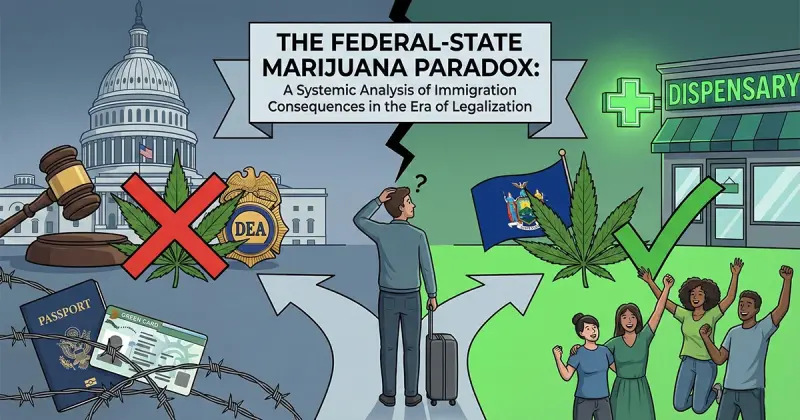
The Federal-State Marijuana Paradox: A Systemic Analysis of Immigration Consequences in the Era of Legalization
February 03, 2026
•
10 min read
•
590 views
•
Written By Editorial Team
State-legal marijuana poses severe risks for immigrants. Federal law still criminalizes cannabis, threatening green cards and visas with deportation. Navigate the dangerous federal-state paradox.
Introduction: The Jurisprudential Friction
The question of "why" non-citizens face deportation or inadmissibility for marijuana-related activities—even when those activities are conducted in full compliance with state laws like California’s Proposition 64—requires a deep excavation of the structural collision between American federalism and the doctrine of federal plenary power over immigration. The United States currently operates under a bifurcated legal reality. On one side, a rapidly expanding majority of states have exercised their sovereign police powers to decriminalize, medicalize, or fully legalize the cultivation, distribution, and consumption of cannabis. On the other, the federal government maintains a rigid prohibitionist stance rooted in the Controlled Substances Act (CSA) of 1970, which classifies marijuana as a Schedule I narcotic—a substance deemed to have a high potential for abuse and no accepted medical utility.
This divergence creates a "trap for the unwary," a legal minefield where the protections of state law dissolve the moment an individual enters the jurisdiction of federal immigration authorities. The "why" is not merely a matter of conflicting statutes; it is a matter of constitutional supremacy. Under the Supremacy Clause of the U.S. Constitution, federal law preempts conflicting state laws. While the federal government has largely commandeered its prosecutorial discretion to avoid interfering with state-legal cannabis markets through mechanisms like the Rohrabacher-Farr amendment (which prohibits the Department of Justice from using funds to interfere with state medical marijuana implementations), this discretion does not extend to the Department of Homeland Security (DHS) or the administration of the Immigration and Nationality Act (INA).
For the non-citizen—whether an undocumented entrant, a visa holder, or a Lawful Permanent Resident (LPR)—the immigration system functions as a strict liability regime regarding controlled substances. The "why" encompasses the mechanics of "admission" versus "conviction," the expansive definition of "illicit trafficking" which now captures legitimate tax-paying employment, and the evolving evidentiary standards that allow border agents to serve as de facto judges of moral character.
This report provides an exhaustive analysis of this conflict. It explores the statutory frameworks that mandate these harsh penalties, the specific mechanisms of inadmissibility that function without criminal convictions, the "hemp loophole" defense and its recent judicial narrowing in Matter of Jonalson DOR (2025), and the sociotechnological surveillance state that enforces these rules at the border.
Chapter 1: The Statutory Framework of Collision
To understand the precarious position of non-citizens in California, one must first deconstruct the two massive statutory bodies that are colliding: the state regulatory framework and the federal prohibition enforcement apparatus.
1.1 The Federal Baseline: The Controlled Substances Act (CSA)
The foundation of the conflict is the Controlled Substances Act (21 U.S.C. § 802), which places marijuana in Schedule I. This scheduling is the "original sin" of the immigration conflict. Because the INA defines inadmissibility and deportability by referencing the CSA, any substance listed in Section 802 automatically triggers immigration consequences.
The persistence of marijuana in Schedule I means that, for federal purposes, there is no distinction between heroin, LSD, and marijuana. They are legally equivalent in terms of their "dangerousness" and lack of medical utility. When USCIS or an Immigration Judge adjudicates a case, they are bound by this federal schedule. They cannot recognize a "defense" based on state legality because the INA does not contain an exception for conduct that is legal in the jurisdiction where it occurred; it only cares whether the conduct violates the federal standard.
1.2 California’s Proposition 64: The Illusion of Safety
In November 2016, California voters passed Proposition 64, the "Control, Regulate and Tax Adult Use of Marijuana Act." This act fundamentally altered the state's penal code regarding cannabis:
Personal Use: It legalized the possession of up to 28.5 grams of marijuana flower and 8 grams of concentrate for adults 21 and over.
Cultivation: It permitted the personal cultivation of up to six plants per residence.
Commercial Activity: It established a licensing scheme for the commercial production and sale of cannabis.
Retroactive Relief: It allowed for the re-sentencing and destruction of records for prior marijuana convictions.
However, Proposition 64 contained a critical limitation: it could only alter California law. It could not amend the federal CSA or the INA. Consequently, while a non-citizen in California can walk into a dispensary and purchase marijuana without fear of arrest by the Los Angeles Police Department, that same act remains a federal felony under 21 U.S.C. § 844 (simple possession) or 21 U.S.C. § 841 (distribution).
1.3 The Comparative Statutory Landscape
The following table illustrates the stark divergence between the rights granted by California and the penalties imposed by federal immigration law for the exact same conduct.
Conduct
California Law (Prop 64)
Federal Immigration Law (INA)
Legal Consequence
Possession (<30g)
Legal for adults 21+
Conditional bar to GMC; Inadmissible if admitted
Potential 212(h) waiver available if "single offense"
Possession (>30g)
Misdemeanor or Legal (depending on context)
Controlled Substance Violation (Inadmissible)
Permanent Bar (No waiver available)
Cultivation (6 plants)
Legal (Personal Use)
"Manufacture" of Controlled Substance
Aggravated Felony (if commercial intent inferred) or GMC Bar
Dispensary Employment
Legal, Taxed, Regulated
"Illicit Trafficking" / "Knowing Aider & Abettor"
Permanent Inadmissibility (No waiver)
Expungement of Conviction
Record destroyed/sealed
Conviction remains valid for immigration purposes
Federal law ignores state "rehabilitative" relief
This table reveals the structural asymmetry: California grants a "right," but the exercise of that right provides the federal government with the evidence necessary to deny entry or citizenship.
Chapter 2: The Mechanics of Inadmissibility and Deportability
The "why" of deportation is further complicated by the distinction between "inadmissibility" (grounds to keep someone out or deny a green card) and "deportability" (grounds to expel someone already admitted). Marijuana activity triggers both, but in different ways.
2.1 The "Conduct-Based" Grounds of Inadmissibility
The most insidious aspect of the INA regarding marijuana is that a criminal conviction is often unnecessary to destroy a non-citizen's life. Under INA § 212(a)(2)(A)(i)(II), a person is inadmissible if they have been convicted of, or admit having committed, or admit committing acts which constitute the essential elements of a controlled substance violation.
The Admission Doctrine
This provision allows a USCIS officer or a consular official to act as prosecutor, judge, and jury. If a non-citizen admits to a medical examiner or an immigration officer that they have used marijuana—even once, and even if it was legal in California—that admission is legally equivalent to a court conviction.
The Scenario: An applicant for a green card attends their medical exam. The doctor asks, "Have you ever used drugs?" The applicant, believing in honesty and protected by state law, says, "Yes, I smoke marijuana occasionally to sleep."
The Consequence: The doctor records this as "Class B" drug abuse or simply notes the admission. This record is forwarded to USCIS. The officer then denies the application based on the admission of the essential elements of a federal crime (possession).
For the admission to be valid, it must meet specific legal standards (the Matter of K- standards): the person must be provided with the definition of the crime and must voluntarily admit to the factual elements. However, in practice, applicants often provide these admissions casually, unaware of the severe ramifications.
2.2 The "Reason to Believe" Standard (Illicit Trafficking)
The most draconian tool in the federal arsenal is INA § 212(a)(2)(C), known as the "Reason to Believe" (RTB) standard. This section renders inadmissible any alien who the consular officer or Attorney General "knows or has reason to believe" is or has been an illicit trafficker in any controlled substance.
Why is RTB so dangerous?
Standard of Proof: It is significantly lower than "beyond a reasonable doubt." It is akin to "probable cause" or even less. A mere suspicion supported by some evidence is sufficient.
No Conviction Required: An individual who was arrested for drug sales but had the charges dropped due to lack of evidence can still be found inadmissible under RTB if the immigration officer believes the police report over the dismissal.
Guilt by Association: The statute extends to any "knowing aider, abettor, assister, conspirator, or colluder." This captures spouses and business partners of those involved in the industry.
No Waiver: unlike simple possession, there is absolutely no waiver available for an RTB finding. It is a permanent lifetime ban from the United States.
2.3 The "Drug Abuser" Health-Related Ground
Beyond criminal grounds, INA § 212(a)(1)(A)(iv) renders inadmissible anyone determined to be a "drug abuser or addict".
Mechanism: This determination is typically made by the Civil Surgeon during the mandatory immigration medical exam.
Current Use: The Centers for Disease Control (CDC) technical instructions define "drug abuse" broadly. While the DSM-5 criteria are used, the mere non-medical use of a controlled substance (defined federally) can lead to a classification of "abuse" if it occurred within the last 12 months.
Remission: To overcome this, an applicant must be in "remission," which typically requires 12 months of sobriety. However, a finding of drug abuse creates a significant delay and a permanent mark on the immigration file.
Chapter 3: The Employment and Economic Trap
A significant driver of the current crisis is the economic legitimization of cannabis. The cannabis industry is a multi-billion dollar sector in California, generating tax revenue and creating thousands of jobs. For the average worker, a job at a dispensary appears no different than a job at a winery or a pharmacy. The "why" here is the disconnect between labor law and immigration law.
3.1 Employment as Trafficking
Federal immigration authorities view employment in the state-legal cannabis industry as active participation in a criminal enterprise. Under the INA, "trafficking" does not require violence or cartels; it essentially means the commercial exchange of a controlled substance. Therefore, a "budtender" who sells marijuana to a customer is, in the eyes of federal law, distributing a Schedule I narcotic.
The Ancillary Personnel Problem: The "Reason to Believe" standard extends to "aiders and abettors." This places ancillary workers at risk:
Accountants/Bookkeepers: Managing the finances of a cannabis business.
Security Guards: Protecting the premises of a grow operation.
HR Professionals: Hiring staff for a dispensary. All of these roles "assist" the trafficking operation. USCIS has explicitly stated that employment in the cannabis industry acts as a conditional bar to Good Moral Character.
3.2 The Case of Maria Reimers
Snippet highlights the case of Maria Reimers, a green card holder in Washington State (which has similar laws to California). She co-owned a licensed cannabis shop with her U.S. citizen husband. When she applied for naturalization, her application was denied. USCIS cited her business ownership as "illicit drug trafficking."
Implication: Despite paying state taxes and following all state regulations, her "legal" livelihood was the sole evidence used to deny her citizenship. Had she been undocumented, this same evidence could have triggered removal proceedings.
3.3 Investment and Financial Ties
The risk extends to investors. A non-citizen who invests in a cannabis REIT (Real Estate Investment Trust) or a cannabis-focused ETF might be scrutinized. While passive investment is less likely to trigger a "trafficking" finding than direct employment, the broad language of "colluder" or "assister" in INA § 212(a)(2)(C) leaves this open to the interpretation of aggressive consular officers.
Chapter 4: The "Hemp Loophole" and The Categorical Defense
As federal enforcement remains rigid, immigration defense attorneys have turned to highly technical legal arguments to protect their clients. The most prominent of these is the "Categorical Approach" and the "Hemp Defense."
4.1 The Categorical Approach Explained
The categorical approach is a rigid analytical framework mandated by the Supreme Court (e.g., in Taylor, Mathis, Descamps) to determine if a state conviction triggers a federal immigration consequence.
The Test: Adjudicators must compare the elements of the state statute of conviction to the generic federal definition of the offense. They must not look at the underlying facts (what the person actually did).
The Mismatch: If the state statute is "overbroad"—meaning it criminalizes conduct that the federal statute does not—then there is no "categorical match," and the conviction cannot be a basis for removal.
4.2 The Hemp Argument
The Agriculture Improvement Act of 2018 (the "2018 Farm Bill") removed "hemp" (cannabis with ≤0.3% THC) from the federal definition of marijuana in the CSA.
The Defense: Defense attorneys argue that California's definition of "cannabis" (e.g., in Health & Safety Code § 11359) is broader than the new federal definition because California regulates all cannabis, whereas the federal government now only prohibits marijuana (high-THC cannabis).
The Logic: Since a person could theoretically be convicted in California for possessing a plant that is actually federal "hemp," the state statute is overbroad. Therefore, a California conviction should not trigger deportation.
4.3 The Judicial Counter-Strike: Matter of Jonalson DOR (2025)
The legal viability of the hemp defense has recently faced a severe setback. In Matter of Jonalson DOR (March 18, 2025), the Board of Immigration Appeals (BIA) and the First Circuit Court of Appeals addressed the "time of conviction" rule.
The Case: Jonalson Dor was convicted of marijuana possession in 2018 before the Farm Bill was enacted. He argued that because hemp was legal at the time of his removal hearing, the federal definition should be applied contemporaneously, making his conviction overbroad.
The Ruling: The BIA and First Circuit rejected this. They held that the relevant federal drug schedule is the one in effect at the time of the conviction, not the time of the immigration hearing.
Reasoning: The court emphasized "consistency and predictability," arguing that immigration consequences should attach to the "actual conduct and culpability" at the moment the crime was committed.
Impact: This means that for non-citizens convicted of marijuana offenses before December 20, 2018 (the Farm Bill enactment), the hemp defense is largely dead. Their convictions are compared to the old federal schedule where hemp was illegal. However, for convictions occurring after 2018, the argument remains viable in circuits that haven't ruled otherwise, though the Jonalson DOR precedent is a heavy weight against it.
Ninth Circuit Nuance: In California (9th Circuit), the law is still grappling with these definitions. The 9th Circuit has historically been rigorous in applying the categorical approach, but recent decisions suggest a tightening alignment with the BIA's "time of conviction" rule.
Chapter 5: Surveillance, Borders, and the Digital Dragnet
The conflict is not limited to courtrooms; it is enforced at the physical and digital borders of the United States. The "why" of inadmissibility is increasingly found in the digital footprints of non-citizens.
5.1 The "Border Search" Exception
The Fourth Amendment protection against unreasonable searches and seizures is significantly weakened at the border. Under the "border search exception," CBP officers can search electronic devices (phones, laptops) without a warrant.
Scope: CBP Directive 3340-049B allows for "basic" searches (manual scrolling) without any suspicion and "advanced" searches (forensic downloading) with "reasonable suspicion".
The Trap: A traveler returning from abroad might be asked to unlock their phone. If the officer finds text messages discussing marijuana, photos of the traveler at a dispensary, or apps related to cannabis culture (e.g., Weedmaps), this evidence can be used to establish a "reason to believe" the person is a trafficker or drug abuser.
5.2 Social Media Monitoring
DHS and ICE have implemented pilot programs and policies to monitor the social media accounts of visa applicants and immigrants.
The Risk: Posting a photo of a "legal" purchase in California on Instagram can be flagged. Even if the post is years old, it can be dredged up during a visa renewal or naturalization interview to prove "bad moral character" or admission of a crime.
5.3 Global Entry and Trusted Traveler Programs
The Reddit threads analyzed provide qualitative evidence of administrative penalties. Global Entry and NEXUS are discretionary privileges, not rights.
Revocation: Users report having their Global Entry revoked immediately upon admitting to past marijuana use during an interview, or after being found with small amounts of paraphernalia.
The "Script" Failure: In snippet , a user describes how his wife was asked "Have you ever used pot?" She answered honestly ("Yes"), believing state legality protected her. She was denied. This illustrates the critical failure of the "honesty is the best policy" heuristic when facing federal agents. The correct legal strategy—silence—is counter-intuitive to most law-abiding residents.
5.4 The "Script" at the Border
Immigration attorneys emphasize that the interaction at the border is a legal interrogation. The "Why" of many deportations is simply that the non-citizen spoke when they should have remained silent.
Right to Silence: Non-citizens have a right to remain silent, though this may lead to prolonged detention or denial of entry (for non-LPRs). However, admitting to the elements of a crime is irrevocable.
The Attorney's Advice: "Don't lie, but don't confess." If asked about marijuana, the recommended response is to refuse to answer and ask for a lawyer. This stops the "admission" from being recorded.
Chapter 6: Defenses, Waivers, and Relief
When the trap snaps shut, the options for relief are starkly limited. The legal framework is designed to be unforgiving toward controlled substance violations.
6.1 The Section 212(h) Waiver: The "30 Gram" Lifeline
The only waiver available for a controlled substance ground of inadmissibility is under INA § 212(h).
Strict Criteria: It is available only for a "single offense of simple possession of 30 grams or less of marijuana".
The Limitations:
Quantity: 31 grams? No waiver.
Type: Hashish or concentrates? Often considered separate from "marijuana" in some jurisdictions or treated more harshly.
Frequency: Two convictions? No waiver.
Context: Possession with intent to sell? No waiver.
Paraphernalia: If the conviction is for paraphernalia, the record must prove it was related only to marijuana (specifically <30g). If the record is ambiguous (could be for cocaine), the waiver is denied.
Hardship: Even if eligible, the applicant must prove "extreme hardship" to a qualifying U.S. citizen relative.
6.2 Post-Conviction Relief (PCR)
Because federal law ignores state "expungements" that are based on rehabilitation (like completing probation), attorneys must use specific PCR statutes that attack the validity of the original conviction.
California PC 1473.7: This statute allows a person to vacate a conviction if they can show they failed to meaningfully understand the immigration consequences at the time of their plea. This is considered a "substantive defect" and is generally respected by immigration courts (unlike a simple expungement).
6.3 The Failure of Executive Pardons
President Biden's October 2022 pardon of federal marijuana possession offenses was largely symbolic for non-citizens.
It only applied to federal convictions (D.C. and Federal Court), whereas most marijuana offenses are state convictions.
It did not amend the INA. Therefore, an admission of the conduct underlying a pardoned offense could theoretically still be used, although the pardon itself removes the conviction.
It explicitly did not apply to non-citizens who were not LPRs at the time of the offense.
Conclusion: The Unresolved Crisis
The "why" of the California-Federal marijuana conflict is a story of a legal system at war with itself. The voters of California have declared that cannabis is a lawful product, a legitimate medicine, and a valid industry. The federal government, through the INA, views it as a moral failing and a criminal enterprise.
Non-citizens are caught in the crossfire of this jurisdictional battle. The mechanisms of their exclusion are vast and overlapping:
Statutory rigidity: The CSA's Schedule I status locks in penalties that are immune to state reform.
Evidentiary looseness: The "Reason to Believe" and "Admission" standards allow for life-altering penalties without the procedural safeguards of a criminal trial.
Economic entrapment: The normalization of the cannabis industry lures non-citizens into employment that federal law defines as trafficking.
Technological surveillance: The digitization of borders means that a single text message or social media post can serve as the smoking gun.
Until Congress amends the INA to create an exception for state-compliant cannabis activity, or until marijuana is descheduled (not just rescheduled) and that change is made retroactive, the "marijuana trap" remains one of the most significant threats to the security of immigrant communities in the United States. The advice from the legal community remains uniform and stark: for the non-citizen, marijuana is never legal.
The analysis indicates that the friction is not merely a "conflict of laws" but a "conflict of realities," where the lived experience of California residents is fundamentally incompatible with the statutory requirements of federal immigration status.
Immigration is strictly governed by federal law, and under the Supremacy Clause of the U.S. Constitution, federal laws override state policies like California's Proposition 64. The federal Controlled Substances Act still classifies marijuana as a Schedule I narcotic—legally equivalent to heroin—meaning the Department of Homeland Security treats its possession or use as a violation of federal law regardless of its legal status in your home state.
Yes. Federal immigration authorities view employment in the state-legal cannabis industry as active participation in "illicit drug trafficking". This applies even to professional roles like security or accounting. USCIS has used this classification to deny green card and citizenship applications, citing a lack of "Good Moral Character" due to the applicant's involvement in a business that is considered a federal crime.
No. Federal law does not recognize medical exceptions for marijuana. If a non-citizen admits to "medical use" during a mandatory green card medical exam or a visa interview, it is legally recorded as an admission of a federal controlled substance violation. This can result in a finding of inadmissibility or even a permanent ban from the United States.
Yes, Customs and Border Protection (CBP) officers have broad authority to search electronic devices at ports of entry, such as LAX or San Ysidro, without a warrant. If an officer finds photos of you at a dispensary, text messages about purchasing cannabis, or apps like Weedmaps, they can use this as evidence to establish a "Reason to Believe" you are a drug trafficker or drug abuser, which may trigger immediate removal proceedings.
This strategy has become significantly more difficult following the March 2025 ruling in Matter of Jonalson DOR. The court established that immigration consequences are determined by the federal drug schedule in effect at the time of the original conviction, not the time of the immigration hearing. Consequently, if your conviction occurred before hemp was federally legalized in December 2018, you generally cannot use the current federal definition of hemp to argue that your state conviction is overbroad.
Hit by a truck in Texas? Follow this immediate step-by-step guide to protect your rights and maximize your financial recovery. Don't ma...
Legal Disclaimer: Best Attorney USA is an independent legal directory and
information resource. We are not a law firm, and we do
not provide legal advice or legal representation. The information on this website should not be taken as a substitute for professional
legal counsel.
Review Policy: Attorney reviews and ratings displayed on this site are strictly based on visitor feedback and
user-generated content.
Best Attorney USA expressly disclaims any liability for the accuracy, completeness, or legality of reviews posted by third parties.
Cookie Preferences
Manage your cookie settings below
Essential Cookies
These cookies are necessary for the website to function and cannot be disabled.
They enable core functionality such as security, network management, accessibility,
and basic authentication (login, cart, session management).
Always Active
Analytics Cookies
These cookies help us understand how visitors interact with our website by collecting
and reporting information anonymously. We use Google Analytics and Microsoft Clarity
to improve our services and user experience.
Optional
Services: Google Analytics, Microsoft Clarity
Marketing Cookies
These cookies track your browsing habits to deliver personalized advertisements.
They help us show you relevant legal services and attorney recommendations based
on your interests.
Note: You can change your cookie preferences at any time by clicking the cookie icon
at the bottom of any page. For more information, read our
Cookie Policy and
Privacy Policy.