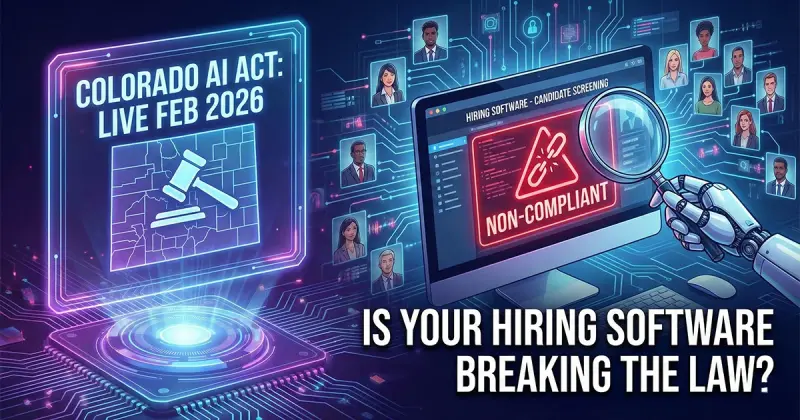
The Colorado AI Act is live (Feb 2026). Is your hiring software compliant? Learn the new rules on algorithmic bias and how to avoid costly legal penalties.
Executive Summary
The emergence of artificial intelligence (AI) has fundamentally reshaped the architecture of the modern American workplace. From the initial sourcing of candidates to the final adjudication of employment offers, automated systems now serve as the gatekeepers of economic opportunity. For years, this technological proliferation operated in a regulatory vacuum, guided only by patchwork guidance and voluntary frameworks. That era has ended. The enactment of the Colorado Artificial Intelligence Act (CAIA), codified as Senate Bill 24-205, represents a watershed moment in U.S. technology policy. As the first comprehensive, cross-sectoral state law to regulate "high-risk" AI systems, the CAIA imposes a statutory duty of care on developers and deployers to prevent algorithmic discrimination.
While the Act was signed into law on May 17, 2024, its substantive obligations are set to take effect starting February 1, 2026, with full enforcement mechanisms and specific deployer duties coming online by June 30, 2026. For employers utilizing hiring software—whether it be an Applicant Tracking System (ATS) that ranks resumes, a video interview platform that analyzes candidate sentiment, or a gamified cognitive assessment—the implications are profound. The CAIA classifies these tools as "high-risk" because they make or significantly influence "consequential decisions" regarding employment.
This report provides an exhaustive analysis of the CAIA, dissecting its complex requirements, the bifurcation of duties between software vendors and employers, the rigorous documentation mandates, and the severe penalties for non-compliance. It explores the shift from a laissez-faire approach to a liability-based model where algorithmic bias is treated as a deceptive trade practice. Furthermore, it offers a detailed examination of the affirmative defenses available to organizations that proactively align their governance with the NIST AI Risk Management Framework. As the February 2026 deadline approaches, employers must recognize that compliance is no longer optional; it is a critical component of corporate risk management.
1. Legislative Genesis and the National Regulatory Landscape
1.1 The Path to Enactment: SB 24-205
The journey of Senate Bill 24-205 reflects the complex interplay between the desire to foster innovation and the urgent need to protect civil rights in the digital age. Sponsored by Senator Robert Rodriguez, the bill was crafted to address the "black box" problem—the opacity of algorithmic decision-making that can inadvertently perpetuate or amplify historical biases.
Governor Jared Polis signed the bill on May 17, 2024, but his approval came with a notable signing statement expressing reservations. He highlighted concerns that a state-by-state "patchwork" of AI regulations could stifle the growth of the technology sector in Colorado and confusingly fragment compliance obligations for national companies. Governor Polis explicitly encouraged the legislature to refine the bill before its effective date, signaling that the CAIA is a living legislative framework likely to evolve even as businesses prepare for its implementation.
Following the initial passage, a special legislative session in August 2025 resulted in amendments that delayed the primary enforcement date from February 1, 2026, to June 30, 2026, for several key deployer obligations. This delay was a concession to business groups and trade associations that argued the original timeline was insufficient for the massive undertaking of auditing and documenting complex AI systems.
1.2 Colorado as a Bellwether for State Action
Colorado is not acting in isolation. The CAIA is part of a broader wave of state-level initiatives filling the void left by federal inaction. While the European Union’s AI Act has set a global standard, Colorado’s law is the first U.S. equivalent to take a comprehensive, risk-based approach.
-
Comparison with NYC Local Law 144: New York City’s law, effective in 2023, requires bias audits for automated employment decision tools (AEDTs). However, the NYC law is a disclosure statute; it mandates transparency but does not impose a general duty of care or liability for the result of the discrimination, provided the audit is published. The CAIA goes significantly further by creating substantive liability for the discriminatory outcomes themselves and imposing a positive duty to mitigate risk.
-
Comparison with California and Illinois: California has finalized regulations regarding automated decision-making under its privacy agency and civil rights council, and Illinois has regulated AI video interviews. The CAIA distinguishes itself by regulating the entire lifecycle of the AI system, from development to deployment, across multiple sectors beyond just employment.
1.3 The "Patchwork" Problem and Preemption
The concern regarding a regulatory patchwork is well-founded. Multi-state employers now face a scenario where a hiring algorithm might be legal in Texas, require a bias audit in New York City, and trigger a full risk management program and duty of care in Colorado. This creates a "lowest common denominator" effect, or more accurately, a "highest common standard" effect. To streamline operations, national employers are likely to adopt the strictest standard—currently Colorado's—as their nationwide baseline compliance protocol.
2. Jurisdictional Scope: Who and What is Covered?
The CAIA’s applicability is determined by three intersecting definitions: the "Developer," the "Deployer," and the "High-Risk Artificial Intelligence System." Understanding these definitions is the first step in assessing liability.
2.1 The Developer-Deployer Distinction
The Act adopts a functional approach to liability, assigning duties based on an entity's role in the AI lifecycle.
-
Developer: Defined as a person doing business in Colorado that develops or intentionally and substantially modifies an artificial intelligence system. This includes traditional software vendors (e.g., Workday, Oracle, specialized AI startups) but also captures employers who build their own tools in-house or significantly customize off-the-shelf software.
-
Deployer: Defined as a person doing business in Colorado that deploys (uses) a high-risk AI system. In the context of hiring, the employer is almost always the deployer. Crucially, the law applies to any entity "doing business in Colorado," which encompasses out-of-state companies hiring Colorado residents.
This bifurcation mirrors the "controller-processor" model in data privacy law (like the GDPR or Colorado Privacy Act), aiming to solve the problem where users blame vendors for bad tools, and vendors blame users for bad data.
2.2 Defining Artificial Intelligence
The Act uses a broad definition of AI: "any machine-based system that, for any explicit or implicit objective, infers from the inputs the system receives how to generate outputs, including content, decisions, predictions, or recommendations, that can influence physical or virtual environments".
This definition captures a wide array of technologies used in hiring:
-
Machine Learning (ML): Algorithms that learn from historical hiring data to predict future performance.
-
Generative AI: Systems like ChatGPT if used to draft job descriptions or evaluate candidate answers (though the Act focuses primarily on predictive decision-making systems).
-
Simple Regressions: Even less complex statistical models could potentially fall under this definition if they "infer" outputs to influence decisions.
2.3 High-Risk Artificial Intelligence Systems
Not all AI is regulated; only "high-risk" systems are subject to the Act's rigorous requirements. A high-risk system is one that, when deployed, makes, or is a substantial factor in making, a consequential decision.
2.3.1 Consequential Decisions
A consequential decision is defined as a decision that has a material legal or similarly significant effect on the provision or denial to any consumer of, or the cost or terms of, specific essential services. The list explicitly includes:
-
Employment or Employment Opportunities.
-
Education enrollment or opportunities.
-
Financial or lending services.
-
Healthcare services.
-
Housing and Insurance.
2.3.2 The Substantial Factor Test
The "substantial factor" element is critical. An AI system does not need to be the sole decision-maker to be high-risk. It is a substantial factor if it generates a factor (content, decision, prediction, recommendation) that:
-
Is used to assist in making the consequential decision; and
-
Is capable of altering the outcome of that decision.
Implication for Hiring: If an ATS ranks 100 resumes and presents the top 10 to a recruiter, the AI has not made the final hiring decision. However, it has effectively denied opportunity to the bottom 90. Therefore, it is a substantial factor in the consequential decision of who gets an interview, making it a high-risk system subject to the law.
3. The Anatomy of High-Risk AI in Employment
To determine if your hiring software is "breaking the law" (or non-compliant), it is necessary to categorize the specific tools commonly used in modern talent acquisition.
3.1 Automated Resume Screeners and Rankers
These are the most ubiquitous forms of high-risk AI. They parse keywords, employment history, and educational background to score candidates.
-
Risk: These systems often replicate historical biases found in training data (e.g., penalizing gaps in employment that correlate with maternity leave, or prioritizing universities with predominantly white populations).
-
Compliance Status: High-Risk. They are a substantial factor in determining who advances in the funnel.
3.2 Video Interview Analysis
Tools that analyze video recordings of candidates to assess "cultural fit," "soft skills," or "honesty" based on facial micro-expressions, tone of voice, or word choice.
-
Risk: High potential for discrimination against candidates with disabilities (e.g., speech impediments, lack of eye contact due to neurodivergence) or those from different cultural backgrounds.
-
Compliance Status: High-Risk. These are used to screen candidates and deny opportunities.
3.3 Gamified Assessments and Psychometric Profiling
Games or tests designed to measure cognitive traits or personality. AI algorithms interpret the gameplay data to predict job performance.
-
Risk: Can disadvantage individuals with different levels of gaming literacy or physical disabilities, unrelated to job performance.
-
Compliance Status: High-Risk. They generate scores used for selection.
3.4 Internal Mobility and Performance Management
AI used to identify employees for promotion, predict flight risk, or suggest termination based on productivity metrics.
-
Risk: Bias in performance data (e.g., sales territories with different demographics) can lead to discriminatory promotion or firing practices.
-
Compliance Status: High-Risk. Employment includes "employment opportunities" like promotion and termination.
3.5 Exempt Technologies
The Act carves out exceptions for technologies that do not make consequential decisions.
-
Keyword Filtering: While not explicitly named as exempt in every summary, simple keyword searches (e.g., "Ctrl+F") are generally not considered AI under the "inference" definition. However, automated filtering that infers relevance is covered.
-
Administrative Tools: Spreadsheets, databases, data storage, and firewalls are explicitly exempt.
-
Chatbots: Interactive technologies (chatbots) are exempt if they are subject to an acceptable use policy prohibiting discriminatory content and are used for information provision rather than decision-making. However, a chatbot that screens candidates by asking "Do you have 5 years of experience?" and rejecting those who say "no" would likely be a high-risk system.
4. The Duty of Care: A Paradigm Shift
The CAIA introduces a "duty of care" for both developers and deployers. In tort law, a duty of care implies a legal obligation to adhere to a standard of reasonable care while performing any acts that could foreseeably harm others.
4.1 Defining Algorithmic Discrimination
The duty is specifically to protect consumers from algorithmic discrimination. The Act defines this as "any condition in which the use of an artificial intelligence system results in an unlawful differential treatment or impact that disfavors an individual or group of individuals on the basis of... classification protected under the laws of Colorado or federal law".
Protected Classifications include:
-
Age, Color, Disability, Ethnicity.
-
Genetic Information, Limited Proficiency in English.
-
National Origin, Race, Religion.
-
Reproductive Health, Sex, Veteran Status.
4.2 Intent vs. Impact
Crucially, the definition covers both "treatment" (which implies intent or disparate treatment) and "impact" (which implies disparate impact, regardless of intent). This aligns with the broader movement in AI ethics that focuses on outcomes. An employer cannot defend a biased system simply by claiming they did not intend to discriminate; if the data shows the system systematically rejects women or veterans, the duty of care has likely been breached.
5. Developer Obligations: The Supply Chain of Trust
Developers (vendors) must provide the transparency necessary for deployers (employers) to use the tools safely. Without this, employers are flying blind.
5.1 Documentation and Disclosure
Developers must provide deployers with a "bundle of documentation". This must include:
-
Training Data Summary: High-level summary of the data used to train the system.
-
Intended Use and Limitations: Clearly stated purpose of the system, its intended benefits, and known limitations.
-
Risk Analysis: Information on known or reasonably foreseeable risks of algorithmic discrimination.
-
Evaluation Metrics: Methods used to evaluate the system's performance and bias mitigation.
5.2 Public Transparency
Developers must publish a statement on their website summarizing the types of high-risk systems they develop and how they manage algorithmic discrimination risks.
5.3 Reporting Obligations
If a developer becomes aware that their system has caused or is reasonably likely to cause algorithmic discrimination, they must notify the Colorado Attorney General and all known deployers within 90 days. This provision creates a dynamic where vendors must self-police and alert their customers to defects, triggering potential liability for the customers if they do not act on that information.
6. Deployer (Employer) Obligations: Operationalizing Compliance
For employers, the CAIA requires a transition from passive consumption of software to active risk management.
6.1 Risk Management Policy and Program
Deployers must implement a risk management policy and program to govern the use of high-risk AI systems. This program must specify the principles, processes, and personnel used to identify and mitigate discrimination risks. It acts as the internal governance structure for AI.
6.2 The Impact Assessment Requirement
The centerpiece of deployer compliance is the Impact Assessment. This is a mandatory, documented evaluation of the AI system's effect on consumers.
Frequency:
Required Components of an Impact Assessment:
-
Purpose and Use Case: Statement of the system's intended use, deployment context, and benefits.
-
Risk Analysis: Analysis of whether the system poses known or reasonably foreseeable risks of algorithmic discrimination and steps taken to mitigate them.
-
Data Transparency: Description of data categories processed (inputs) and outputs generated.
-
Customization: Overview of any data used to customize or fine-tune the system (crucial for employers using their own candidate data).
-
Performance Metrics: Metrics used to evaluate performance and known limitations.
-
Transparency Measures: Description of how the deployer notifies consumers (applicants).
-
Post-Deployment Monitoring: Safeguards and oversight processes.
6.3 Consumer Notification and Rights
The CAIA grants job applicants specifically defined rights to transparency and due process.
Pre-Decision Notice: Before an AI system makes a consequential decision, the employer must notify the applicant. The notice must:
-
Disclose that an AI system is being used.
-
Describe the purpose of the AI system.
-
Provide a plain-language description of the system.
-
Be clear and readily available (e.g., on the job application page).
Adverse Decision Notice:
If the AI system rejects a candidate (an "adverse consequential decision"), the employer must provide a second notice containing:
-
The principal reason(s) for the decision.
-
An opportunity to correct any incorrect personal data relied upon by the system.
-
An opportunity to appeal the decision.
The Human Review Mandate: The appeal process must, if technically feasible, allow for human review. This is a critical operational burden. Employers cannot simply rely on "computer says no." They must have a human available to review the inputs and the AI's logic if an applicant challenges the rejection.
6.4 Reporting Discrimination
If a deployer discovers their system has caused algorithmic discrimination, they must disclose this to the Colorado Attorney General within 90 days. This creates a high-stakes environment for internal audits; finding a problem triggers a mandatory report to the regulator.
7. Affirmative Defenses and the NIST AI RMF
The CAIA creates a powerful incentive for compliance through an "affirmative defense." If an enforcement action is brought, a developer or deployer can defend themselves by proving they acted with reasonable care.
7.1 The Rebuttable Presumption
Compliance with the Act’s specific requirements (risk management program, impact assessments, notices) creates a rebuttable presumption that the entity used reasonable care. This shifts the legal burden to the Attorney General to prove negligence, placing the company in a much stronger legal position.
7.2 The NIST AI Risk Management Framework (RMF)
The Act explicitly links the definition of "reasonable care" to recognized standards. A deployer or developer is eligible for an affirmative defense if they:
-
Discover and cure violations through internal feedback, red teaming, or reviews.
-
Are in compliance with the NIST Artificial Intelligence Risk Management Framework (AI RMF) or another nationally recognized standard designated by the AG (e.g., ISO/IEC 42001).
Table 1: The NIST AI RMF Core Functions for Hiring Compliance
| Function |
Action for Employers |
| GOVERN |
Establish policies prohibiting discrimination; assign roles/responsibilities for AI oversight. |
| MAP |
Contextualize risks: Identify that hiring is "high-risk" and map out potential bias in data sources (e.g., zip codes as proxies for race). |
| MEASURE |
Quantify risks: Use statistical tools to test for disparate impact (e.g., 4/5ths rule analysis). |
| MANAGE |
Mitigate risks: Prioritize high risks; implement "human-in-the-loop" protocols for rejections; disable features if bias is found. |
By aligning their Risk Management Program with these four pillars, employers not only improve their processes but also secure a critical legal shield.
8. Exemptions and Limitations
Not every business or tool is covered. The Act includes specific exemptions to balance regulation with practicality.
8.1 The Small Business Exemption
Small businesses are exempt from the requirements to maintain a risk management program, conduct impact assessments, and make certain public statements.
Criteria for Exemption:
-
Employ fewer than 50 full-time equivalent employees.
-
Do not use their own data to train or customize the high-risk AI system.
-
Use the system only for intended, disclosed uses.
-
Make the developer's impact assessment available to consumers.
Critical Warning: If a small business "customizes" an off-the-shelf ATS with its own historical hiring data to "teach" the AI what a good candidate looks like, they lose the exemption.
8.2 Federal Preemption and Other Carve-Outs
The Act exempts systems that are already regulated by federal agencies with standards equivalent to or stricter than the CAIA.
-
HIPAA: Covered entities making healthcare recommendations are often exempt, but likely not when using AI for employment decisions (as employment is distinct from healthcare delivery).
-
Federal Contractors: Research for DoD or NASA is exempt.
-
Specific Tools: Anti-virus, spam filters, calculators, and databases are exempt.
9. Enforcement and Civil Penalties
The Colorado Attorney General holds exclusive enforcement power.
-
No Private Right of Action: Individual job seekers cannot sue employers under the CAIA itself. However, violations are deemed "deceptive trade practices" under the Colorado Consumer Protection Act (CCPA). While the CAIA blocks private suits, the broader CCPA sometimes allows them, creating some ambiguity that courts may need to resolve.
-
Civil Penalties: Violations can incur civil penalties of up to $20,000 per violation. In a class-action hiring scenario involving thousands of applicants, potential liability could theoretically scale into the millions, although the AG is the primary gatekeeper.
-
Rulemaking: The AG has broad rulemaking authority to define the specifics of impact assessments, notices, and risk management standards. Employers must watch for these rules in late 2025 and 2026.
10. Strategic Implications and Action Plan
The CAIA creates a new reality for HR and Legal departments.
Table 2: Strategic Action Plan for 2026 Compliance
The "De Facto" National Standard
Given the difficulty of geofencing "Colorado residents" in a remote-work world, and the fact that an applicant applying from New York might move to Denver, most national employers will likely adopt CAIA standards across their US operations. It creates a high-water mark for transparency and accountability that is easier to implement universally than to segregate.
Conclusion
The Colorado AI Act is not merely a compliance checklist; it is a fundamental restructuring of the relationship between employers, candidates, and algorithms. It demands that "black box" hiring systems be opened, inspected, and monitored. While the compliance burden is significant, involving extensive documentation and the potential for costly human intervention in appeals, the "affirmative defense" offers a clear path to safety for those who take it seriously.
By February 2026, the question "Is your hiring software breaking the law?" will be answerable not by intent, but by documentation. Employers who rely on "we didn't know the AI was biased" will find no quarter in Colorado courts. Those who embrace the NIST framework and demand transparency from their vendors will not only avoid the $20,000 fines but will likely build more robust, fair, and effective hiring systems for the future. The era of the unaccountable algorithm is over; the era of the audited algorithm has begun.