





10 min read
Amazon & FedEx Delivery Van Accidents in Texas: Who is Actually Liable?
Hit by an Amazon or FedEx van in Texas? Discover who is liable in the e-commerce boom. Learn your legal rights and how to pursue a clai...
Jan 2026 Epstein files expose new details. Can victims reopen estate claims? Analysis of fraud exceptions, new assets, and rights for unnamed victims.
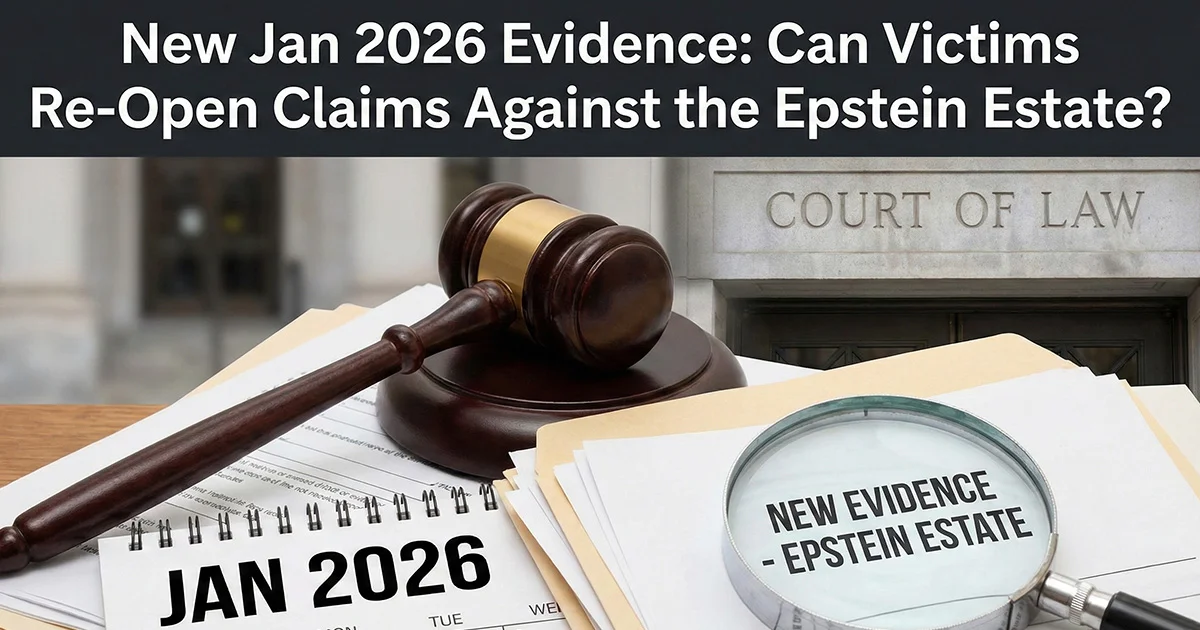
The morning of January 30, 2026, will likely be recorded by legal historians as the moment the "Epstein Era" of sexual abuse litigation transitioned from a phase of managed containment to one of chaotic, unbridled accountability. For nearly two decades, the legal narrative surrounding the late financier Jeffrey Epstein and his vast network of enablers was defined by a calculated opacity. Settlements were reached in shadow; non-disclosure agreements (NDAs) functioned as iron curtains; and the "Epstein Victims' Compensation Program" (EVCP) was established, in part, to offer victims a path to closure that avoided the brutalizing scrutiny of public trials. This architecture of resolution was built on a foundation of "legal finality"—the judicial principle that once a case is settled, it is closed forever.
That foundation has now been subjected to a seismic shock. The release of over 2,000 files, reportedly including high-definition video and photographic evidence seized from secure archives, has fundamentally altered the factual matrix of every settled claim. Unlike the document dumps of the early 2020s—which consisted largely of flight logs, redacted emails, and dry deposition transcripts—this new cache is visceral and objective. It moves the evidentiary standard from the testimonial ("I remember being there") to the undeniable ("Here is the recording of the event").
This report provides an exhaustive, forensic analysis of the legal ramifications of this disclosure. It is written not merely to report the news, but to dissect the complex interplay between contract law, tort liability, and the equitable doctrine of fraud. We examine the formidable barriers to re-opening settled claims, primarily the sanctity of releases signed by victims. Conversely, we explore the potent legal solvent known as "fraudulent concealment"—the principle that "fraud unravels all," which may now allow victims to pierce the corporate and estate veils that have long shielded the full truth.
Furthermore, this analysis places a specific lens on the implications for Canadian victims and the broader application of Canadian legal precedents. The recent 2025 acquittals in the Hockey Canada sexual assault trial and the stay of proceedings in the Peter Nygard criminal case serve as critical, contemporary counter-narratives that highlight exactly why this video evidence is so transformative. While testimonial frailty led to acquittals in those cases, the objective certainty of the Jan 2026 Epstein footage likely precludes such defenses in civil court.
We also turn our gaze to the "third-party enablers"—the financial institutions, hospitality chains, and high-profile associates who, until now, have successfully argued that they were unaware of the specific nature of Epstein’s activities. The 2026 evidence, by potentially depicting these actors in situ, threatens to convert their "willful blindness" into "actual knowledge," triggering massive liability under statutes like the Trafficking Victims Protection Reauthorization Act (TVPRA) and Ontario’s Prevention of and Remedies for Human Trafficking Act.
The central question is simple, yet the answer is labyrinthine: Does the existence of a video, hidden for years, grant a victim the right to tear up a contract they signed a decade ago? The answer lies in the murky waters of what the Estate knew, when they knew it, and whether they lied to buy their peace.
To understand the legal power of the Jan 2026 release, one must appreciate the hierarchy of evidence in sexual assault litigation. Historically, these cases have relied heavily on testimonial evidence—the memories of survivors. While the courts start from a position of believing survivors, the defense bar has spent decades refining techniques to dismantle credibility. They attack memory decay, inconsistencies in timelines, and the influence of media on recollection.
The July 2025 acquittal of five former World Junior hockey players in London, Ontario, stands as a stark testament to the fragility of testimonial evidence. In that case, the judge found the complainant "neither credible nor reliable," citing inconsistencies and a "tendency to blame others". Defense lawyers successfully used video evidence from a hotel lobby and bar—not of the assault itself, but of the surrounding timeframe—to contradict the complainant's testimony regarding her level of intoxication.
The lesson from Hockey Canada is clear: when testimony clashes with video, video usually wins. In the Epstein context, the dynamic is inverted. For years, victims’ testimonies describing specific rooms, specific abuse, and specific third-party observers were met with denials or claims of "fantasy." The Jan 2026 release potentially provides the "video win" for the plaintiffs. If a victim described a specific act of abuse involving a specific toy or location, and the video confirms it, the defense of "memory fabrication" is obliterated.
This shift is monumental for civil litigation. In a civil trial, the standard of proof is the "balance of probabilities" (51% likely). If a plaintiff possesses a video that corroborates their account, the probability of their truthfulness skyrockets, forcing defendants to settle or face almost certain defeat.
For new evidence to justify re-opening a settled case or a closed investigation, it must be "material." It cannot simply be cumulative—i.e., just another photo of Epstein on a plane. It must be evidence that, had it been available at the time of the original settlement, would have likely changed the outcome.
The videos released in Jan 2026 reportedly meet this high threshold because they do not just prove "abuse" in the abstract; they prove the mechanism of the trafficking and the identity of participants.
Proof of Coercion: Videos showing locked doors, the confiscation of passports, or physical restraint serve as direct evidence of "force, fraud, or coercion," which are necessary elements for federal sex trafficking charges and civil claims under the TVPRA.
Proof of Third-Party Presence: A photo of a bank executive at a dinner is one thing; a video of that executive witnessing abuse and doing nothing is legally distinct. It moves the needle from "association" to "complicity."
Anticipating the legal battles of 2026, we must address the inevitable defense: authentication. In an era where Generative AI can create photorealistic video, defendants will undoubtedly argue that the leaked files are "deepfakes" or manipulated media.
However, Canadian and American courts have established rigorous standards for the admission of digital evidence. As noted in R. v. Nikolovski (Supreme Court of Canada), the party submitting the video must establish that it accurately represents the facts. This is typically done through a chain of custody. If these files were released by a government entity (e.g., the DOJ or FBI) following a FOIA request or a court order unsealing them, the chain of custody is secure. If they were leaked by a whistleblower, authentication becomes complex but not impossible. Forensic metadata analysis can determine the creation date, device type, and lack of editing artifacts.
Furthermore, the "deepfake" defense carries its own risks. To assert a video is fake, a defendant might be forced to take the stand to deny being there, opening themselves up to cross-examination. If forensic experts authenticate the video, the defendant's credibility is destroyed, likely leading to punitive damages for prolonging the litigation with frivolous defenses.
The judicial systems of the Western world operate on the premise that litigation must have an end. Settlements are the mechanism that ensures this. As emphasized in Book v. Cociardi (2024 Ont CA), courts strongly favor the finality of settlements. When a plaintiff signs a release in exchange for compensation, they are selling their right to sue, essentially betting that the settlement amount is better than the uncertain outcome of a trial.
This principle is codified in the releases used by the Epstein Victims' Compensation Program (EVCP). These documents were drafted by top-tier legal minds to be comprehensive, releasing the Estate, its executors, and related entities from "any and all" claims, known or unknown. The Program was voluntary, independent, and promised "closure".
For a victim to return in 2026 and say, "I want more money because there is now a video," the default legal answer is "No." The courts typically view the discovery of new evidence as a risk the settling party assumed. As stated in Nanda regarding personal injury: "The settlement amount is the final sum... even if they discover later that the extent of their injuries are more".
There is, however, a master key that can unlock even the most securely bolted settlement doors: Fraud.
The legal maxim fraus omnia corrumpit—"fraud unravels all"—is recognized in the UK, Canada, and the US. It holds that a contract obtained by fraud is voidable at the option of the defrauded party. As the Supreme Court of Canada affirmed in M.(K.) v. M.(H.) and recent UK judgments like Lazarus Estates, a judgment or settlement procured by fraud cannot stand.
The critical distinction is between "new evidence" and "fraudulently concealed evidence."
Scenario A (New Evidence): A witness comes forward in 2026 who was previously afraid. This is usually not grounds to re-open a settlement, as the unavailability of the witness was a known litigation risk.
Scenario B (Fraudulent Concealment): The Epstein Estate possessed the videos in 2020, knew they were material to the victims' claims, and intentionally suppressed them or lied about their existence during the EVCP process to induce lower settlements.
This is the battleground. To rescind the settlement, a victim must prove the elements of Civil Fraud or Fraudulent Misrepresentation:
False Representation: The Estate made a statement (e.g., "We have disclosed all relevant records") that was false.
Knowledge: They knew it was false.
Inducement: The victim relied on that statement when deciding to settle.
Causation: Had the victim known of the videos, they would not have settled for that amount.
In Hayward v. Zurich Insurance Co plc (UK), the court wrestled with this tension. It ruled that if a defendant settles a claim suspecting fraud but wanting to avoid the hassle, they cannot later re-open it when fraud is proven. They settled "with eyes wide open".
Epstein’s defense team (or the Estate) might argue that victims knew Epstein was a monster and knew he likely recorded things, so they settled with the "risk" that tapes might emerge.
However, the counter-argument for the victims is stronger in 2026. The specific nature of the Jan 2026 evidence—videos showing third-party involvement or specific acts of trafficking—was likely unknown to the victims. A victim might know they were abused, but not know that a camera was behind the mirror recording it for blackmail purposes. If the Estate denied the existence of such recordings, that is a specific fraudulent misrepresentation that induced the settlement. The "eyes wide open" defense fails if the defendant glued the plaintiff's eyes shut regarding the specific asset (the video) in question.
Canadian jurisprudence is particularly favorable to plaintiffs in these scenarios. In Deschenes v. Lalonde (2020 ONCA), the court upheld the rescission of a settlement based on "innocent misrepresentation" regarding a material fact. The court ruled that even if the defendant didn't know they were lying (innocent misrepresentation), if the fact was material to the decision to settle, the contract could be set aside.
Furthermore, M.(K.) v. M.(H.) establishes that fraudulent concealment suspends limitation periods. In incest and sexual abuse cases, the "discoverability" principle is applied generously. The limitation clock does not start until the victim discovers the fraud. Thus, the "discovery" of the fraud (the concealment of the tapes) would be dated to January 30, 2026, making the motions to re-open timely.
One of the most contentious aspects of the Epstein litigation has been the use of "Third-Party Releases." This was brought to global attention during Virginia Giuffre v. Prince Andrew.
Prince Andrew’s legal team successfully argued that a 2009 settlement agreement between Giuffre and Jeffrey Epstein protected him, even though he was not a party to it. The agreement released Epstein and "any other person or entity who could have been included as a potential defendant". Judge Lewis Kaplan was skeptical but acknowledged the breadth of the language before the case eventually settled out of court.
The Jan 2026 videos provide a fresh avenue to attack the validity of that 2009 release (and similar ones). If Giuffre can prove that Epstein obtained that 2009 release by fraudulently concealing the videos (which would have proved the "potential defendants" were actually "co-conspirators" engaged in active crimes), the release itself could be voided.
If the release is voided for fraud, the shield it provides to third parties (like Prince Andrew or other associates named in the 2026 files) evaporates. This is a critical nuance: the fraud of the primary defendant (Epstein) can vitiate the protection extending to the third-party beneficiaries (the "Potential Defendants").
The videos likely implicate individuals who were never sued because there was insufficient evidence to link them to the abuse. For these individuals, no settlement release exists. The emergence of the videos allows victims to file new lawsuits against these individuals.
No Double Jeopardy in Civil Law: While you cannot sue the same person twice for the same tort if you settled, you can sue new joint tortfeasors unless your original release explicitly covered "all joint tortfeasors" (which many Epstein releases did, but again, subject to the fraud exception).
To predict the trajectory of the post-2026 Epstein litigation, we must look to parallel Canadian cases that highlight the role of evidence retention and corporate liability.
Peter Nygard, the fashion mogul, faced allegations strikingly similar to Epstein’s: a trafficking ring run from a compound (in the Bahamas), facilitated by corporate employees, and involving the recruitment of young women.
The Criminal Failure: In October 2025, criminal charges against Nygard in Winnipeg were stayed because police had destroyed interview records from the 1990s. The judge ruled this violated his right to a fair trial. This underscores the fragility of criminal justice when evidence is not preserved.
The Civil Success: Conversely, the civil class actions against Nygard proceeded. The civil courts allowed the use of "similar fact evidence" from dozens of victims to establish a pattern. The lesson here is that while criminal courts require pristine procedural history, civil courts are more flexible in aggregating evidence to find liability. The Epstein videos, unlike the lost Nygard tapes, are preserved. This prevents the "lost evidence" defense and empowers the civil plaintiffs to succeed where criminal prosecutors might stumble on procedural technicalities.
Corporate Liability: The Nygard lawsuits targeted "Nygard International" and "Nygard Inc." as enterprises. The complaint alleged the corporation’s funds and offices were used to recruit victims. The Jan 2026 Epstein videos likely show similar institutional support (e.g., pilots, assistants, household staff). This reinforces the ability of victims to sue the Estate and shell companies for the "enterprise liability" of trafficking, rather than just the individual acts of Epstein.
The acquittal of the five Hockey Canada players in 2025 serves as a grim reminder of the "he said, she said" dynamic. The defense successfully leveraged the complainant’s intoxication and memory gaps against her.
The Video Difference: In the Epstein case, the Jan 2026 videos serve as the antidote to the "Hockey Canada defense." If a victim was intoxicated (often a tactic of Epstein’s grooming), their memory might be fragmented. The defense would typically exploit this. However, the video evidence fills those gaps objectively. It proves the intoxication was likely induced (a crime) and documents the acts that followed. The video shifts the narrative from "unreliable witness" to "vulnerable victim of documented crime."
With the Estate’s assets depleted or tied up, the new frontier of litigation is the "enablers." The Jan 2026 evidence is most dangerous to these entities.
Banks like JPMorgan and Deutsche Bank have already settled for hundreds of millions based on "Know Your Customer" (KYC) failures. However, the new videos could trigger a second wave of litigation based on actual knowledge.
TVPRA Liability: The TVPRA allows victims to sue anyone who "knowingly benefits" from a venture they "knew or should have known" was trafficking.
The Shift: Previous cases relied on the argument that banks "should have known" based on high-risk transaction patterns (large cash withdrawals, payments to recruiters). The Jan 2026 videos might show something worse: direct interaction between bank relationship managers and the trafficking environment. If a video shows a banker at Epstein's island witnessing the presence of minors, the bank’s defense of "we just processed the transactions" collapses. Actual knowledge triggers punitive damages, which are often excluded from insurance coverage.
Hotels are increasingly being held liable for trafficking occurring on their premises.
Canadian Context: Under Ontario’s Prevention of and Remedies for Human Trafficking Act, a hotel that "harbours" a victim can be sued.
US Context: In Jane Doe v. Hotel Chains, courts have denied motions to dismiss where plaintiffs alleged hotels ignored obvious signs (men coming and going, cash payments).
The Video Impact: If the Jan 2026 videos are time-stamped and located within specific luxury hotels, they provide undeniable proof that the trafficking occurred there. If the videos show hotel staff bringing room service to a room where abuse was visible, or staff interacting with obviously coerced minors, the hotel’s liability becomes nearly strict.
In Canada, the issue of "coerced debt" is rising. Traffickers often force victims to take out loans or credit cards. If the Epstein videos show Canadian victims being forced to sign financial documents, this opens a specific avenue of litigation against Canadian banks for "coerced debt" recovery and damages for facilitating financial abuse. The Cassandra Harvey case highlights the CRA and banks' slow response to this ; the Epstein evidence could spur a class action demanding systemic reform and compensation for financial credit destruction.
| Legal Standard | Civil Fraud (The Key to Re-Opening) | Negligence (Insufficient for Re-Opening) | Impact of Jan 2026 Evidence |
| Burden of Proof | Balance of Probabilities (but requires "cogent" evidence). | Balance of Probabilities (more likely than not). | The videos provide the "cogent" evidence needed to prove the serious allegation of fraud. |
| Mental State |
Intentional deceit or recklessness regarding truth. |
Carelessness; breach of standard of care. | Videos showing organized recording imply intent to blackmail/conceal, supporting fraud. |
| Effect on Releases |
Voids the Release ("Fraud unravels all"). |
Release remains binding (Mistake is not enough). |
Only by proving Fraud can victims bypass the EVCP release. |
| Limitation Periods |
Suspended until fraud is discovered (Jan 2026). |
Runs from the date of injury/loss. | The "Discovery Rule" resets the clock as of Jan 30, 2026. |
| Damages Available | Rescission (undo settlement) + Punitive Damages. | Compensatory Damages. | Opens the door to massive punitive awards against the Estate/Enablers. |
Option 1: The "Rescission" Motion
Target: The Epstein Estate.
Mechanism: File a motion to set aside the EVCP settlement based on newly discovered evidence of fraudulent concealment.
Pros: Potential for much higher damages if the Estate has hidden assets or insurance.
Cons: High legal cost; risk of returning the original settlement money (though courts often allow it to be set off against the new award); the Estate is largely liquidated.
Option 2: The "Third-Party" Blitz
Target: Banks, Hotels, Recruiters, Associates (Prince Andrew, etc.).
Mechanism: File new lawsuits under TVPRA or Canadian Torts alleging these parties were not covered by the original releases (or the releases are void due to fraud).
Pros: Deep pockets (Banks); new defendants not previously sued; strong video evidence of complicity.
Cons: Complex litigation against well-funded corporate defense teams.
Option 3: The Canadian Statutory Tort
Target: Any Canadian-connected enabler or asset.
Mechanism: Sue under Ontario’s Human Trafficking Act.
Pros: No limitation periods; statutory presumption of damages; easier asset freezing.
Cons: Limited to cases with a Canadian nexus (victim, perpetrator, or act occurred in Canada).
The release of the Jan 2026 evidence does not guarantee that every victim will receive a new payout. The legal system is designed to protect finished business, and the "finality" of the EVCP settlements is a formidable barrier. However, the sheer nature of this evidence—its capacity to prove fraudulent concealment—provides the specific key needed to unlock those doors.
The "fraud unravels all" doctrine is the victims' most powerful weapon. By arguing that they were induced to settle by an Estate that lied about the existence of this incriminating footage, victims can legally reset the clock.
Moreover, the primary fallout will likely not be against the hollowed-out Estate, but against the periphery: the banks that moved the money and the hotels that hosted the abuse. The videos strip these entities of "plausible deniability." In the Nygard case, the civil system proved resilient even when the criminal system failed. In the Epstein case, the civil system is now armed with the kind of evidence prosecutors dream of.
For the victims, January 30, 2026, marks the day the "he said, she said" era ended, and the era of "we saw what you did" began.
Q: I signed a "General Release" with the Epstein Estate in 2021. Can I really sue again?
A: It is difficult, but possible. You cannot sue simply because you want more money. You must prove that the Estate defrauded you by hiding specific evidence (the videos) that they had a legal duty to disclose. If the court agrees they lied to get you to sign, the release can be "rescinded" (cancelled).
Q: Does the Canadian "Hockey Canada" acquittal mean the videos won't help?
A: No, quite the opposite. The Hockey Canada players were acquitted largely because there was no video of the alleged assault, only testimonial inconsistencies. In the Epstein case, the existence of video cures the problems of memory and testimony. It provides the objective proof that was missing in the Hockey Canada case.
Q: Can I sue a bank if I see a video of their manager with Epstein?
A: Yes. Under the US Trafficking Victims Protection Reauthorization Act (TVPRA), you can sue anyone who "knowingly benefited" from the trafficking. A video showing a bank manager witnessing abuse or interacting with victims in a trafficking setting is powerful proof of "actual knowledge," which is much harder for a bank to defend against than "constructive knowledge."
Q: I am a Canadian victim. Does the "Statute of Limitations" prevent me from using this new evidence?
A: Likely not. In Ontario and British Columbia, there is no limitation period for civil sexual assault claims. You can sue regardless of how much time has passed. Additionally, the "discoverability principle" means that if you only found out about a specific enabler's involvement because of the Jan 2026 videos, your time to sue them likely starts now.
Q: What is the "Tort of Human Trafficking"?
A: This is a specific law in Ontario (and similar ones in other provinces) that allows victims to sue traffickers and enablers. It is favorable to victims because it streamlines the process of proving the crime and allows for the freezing of the defendant's assets to ensure you get paid.
Hit by an Amazon or FedEx van in Texas? Discover who is liable in the e-commerce boom. Learn your legal rights and how to pursue a clai...

Injured on an icy Georgia sidewalk? Find out who is liable. Our legal guide explains premises liability rules for business owners, land...
How much is a divorce in California? Get a 2026 breakdown of attorney fees, court filing costs, and expenses for contested vs. uncontes...
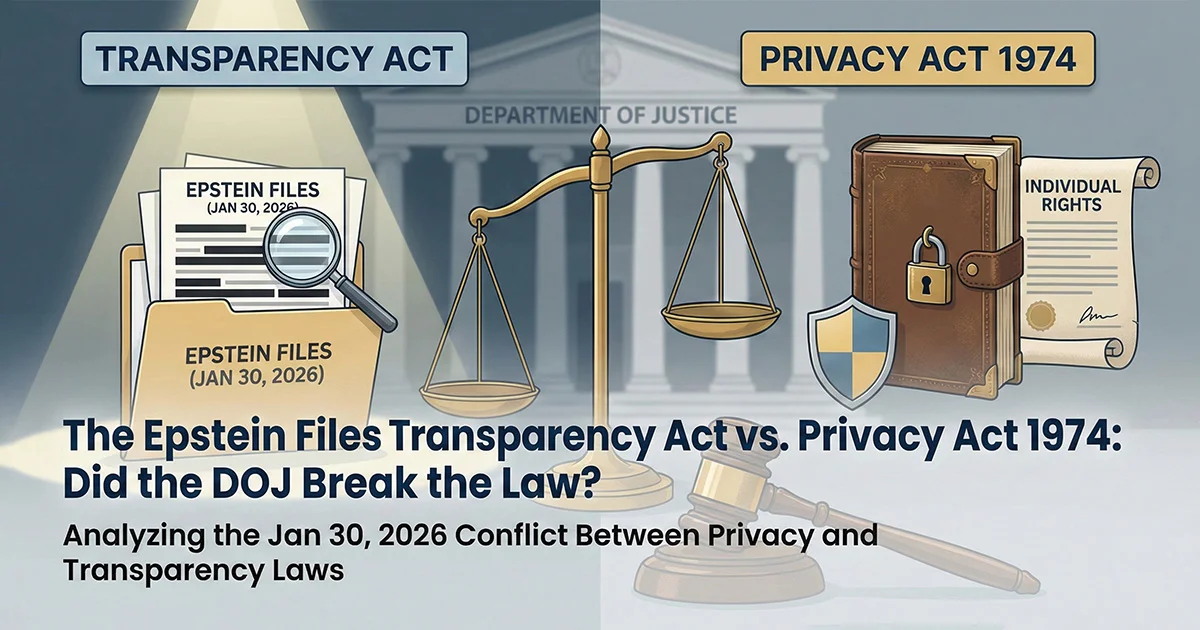
The Jan 30, 2026 Epstein release sparked a legal war. Did the DOJ violate the Privacy Act of 1974 by releasing names of innocent people...
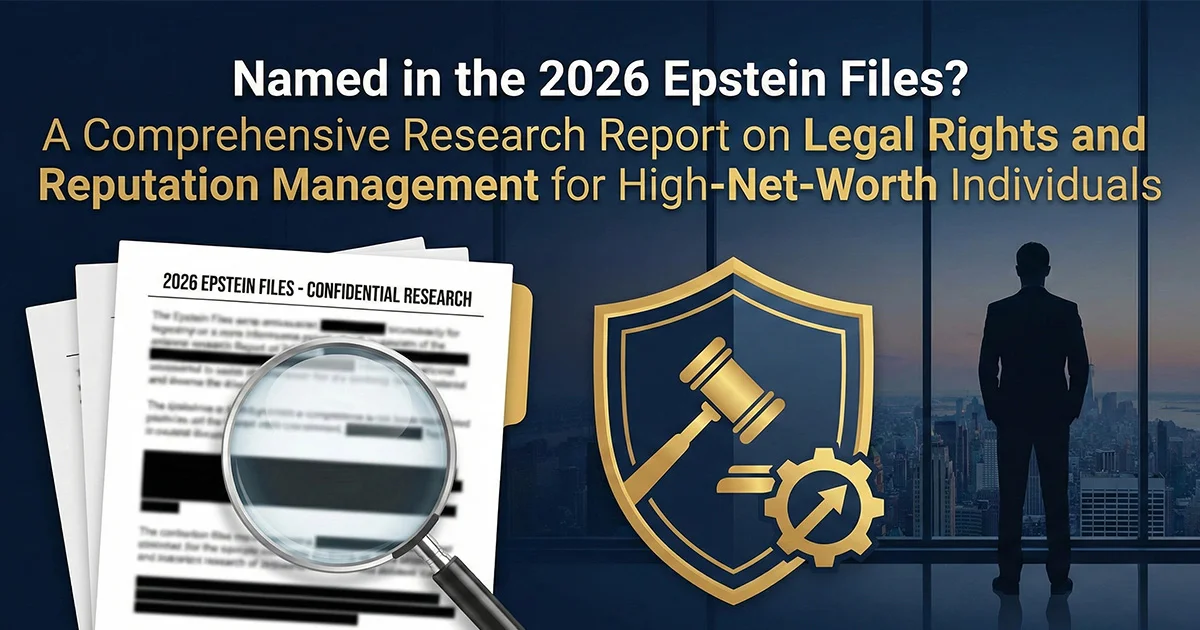
Was your name released in the Jan 30 Epstein files? Don't panic. Learn your rights under Canadian defamation law and how to protect you...

iscover the hidden dangers that can strip away your US status. From shoplifting to tax fraud, we explain deportation risks for Green Ca...
Legal Disclaimer: Best Attorney USA is an independent legal directory and information resource. We are not a law firm, and we do not provide legal advice or legal representation. The information on this website should not be taken as a substitute for professional legal counsel.
Review Policy: Attorney reviews and ratings displayed on this site are strictly based on visitor feedback and user-generated content. Best Attorney USA expressly disclaims any liability for the accuracy, completeness, or legality of reviews posted by third parties.