Injured on an icy Georgia sidewalk? Find out who is liable. Our legal guide explains premises liability rules for business owners, landlords, and municipalities in GA.
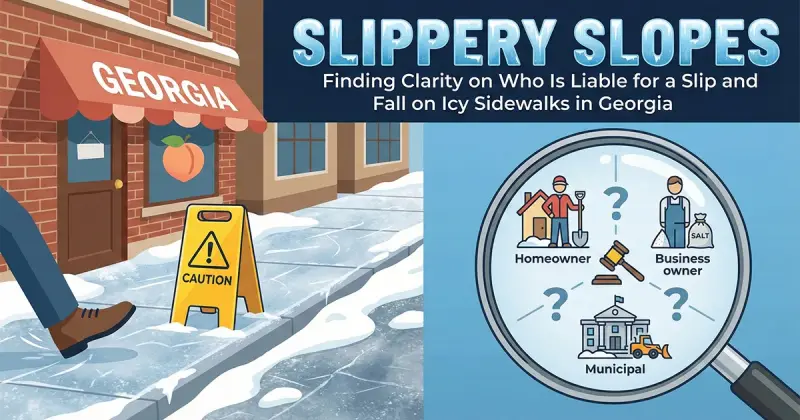
One moment, you are walking into a store or heading to your car on a chilly morning; the next, your feet are out from under you, and you are staring at the Georgia sky from the cold pavement. The shock is immediate, but the physical pain and the stress of medical bills often linger much longer. You might feel embarrassed or blame yourself for "not looking," but in many cases, the law tells a different story. If you have suffered a slip and fall on icy sidewalks, understanding who is liable in Georgia is the first step toward getting the help you need.
Georgia’s winters are notoriously unpredictable, often bringing "black ice" that is nearly invisible to the naked eye. While property owners cannot control the weather, they can control how they maintain their premises to protect you. Navigating the legal aftermath of a fall is overwhelming, especially when insurance companies start calling to shift the blame. This guide is designed to cut through the legalese and provide the empathetic, authoritative guidance you deserve.
The Foundation of Your Claim: O.C.G.A. § 51-3-1
In Georgia, premises liability is governed by a specific statute: O.C.G.A. § 51-3-1. This law dictates that if a property owner or occupier invites you onto their land for a lawful purpose, they have a legal duty to exercise ordinary care in keeping the premises and "approaches" (like sidewalks and parking lots) safe.
However, "ordinary care" does not mean a property owner is an insurer of your total safety. It means they must act reasonably. If an ice storm passed through twelve hours ago and the store owner did nothing to salt the entrance, they may have breached this duty. If the ice formed 30 seconds before you stepped on it, the law is much more forgiving to the owner.
Your Legal Status Matters
The level of protection you are entitled to depends on why you were on the property. Georgia classifies visitors into three categories:
-
Invitees: These are customers at a store, clients at an office, or patients at a hospital. Owners owe invitees the highest duty of care, which includes a duty to inspect for hazards like ice.
-
Licensees: These are social guests. A homeowner generally only has a duty to warn you of "non-obvious" dangers they actually know about. They do not necessarily have to inspect the driveway for ice every hour.
-
Trespassers: People on property without permission. Owners generally only have a duty to avoid "willful or wanton" injury.
The "Superior Knowledge" Doctrine: The Legal Battleground
To win a case for a slip and fall on icy sidewalks, you must prove more than just the existence of ice. Georgia courts use the Superior Knowledge Doctrine. This means you must show:
-
The property owner had actual or constructive knowledge of the ice.
-
You, despite exercising ordinary care, lacked knowledge of the hazard.
Actual vs. Constructive Knowledge
-
Actual Knowledge: An employee saw the ice or a customer complained about it before your fall.
-
Constructive Knowledge: This is the "should have known" standard. If the ice was there long enough that a reasonable inspection would have found it, the law treats the owner as if they knew.
The Golden Rule
Never admit fault at the scene. Even a simple "I'm sorry, I wasn't looking where I was going" can be used by insurance companies to prove you had "equal knowledge" of the hazard, which could completely bar you from recovering any compensation under Georgia's strict liability rules.
Natural vs. Artificial Accumulation: Is the Weather an Excuse?
For years, property owners tried to use the "Natural Accumulation Rule" to argue they weren't responsible for "Acts of God" like snow or ice. However, Georgia law has evolved.
In the landmark case Dumas v. Tripps of North Carolina, Inc., the court clarified that naturally occurring ice does not negate a business owner's duty to inspect and make the premises safe. The focus is on whether the owner acted reasonably after the ice formed.
The "Black Ice" Complication
"Black ice" is a thin, transparent coating that takes on the color of the pavement beneath it. Because it is so hard to see, it is often not considered an "open and obvious" danger. If you can prove the owner knew the temperature had dropped and that moisture was present (like a leaking sprinkler or recent rain), you can argue they had constructive knowledge that black ice was likely to form.
Local Nuances: Atlanta Code Section 138-14
If your fall happened within the City of Atlanta, you have an additional layer of protection. Atlanta Code Section 138-14 explicitly requires owners or occupants of buildings fronting a sidewalk to clear snow and ice within a reasonable time after it accumulates.
While a violation of this ordinance does not lead to "automatic" victory, your attorney may argue Negligence Per Se. This means that because the owner violated a safety law intended to protect pedestrians, the "duty" and "breach" parts of your claim are much easier to prove.
Defenses: How They Will Try to Stop Your Claim
Insurance companies have a "playbook" for Georgia slip and fall cases. You need to be prepared for these common defenses:
-
Open and Obvious: They will argue that any reasonable person would have seen the ice and avoided it. We counter this by highlighting poor lighting, distractions created by the store (like sales signs), or the "invisible" nature of black ice.
-
Comparative Negligence (The 50% Rule): Georgia follows a "Modified Comparative Negligence" system.
-
If you are less than 50% at fault, you can recover damages (though they are reduced by your fault percentage).
-
If you are 50% or more at fault, you get nothing.
Data Visualization: Settlement vs. Trial
Choosing how to resolve your claim is a major decision. Here is how the two paths generally compare:
| Feature |
Out-of-Court Settlement |
Jury Trial |
| Speed |
Typically faster (months) |
Much slower (1–3 years) |
| Control |
You decide whether to accept |
The jury decides your fate |
| Cost |
Lower legal expenses |
Higher (expert witnesses, court fees) |
| Certainty |
Guaranteed payment once signed |
No guarantee of a win |
| Privacy |
Usually remains confidential |
Public court record |
| Max Value |
Often lower than "jackpot" verdicts |
Potential for much higher awards |
FAQs: What People Ask About Icy Falls in Georgia
1. How long do I have to file a lawsuit? In Georgia, the Statute of Limitations for personal injury is generally two years from the date of the fall. However, if you fell on government-owned property (like a city sidewalk), you must file an Ante Litem Notice much sooner—often within 6 months.
2. Can I still sue if there was a "Wet Floor" sign? Yes. A sign is just one factor. If the sign was placed in a way that wasn't visible, or if the ice was so widespread that a single sign didn't solve the hazard, the owner may still be liable.
3. What if I was wearing "inappropriate" shoes? The defense will use this to argue you were negligent. However, unless you were wearing something truly reckless for the weather, this usually only results in a small reduction in your award, not a total bar to recovery.
4. What kind of evidence do I need? Photos of the ice, your shoes, and the surrounding area are critical. Since ice melts, this evidence disappears quickly. Surveillance footage is also vital, but many stores overwrite it within 24–48 hours, so an attorney must send a "spoliation letter" immediately.
5. How much is my case worth? Value depends on your "economic damages" (medical bills, lost wages) and "non-economic damages" (pain and suffering). Verdicts in Georgia for serious injuries on ice have ranged from thousands to over $1.5 million depending on the severity and the owner's level of negligence.
Conclusion: You Don't Have to Walk This Path Alone
A slip and fall on an icy sidewalk is more than just a physical injury; it is a financial and emotional burden that can stall your life. Between the Superior Knowledge Doctrine and the 50% bar for comparative negligence, Georgia law is complex and favors property owners who have high-powered insurance lawyers on their side.
You deserve a team that understands the local ordinances in Atlanta and the statewide statutes that protect you. Don't let a "hidden" patch of ice or a negligent property owner derail your future. Contact a professional Georgia premises liability attorney today for a free case evaluation. We will help you gather the evidence, handle the insurance adjusters, and fight for the compensation you need to heal.
Authoritative Resources for Further Reading