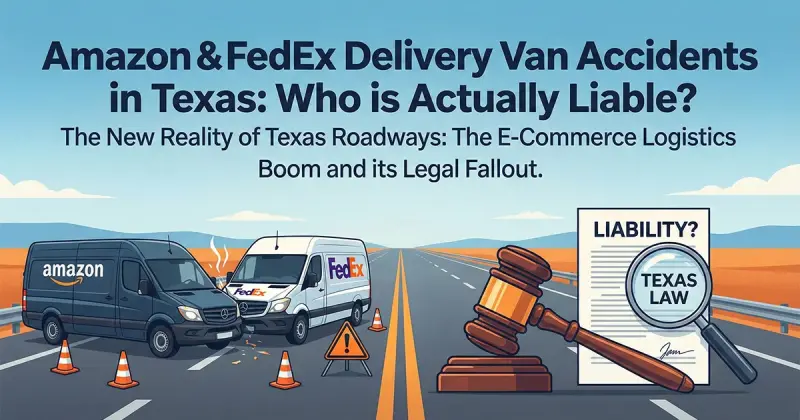
Hit by an Amazon or FedEx van in Texas? Discover who is liable in the e-commerce boom. Learn your legal rights and how to pursue a claim under TX law in our guide.
The New Reality of Texas Roadways: The E-Commerce Logistics Boom and its Legal Fallout
The highways and residential streets of Texas have undergone a profound transformation over the last decade. The undeniable convenience of e-commerce, driven by logistics behemoths like Amazon and FedEx, has flooded the state’s infrastructure with a relentless fleet of delivery vehicles. From the dense urban traffic of Houston and Dallas to the sprawling interstates connecting San Antonio and Austin, the presence of Prime vans and FedEx trucks is now a ubiquitous feature of daily life. However, this surge in delivery volume has precipitated a parallel rise in catastrophic vehicular accidents, creating a complex new frontier in personal injury litigation. For the stressed individual in Texas who has been injured in such a collision, or for the family grieving a wrongful death, the aftermath is often characterized not just by physical pain and financial anxiety, but by a labyrinthine legal system designed to obscure liability.
The fundamental legal challenge in these cases lies in the "corporate shield" operational models employed by these giants. Unlike traditional trucking companies that might directly own their fleets and employ their drivers, Amazon and FedEx largely rely on a fragmented network of independent contractors, third-party logistics providers, and gig-economy workers to complete the "last mile" of delivery. This structural decoupling is not accidental; it is a sophisticated legal strategy intended to distance the parent corporation from the negligent acts of the drivers delivering their packages. Consequently, a victim is rarely suing just a driver; they are engaging in a high-stakes battle against a layered defense system that involves shifting insurance periods, contested employment statuses, and recently enacted state statutes like House Bill 19 that fundamentally alter how commercial vehicle trials are conducted in Texas.
This comprehensive analysis serves as a definitive guide for navigating the liability maze of delivery van accidents in Texas. It dissects the operational hierarchies of FedEx and Amazon, examines the specific insurance mandates under the Texas Insurance Code and the new Delivery Network Company (DNC) regulations, and details the procedural hurdles introduced by tort reform. By understanding the interplay of federal motor carrier regulations, state statutory frameworks, and emerging case law—such as the landmark $105 million verdict in Lopez v. All Points 360—victims and their advocates can better identify the path to securing fair compensation.
Part I: The Bifurcated Reality of FedEx Liability
To the average motorist, a white truck with purple and orange lettering is simply "FedEx." However, in the eyes of the law, the entity responsible for that vehicle depends entirely on which division of the FedEx corporation is operating it. This distinction is the single most critical factor in determining liability and available insurance coverage.
The Direct Employment Model: FedEx Express and FedEx Freight
FedEx operates distinct operating companies that function under different legal paradigms. FedEx Express (air and time-definite ground) and FedEx Freight (less-than-truckload freight) typically employ their drivers directly. This direct employment relationship significantly simplifies the legal theory of liability through the doctrine of respondeat superior.
Under Texas law, respondeat superior (Latin for "let the master answer") holds an employer vicariously liable for the negligence of its employees if that negligence occurs within the "course and scope" of employment. In a collision involving a FedEx Express van, the plaintiff does not necessarily need to prove that FedEx corporate was negligent in its hiring or training; they need only prove that the driver was negligent and was on the clock. Because the driver is an employee, their negligence is imputed to the corporation, allowing access to FedEx’s substantial corporate insurance policies.
Drivers in these divisions typically receive company benefits, drive vehicles owned directly by FedEx, and are subject to direct supervision regarding their routes and schedules. This clear chain of command makes establishing corporate liability relatively straightforward compared to the Ground division.
The Independent Contractor Shield: FedEx Ground
The FedEx Ground division, which handles the bulk of residential and e-commerce deliveries, operates on a fundamentally different legal chassis. FedEx Ground generally does not employ its drivers. Instead, it contracts with thousands of small, independent businesses known as Independent Service Providers (ISPs) or Contracted Service Providers (CSPs).
These ISPs are separate for-profit corporations that own the delivery routes and the vehicles. They are contractually obligated to hire, train, and employ their own drivers. When a FedEx Ground van runs a red light and causes a T-bone collision, FedEx’s immediate legal defense is that it is not the driver's employer and therefore bears no vicarious liability for the driver's actions.
The "Right of Control" Test
The legal battle in FedEx Ground cases often centers on piercing this independent contractor shield. Texas courts look beyond the label in the contract to the actual reality of the relationship. The central inquiry is the "Right of Control." Under Texas jurisprudence, an owner or general contractor (FedEx) can be held liable for the acts of an independent contractor (the ISP) if the owner retains the right to control the "means, methods, and details" of the work.
Plaintiffs' attorneys meticulously investigate the following factors to establish this control:
-
Uniforms and Branding: Does FedEx require drivers to wear specific uniforms and maintain vehicles to exact branding standards?.
-
Scanners and Technology: Does FedEx require the use of proprietary scanners that dictate the sequence of deliveries?.
-
Scheduling: Does FedEx dictate the window of time in which packages must be delivered, effectively removing the ISP’s discretion over scheduling?.
-
Training Mandates: Does FedEx require drivers to undergo specific safety training programs like the "Safe Driving Skills" course?.
Litigation history, such as the Alexander v. FedEx Ground decision and the subsequent $240 million settlement in 2016, demonstrates that courts are increasingly skeptical of this independent contractor classification when the parent company exercises pervasive control over daily operations. However, without strong evidence of such control, liability may stop at the ISP—a much smaller entity with significantly lower insurance limits than FedEx Corporation.
Insurance Requirements for FedEx Ground ISPs
While FedEx attempts to insulate itself, it does mandate that its ISPs carry substantial insurance. The standard FedEx Ground ISP agreement requires the contractor to maintain:
-
Auto Liability Insurance: A minimum combined single limit (CSL) of $1,000,000 per occurrence for bodily injury and property damage.
-
General Liability: Coverage for non-vehicular negligence.
-
Workers' Compensation: Statutory limits to cover driver injuries.
For the victim, this means the first layer of recovery is the ISP’s $1 million policy. Accessing FedEx’s excess coverage usually requires proving that FedEx’s own negligence (e.g., in selecting or retaining an unsafe contractor) contributed to the accident.
Part II: Amazon’s Multi-Tiered Delivery Network
Amazon’s logistics ecosystem is even more fragmented than FedEx's, utilizing a tripartite system that includes Delivery Service Partners (DSPs), Amazon Flex drivers, and Middle Mile carriers. Each tier presents unique liability challenges and insurance structures.
1. The Delivery Service Partner (DSP) Program
The ubiquitous blue-gray Prime vans are overwhelmingly operated by DSPs—small, independent logistics companies that lease vans and employ drivers to execute routes generated by Amazon’s algorithms.
The Joint Employer Doctrine
Similar to FedEx Ground, Amazon asserts that DSP drivers are not its employees. However, the "Joint Employer" doctrine is frequently litigated in these cases. Plaintiffs argue that Amazon’s control is so absolute—monitoring drivers via Netradyne cameras, setting rigid delivery quotas, and possessing the power to "offboard" (effectively fire) drivers—that it functions as a joint employer alongside the DSP.
Recent verdicts have validated this approach. In the Lopez v. All Points 360 case, a jury returned a staggering $105 million verdict against an Amazon DSP and other defendants after a catastrophic accident. The jury found the DSP grossly negligent for employing an unlicensed and untrained driver, a fact pattern that highlights the immense risks inherent in the rapid scaling of the DSP program.
2. Amazon Flex: The Gig Economy Variable
Amazon Flex utilizes individuals driving their personal vehicles to deliver packages, similar to Uber or Lyft. This model introduces the "Period" system of insurance coverage, which is a frequent source of coverage denial and litigation disputes.
The Three Periods of Coverage
Liability coverage for Flex drivers fluctuates based on their status within the app at the exact moment of the crash. This structure is codified in emerging laws like Texas HB 4215 (Delivery Network Companies) but remains a contentious issue in claims adjustment.
The Gap Trap: The most dangerous "gap" for victims is Period 1. If a Flex driver hits you while looking for a route but hasn't accepted one, their personal insurer may deny the claim because they were engaged in commercial activity (app on), while Amazon may argue the driver wasn't "working" yet. While Texas law mandates contingent coverage here, securing it often requires a formal denial letter from the personal carrier, delaying the victim's recovery.
3. The Middle Mile: 18-Wheelers and Freight
Amazon also contracts with motor carriers to haul freight between fulfillment centers (the "Middle Mile"). These accidents involve heavy commercial trucks and are governed by federal FMCSA regulations. In Lopez v. All Points 360, the at-fault vehicle was an 18-wheeler carrying Amazon freight, illustrating that Amazon's liability extends beyond just the sprinter vans in neighborhoods to the massive rigs on the interstate.
Part III: The Texas Statutory Landscape – HB 19 and Beyond
The procedural reality of suing a delivery company in Texas changed dramatically on September 1, 2021, with the enactment of House Bill 19 (HB 19). This law was designed to curb what the legislature termed "abusive commercial vehicle litigation," but for plaintiffs, it represents a significant strategic hurdle.
The Mechanism of Bifurcated Trials
HB 19 allows a defendant (such as a trucking company or DSP) to request a bifurcated trial. This splits the litigation into two distinct phases.
-
Phase 1: The jury hears evidence only regarding the specific accident details and the driver's negligence. The jury determines compensatory damages (medical bills, lost wages). Crucially, evidence of the company’s broader safety history or systemic negligence is generally inadmissible in this phase, provided the company stipulates that the driver was acting within the course and scope of employment. This prevents the jury from being "prejudiced" by the company's deep pockets or past bad acts when deciding simple fault.
-
Phase 2: Only if the driver is found liable in Phase 1 does the trial proceed to Phase 2. Here, the plaintiff can present evidence of the company's direct negligence (e.g., negligent hiring, training, or entrustment) to seek exemplary (punitive) damages.
Strategic Implication: This bifurcation makes it harder for plaintiffs to leverage a company's bad safety culture to secure a liability finding in the initial phase. It forces the case to focus narrowly on the driver's split-second error rather than the systemic pressure placed on them.
Critical Exceptions: When the Shield Cracks
HB 19 contains specific exceptions where the protections of bifurcation are stripped away, allowing for a unified trial. These exceptions are vital for plaintiffs' attorneys to investigate immediately. A bifurcated trial may be avoided if the driver was:
-
Unlicensed or Disqualified: If the DSP allowed an unlicensed driver behind the wheel (as seen in the Lopez case scenario), the company’s negligence is relevant in Phase 1.
-
Impaired: If the driver had a BAC of 0.04 or higher, or refused a drug test.
-
Grossly Negligent: Specific egregious acts like texting while driving, using a handheld phone, or violating Hours of Service (HOS) regulations.
HB 4215: Regulating the Delivery Network
Looking forward, Texas HB 4215 (effective September 1, 2025) will further codify the status of Delivery Network Companies (DNCs). This statute essentially applies the TNC (rideshare) regulatory framework to delivery apps. It mandates specific insurance minimums, requires background checks, and defines the independent contractor relationship statutorily. For victims, this law provides a clearer statutory basis to demand coverage during the ambiguous "Period 1" and "Period 2" of delivery app usage, removing some of the "wild west" aspects of gig-economy liability.
Part IV: Insurance Gaps and Coverage Limits Analysis
The financial viability of a claim often rests on the available insurance limits. In Texas, the chasm between personal minimums and commercial policies is vast.
The Inadequacy of Personal Limits
Texas law requires all drivers to carry "30/60/25" liability coverage:
-
$30,000 for bodily injury per person.
-
$60,000 total bodily injury per accident.
-
$25,000 for property damage.
In a collision with a delivery van that causes serious injuries (e.g., surgeries, lengthy rehab), $30,000 is often exhausted within the first few days of hospital care. This makes accessing the commercial policy imperative.
The Million-Dollar Commercial Standard
Both Amazon (for DSPs and Flex Period 3) and FedEx Ground (for ISPs) require $1,000,000 in commercial liability coverage. This policy covers bodily injury and property damage caused by the driver.
-
Contingent nature: For Flex drivers, this coverage is often "contingent," meaning it only pays out if the driver's personal policy denies the claim or is exhausted. This can lead to administrative delays while insurers play "hot potato" with the claim.
-
Excess Coverage: Amazon typically maintains excess liability policies that sit on top of the DSP's $1 million limit. Accessing this layer usually requires damages that exceed $1 million and a legal theory that implicates Amazon directly.
The Form E Filing Requirement
For intrastate motor carriers operating in Texas (vehicles over 26,000 lbs), insurance companies must file a Form E with the Texas Department of Motor Vehicles (TxDMV). This form serves as a public guarantee that the carrier maintains the required financial responsibility. It prevents carriers from cancelling insurance without notifying the state (via Form K).
-
Why it matters: If a FedEx ISP’s insurance was cancelled but a Form K was never filed, the insurer may still be liable to the public under the Form E filing, even if the policy had technically lapsed. This is a critical "safety net" provision that thorough legal investigation can uncover.
Part V: Discovery and the Role of Advanced Technology
In modern commercial vehicle litigation, witness testimony is secondary to the objective data generated by the vehicle itself. Delivery vans are essentially rolling computers, and preserving this data is the most urgent task following an accident.
Netradyne and Biometric Surveillance
Amazon has aggressively deployed Netradyne Driver-i cameras across its fleet. This AI-powered system utilizes four lenses to record the driver and the road simultaneously. It does not just record continuously; it detects "events" such as:
-
Distracted Driving: Looking down at a phone or scanning a package while moving.
-
Traffic Violations: Running red lights or stop signs.
-
Following Distance: Tailgating detection.
This footage is uploaded to a cloud portal accessible by the DSP and Amazon. It is the "smoking gun" in many cases. For example, in Lopez, evidence regarding driver training and behavior is often corroborated or refuted by such telematics data. However, this footage is not kept indefinitely.
The "Black Box" (ECM/EDR)
Commercial vehicles are equipped with Electronic Control Modules (ECMs) and Event Data Recorders (EDRs). This data provides a granular, second-by-second account of the vehicle's physics leading up to the crash:
-
Speed & RPM: Was the driver speeding? Did they accelerate into the crash?.
-
Braking: Did the driver hit the brakes? If so, how hard and how many seconds before impact?.
-
Steering Input: Did the driver attempt to swerve?.
The Spoliation Letter: Locking Down Evidence
Because digital data can be overwritten (often in as little as 30 days) or "lost," a Spoliation of Evidence letter must be sent immediately. This legal notice demands that the company preserve:
-
The vehicle itself (for physical inspection).
-
All ECM/EDR data downloads.
-
Netradyne/Dashcam footage.
-
Driver Qualification Files (DQ Files), including training records and drug test results.
-
Electronic Logging Device (ELD) records showing hours of service.
If a company destroys this evidence after receiving a spoliation letter, a court may instruct the jury to assume the missing evidence would have been damaging to the company (a "spoliation instruction"), which can be devastating to the defense.
Part VI: Comparative Fault and Proportionate Responsibility
Texas utilizes a Modified Comparative Fault rule, codified in Chapter 33 of the Civil Practice & Remedies Code. This is known as the "51% Bar Rule".
How the 51% Rule Impacts Recovery
In any accident lawsuit, the jury assigns a percentage of responsibility to each party.
-
0-50% Fault: If the plaintiff (victim) is found to be 50% or less responsible, they can recover damages, but their award is reduced by their percentage of fault.
-
Example: If a jury awards $100,000 but finds the victim 30% at fault (e.g., for speeding), the victim receives $70,000.
-
51% or More Fault: If the plaintiff is found to be 51% or more responsible, they recover $0. They are completely barred from recovery.
Defense attorneys for Amazon and FedEx are acutely aware of this rule. Their strategy often involves shifting just enough blame onto the victim—alleging they were distracted, speeding, or failed to yield—to push that percentage over 50%. This makes the objective data from black boxes and cameras essential not just for proving the delivery driver's fault, but for disproving allegations against the victim.
Part VII: Case Studies and Precedents
Examining recent litigation provides a window into how these legal theories play out in the courtroom.
Lopez v. All Points 360 (2024): A $105 Million Warning
One of the most significant verdicts in recent years involved a collision where an Amazon-contracted 18-wheeler, operated by the DSP "All Points 360," rear-ended a vehicle, killing the driver, Gustavo Lopez.
-
The Negligence: Evidence showed the driver was unlicensed, untrained, and had not been properly background-checked. This falls under "Gross Negligence" and "Negligent Hiring".
-
The Verdict: A Texas jury awarded $105 million, comprising $42 million in compensatory damages and $63 million in punitive damages.
-
The Implication: This verdict shattered the idea that DSPs are small, judgment-proof entities. It also highlighted that when a DSP fails basic safety protocols (like checking a license), the liability can be astronomical. While Amazon itself often settles or is dismissed if the DSP is the primary tortfeasor, the "Joint Employer" pressure remains a powerful lever in settlement negotiations.
McMillan v. Amazon: The Product Liability Frontier
While primarily a product liability case regarding a defective remote sold on Amazon, McMillan reached the Texas Supreme Court on the question of whether Amazon is a "seller". The Court ruled Amazon was not a seller under Texas law for third-party products, shielding it from strict product liability. This seemingly unrelated case reinforces the difficulty of holding Amazon directly liable in Texas courts; the judiciary has shown a tendency to interpret statutory definitions (like "seller" or "employer") narrowly, favoring the corporate structure unless specific control or gross negligence is proven.
FedEx Ground v. Drivers: The Misclassification Wars
The $240 million settlement regarding driver misclassification (Independent Contractor vs. Employee) serves as the historical backdrop for current injury cases. It established that FedEx’s control over drivers is a litigable fact, not a settled contractual matter. Plaintiff attorneys continue to use the evidence gathered in these labor disputes—showing FedEx’s micromanagement of routes and appearance—to argue for vicarious liability in injury cases.
Part VIII: Actionable Guidance for the Stressed Individual
If you or a loved one has been involved in an accident with an Amazon or FedEx vehicle in Texas, the path forward requires immediate and strategic action.
1. Scene Management & Identification
-
Identify the Carrier: Look closely at the door of the truck. Does it say "FedEx Express" or "FedEx Ground"? If it’s an Amazon van, look for the "Operated by" sticker usually found on the side or rear. This identifies the primary defendant.
-
Police Report: Ensure the officer notes the commercial nature of the vehicle. This triggers commercial insurance protocols.
2. Immediate Evidence Preservation
-
The Spoliation Letter: Do not wait. Hire an attorney to send a spoliation letter immediately to the DSP/ISP and the parent corporation (Amazon/FedEx). Demand the preservation of Netradyne footage, ECM data, and driver logs.
-
Document the App Status: In Flex cases, the driver’s app status is the key to coverage. Evidence of whether they were "en route" or "waiting" must be secured before digital logs are purged.
3. Medical & Financial Triage
-
Avoid Recorded Statements: Insurance adjusters for commercial carriers are trained to elicit statements that increase your percentage of proportionate responsibility (e.g., "I came out of nowhere"). Decline statements until represented.
-
Treatment Consistency: Gaps in medical treatment are used by defense attorneys to argue that injuries were not serious or were pre-existing. Consistent care documents the damages for the Phase 1 trial.
4. Legal Strategy
-
Bifurcation Preparation: Understand that your attorney will likely have to try the case in two parts. The focus first must be on the driver’s specific errors. Systemic arguments against Amazon/FedEx generally come later or are used to leverage a settlement before trial.
-
Check for Exceptions: Your legal team should immediately investigate if the driver was unlicensed, intoxicated, or texting. Finding this evidence can bypass the bifurcation hurdles of HB 19 and open the door to direct corporate liability immediately.
Conclusion
The question "Who is liable?" in a Texas delivery van accident rarely has a singular answer. It is a question that peels back layers of corporate structuring, insurance underwriting, and statutory reform. While the driver bears immediate fault, the true financial responsibility may lie with a Delivery Service Partner, an Independent Service Provider, or, in cases of proven control and gross negligence, the corporate giants themselves.
The $105 million verdict in Lopez signals a shifting tide where juries are increasingly willing to hold logistics operations accountable for the safety of Texas families. However, accessing that justice requires navigating a minefield of "independent contractor" defenses and the rigorous procedural demands of HB 19. For the injured, success depends on moving faster than the data-deletion cycles of the "black boxes" and building a case that bridges the gap between the reckless driver on the road and the algorithm that put them there.
Disclaimer: This report is for informational purposes only and does not constitute legal advice. Laws regarding commercial vehicle liability and insurance in Texas are subject to change. Consult with a qualified attorney for advice regarding your specific situation.