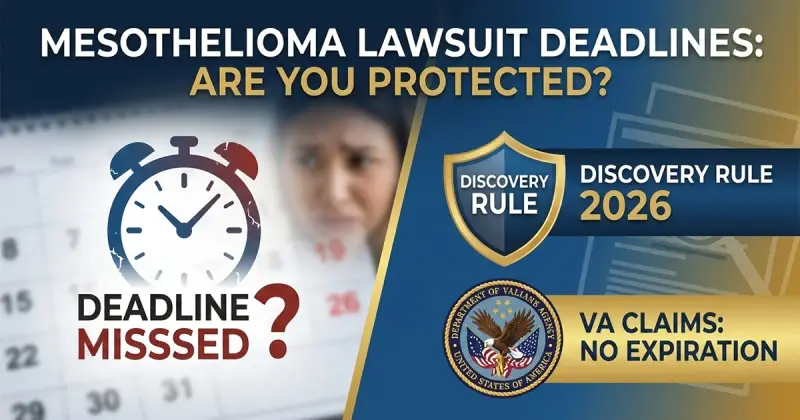
Worried you missed the mesothelioma deadline? See how the 2026 Discovery Rule protects you, state-by-state time limits, and why VA claims never expire.
Receiving a mesothelioma diagnosis is overwhelming. Between doctor visits, chemotherapy schedules, and breaking the news to your family, the last thing on your mind is legal paperwork. However, there is a legal clock ticking in the background that you cannot ignore. This clock is called the Statute of Limitations.
If this clock runs out, you lose your right to sue the asbestos companies responsible for your illness forever. You could be walked away from millions of dollars in compensation that your family needs for medical bills and future security.
But here is the confusing part: You might have been exposed to asbestos in 1975, but you only got sick in 2026. Does that mean you are 50 years too late to sue? Absolutely not.
In this guide, we will break down exactly how these deadlines work in 2026, which states have the shortest timelines, and the "legal loopholes" that might save your claim even if you think you waited too long.
What is the Statute of Limitations?
In simple terms, a statute of limitations is a law that sets a strict deadline for filing a lawsuit. Every type of crime or injury has one. For a car accident, you might have two years to sue. For a robbery, the police might have five years to catch the suspect.
For mesothelioma, the rules are different because the disease is unique. Mesothelioma has a latency period of 20 to 50 years. This means you could breathe in asbestos fibers while serving in the Navy in 1980, but the cancer cells wouldn't start growing until 2025.
If the law said you had to sue within "two years of the injury" (exposure), every single mesothelioma victim would be banned from court before they even coughed once. To fix this unfairness, courts use something called the Discovery Rule.
The Discovery Rule: Your Safety Net
Under the Discovery Rule, the "clock" for the statute of limitations does not start when you were exposed to asbestos. Instead, it starts on the date you were diagnosed with an asbestos-related disease.
-
Example: You worked in construction in 1990 (exposure). You were diagnosed with pleural mesothelioma on January 15, 2026. Your statute of limitations clock started ticking on January 15, 2026. Depending on your state, you might have until 2027, 2028, or 2029 to file.
Deadlines by State: How Much Time Do You Have?
The United States does not have one single deadline for everyone. Each of the 50 states sets its own laws. In 2026, most states give you between 1 and 3 years to file, but some are much shorter or longer.
The "Danger Zone" States (1 Year)
If you file your lawsuit in these states, you have very little time. You typically have only one year from the date of your diagnosis to take legal action.
-
California: 1 year
-
Louisiana: 1 year
-
Tennessee: 1 year
-
Kentucky: 1 year
If you live in one of these states and were diagnosed 13 months ago, you might think you are out of luck. However, do not give up yet—an attorney might be able to file your case in a different state (we will explain this in the "Jurisdiction Strategy" section below).
The "Standard" States (2-3 Years)
Most states fall into this category.
The "Generous" States (4-6 Years)
A few states give victims much more time to act.
-
Florida: 4 years (for personal injury)
-
Minnesota: 6 years
-
Missouri: 5 years (Note: In 2025, legislation was proposed to lower this to 2 years, so act fast if filing here)
-
North Dakota: 6 years
Important Note: These lists are general guides. Laws can change, or specific circumstances can shorten these windows. Always verify with a lawyer immediately.
Two Types of Clocks: Personal Injury vs. Wrongful Death
It is critical to know that there are two separate "clocks" depending on who is filing the lawsuit.
1. Personal Injury Claims (Filed by the Patient)
If you are the one who is sick, you file a Personal Injury claim.
-
Clock Starts: The day your doctor diagnosed you with mesothelioma.
-
What You Sue For: Medical bills, lost wages, pain and suffering.
-
Deadline: Usually 1 to 3 years from the diagnosis date.
2. Wrongful Death Claims (Filed by the Family)
If your loved one passed away from mesothelioma, you file a Wrongful Death claim.
-
Clock Starts: The day your loved one passed away.
-
What You Sue For: Funeral costs, loss of income, loss of companionship.
-
Deadline: Usually 1 to 3 years from the date of death.
Crucial Warning: The deadline for Wrongful Death can be shorter than Personal Injury. For example, in Florida, you have 4 years to file a Personal Injury claim, but only 2 years to file a Wrongful Death claim. Do not assume the deadlines are the same.
What If I Missed the Deadline? (Exceptions that Might Save You)
If you look at the calendar and realize your deadline passed last week, do not panic. An experienced mesothelioma lawyer might still be able to help you using one of these exceptions.
1. The "Second Injury" Rule
This is a common scenario: You were diagnosed with Asbestosis (a non-cancerous lung disease) 10 years ago. You didn't sue then. Now, in 2026, you are diagnosed with Mesothelioma.
Did your clock run out 10 years ago? No. Courts generally consider Mesothelioma a "separate and distinct" disease from Asbestosis. Your clock for Mesothelioma likely started on the day of your new cancer diagnosis, giving you a fresh timeline to sue.
2. Jurisdiction Shopping (Filing in a Different State)
Asbestos cases are unique because exposure often happened in many places.
-
Scenario: You live in Tennessee (1-year limit) and you missed the deadline. However, 40 years ago, you worked at a shipyard in New York (3-year limit) for a few months.
-
Solution: Your lawyer might be able to file your lawsuit in New York courts because you were exposed there. This would legally grant you New York's longer 3-year deadline, saving your case.
3. Tolling for Minors or Incapacity
If the person entitled to sue is a minor (under 18) or is legally incapacitated (mentally unable to handle their affairs), the clock may be "tolled" (paused). It only starts ticking once they turn 18 or regain mental capacity. This is rare for the patient (who is usually older) but can apply if a child is filing a wrongful death claim for a parent.
Deadlines for Asbestos Trust Funds and VA Claims
Not all compensation comes from lawsuits. There are other pots of money with different rules.
Asbestos Trust Funds ($30 Billion)
These are funds set up by bankrupt companies.
-
Deadline: They generally follow the statute of limitations of the state where the claim is filed. However, each Trust has its own specific rules. Some Trusts allow claims to be filed up to 3 years after a diagnosis, regardless of state law.
Veterans Affairs (VA) Benefits
This is the big exception.
-
Deadline: There is NO statute of limitations for VA claims.
-
You can file for VA Disability Compensation 10, 20, or 30 years after your diagnosis.
-
However, you cannot get "back pay" for the years you waited. Benefits usually start from the date you finally submit your application. So, while you can file late, you lose money every month you wait.
Why You Need to Act Immediately in 2026
Waiting is the biggest mistake you can make. Aside from the legal deadline, there are practical reasons to file now:
-
Evidence Disappears: To win, you need to prove you worked with specific products 40 years ago. Witnesses (former coworkers) are aging and passing away. The sooner you file, the easier it is to record their testimony.
-
Changing Laws: In 2025 and 2026, corporate lobbyists pushed for laws to make lawsuits harder. For example, a bill in Missouri (HB 68) aimed to shorten the filing time from 5 years to 2 years. Filing now "locks in" your rights under current laws before they potentially get worse.
-
Living Witnesses: It is much easier to win a case if the patient is alive to tell their story. Your lawyer can conduct a "deposition" (recorded interview) to preserve your testimony forever, ensuring your family is protected even if your health declines.
Conclusion: Do Not Disqualify Yourself
If you are reading this and worried that it has been too long since your diagnosis, do not disqualify yourself. Do not assume you are too late.
The laws surrounding the statute of limitations are complicated, with dozens of exceptions regarding where you worked, where the company is based, and when you discovered the specific nature of your illness. Only a specialized asbestos attorney can look at your unique life history and tell you if a door is still open.