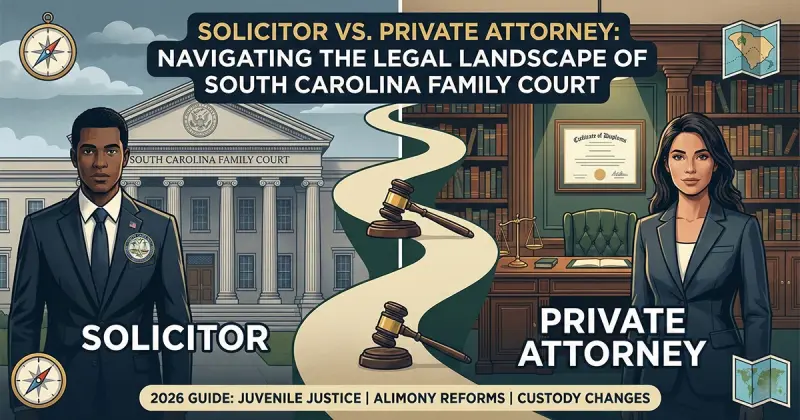
An exhaustive expert analysis on legal representation within the South Carolina Family Court system. Distinguish the roles of Solicitors and Private Attorneys, understand juvenile justice, and explore 2026 alimony and custody reforms.
The legal nomenclature within the state of South Carolina possesses historical and procedural nuances that often create confusion for litigants, particularly those navigating the sensitive environment of Family Court. Central to this complexity is the distinction between a "Solicitor" and a "Private Attorney." While the term "solicitor" in international jurisdictions—such as Canada or the United Kingdom—refers to a lawyer primarily engaged in office-based legal work, South Carolina employs the term uniquely to denote its elected public prosecutors. Conversely, a private attorney is a legal professional retained by an individual to manage civil domestic disputes ranging from divorce to child custody. This report provides a comprehensive examination of these roles, the jurisdictional boundaries of the Family Court, the financial architecture of private versus public representation, and the significant legislative shifts occurring in 2025 and 2026.
Conceptual Framework: Defining Legal Practitioners in South Carolina
To understand who handles a Family Court case, one must first distinguish between the broad categorization of "lawyer" and the specific licensure of an "attorney." In South Carolina, a lawyer is an individual who has obtained a Juris Doctor degree and possesses legal training, but this status does not automatically grant the right to advocate for clients in a judicial forum. An attorney, however, is a lawyer who has successfully passed the South Carolina Bar Exam and is licensed by the South Carolina Supreme Court to file motions, appear in court, and provide formal legal advice.
The distinction is critical because the state maintains a rigorous stance against the unauthorized practice of law. Only licensed attorneys in good standing with the South Carolina Bar are permitted to sign pleadings or represent individuals before a judge. Attempting to proceed with an unlicensed individual can result in significant procedural delays or the dismissal of filings. This framework ensures that any representative—whether a state-funded Solicitor or a privately retained attorney—meets the professional standards required for complex domestic litigation.
The Evolution of the Circuit Solicitor
South Carolina stands as the only state in the Union that uses the title "Solicitor" for its chief prosecutors in individual judicial circuits. The position, established in 1791 and solidified by the Constitution of 1868, oversees the prosecution of criminal offenses. There are 16 judicial circuits in the state, each encompassing two to five counties. Each circuit elects a Solicitor to a four-year term, during which they act as the lead "minister of justice" for their jurisdiction.
While the Solicitor’s primary domain is the Court of General Sessions—the criminal side of the Circuit Court—their role extends into the Family Court through the prosecution of juvenile offenders. In this capacity, the Solicitor represents the State of South Carolina, not the victim or any private party. This distinction is paramount for litigants to grasp: a Solicitor cannot be hired to handle a divorce, nor can they provide legal advice to individuals in civil domestic disputes.
The Private Attorney: Choice, Resources, and Advocacy
A private attorney is a professional chosen and paid for by the client to represent their specific interests. Unlike the Solicitor, who is assigned to cases by the state, a private attorney offers the client complete control over who manages their legal strategy. This relationship is defined by a private contract and a fiduciary duty to the client rather than the public interest.
Private attorneys in the Family Court system are typically engaged for "civil" matters, which comprise the majority of the court's docket. This includes the dissolution of marriage, property division, and the establishment of parental rights. The advantages of private representation often center on the attorney's ability to manage their caseload, allowing for more personalized attention and faster response times compared to government-funded representatives who may be burdened by heavy dockets.
| Feature |
South Carolina Solicitor |
Private Family Law Attorney |
| Status |
Elected Public Official |
Private Practitioner |
| Client |
The State of South Carolina |
Individual Citizen |
| Primary Court |
General Sessions / Family (Juvenile) |
Family Court (Civil) |
| Selection |
Popular Election (4-Year Term) |
Hired Directly by Client |
| Fees |
Taxpayer Funded |
Retainer and Hourly Rates |
| Case Type |
Criminal/Juvenile Prosecution |
Divorce, Custody, Alimony, Property |
Jurisdictional Boundaries of the South Carolina Family Court
The Family Court in South Carolina is a court of limited jurisdiction, meaning it only possesses the authority to hear cases explicitly granted to it by statute. Established as a unified statewide system in 1976, it operates as a formal court of record under the South Carolina Constitution. The court's primary mandate is to resolve domestic disputes and safeguard the welfare of children.
Domestic Relations and Civil Authority
The Family Court maintains exclusive jurisdiction over the following civil matters:
-
Dissolution of Marriage: This includes granting divorces, annulments, and legal separations.
-
Financial Support: The court determines alimony (spousal support) and child support obligations.
-
Custody and Visitation: Judges decide the physical and legal custody arrangements for minor children based on the "best interest of the child" standard.
-
Property Division: South Carolina follows "equitable distribution" principles, meaning marital property is divided fairly, though not necessarily equally.
-
Parental Rights: This includes the termination of parental rights, finalization of adoptions, and paternity disputes.
In these civil proceedings, the "State" is rarely a party unless the case involves the Department of Social Services (DSS). Therefore, private attorneys represent both the plaintiff (the person filing the case) and the defendant (the person responding).
Juvenile Delinquency: The Criminal Interface
The Family Court also serves as the venue for juvenile delinquency proceedings, which is where the Solicitor becomes actively involved. In South Carolina, a "child" is generally defined as any offender under the age of eighteen. The juvenile system is designed to be rehabilitative rather than punitive, aiming to save minors from the permanent stigma of a criminal record.
When a juvenile is alleged to have committed a crime, the case is initiated through a referral from law enforcement or a school to the South Carolina Department of Juvenile Justice (SCDJJ). The Solicitor's role begins once SCDJJ makes a recommendation on how to handle the youth's case. The Solicitor has the authority to:
-
Dismiss: Close the case if the evidence is insufficient or the interests of justice are served.
-
Divert: Refer the youth to programs like Juvenile Arbitration or Pre-Trial Intervention (PTI), allowing them to avoid a formal court appearance.
-
Prosecute: File a summons and complaint to proceed to a formal adjudication hearing before a Family Court judge.
The Role of the Department of Social Services (DSS) Attorneys
A common point of confusion for South Carolina residents is the involvement of the Department of Social Services (DSS). DSS acts as a massive state-run law firm, employing more than 80 attorneys and 100 paralegals across the state. Their role is distinct from the Solicitor's Office; while Solicitors prosecute crimes, DSS attorneys handle civil protection cases.
Abuse, Neglect, and Child Protective Services
When a report of child abuse or neglect is made, DSS is statutorily required to investigate within 45 days. If the agency finds a "preponderance of evidence" supporting the allegations, they "indicate" the case and may seek to remove the child from the home. DSS attorneys represent the agency in these Family Court hearings, arguing that removal or court-ordered treatment services are necessary for the child's safety.
In these scenarios, a parent may find themselves facing both a DSS attorney in Family Court (for the civil protection of the child) and a Solicitor in General Sessions Court (if the abuse also constitutes a criminal act like assault and battery). This duality necessitates specialized legal representation, as the outcomes of one case can significantly impact the other.
Child Support Enforcement and Paternity
DSS also manages child support cases for parents who are not pursuing private litigation. This is often done through the Child Support Enforcement Division. DSS attorneys establish paternity and enforce support orders, but they do not represent either parent's individual interests; their goal is to ensure the state's financial guidelines are met and that the child receives necessary support.
Economic Realities: Pricing and Accessibility of Representation
The cost of legal representation in South Carolina varies according to the complexity of the case and the type of practitioner involved. While the Sixth Amendment guarantees a right to counsel in criminal cases (including juvenile delinquency), there is no such universal right in civil Family Court cases.
Hourly Rates and Practice Areas
Data from legal billing studies indicate that the average hourly rate for a South Carolina attorney is approximately $297 to $303, though rates for highly experienced family law specialists can reach $500 or more.
| Practice Area |
Average Hourly Rate (SC) |
| Family Law |
$303 |
| Civil Litigation |
$254 |
| Appellate Law |
$368 |
| Criminal Defense (Private) |
$300 - $400 |
| Bankruptcy |
$363 |
For private family law cases, attorneys typically require a "retainer fee"—an upfront deposit against which hourly work is billed. Retainers for simple, uncontested divorces may range from $2,000 to $5,000, while complex contested custody battles can require $10,000 or more.
Indigent Representation and Legal Aid
For individuals who cannot afford a private attorney, the South Carolina legal system provides several pathways:
-
Public Defenders: In juvenile delinquency cases or when a parent faces criminal contempt (where jail time exceeds 6 months), a Public Defender may be appointed. An application fee of $40 is generally required.
-
South Carolina Legal Services (SCLS): This organization provides free civil legal aid to low-income residents, focusing on domestic abuse, child protection, and cases where basic needs are at risk. SCLS generally does not handle "fee-generating" cases like car accidents where an attorney might be paid from a settlement.
-
Pro Se Resources: Litigants have the right to represent themselves (pro se). The South Carolina Judicial Branch provides self-help forms for uncontested divorces and simple child support modifications.
Procedural Revolution: The 2025 Amendments to Rule 21
One of the most significant changes to South Carolina Family Court in decades took effect on October 1, 2025, with the amendment of Rule 21. This rule governs "temporary hearings," which are the fast-paced proceedings held shortly after a case is filed to establish temporary custody, support, and use of the marital home while the final trial is pending.
Ending the Era of "Motion by Ambush"
Historically, temporary hearings in South Carolina were criticized for being "trials by ambush," where one party might present surprise affidavits or evidence on the day of the hearing. The 2025 amendments replaced this system with a structured timeline intended to ensure procedural fairness.
-
20-Day Notice: Parties must now be given at least 20 days' notice before a temporary hearing, a 400% increase from the previous 5-day requirement.
-
10-Day Return Deadline: The responding party must file their formal response (the "return") at least 10 days before the hearing.
-
5-Day Affidavit Exchange: All supporting witness statements (affidavits) must be served 5 business days before the hearing.
-
Strict Reply Limits: Only "reply affidavits"—those directly responding to the other side's 5-day filings—may be served on the day of the hearing.
This evolution requires private attorneys to be significantly more prepared from the outset. For litigants, it means that "surprise" allegations are much harder to introduce, allowing for a more stable and predictable environment for children during the initial stages of a divorce.
Legislative Horizon: Bill H. 3085 and Alimony Reform
South Carolina's family law statutes are undergoing modernization through several high-profile bills in the 2025-2026 legislative session. These changes reflect a shift toward shared parenting and financial independence.
The Equal Parenting Act (Bill H. 3085)
Bill H. 3085 seeks to amend Section 63-15-220 to create a "rebuttable presumption" that equal or approximately equal parenting time (50/50 custody) is in the best interest of the child. This represents a monumental shift from the traditional model where one parent was typically awarded primary custody while the other received weekend visitation.
Under this bill, if a judge chooses not to award equal time, they must provide specific "written findings of fact" explaining why a 50/50 split would be harmful or not in the child's best interest. The bill outlines 17 factors the court must consider, including:
-
The developmental needs of the child.
-
The capacity of each parent to meet those needs.
-
Any history of domestic violence, child abuse, or neglect.
-
The child's adjustment to their home, school, and community.
Alimony Reform (Bill 3098)
Simultaneously, the South Carolina General Assembly is considering reforms to alimony (spousal support). Historically, "permanent periodic alimony" was a common outcome of long-term marriages, often resulting in indefinite financial obligations.
The proposed reforms in 2026 aim to:
-
Eliminate Indefinite Alimony: Alimony would instead be calculated based on the length of the marriage (e.g., one year of support for every three years of marriage).
-
Prioritize Financial Independence: Courts would focus on "rehabilitative alimony" to help a spouse re-enter the workforce.
-
Clarify Termination: Alimony would strictly terminate upon remarriage, continued cohabitation, or the death of either party.
International Comparison: The Canadian "Barrister and Solicitor" Model
To contextualize the South Carolina "Solicitor" role, it is instructive to look at the Canadian legal system, which is a frequent point of comparison for international litigants. In Canada, the legal profession is "merged," meaning almost every lawyer holds the dual title of "Barrister and Solicitor". However, the duties they perform align closely with the functional split seen in South Carolina’s private versus public roles.
Functional Differences in Practice
In a Canadian family law scenario, the "Solicitor" aspect of a lawyer's license covers the transactional and office-based work: drafting marriage contracts, separation agreements, and managing real estate transfers. The "Barrister" aspect covers the advocacy and courtroom litigation: arguing for custody or property division before a judge.
Unlike South Carolina, where the Solicitor is always a state prosecutor, a Canadian "Solicitor" can be a private family lawyer. For example, in the Ontario case of Hart v. Hart, the court emphasized the importance of parties having independent "expert counsel" (solicitors) when signing a separation agreement. The court ruled that a final support release is much more likely to be upheld if both parties had solicitors who ensured they understood the long-term financial consequences.
Real-Life Scenario: Toronto vs. Columbia
Consider a scenario where a parent is accused of domestic violence.
-
In Toronto (Canada): The parent would likely hire one lawyer who acts as both a solicitor (reviewing the evidence and negotiating a settlement) and a barrister (defending them in court against both criminal charges and family law motions).
-
In Columbia (South Carolina): The parent would face a Solicitor (the state prosecutor) in a criminal court for the assault, a DSS Attorney in Family Court regarding the children's safety, and would need a Private Attorney to handle their divorce and custody counter-claims.
This highlights why the South Carolina system is often perceived as more fragmented and specialized, requiring litigants to understand exactly which "attorney" is handling which specific thread of their case.
Practical Guidance for Litigants in South Carolina
Navigating the Family Court without an attorney is a precarious undertaking. The court operates under the South Carolina Rules of Evidence and the Rules of Family Court, which are strictly enforced regardless of whether a party has a lawyer.
The Role of the Guardian ad Litem (GAL)
In contested custody cases, the court will almost always appoint a Guardian ad Litem (GAL). The GAL is not a Solicitor or a private attorney for either parent; they are an independent advocate for the child's best interests. They conduct home studies, interview teachers and doctors, and submit a report to the judge. Under proposed 2026 legislation (Bill 4622), the oversight of GALs may increase to prevent bias and ensure they "stick to the facts" rather than injecting personal opinions into the case.
Steps for Preparing a Family Court Action
-
Determine the Grounds: Decide if you are filing for a no-fault divorce (one-year separation) or a fault-based divorce (adultery, cruelty, etc.).
-
Consult a Private Attorney: Especially with the new Rule 21 deadlines, early legal advice is critical to meeting filing requirements.
-
Prepare a Parenting Plan: South Carolina law now requires parents to submit detailed plans outlining how they will share time and make major decisions for the child.
-
Exchange Affidavits: Ensure all witness statements are served at least 5 business days before any temporary hearing to comply with the new "anti-ambush" rules.
Frequently Asked Questions (FAQs)
What is the main difference between a Solicitor and a Private Attorney? In South Carolina, a Solicitor is a state-funded prosecutor who handles criminal and juvenile cases. A private attorney is a lawyer you hire and pay to handle your personal civil matters, such as a divorce or a custody dispute.
Does every Family Court case involve a Solicitor? No. Most Family Court cases are civil (divorce, custody, child support) and involve only private attorneys or DSS attorneys. A Solicitor only becomes involved if there is a juvenile delinquency charge.
Can a Solicitor give me advice on my divorce? No. Solicitors are legally prohibited from providing legal advice to private citizens in civil matters. They represent the State of South Carolina.
How much does it cost to get a divorce in South Carolina? Costs vary widely. A private attorney typically charges between $200 and $500 per hour, and retainer fees can range from $2,000 to over $10,000 depending on the case's complexity.
What is the "best interest of the child" standard? This is the legal framework judges use to decide custody. They look at factors like the child's needs, the parents' stability, any history of abuse, and the child's own preferences if they are of sufficient age and maturity.
What happens if I miss the 5-day affidavit deadline under Rule 21? If you fail to serve your supporting affidavits at least 5 business days before your temporary hearing, the judge may refuse to consider your evidence, potentially resulting in an unfavorable temporary order.
Conclusion
The South Carolina Family Court system is a complex machinery governed by specific jurisdictional rules and a unique nomenclature. Litigants must recognize that the "Solicitor" is a public prosecutor whose presence is limited to the criminal aspects of the court's jurisdiction, while the "Private Attorney" is the primary engine for civil domestic advocacy. With the implementation of Rule 21’s procedural safeguards in 2025 and the potential for a shared-parenting default under Bill H. 3085 in 2026, the state is moving toward a more transparent and equitable system. Understanding these roles and the evolving legislative landscape is essential for any individual seeking to protect their family, their finances, and their future in the Palmetto State.