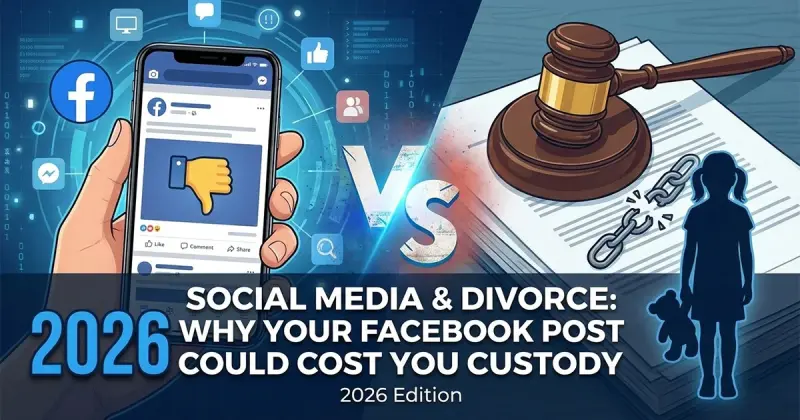
In 2026, a single tweet or TikTok can lose you custody. Learn how "sharenting" laws, AI evidence, and digital trails impact family court rulings today.
Imagine losing the right to tuck your child into bed because of a meme you posted on Facebook. Or imagine a judge handing over half your savings to your ex because of a Venmo transaction you thought was private. In 2026, this isn't just a nightmare scenario—it is happening in courtrooms every single day.
For decades, divorce lawyers relied on bank statements and whispered rumors. Today, the most powerful witness against you is the phone in your pocket. As we navigate the legal landscape of 2026, the intersection of has become a minefield. From "sharenting" laws to AI-detected hostility, your digital footprint is now the first place a judge looks to decide if you are a fit parent.
If you are going through a separation, or just co-parenting in the digital age, you need to understand the new rules of the road. Here is why hitting "post" might be the most expensive mistake of your life.
The "Deleted" Post Myth: Why the Internet is Written in Ink
The biggest mistake people make in 2026 is thinking, "I'll just delete it."
In the world of digital forensics, the "delete" button is an illusion. When you scrub a nasty comment about your ex or remove a photo of you partying during your parenting time, you aren't just cleaning up your profile—you might be committing a crime called spoliation of evidence.
Courts in 2026 use advanced that can recover posts, messages, and even location data that you thought were gone forever. If a judge finds out you deleted evidence, they can assume the worst: that the post was so bad, you had to hide it. This can lead to sanctions or even an automatic loss on certain custody issues.
Rule #1: Assume everything you type, snap, or upload is being projected onto a giant screen in a courtroom. Because it probably will be.
The Rise of "Sharenting" Laws: Protecting Child Privacy
One of the biggest shifts in family law over the last two years has been the crackdown on "sharenting"—the practice of parents oversharing their children's lives online.
Following the lead of the (which went into full effect in 2024) and similar 2025 legislation in California and Minnesota, judges are now hyper-critical of parents who exploit their children for "likes" or money.
In a custody battle, if you are constantly posting videos of your crying child to get sympathy, or if you are running a "family vlog" that invades your child's privacy, the court may view this as exploitation. We are seeing judges in 2026 award custody to the parent who protects the child's digital privacy, rather than the one who broadcasts it.
Key 2026 Trend: Courts are including "social media bans" in custody orders, prohibiting parents from posting any recognizable photos of their children until they turn 18.
How Your "Digital Wallet" Betrays You
It's not just about photos. Your financial apps are telling a story, too.
In 2026, is rarely caught by finding cash under a mattress. It is caught on Venmo, CashApp, and crypto wallets.
-
The "Broke" Parent: If you tell the judge you can't afford child support, but your Venmo history shows public transactions for "VIP Tables in Vegas" or "New Golf Clubs," you have destroyed your own credibility.
-
The Crypto Hiding Spot: Courts are now savvy to . Hiding assets in Bitcoin or NFTs is no longer a clever trick; it’s a standard thing lawyers look for. If you fail to disclose a digital wallet, the court can reopen your entire divorce settlement years later.
AI is Watching Your Tone
High-conflict communication is the #1 reason parents lose custody time. But in 2026, we have a referee that never sleeps: Artificial Intelligence.
Apps like (https://www.ourfamilywizard.com/knowledge-center/tips-tricks/tonemeter) now use advanced features like "ToneMeter AI." Before you send an angry message to your ex saying, "You're a lazy parent," the AI stops you. It warns you that the message is aggressive and suggests a neutral rewrite: "I am concerned about the schedule."
If you refuse to use these tools and continue to send abusive texts, judges will see a log of every time the AI warned you and you ignored it. This proves you are choosing conflict, which is a fast way to lose decision-making rights for your kids.
The "Digital Kidnapping" Threat
A terrifying trend that has impacted family law in 2026 is "digital kidnapping." This is when strangers take photos of your children from your open social media profiles and roleplay that the children are theirs.
While this is a crime by strangers, it becomes a custody issue if you made it possible. If you leave your profiles public despite your ex's warnings, a judge may rule that you are failing to protect your child's safety. In high-profile cases, parents have lost physical custody simply because they refused to set their Instagram to "Private."
5 Rules to Survive a Digital Divorce in 2026
If you are currently involved in a family law case, follow these rules as if your future depends on them:
-
The "Grandma Rule": If you wouldn't want your grandmother (or a judge) to see it, don't post it. This includes "vaguebooking" (posting sad song lyrics or passive-aggressive quotes).
-
Audit Your Friends: You might trust your friends, but do you trust their friends? Screenshots travel fast. Prune your follower list.
-
Turn Off Locations: Don't check in at bars, clubs, or expensive resorts. It creates a timeline that can be used to prove you were away from your kids or spending money you claimed you didn't have.
-
Respect the "Right to be Forgotten": If your child asks you not to post them, listen. are a major legal focus right now. Ignoring your child's consent is a bad look in court.
-
Go Dark: The absolute best strategy? Deactivate your accounts until the ink is dry on your divorce decree. It is boring, but it is safe.
Conclusion
In 2026, your social media profile isn't just a collection of memories; it is a legal document. It is evidence. It is a character witness.
The courts have caught up to technology. Judges are no longer confused by TikTok trends or Venmo histories; they use them to make life-altering decisions about where your children sleep at night. By treating your online presence with the same seriousness as your courtroom testimony, you protect not just your case, but your family's privacy and future.