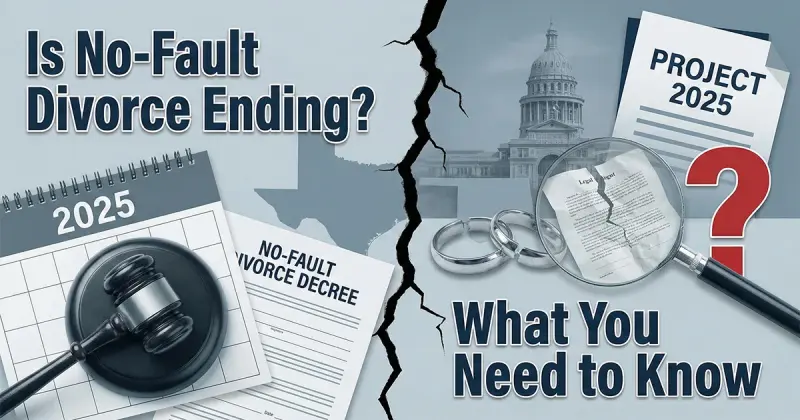
Are rumors about no-fault divorce ending in 2025 true? We explore Project 2025, state-level bills in Texas and Oklahoma, and how these changes might impact you.
If you’ve been on social media lately, you might have seen some pretty scary headlines claiming that "no-fault divorce is ending in 2025." For anyone currently going through a tough time in their marriage or even just thinking about the future, these rumors can feel overwhelming.
But before you panic, let’s take a deep breath and look at the actual facts. As an expert in legal trends, I’m here to help you cut through the noise. We’re going to break down what no-fault divorce actually is, why people are talking about changing it, and what is really happening in the legal world right now.
What Exactly is "No-Fault" Divorce?
In the old days (think before the 1970s), if you wanted to get a divorce, you had to prove your spouse did something "wrong." You couldn’t just say, "We don't get along anymore." You had to prove things like adultery (cheating), physical cruelty, or abandonment. This often led to messy, expensive court battles where people were forced to "spy" on each other to get evidence.
Everything changed in 1969 when California, led by Governor Ronald Reagan, passed the first no-fault divorce law. This allowed couples to end a marriage simply by citing "irreconcilable differences"—basically saying the marriage is broken and can’t be fixed. Today, every single state in the U.S. has some form of no-fault divorce.
The Big Question: Is It Ending in 2025?
The short answer is no, it is not ending everywhere. However, it is true that several states are having big debates about it.
The Project 2025 Debate
Much of the current buzz comes from a policy framework called Project 2025, created by a group called the Heritage Foundation. While the 900-page "Mandate for Leadership" doesn't explicitly lay out a step-by-step plan to ban no-fault divorce, many of its advisors and supporters have publicly suggested that making divorce harder would "strengthen the family unit." They argue that easy divorce hurts children and society.
State-Level Battles
Divorce laws are decided by states, not the federal government. This means a President can't just sign a paper and end no-fault divorce for the whole country. Here is what is actually happening in specific states as of early 2025:
-
Texas: Lawmakers introduced House Bill 3401, which aimed to remove "insupportability" (the no-fault ground) from the law. However, the bill failed in committee in June 2025. For now, no-fault divorce is still the law in Texas.
-
Oklahoma: Senator Dusty Deevers introduced Senate Bill 1958, which would require spouses to prove a specific fault like adultery or abandonment.
-
Louisiana and Nebraska: Republican party platforms in these states have discussed restricting no-fault divorce, but as of mid-2025, no major laws have passed to repeal it.
Why Do People Want to Keep No-Fault Divorce?
While some politicians want to bring back "fault" grounds, many experts and advocacy groups (like the National Organization for Women) warn that this would be a step backward.
-
Safety for Survivors: For people in abusive relationships, no-fault divorce is a literal lifesaver. Requiring a victim to "prove" abuse in court can be dangerous and expensive.
-
Lower Conflict: No-fault laws were created to stop the "blame game." When you don't have to prove someone is a "bad person" to get a divorce, it’s much easier to focus on co-parenting and moving on.
-
Cost and Speed: Proving "fault" requires investigators, extra witnesses, and more time in front of a judge. This makes the process much more expensive for average families.
Comparison: Fault vs. No-Fault Divorce
| Feature |
No-Fault Divorce |
Fault-Based Divorce |
| Main Reason |
Irreconcilable differences (broken marriage) |
Adultery, Cruelty, Abandonment |
| Evidence Needed |
None (just a statement that it's over) |
High (photos, witnesses, documents) |
| Conflict Level |
Generally lower |
Often very high and emotional |
| Cost |
More affordable |
Very expensive due to litigation |
| Impact on Alimony |
Usually depends on income/needs |
"Fault" can sometimes change the payout |
A View from the North: The Canadian Perspective
If you look across the border to Canada, the conversation is very different. Canadian family law is rooted in a "modern, pragmatic view" that focuses on minimizing harm to children.
In Canada, the Divorce Act establishes that there is only one ground for divorce: the "breakdown of the marriage." Most people prove this by living "separate and apart" for one full year.
Real-Life Scenario: Sarah and Mark (Toronto, Ontario)
To understand how this works in a human way, let's look at Sarah and Mark. They realized in early 2024 that they were no longer happy together. Instead of fighting in court about who was "to blame," they used the Canadian no-fault system.
They decided to separate on January 1st. Because Toronto is expensive, they actually lived under the same roof for the first six months to save money. To prove they were "legally separated" while living in the same house, they:
-
Slept in separate bedrooms.
-
Stopped sharing meals and social outings.
-
Managed their bank accounts separately.
The "90-Day Grace Period":
In April, Sarah and Mark thought maybe they should try one more time. They lived as a couple again for two months. Unfortunately, it didn't work. Under Canadian law, you can try to reconcile for up to 90 days without "resetting" your one-year clock. Because their attempt was less than 90 days, they didn't have to start their one-year wait all over again. They were able to finalize their divorce on January 2nd of the following year.
What Should You Do if You’re Worried?
If you live in a state like Texas, Oklahoma, or South Carolina where these laws are being debated, it’s important to stay informed but not to panic.
-
Consult a Professional: If you are thinking about a for your case, talk to them about the current laws in your specific county.
-
Keep Good Records: Regardless of the law, having clear financial records and documentation of your separation date is always a good idea.
-
Watch the Legislature: Most changes to divorce laws happen slowly. They usually have "transition periods" where any case already filed is safe from the new rules.
Frequently Asked Questions (FAQs)
1. Is it true that J.D. Vance wants to end no-fault divorce?
The Vice President has previously criticized no-fault divorce as a "trick" of the sexual revolution, but he has not proposed a specific federal law to ban it. Laws remain under the control of individual states.
2. Can I still get a divorce if my spouse doesn't agree?
Yes. In a no-fault system, if one person says the marriage is over, the court will eventually grant the divorce, even if the other person wants to stay married.
3. Will ending no-fault divorce lower the divorce rate?
History shows that when divorce is harder to get, people often just separate without legal papers or, in the past, even resorted to faking evidence of cheating just to satisfy the court. It doesn't necessarily make marriages "happier."
4. What states are most likely to change their laws in 2025?
Texas and Oklahoma have seen the most active "repeal" bills, though the Texas bill failed this year. Lawmakers in South Carolina and South Dakota have also introduced similar ideas in the past few years.
Final Thoughts
The rumor that no-fault divorce is "ending" in 2025 is largely a misunderstanding of some very specific (and often unsuccessful) state bills. While there is a cultural push from some groups to return to older ways of doing things, the "no-fault" system remains the standard for the vast majority of people.
Legal systems are always evolving—just look at the recent or the new for evidence. The best way to protect yourself is to stay educated, seek expert advice, and remember that you have rights, no matter how the headlines try to spin it.
Disclaimer: This blog post is for informational purposes only and does not constitute legal advice. Laws vary significantly by jurisdiction. Please consult with a licensed attorney in your area for advice specific to your situation.