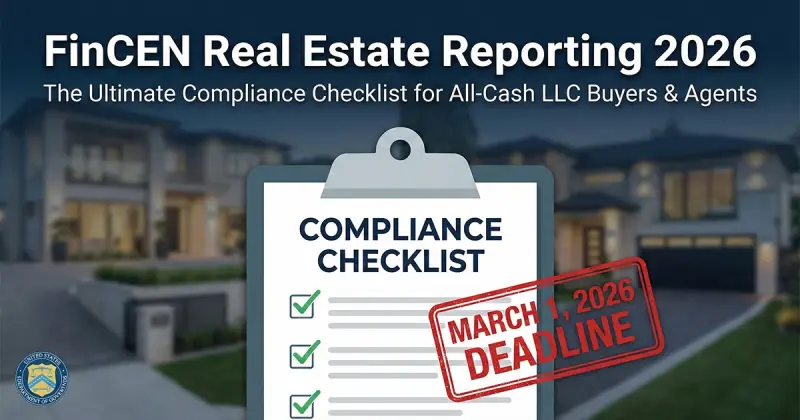
Starting March 1, 2026, LLCs must report all-cash home buys to FinCEN. Avoid penalties with our "Residential Real Estate Rule" compliance checklist.
Chapter 1: The End of the "Anonymous" Era in American Real Estate
On March 1, 2026, the opaque curtain that has long shielded the identities of high-end real estate buyers in the United States will be pulled back. For decades, the American property market has been a favored destination for global capital—a safe harbor where investors could park millions of dollars in stable assets. A significant portion of these transactions, particularly in luxury markets like New York, Miami, and Los Angeles, were conducted using "all-cash" offers and routed through shell companies, such as Limited Liability Companies (LLCs) or trusts.
While the vast majority of these transactions are legitimate business dealings or privacy-seeking investments by high-net-worth individuals, this structure created a "blind spot" in the U.S. financial system. Criminal actors, kleptocrats, and drug cartels realized they could bypass the strict anti-money laundering (AML) checks of the banking system by simply avoiding banks altogether. Instead of getting a mortgage, they would bring cash—or more accurately, wire transfers—to buy homes outright in the name of a faceless corporate entity.
The Financial Crimes Enforcement Network (FinCEN), the arm of the U.S. Treasury Department tasked with fighting financial crime, is closing this loophole permanently.
The new regulation, formally known as the Residential Real Estate Rule (RRE Rule), mandates that specific professionals involved in real estate closings must file detailed reports on non-financed transfers of residential real estate to legal entities or trusts. This is not a suggestion; it is a federal requirement with severe civil and criminal penalties for non-compliance.
The "SEO" of Compliance: Why You Need to Know This Now
As an investor, real estate agent, or title professional, understanding this rule is no longer optional—it is a survival skill for your business. The rule was originally slated for late 2025, but FinCEN has officially postponed the effective date to March 1, 2026. This delay is a gift: it provides a crucial window for the industry to update software, train staff, and educate clients.
This comprehensive report is designed to be your definitive guide. Written in clear, accessible language, it breaks down the complex legal jargon into a practical "Compliance Checklist." We will explore who must report, what must be reported, and the specific triggers that bring a transaction under the microscope of the federal government.
Chapter 2: The Historical Context of "Dirty Money" in Housing
To understand where we are going in 2026, we must look at where we have been. The RRE Rule is not a sudden, reactionary measure. It is the culmination of over 50 years of evolving financial intelligence policy in the United States.
The Bank Secrecy Act (1970): The Foundation
The cornerstone of all U.S. anti-money laundering efforts is the Bank Secrecy Act (BSA) of 1970. The BSA established the principle that financial institutions must assist the government in detecting and preventing money laundering. It introduced the concept of the "paper trail"—requiring banks to keep records and file reports on suspicious activities.
However, the BSA had a significant limitation: it focused heavily on banks. The assumption was that large sums of money would inevitably pass through a bank. But what if they didn't?
The "Real Estate Loophole" (2002–2025)
Following the passing of the USA PATRIOT Act in 2001, the definition of "financial institution" was expanded to include persons involved in real estate closings. Congress recognized that a title agent handling a $10 million wire transfer was functioning similarly to a bank teller.
Despite this, in 2002, FinCEN granted a "temporary" exemption to the real estate industry. The agency acknowledged the risk but felt the industry was not yet ready for the heavy compliance burden of full AML programs. This "temporary" exemption lasted for nearly 24 years. During this period, while banks were spending billions on compliance departments, real estate professionals were largely exempt from asking the hard question: "Who is the actual human being buying this house?".
The Geographic Targeting Orders (GTOs): The Pilot Program
The government knew the loophole was being exploited. In 2016, FinCEN launched a pilot program called Geographic Targeting Orders (GTOs).
-
The Mechanism: FinCEN would issue an order to title insurance companies in specific "high-risk" counties (e.g., Manhattan, Miami-Dade, Bexar County in Texas). The order stated that if a legal entity bought a residential property for all-cash above a certain price threshold (e.g., $300,000), the title company had to identify the beneficial owner.
-
The Findings: The GTOs were a success in terms of intelligence gathering. They revealed that a significant percentage of these all-cash entity purchases were linked to individuals who had been the subject of Suspicious Activity Reports (SARs) by banks.
-
The Limitation: GTOs were temporary, geographically patchy, and had price floors. A money launderer could simply buy a property in a county next to a GTO zone, or buy a property for $299,000 to stay under the $300,000 radar.
The Final Rule: March 1, 2026
The new RRE Rule replaces the patchwork GTO system with a permanent, nationwide standard. It removes the geographic boundaries—reporting is now required in Kansas just as it is in New York. It removes the price thresholds—a $50,000 lot is treated the same as a $50 million penthouse. And it mandates the reporting of "Beneficial Ownership Information" (BOI) for all applicable transactions.
Chapter 3: The Four Triggers – A Compliance Checklist
The most common question from investors and agents is: "Does this apply to my deal?"
FinCEN has designed the rule with specific "triggers." If your transaction hits all four triggers, a report must be filed. If it misses even one, no report is needed.
Trigger 1: Residential Real Property
The rule is strictly focused on residential real estate. It does not currently apply to commercial buildings like shopping malls or office towers (though those may be targeted in future rules).
What Counts as Residential?
-
Single-Family Homes: The classic detached house.
-
Townhouses & Rowhouses: Attached single-family units.
-
Condominiums (Condos): Individual units in a larger building.
-
Cooperatives (Co-ops): Shares in a corporation that grants the right to occupy a unit. This is critical for markets like New York City.
-
Apartment Buildings: Specifically, buildings designed for occupancy by 1 to 4 families.
-
Insight: This distinguishes "residential" from "commercial" multifamily. A duplex, triplex, or fourplex is covered. A 100-unit apartment complex is generally considered commercial and effectively outside this specific rule (though other commercial regulations may apply).
-
Vacant Land: This is a major expansion from previous rules. The rule applies to vacant or unimproved land if the land is zoned or intended for the construction of a structure designed for occupancy by 1 to 4 families.
Scenario:
Trigger 2: Non-Financed Transfer
This is the most misunderstood trigger. The rule targets "non-financed" transfers, which the industry colloquially calls "all-cash" deals. However, FinCEN's definition of "non-financed" is broader than just a suitcase of bills.
The "Regulated Lender" Test:
FinCEN trusts banks. If a buyer gets a mortgage from a bank (like Chase, Bank of America, or a local credit union), that bank is already required to perform AML checks. FinCEN does not need a second report from the title company because the bank is the "gatekeeper."
Therefore, a transfer is exempt if it involves an extension of credit that is:
-
Secured by the property (a mortgage); AND
-
Extended by a financial institution subject to AML program requirements and SAR filing obligations.
The "Private Lender" Trap:
What if you borrow money from a wealthy friend, a "Hard Money" lender, or a private equity fund that isn't a bank?
-
These lenders typically do not have the same AML obligations as banks.
-
Consequently, FinCEN treats these loans as "non-financed." Even though you, the buyer, are borrowing money, FinCEN considers it an "all-cash" deal for reporting purposes because no regulated gatekeeper is involved.
-
Result: Purchases funded by private lenders, seller financing, or hard money must be reported.
Trigger 3: The Transferee is a Legal Entity or Trust
FinCEN is not interested in tracking ordinary families buying homes in their own names. If John and Jane Smith buy a house, they present their IDs to the notary, and their names are recorded on the public deed. There is no anonymity to pierce.
The risk arises when the buyer is a "Legal Entity" or a "Trust." These structures can mask the true owner.
Covered Transferees (Buyers):
-
Corporations: (C-Corps, S-Corps).
-
Limited Liability Companies (LLCs): The most common vehicle for real estate investment.
-
Partnerships: (LPs, LLPs, LLPs).
-
Trusts: This includes statutory trusts, business trusts, and many personal trusts used for estate planning.
The "Revocable Trust" Nuance: Many Americans put their homes in a "Living Trust" (e.g., "The Smith Family Trust") to avoid probate court when they die. Under the RRE Rule, trusts are generally covered transferees. However, specific exemptions exist for certain trusts, which we will detail in the Exemptions chapter.
Trigger 4: No Exemption Applies
Finally, a transaction is only reportable if it does not fall into one of the specific "safe harbor" exemptions defined by FinCEN. If triggers 1, 2, and 3 are met, you must check the exemption list. If you aren't on it, you must file.
Chapter 4: The Reporting Cascade – Who Is Responsible?
In a typical real estate closing, there is a cast of characters: the real estate agent, the title officer, the escrow agent, the buyer's attorney, the seller's attorney, and the mortgage broker. When the law says "someone must file the report," who exactly is "someone"?
FinCEN avoided pointing the finger at just one job title, because job titles vary by state. In California, "Escrow Agents" handle closings. In Georgia, "Closing Attorneys" do it.
To solve this, FinCEN created a Reporting Cascade. It is a hierarchy of seven functions. The obligation falls on the person highest on this list who is participating in the deal.
The 7-Step Ladder of Liability
The "Designation Agreement": A Compliance Lifeline
This cascade can be confusing. What if there is both a Closing Attorney (Priority 1) and a Title Company involved? Who files?
To prevent arguments (and duplicate filings), FinCEN allows the parties to sign a Designation Agreement.
-
How it works: The professionals involved in the transaction can agree in writing that one specific person (who must be in the cascade) will file the report.
-
Benefit: Once the agreement is signed, the designated person is responsible. Everyone else is legally off the hook.
-
Strategy: We expect most title companies to have a standard "Designation Agreement" form ready for every closing, likely taking the responsibility themselves (for a fee) to ensure the deal closes smoothly.
Chapter 5: The Data – What is "Beneficial Ownership"?
The core purpose of the RRE Rule is to collect Beneficial Ownership Information (BOI). This is the data that links the "faceless" LLC to a human being.
If you are an All-Cash LLC buyer, you must be prepared to provide the following data to your reporting person (title agent). You cannot refuse; if you do, the agent is legally prohibited from closing your deal.
1. Identify the "Beneficial Owner"
Who is a beneficial owner? It is any individual who, directly or indirectly, exercises substantial control over the transferee entity OR owns/controls at least 25% of the ownership interests of the entity.
-
Example: If "Empire Properties LLC" is buying the house, and "Empire Properties" is owned by "Global Holdings Inc," which is owned by John Doe, then John Doe is the beneficial owner. You must trace the chain all the way to the human.
2. The Data Fields
For each beneficial owner, the report must include:
-
Full Legal Name
-
Date of Birth
-
Residential Address (This must be a street address; P.O. Boxes and lawyer's offices are generally not accepted).
-
Citizenship
-
Taxpayer Identification Number (TIN): For U.S. persons, this is a Social Security Number (SSN). For foreign nationals, it may be an ITIN or a foreign passport number.
3. Transaction & Property Details
The report also captures the financial specifics:
-
Property Address and legal description.
-
Date of Closing.
-
Total Consideration: The sale price.
-
Method of Payment: How was the money moved? Wire transfer? Certified check? Cryptocurrency?
-
The Transferor: Information about the seller is also required (Identity of the person or entity transferring the property).
Chapter 6: Exemptions – Who Gets a Pass?
Not every transfer needs to be reported. FinCEN has carved out exemptions to avoid cluttering their database with low-risk transfers.
1. Transfers to Individuals
As stated in Chapter 3, if the buyer is an individual (e.g., "Jane Doe"), the rule does not apply. This is the biggest and most obvious exemption.
2. Death and Divorce
Transfers that happen due to the "messiness of life" rather than commercial intent are often exempt.
-
Death: Transfers resulting from a will, a death, or the administration of a decedent's estate are exempt.
-
Divorce: Transfers incident to a divorce settlement are exempt.
-
Why? These transfers are usually court-supervised or legally mandated, making them poor vehicles for money laundering.
3. Bankruptcy & Court Supervision
Transfers supervised by a U.S. court (like a bankruptcy sale or a receivership) are exempt because the court creates a record of the transaction.
4. No Consideration (Gifts)
Transfers where there is no money exchanged (e.g., a pure gift) can be exempt. However, be careful: simply selling a house for $1 (nominal consideration) usually does not trigger the "no consideration" exemption. The rule looks at whether the transfer is truly a gift or a disguised sale. Snippet notes that FinCEN states there is "no minimum purchase price," so a gift could be reportable if it doesn't fit a specific "grant" exemption, but transfers for "no consideration to certain trusts" are listed as exempt in.
5. Easements
Buying a right-of-way (easement) across a property is not a reportable transfer of ownership.
6. 1031 Exchanges?
Be careful here. A transfer to a "Qualified Intermediary" (QI) as part of a 1031 Exchange is mentioned as exempt in some contexts , but the acquisition of the replacement property by the LLC likely remains reportable. The intermediary step is exempt, but the final purchase is the target.
Chapter 7: Penalties – The High Cost of Non-Compliance
FinCEN is not asking nicely. The enforcement mechanism for the RRE Rule is robust, designed to make non-compliance a business-ending risk for title companies and a liberty-ending risk for buyers.
Civil Penalties (For Mistakes)
If a Reporting Person (e.g., the title agent) is negligent—meaning they simply forgot, or were sloppy in their data collection—they face civil fines.
-
Per Violation: Up to $1,394 per missing or incorrect report.
-
Pattern of Negligence: If a company habitually ignores the rule, the penalty escalates to $108,489.
Criminal Penalties (For Intentional Evasion)
If a person willfully violates the rule, the consequences shift from financial to penal. "Willful" means you knew you had to report and chose not to, or you intentionally lied on the report.
-
Prison Time: Up to 5 years in federal prison.
-
Criminal Fines: Up to $250,000.
-
Additional Civil Fines: For willful violations, the government can impose a civil penalty equal to the amount involved in the transaction (capped at roughly $278,000).
Warning for Buyers:
While the obligation to file falls on the professional (the title agent), a buyer who provides false information to the agent (e.g., giving a fake name for the beneficial owner) is committing fraud. You can be charged with causing a false filing to be made to the federal government—a serious felony.
Chapter 8: The Filing Process – BSA E-Filing
For the real estate professionals reading this, "How do I actually file?"
The System
Reports must be filed electronically using FinCEN's BSA E-Filing System. This is the same secure portal used by banks to file Suspicious Activity Reports (SARs).
-
You will need to register for an account well before the March 1, 2026 deadline.
-
FinCEN advises getting a "Login.gov" account to access the system.
The Timing
The report generally must be filed within 30 days of the closing date. This provides a brief window to gather missing data, but best practice is to have all data before you disburse funds. Do not close the deal if you do not have the data.
Record Retention
The Reporting Person must keep a copy of the report and the beneficial ownership certifications for five years. If FinCEN audits you in 2030 regarding a deal from 2026, you must be able to produce the records.
Chapter 9: Market Impact Analysis
How will this rule change the U.S. real estate market?
1. The "Cooling" of Luxury Markets
Markets like Miami and New York have historically been buoyed by foreign capital seeking safety. Some legitimate buyers value privacy for security reasons (e.g., avoiding kidnapping risks in their home countries). The requirement to disclose their names to the U.S. government may deter some of these buyers, leading to a temporary cooling in the ultra-luxury segment. However, history (from GTOs) suggests legitimate capital adapts. The U.S. property market's stability usually outweighs the privacy cost.
2. Rise in Closing Costs
Compliance is labor-intensive. Title companies must train staff, upgrade software, and spend hours verifying beneficial ownership data.
3. Delays in Closing
The "all-cash" deal was formerly prized for its speed—"We can close in 7 days!"
With the RRE Rule, the speed of the closing is now limited by the speed of data collection. If a buyer has a complex structure (an LLC owned by a trust owned by a foreign corporation), verifying the beneficial owner can take days. "Quick close" timelines may stretch out.
Chapter 10: The Ultimate Compliance Checklist (Downloadable Format)
If you are preparing for a transaction post-March 1, 2026, print this checklist.
Phase 1: Pre-Contract (The Setup)
-
Determine Applicability:
-
Is the property "Residential" (1-4 units or vacant land)?
-
Is the buyer an Entity (LLC, Trust, Corp)?
-
Is the deal Non-Financed (Cash, Private Loan, Hard Money)?
-
If YES to all three, proceed.
-
Entity Audit:
-
Review your LLC's Operating Agreement.
-
Identify every individual with >25% ownership.
-
Identify the "Substantial Control" individual (Manager/CEO).
Phase 2: Under Contract (The Data Collection)
-
Notify the Title Company: Inform them immediately that this is a reportable transaction.
-
Gather Documents:
-
Clear, color copies of Passports or Driver's Licenses for all Beneficial Owners.
-
Social Security Numbers (SSNs) or ITINs for all Beneficial Owners.
-
Residential addresses (current) for all Beneficial Owners.
-
Designation Agreement: Ask your attorney and title agent: "Who is filing the FinCEN report?" Ensure a Designation Agreement is drafted if necessary.
Phase 3: Closing (The Execution)
-
Certify: You may be asked to sign a certification attesting that the BOI provided is true and correct. Read this carefully. It is a federal document.
-
Fund: Ensure the "Method of Payment" matches what was reported (e.g., if you said wire transfer, don't show up with a cashier's check at the last minute).
Phase 4: Post-Closing (The Records)
-
Verification: Ask the reporting agent for confirmation that the report was filed (though they are not strictly required to give you the report itself, they can confirm compliance).
-
Archive: Save your BOI data package in your secure files for 5 years.
Chapter 11: Frequently Asked Questions (The 10th Grade Guide)
Q: I'm just a regular person buying a house with a mortgage. Does this affect me?
A: No. If you buy in your own name, or if you get a regular bank loan, this rule does not apply to you.
Q: I am buying a rental property with an LLC, but I'm getting a loan from a private guy I know. Is that "Non-Financed"?
A: Yes! Because your private lender is not a bank with AML rules, FinCEN counts this as a "Non-Financed" deal. You must report it.
Q: Will my name be published on Google? A: No. The "Real Estate Report" is a secret government document. It goes into a secure database for the FBI and IRS. Your neighbors cannot see it. It is not a public record like a deed.
Q: Can I use a Trust to hide my name?
A: No. Trusts are "Transferee Entities" under the rule. You must report the people behind the trust (the trustees and beneficiaries).
Q: When does this start?
A: The rule is effective March 1, 2026. If your closing happens on February 28, 2026, you are safe (under the current rule, though GTOs might still apply in some cities). If it closes March 1, you must file.
Conclusion
The "wild west" of anonymous real estate investing is ending. The Residential Real Estate Rule represents a massive shift in how property is bought and sold in America. While it imposes new burdens on honest investors and professionals, its goal is to protect the integrity of the U.S. economy.
For the All-Cash LLC Buyer, the strategy is simple: Transparency. Do not try to hide. Prepare your documents, budget for the extra time and cost, and view compliance as just another checklist item in your investment journey.
Mark the date: March 1, 2026. The rules of the game are changing.