Charged with DUI on a visa? Even one offense can lead to revocation or deportation. Understand the severe immigration risks and how to protect your legal status.
Imagine this: You’re a successful professional on an H-1B visa or a dedicated student on an F-1. You’ve spent years building a life in the United States. One Friday night, you have dinner with friends, share a bottle of wine, and decide you’re "fine" to drive the three miles home.
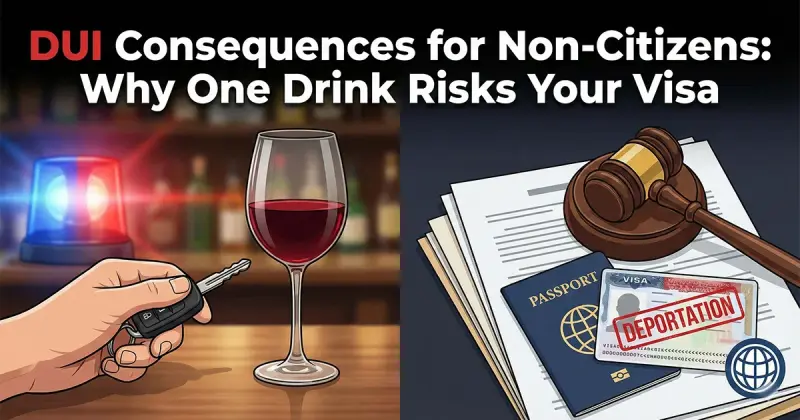
The blue and red lights in your rearview mirror don't just signal a traffic stop; for a non-citizen, they represent a potential end to your American dream. In 2026, the intersection of criminal and immigration law has become more treacherous than ever. While a U.S. citizen might face a fine and a license suspension, you are facing a "Prudential Revocation"—an administrative "kill switch" that can be flipped the moment your fingerprints are scanned at the local precinct.
At bestattorneyus.com, we understand the paralyzing anxiety that follows a DUI arrest. You aren't just worried about jail; you’re worried about being forced to leave your family, your job, and your future. This guide breaks down why the Department of State treats a single drink as a national security issue and what you must do to protect your status.
The "Invisible" Penalty: Understanding Prudential Revocation
The most shocking realization for most non-citizens is that the Department of State (DOS) does not need a conviction to take action against your visa. Under INA section 221(i), consular officers have the discretionary authority to revoke a visa at any time.
This is known as Prudential Revocation. Traditionally, the government waited for a judge to rule on a case. However, current policy allows the DOS to "prudentially" revoke a visa sticker the moment they receive derogatory information—specifically a DUI arrest.
Why the hair-trigger response? The government views a DUI as a potential indicator of a "physical or mental disorder with associated harmful behavior" (alcoholism), which is a medical ground for inadmissibility. By revoking the visa sticker, they essentially put a "pause" on your ability to travel, forcing you to undergo a medical screening by a government-authorized physician before you can ever set foot in the U.S. again.
Visa vs. Status: The Critical Distinction
If you receive an email from the consulate stating your visa has been revoked, your first instinct might be to pack your bags. Wait.
It is vital to understand that your visa and your immigration status are two different things.
-
The Visa: This is the physical stamp in your passport. It is an entry document only. Think of it as a key to a door.
-
The Status: This is your legal right to be in the U.S., governed by your I-94 record.
The Golden Rule:
If your visa is prudentially revoked while you are inside the United States, you are generally allowed to stay and continue your authorized activities (working or studying) until your I-94 expires. However, you cannot leave and come back. The moment you cross the border, your "key" is broken. You will be required to apply for a brand-new visa and face an intensive consular interview.
**
Simple DUI vs. Aggravated DUI: The Risks Compared
Not all DUIs are created equal in the eyes of U.S. Immigration and Customs Enforcement (ICE). While a first-time "simple" DUI rarely leads to immediate deportation for those with lawful status, "aggravating factors" can reclassify your mistake as a Crime Involving Moral Turpitude (CIMT) or even an Aggravated Felony.
| Factor |
Simple DUI |
Aggravated DUI |
| Substance |
Alcohol only |
Controlled substances (including Marijuana) |
| Occupants |
Driver only |
Minor children in the vehicle |
| License Status |
Valid License |
Suspended or No License |
| Outcome |
No property damage/injury |
Serious bodily injury or death |
| Immigration Risk |
Low risk of deportation; High risk of visa revocation |
High risk of deportation and permanent bar |
| Naturalization |
5-year delay (Good Moral Character) |
Permanent bar to citizenship |
How a DUI Affects Different Immigration Statuses
The consequences of a DUI ripple differently depending on your specific legal standing in the US.
1. F-1 and J-1 Students
Students are under extreme scrutiny in 2026. Recent data shows that the DOS has moved toward "mass revocations" for students with even minor law enforcement interactions. A DUI can lead to the termination of your SEVIS record. If your SEVIS is terminated, you lose your legal status immediately and must depart the U.S. or face removal proceedings.
2. H-1B and L-1 Professionals
For professionals, the risk is often to their career. If your visa is revoked, you are effectively "grounded." If a family emergency requires you to travel home, you may be stuck abroad for months waiting for a medical clearance and a new visa interview. Many employers are also hesitant to renew contracts for individuals with pending criminal charges.
3. Green Card Holders (Lawful Permanent Residents)
While more protected than temporary visa holders, Green Card holders are not immune. A DUI involving drugs or a second DUI conviction can lead to a "Notice to Appear" (NTA) in immigration court. Furthermore, a DUI within five years of your naturalization application is a common ground for denial due to a lack of "Good Moral Character."
4. DACA Recipients and TPS Holders
For DACA recipients, a DUI is a "significant misdemeanor." A conviction will almost certainly result in the loss of your protected status and an immediate referral to ICE for deportation. There is very little room for error here.
The 2026 Landscape: Increased Federal-Local Cooperation
In early 2026, the deployment of the Gemini 3 AI system within the Department of Homeland Security has streamlined the "Watchlist Promote Hit" system. Local police departments in many states now share fingerprint data with federal databases in real-time.
We have seen cases where a non-citizen is arrested at 2:00 AM, and by 10:00 AM, they have received an automated email from the U.S. Embassy in their home country informing them that their visa is no longer valid. The speed of this "digital deportation" requires an equally fast legal response.
Step-by-Step: What to Do After an Arrest
If you are a non-citizen and find yourself in the back of a patrol car, follow these steps:
-
Exercise Your Right to Silence: Do not attempt to explain your immigration status or your evening to the officer. Anything you say about "having a few drinks" will be used by the government to justify a "medical ineligibility" finding later.
-
Contact a "Crimmigration" Expert: You need a lawyer who understands the intersection of state criminal law and federal immigration law. A standard criminal defense attorney might suggest a "plea deal" that avoids jail but inadvertently triggers a mandatory deportation.
-
Secure Your Court Dispositions: Even if your case is dismissed, you must keep "certified" copies of all court documents. You will need these for every future visa application for the rest of your life.
-
Do Not Travel: Until you have consulted with an immigration attorney, do not attempt to leave the U.S., even for a weekend trip to Canada or Mexico. You may be denied re-entry at the border.
Conclusion: Don't Face the System Alone
A DUI is a human mistake, but for a non-citizen, the U.S. government views it as a breach of the privilege of being in this country. The complexity of Prudential Revocations and INA 221(i) means that the stakes are simply too high to handle this on your own.
Your future in the United States depends on the actions you take in the first 48 hours after an arrest. You need a legal team that can fight the criminal charges while simultaneously building a "shield" around your immigration status.
Are you or a loved one facing a DUI charge as a non-citizen? Do not wait for the consulate to email you. Contact a qualified attorney today for a comprehensive case evaluation to protect your life in America.
External References & Further Reading: