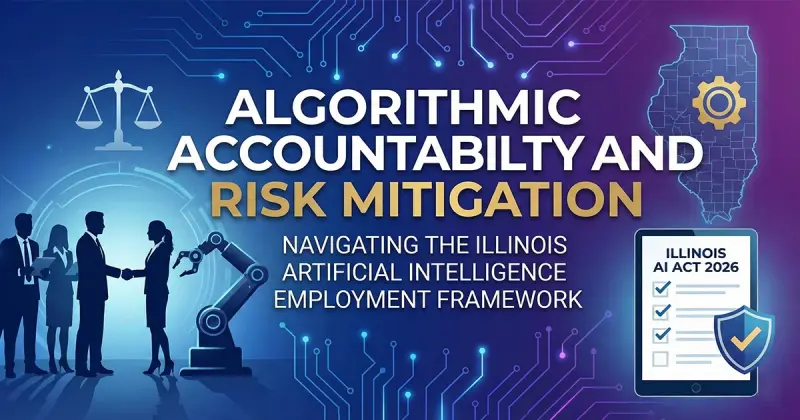
Navigate the 2026 Illinois AI Employment Framework. Essential guide for employers on ensuring algorithmic accountability, mitigating bias risks, and maintaining compliance.
The landscape of human resource management has transitioned from a period of experimental automation to a rigorous era of algorithmic accountability. Illinois, historically a pioneer in privacy and labor protections, has codified this transition through a suite of legislative instruments that place significant burdens on employers utilizing artificial intelligence. The primary challenge for modern organizations is no longer the technical integration of these tools but the navigation of a complex legal architecture designed to prevent systemic discrimination. Central to this architecture is House Bill 3773 (HB 3773), which redefines the Illinois Human Rights Act (IHRA) to address the unique risks of algorithmic bias. When combined with the pre-existing Artificial Intelligence Video Interview Act (AIVIA) and the high-stakes litigation environment of the Biometric Information Privacy Act (BIPA), the regulatory environment in Illinois demands a level of transparency and diligence that exceeds almost any other jurisdiction in North America. Avoiding multi-million dollar liabilities requires an understanding of how these laws interact, the specific mechanisms of "proxy discrimination," and the evolving standards for "meaningful human review."
The Legislative Nexus of HB 3773 and the Illinois Human Rights Act
Effective January 1, 2025, the Illinois Human Rights Act was expanded to establish broader protections, including an extension of the statute of limitations for filing charges from 300 days to two years. However, the most transformative shift arrives on January 1, 2026, when HB 3773 officially amends the IHRA to regulate the use of artificial intelligence in employment-related decisions. This legislation represents a pivot from traditional civil rights enforcement—which often struggled to keep pace with "black box" algorithms—toward a proactive framework that treats discriminatory effects as actionable civil rights violations.
Definitional Scope and Operational Triggers
The statute employs a broad definition of "artificial intelligence" to ensure that various forms of automated decision systems fall under its purview. AI is defined as a machine-based system that, for explicit or implicit objectives, infers from the input it receives how to generate outputs such as predictions, content, recommendations, or decisions that can influence physical or virtual environments. Crucially, the law also incorporates "generative artificial intelligence," identifying it as an automated computing system that produces outputs simulating human-produced content when prompted with human queries or descriptions.
The regulatory triggers for HB 3773 are not limited to the final act of hiring. Instead, they encompass the entire lifecycle of the employment relationship. Employers are prohibited from using AI in a manner that subjects employees to discrimination across a wide spectrum of "covered employment decisions".
Operationalizing Transparency: The IDHR Notice Mandate
The Illinois Department of Human Rights (IDHR) is tasked with enforcing the new AI provisions and has issued draft rules under "Subpart J" to clarify employer obligations. The central tenet of these rules is the affirmative duty to provide notice. Unlike other jurisdictions where notice might only be required for high-risk systems, the Illinois framework demands disclosure whenever AI "influences or facilitates" a covered employment decision, regardless of whether that influence is deemed "substantial".
Drafting the Compliant AI Notice
The draft rules specify that a simple disclaimer is insufficient. For an employer to be compliant, the notice must be comprehensive, accessible, and transparent. The notice must be provided in plain language, formatted for readability, and available in the languages commonly spoken by the employer’s workforce. For prospective employees, the notice must be included in any job posting or notice of recruitment, while current employees must receive notice annually or within 30 days of the adoption of a new or substantially updated AI system.
The draft rules further specify that certain activities do not trigger the notice requirement. These include general business operations that do not facilitate employment decisions, such as generating marketing copy or using standard word processing and spreadsheet software. However, the line is thin; if a spreadsheet is used to "rank" candidates based on predictive formulas, it may migrate into the regulated territory of "automated decision-making".
The Trap of Proxy Discrimination and Disparate Impact
The most significant legal risk under the 2026 IHRA amendments is the prohibition of AI use that has "the effect" of discrimination. This focuses the law squarely on disparate impact—where a neutral policy or algorithm unintentionally disadvantages a protected group. Machine learning models are particularly susceptible to this because they identify patterns in data that humans might overlook. If the training data contains historical biases, the AI will learn and amplify those biases, even if protected characteristics like race or gender are explicitly removed from the dataset.
The Mechanism of Proxy Variables
Proxy discrimination occurs when a "neutral" variable serves as a stand-in for a prohibited characteristic. The classic example cited in Illinois legislation is the use of zip codes. HB 3773 explicitly prohibits the use of zip codes as a proxy for protected classes. Because residential areas in many parts of the United States, including Illinois, reflect historical patterns of segregation (often referred to as "redlining"), an algorithm that filters by zip code—perhaps under the guise of "reducing commute times" or "predicting stability"—may effectively exclude Black or Latino applicants.
Other proxy variables are more subtle but equally dangerous. Graduation dates or years since graduation are clear proxies for age. Participation in certain college sports, such as "lacrosse" versus "softball," can serve as a proxy for gender or socioeconomic status. Even the type of technology listed on a resume (e.g., "COBOL" or "Lotus Notes") can allow an AI to infer that an applicant is an older worker.
Common Data Proxies in AI Hiring
The Specialized Rigor of the Artificial Intelligence Video Interview Act (AIVIA)
While HB 3773 covers the broad employment relationship, the Artificial Intelligence Video Interview Act (AIVIA) has regulated video-based hiring in Illinois since 2019. This act targets the specific risks of video analytics, which often claim to measure "honesty," "confidence," or "culture fit" by analyzing facial expressions and voice patterns.
Mandatory Disclosure and Consent
Before an employer can even ask an applicant to submit a video interview that will be analyzed by AI, they must satisfy three strict requirements:
-
Direct Notification: Notify the applicant that AI may be used to analyze their video.
-
Explanatory Detail: Provide information explaining how the AI works and the general types of characteristics it evaluates.
-
Explicit Consent: Obtain written consent from the applicant to be evaluated by the AI program.
If an applicant refuses consent, the employer cannot use AI to evaluate them. While AIVIA is silent on whether an employer must offer a non-AI alternative, the risk of a "failure to hire" claim suggests that providing a human-led interview is the safer course of action.
Data Governance and Reporting
AIVIA also imposes strict data governance standards. Video interviews may only be shared with those whose expertise or technology is necessary for the evaluation. Furthermore, if an applicant requests the destruction of their video, the employer (and all recipients of the video) must delete it within 30 days.
Of particular note for high-volume recruiters is the 2022 amendment requiring annual reporting for employers who rely solely on AI to determine whether a candidate moves forward. These employers must collect race and ethnicity data and submit an annual report to the Department of Commerce and Economic Opportunity (DCEO), stating the "pass rates" for various demographic groups. This reporting requirement acts as an early warning system for regulators to identify tools with disparate impact.
The Biometric Information Privacy Act (BIPA) Overlap
The most potent threat to Illinois employers is the synergy between AI tools and the Biometric Information Privacy Act (BIPA). Many AI video interview tools function by creating a "map" of an applicant's facial geometry to analyze expressions. Under BIPA, "facial geometry" is a biometric identifier, and its collection without specific notice and written consent is a violation.
Statutory Damages and Recent Reforms
BIPA permits "aggrieved" individuals to recover statutory damages of $1,000 for negligent violations and $5,000 for intentional or reckless ones. In 2023, the Illinois Supreme Court's Cothron v. White Castle decision suggested that damages could accrue for every single "scan," potentially leading to billions of dollars in liability for a single employer.
However, in August 2024, the Illinois legislature amended BIPA to limit liability. The new rule states that an entity that collects the same biometric from the same person using the same method has committed only a "single violation," regardless of how many times the individual was scanned. While this prevents "astronomical" damages, it does not eliminate the risk. For an employer with 1,000 job applicants, a single reckless violation (failing to get BIPA-compliant consent) still represents a $5 million class action exposure.
Lessons from the Litigation Front: Case Studies in Algorithmic Liability
The risks identified in Illinois statutes are being actively tested in the courts. Two major cases—Mobley v. Workday and the ongoing investigation into Sirius XM—provide a roadmap for how plaintiffs' attorneys are attacking AI-driven hiring.
Mobley v. Workday: The "Agent" Theory of Liability
In Mobley v. Workday, Inc., a federal court in the Northern District of California (applying federal standards relevant to Illinois ADEA claims) granted preliminary certification to a nationwide collective of applicants over 40. The plaintiff alleged that Workday’s AI-based filtering algorithm disproportionately disqualified older candidates.
The critical takeaway for employers is that the court allowed the lawsuit to proceed against the software vendor on the theory that Workday was acting as an "agent" of the employer. If a vendor effectively performs the functions of a traditional human resources department—screening, ranking, and selecting—they can be held liable as an employer. This destroys the "outsourced liability" defense. Illinois employers cannot simply point the finger at their vendor; they are responsible for the outcomes of the tools they deploy.
Sirius XM: The Proxy and "Culture Fit" Risk
Sirius XM is currently defending a lawsuit alleging that its AI-driven hiring tool systematically discriminates against Black candidates. The complaint argues that the tool assigns scores based on proxies for race, including residential zip codes and specific educational institutions. This case highlights the "doom loop" of AI hiring: by training a model on "successful" past hires (who may have been predominantly white), the algorithm learns to view attributes associated with those hires as "ideal," effectively codifying historical bias into a permanent barrier for future minority applicants.
Global Benchmarking: Comparing Illinois to Ontario’s Bill 149
The trend toward AI regulation is not unique to the United States. In Canada, Ontario has introduced the Working for Workers Four Act (Bill 149), which mandates AI transparency in job postings starting January 1, 2026.
Common Obligations in Transparency
Both Illinois and Ontario have targeted the "job posting" as the primary vehicle for notice. In Ontario, any employer who uses AI to "screen, assess, or select" applicants must include a statement disclosing this use in the posting. Similar to Illinois draft rules, Ontario emphasizes that this applies even if a human makes the final decision.
Divergent Enforcement and Scopes
However, the Illinois framework is significantly more punitive. While Ontario focuses on Ministry of Labour complaints and compliance orders, Illinois provides for a private right of action and administrative charges that can lead to uncapped compensatory damages, back pay, and attorneys' fees. Furthermore, Ontario’s Bill 149 is limited to the hiring phase, whereas Illinois HB 3773 covers the entire employee lifecycle, including discipline and discharge.
The "Canadian Experience" Cautionary Tale
Ontario's Bill 149 also bans requirements for "Canadian experience" in job postings. While this is a separate provision, it is highly relevant to AI hiring. Often, AI models are trained to prioritize "local" or "prestigious" experience, which can act as a proxy for citizenship or place of origin. In one Quebec case, a bar was sanctioned for excluding "woke" applicants in a job ad—a reminder that even subjective human "filters" are illegal when they target political or protected beliefs. For Illinois employers, the takeaway is clear: any filter—automated or human—that targets characteristics not directly related to job performance is a litigation magnet.
Enforcement and Economic Consequences under IHRA
In Illinois, the Department of Human Rights (IDHR) and the Human Rights Commission handle the primary enforcement of HB 3773. Applicants or workers who believe their rights have been violated must first exhaust administrative remedies by filing a charge with the IDHR. If the IDHR finds "substantial evidence" of a violation, it can file a formal complaint with the Commission or issue a "right to sue" letter, allowing the plaintiff to proceed in court.
The financial stakes are immense. Victims of AI discrimination can seek:
-
Uncapped Compensatory Damages: Payments for emotional distress and suffering.
-
Back Pay and Front Pay: Lost wages from the date of the discriminatory act forward.
-
Lost Benefits: The value of health insurance, retirement contributions, and other perks.
-
Attorneys’ Fees: A major driver of settlement pressure, as plaintiffs' firms in Illinois are highly motivated by the fee-shifting provisions of the IHRA.
Furthermore, the IDHR draft rules mandate that employers keep records of AI use—including notices and postings—for four years. Failure to produce these records during an investigation can lead to an adverse inference, where the court or commission assumes the missing data would have proven discrimination.
Strategic Framework for Mitigation: A Multi-Layered Defense
To avoid a multi-million dollar lawsuit, Illinois employers must shift from passive adoption of AI to active algorithmic governance. This defense must be built on four pillars: Diligence, Auditing, Human Oversight, and Transparency.
Pillar 1: Rigorous Vendor Due Diligence
Organizations must stop treating AI vendors as neutral service providers and start treating them as "high-risk" agents. Contracts should be amended to include:
-
Transparency Clauses: Requiring vendors to disclose the "features" and "weights" used in their models.
-
Bias Warranty: A contractual guarantee that the tool has been tested for disparate impact using Illinois-specific standards (e.g., zip code removal).
-
Indemnification: Ensuring the vendor shares financial responsibility if their tool is found to be inherently discriminatory.
Pillar 2: The "Human-in-the-Loop" Mandate
A recurring theme in both Illinois and Canadian commentary is the necessity of human judgment. An employer’s strongest defense against a "black box" claim is a clear record showing that AI was merely an "influence" and that a human manager made the final, reasoned decision.
-
Review Process: Implement a policy where no candidate is rejected, and no employee is disciplined, based on AI output alone.
-
Explainability Training: Managers should be trained to explain the "human" reasons for a decision, even if they initially saw a high score from an AI assessment.
Pillar 3: Regular Bias Auditing
While HB 3773 does not explicitly require annual bias audits (unlike Colorado’s law), the potential for liability makes them effectively mandatory for defense.
-
Statistical Testing: Use the "Four-Fifths Rule" to check if the AI’s "pass rate" for Black, Latino, or female candidates is at least 80% of the rate for the highest-performing group.
-
Human Rights Impact Assessments (HRIA): Adopt the framework developed by the Ontario Human Rights Commission to identify potential harms throughout the lifecycle of the AI system.
Pillar 4: Precision in Notice Delivery
The notice requirement is the "gotcha" of HB 3773. Even a non-discriminatory AI tool can trigger a lawsuit if the employer fails to provide the required notice.
-
Standardized Templates: Create a central repository of AI notices for all job categories.
-
Multichannel Delivery: Ensure the notice appears in the job posting, the employee handbook, and on the physical premises.
-
Accommodation Workflows: Establish a clear, 24-hour turnaround for candidates who request a non-AI alternative due to a disability.
The Future Outlook: Federal Preemption and the Trump Executive Order
A significant wildcard in the Illinois regulatory landscape is the recent federal intervention. In December 2025, President Donald Trump signed an executive order restricting states and localities from issuing new laws or regulations related to AI, asserting federal preemption over the space. The order directs the Department of Justice to challenge state laws like HB 3773 that may conflict with national policy aimed at consistency and innovation.
However, legal experts in Chicago warn that this creates "ongoing uncertainty" rather than immediate relief. Federal preemption often takes years to litigate through the Supreme Court. In the interim, Illinois state agencies like the IDHR are proceeding with enforcement. Employers who ignore the January 2026 deadline in the hope of federal intervention may find themselves facing years of expensive litigation before the preemption issue is ever resolved. The most prudent course of action is to prepare for full compliance with Illinois law while monitoring federal developments.
Conclusion: Resilience Through Algorithmic Integrity
The arrival of AI in the workplace has fundamentally changed the social contract between employer and employee. In Illinois, the law has moved with remarkable speed to ensure that this change does not come at the cost of civil rights. The integration of the Illinois Human Rights Act amendments, AIVIA, and BIPA creates a "triple threat" of legal risk that can easily escalate into multi-million dollar liabilities.
However, these laws also provide a roadmap for ethical innovation. By demanding transparency, banning discriminatory proxies like zip codes, and requiring meaningful human oversight, Illinois is forcing organizations to build more rigorous, defensible, and ultimately more effective hiring and management systems. The path to avoiding a lawsuit is not to fear AI, but to master its governance. Employers who audit their tools, demand transparency from their vendors, and maintain a "human-in-the-loop" will not only survive the regulatory storm of 2026 but will emerge as leaders in the new era of algorithmic integrity. In a jurisdiction where the "effect" of an algorithm is a matter of law, silence and opacity are no longer viable business strategies. Responsibility cannot be outsourced, and the "black box" must be opened.