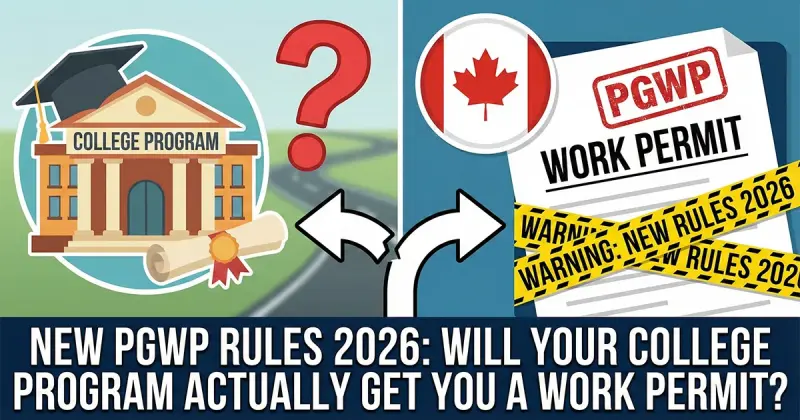
Canada’s new PGWP rules for 2026 have changed everything. Discover which private colleges and programs no longer qualify for work permits before you pay tuition.
Imagine this: You’ve just spent two years studying in Canada. You paid over $35,000 in tuition, worked late nights to submit assignments, and endured the freezing winter. You walk across the stage, grab your diploma, and apply for your Post-Graduation Work Permit (PGWP)—the golden ticket to working in Canada.
Two months later, your application is refused.
Why? Because while you were studying, the rules changed.
This isn’t a scare tactic; it is the new reality for thousands of international students graduating in 2025 and 2026. Canada has capped student visas and fundamentally altered who gets to stay and work. If you are planning to study in Canada, or are already here, you need a reality check now, not after you graduate.
This guide acts as your safety manual to navigate the minefield of the New PGWP Rules 2026.
The Big Warning: The "Public-Private" Trap
For years, many students flocked to private colleges that partnered with public colleges. These were often located in strip malls in the Greater Toronto Area (GTA), offering "easier" admission and the same work permit rights as big universities.
As of May 15, 2024, that door is shut.
If you are starting a program at a private college that delivers a curriculum on behalf of a public college (often called a Public-Private Partnership or PPP), you are NOT eligible for a PGWP.
The Risk: Many agents still sell these programs because they get high commissions. They might tell you, "It's a public college curriculum!" That is true, but the campus is private, and under the new rules, that means no work permit.
Rule of Thumb: If the college name sounds like a big public institution (e.g., "Mohawk College at Mississauga" or "Sheridan at CCTT"), double-check if it is a "partner" campus. If it is, run the other way.
The "Useless Diploma" Risk: Field of Study Requirements
This is the biggest change affecting students graduating in 2026.
If you are studying for a Master’s or PhD at a university, you are safe. You can study anything—History, Philosophy, Art—and still qualify for a 3-year PGWP.
However, if you are studying at a College (Diploma or Certificate):
You no longer get a work permit just for graduating. Your program must be in a field that Canada actually needs.
As of November 1, 2024, if you apply for a study permit, your college program must fall under these five categories to be eligible for a PGWP:
-
Agriculture and Agri-food
-
Healthcare (Nursing, Pharmacy Tech, etc.)
-
STEM (Science, Technology, Engineering, Math)
-
Trade (Carpentry, Electrician, Welding)
-
Transport
The Danger Zone:
General "Business Administration," "Hospitality Management," or "Arts and Design" diplomas at the college level are now incredibly risky. Unless your specific program code (CIP code) matches the government's shortage list, you might graduate with a diploma but zero right to work.
The Language Barrier: CLB 5 vs. CLB 7
Think your English is "good enough"? The government now demands proof before they give you a work permit.
-
University Graduates: Must prove CLB 7 (approx. IELTS 6.0 in all bands).
-
College Graduates: Must prove CLB 5 (approx. IELTS 5.0 overall, with specific band minimums).
If you struggled with IELTS to get into Canada, you can't relax. You will need to take a test again (CELPIP, IELTS General, or PTE Core) to apply for your work permit.
Reality Scenario: Rahul vs. Sarah
Let's look at two students graduating in 2026 to see how these rules play out in real life.
| Feature |
Rahul (The Safe Path) |
Sarah (The "Old Rules" Path) |
| Institution |
Public University (e.g., University of Alberta) |
Private College (Public-Private Partner) |
| Program |
Master of Business Admin (MBA) |
Diploma in Hospitality Management |
| Field of Study |
Business (Not on shortage list) |
Hospitality (Not on shortage list) |
| PGWP Eligible? |
YES |
NO |
| Why? |
University Master's degrees are exempt from field restrictions. |
1. It's a PPP college (ineligible).
2. Hospitality is often not on the priority list.
|
| Outcome |
Gets a 3-year Open Work Permit. |
Must leave Canada or find an employer to sponsor a closed work permit (very hard). |
Comparison Table: Are You Safe?
Use this table to check your status instantly.
| If you study here... |
And your program is... |
Are you eligible for PGWP in 2026? |
| Public University |
Bachelor's, Master's, or PhD |
YES (Field of study doesn't matter). |
| Public College |
Engineering / Health / Trades |
YES (Matches shortage list). |
| Public College |
General Business / Arts |
NO (Unless you applied for a study permit before Nov 1, 2024). |
| Private College |
Degree Program (e.g., Bachelor's) |
MAYBE (Check if the school is a DLI with degree-granting powers). |
| Private College |
PPP (Curriculum Licensing) |
NO (Strictly banned). |
Frequently Asked Questions (FAQs)
Q1: I started my college business diploma in September 2024. Am I safe?
A: Yes, likely. If you submitted your study permit application before November 1, 2024, you are "grandfathered" in under the old rules. The field of study requirement usually applies to those applying for study permits after that date.
Q2: Can I just switch from a college diploma to a university degree?
A: Yes, but it is expensive. University tuition is generally higher. However, graduating with a Bachelor's degree exempts you from the specific "shortage list" requirements.
Q3: Is the 2026 "Student Cap" going to stop me from getting a PGWP?
A: No. The "Cap" limits how many new students can enter Canada. Once you are in and have your study permit, the cap doesn't block your PGWP—the eligibility rules (field of study, school type) do.
Q4: My agent says private colleges are cheaper and still give work permits. Is he lying?
A: He might be outdated or misleading you. Some private colleges in Quebec or those that grant actual Degrees (not just diplomas) might still be eligible. But the vast majority of "strip mall" private colleges are now a dead end for work permits. Always check the official IRCC DLI list.
References & Official Sources
Don't just take our word for it. Verify everything on the official Government of Canada websites:
-
Field of Study Requirements: Canada.ca - PGWP Field of Study
-
Public-Private Partnership Changes: IRCC Notice on PPPs
-
Language Requirements: PGWP Language Criteria