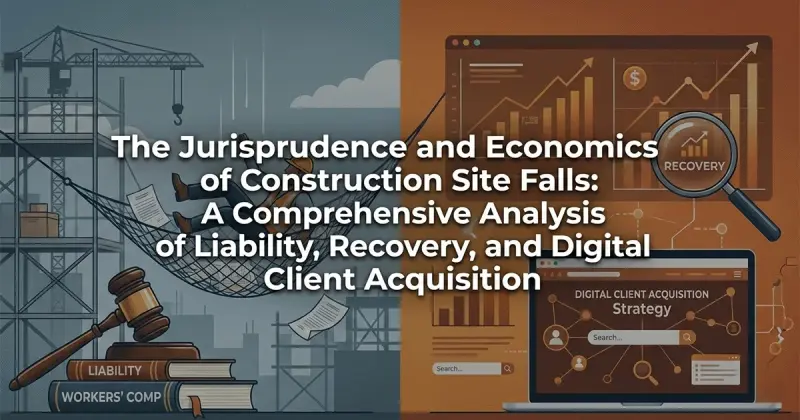
Explore the jurisprudence and economics of construction site falls. A deep dive into liability, workers’ comp, and digital strategies for client acquisition.
Chapter 1: The Epidemiology and Mechanics of Vertical Descent Injuries in the Construction Sector
1.1 The Persistent Crisis of Elevation Hazards
The construction industry in the United States remains defined by a stark paradox: despite decades of regulatory advancement and the proliferation of safety technologies, gravity remains the single greatest threat to the workforce. The data emerging from the Bureau of Labor Statistics (BLS) and the Occupational Safety and Health Administration (OSHA) for the 2023-2024 period paints a grim picture of occupational mortality, with falls from elevation serving as the primary driver of fatalities. This phenomenon is not merely a collection of accidents but a systemic failure of hazard management that necessitates a deep understanding of both the physical and legal mechanisms at play.
In 2023, the construction sector recorded 1,075 fatalities, a figure that has remained stubbornly high, accounting for nearly one in five of all workplace deaths across the national economy. Within this aggregate, the "Fatal Four" hazards—falls, struck-by incidents, electrocutions, and caught-in/between incidents—continue to dominate. However, falls are statistically unrivaled in their lethality. Falls, slips, and trips accounted for 38.4% to 39.2% of all construction deaths in recent reporting periods. Specifically, falls to a lower level claimed 421 lives in 2023.
The persistence of these numbers suggests that the risk is endemic to the current operational model of the industry. The prevalence of vertical construction, coupled with the transient nature of the workforce and the intense economic pressure to accelerate project timelines, creates an environment where fall protection protocols are frequently bypassed. OSHA enforcement data corroborates this: the standard for "Fall Protection, General Requirements" (29 CFR 1926.501) remains the most frequently cited violation in the entire Code of Federal Regulations, indicating a widespread culture of non-compliance.
1.2 Granular Analysis of Fall Mechanics and Demographics
To understand the legal liabilities arising from these incidents, one must first understand the granular mechanics of how and where these falls occur. Contrary to the cinematic image of falls occurring from skyscrapers, the data reveals that the most lethal zone is relatively close to the ground.
1.2.1 The "Low-Level" Lethality Paradox
Most fatal falls do not occur from extreme heights. In 2023, 260 fatal falls—representing 64.4% of the total—occurred from a height of between 6 and 30 feet. This height range is critical because it corresponds to the most common residential and light-commercial activities: second-story framing, roofing, and siding installation. Only 67 fatalities involved falls from heights exceeding 30 feet.
This statistic has profound legal implications. It suggests that the industry's focus on complex engineering solutions for high-rises may be overshadowing the need for basic compliance in the residential sector. The legal standard of care for a single-family home build is often where the most catastrophic breaches occur. The prevalence of falls from 6 to 30 feet also implicates specific equipment: portable ladders and stairs were the primary source of 109 fatalities. This points to "access equipment" as a critical area for product liability and negligence investigations.
1.2.2 High-Risk Trades and Sub-Sectors
The burden of these fatalities is not shared equally across trades. Roofing contractors are the epicenter of the crisis, accounting for 110 deaths in 2023, or roughly 26% of all fall-related fatalities. Residential building construction followed with 62 deaths. This concentration of risk in roofing and residential framing highlights the "fragmentation" problem in construction liability. These sectors are often characterized by smaller subcontractors, lower capitalization, and less rigorous safety oversight compared to large commercial infrastructure projects.
| Trade Classification |
Fatalities (Falls/Slips/Trips, 2023) |
% of Sector Fatalities |
| Roofing Contractors |
110 |
26.0% |
| Residential Construction |
62 |
14.7% |
| Painting/Wall Covering |
29 |
~7% |
| Framing Contractors |
27 |
~6.5% |
| Electrical Contractors |
27 |
~6.5% |
| Plumbing/HVAC |
24 |
~5.7% |
Data synthesized from BLS Census of Fatal Occupational Injuries.
1.3 The Socio-Economic Dimensions of Casualty
A rigorous analysis must also address the demographic disparities evident in the casualty data. The construction industry relies heavily on Hispanic and Latino labor, and this demographic bears a disproportionate share of the fatal injury burden. In 2023, the construction industry accounted for 410 fatalities among Hispanic or Latino workers. Even more concerning is the vulnerability of foreign-born workers within this group; foreign-born Hispanic or Latino workers made up 67.1% of all fatalities in this demographic.
This disparity drives a specific set of legal challenges and "second-order" insights for practitioners:
-
Communication Barriers: The failure to provide safety training in a language the worker understands is a potential breach of OSHA regulations and a basis for negligence claims.
-
Retaliation and Reporting: Vulnerable populations, particularly those with precarious immigration status, are less likely to report safety violations (like missing guardrails) before an accident occurs, and more likely to be coerced into "under the table" settlements that bypass the legal system.
-
Investigative Necessity: Effective legal representation in this sector requires bilingual investigative capabilities to interview witnesses who may otherwise remain silent due to fear of employer retaliation.
The data indicates that fall prevention is not merely a technical engineering challenge but a socio-linguistic one. The failure of a General Contractor to ensure that safety briefings are comprehensible to the actual workforce on site (not just the foremen) is a potent theory of liability in third-party lawsuits.
1.4 The Temporal Patterns of Risk
Understanding when falls occur also aids in reconstructing the accident for litigation. Data from the Center for Construction Research and Training (CPWR) indicates that most fatal falls occur between 10:00 a.m. and 12:59 p.m.. This pre-lunch window may correspond to a drop in blood sugar, increasing fatigue, or the rush to complete a task before the break. From a litigation perspective, this data point is vital. If an accident occurs in this window, attorneys investigate "pace of work" issues. Was the subcontractor rushing to meet an unrealistic deadline set by the General Contractor? Pressure to speed up work at the expense of safety is a key evidence point in establishing the negligence of a managing entity.
Chapter 2: The Administrative Compromise: The Workers' Compensation System
2.1 The Historical "Grand Bargain"
The modern approach to industrial injury in the United States is predicated on a socio-legal compromise known as the "Grand Bargain," established in the early 20th century. Prior to this system, an injured worker's only recourse was to sue their employer in tort. These lawsuits were fraught with difficulty; employers utilized "The Unholy Trinity" of defenses: contributory negligence (if the worker was 1% at fault, they got nothing), the fellow servant rule (if a coworker caused the injury, the employer wasn't liable), and assumption of risk (the worker knew the job was dangerous when they took it).
Workers' Compensation statutes dismantled this adversarial system in favor of an administrative, no-fault model. The core tenets of this bargain are:
-
Certainty over Adequacy: Workers receive guaranteed benefits for medical care and lost wages without having to prove the employer was negligent.
-
Immunity for Employers: In exchange, employers are granted immunity from civil lawsuits. The Workers' Comp claim is the "Exclusive Remedy" for the employee against the employer.
2.2 The Mechanics of No-Fault Recovery
For a construction worker who falls from a scaffold, the "no-fault" aspect is the system's most significant advantage. The worker does not need to prove that the scaffold was defective or that the foreman was negligent. They simply need to demonstrate that the injury arose "out of and in the course of employment" (AOE/COE). This means that even if the worker was clumsy, forgot to tie off their lanyard, or tripped over their own feet, they are still entitled to benefits. This protects the worker from destitution in cases of genuine accident or self-error.
2.2.1 Benefit Structure and Limitations
While access to benefits is broad, the quantum of those benefits is strictly capped by statute.
-
Medical Treatment: The system covers 100% of "reasonable and necessary" medical expenses. This includes surgeries, hospital stays, physical therapy, and prosthetics. There are no deductibles or co-pays.
-
Indemnity (Wage Replacement): This is where the system often fails the high-earning construction worker. Benefits are typically calculated at roughly two-thirds (66.6%) of the worker's Average Weekly Wage (AWW), subject to a state-mandated cap. For example, in New Jersey, the 2025 maximum weekly benefit was $1,159. If a union ironworker was earning $2,500 a week, receiving only $1,159 represents a catastrophic loss of income that the system does not make whole.
-
Permanent Disability: If the fall results in permanent impairment (e.g., loss of use of a leg, spinal fusion), the worker receives a "Permanent Partial Disability" (PPD) award. This is often based on a "schedule of losses"—a gruesome actuarial table that assigns a specific dollar value to every body part. A leg might be worth a specific number of weeks of pay; an eye another amount.
2.3 The "Justice Gap" in Catastrophic Cases
The inherent limitation of Workers' Compensation is its refusal to recognize non-economic damages. The system treats the worker as a unit of economic production, compensating only for the repair of the machine (medical bills) and the downtime (lost wages). It does not account for the human experience of the injury.
-
Pain and Suffering: A worker who suffers a shattered pelvis from a 20-foot fall endures agonizing pain and months of rehabilitation. Workers' Comp pays $0.00 for this physical suffering.
-
Loss of Enjoyment of Life: If the worker can no longer play catch with their children or hike, the system provides no remedy.
-
Loss of Consortium: The spouse of the injured worker, who must become a caregiver and loses the intimacy of the marriage, has no claim within the Workers' Comp system.
This "Justice Gap"—the difference between the limited administrative benefits and the true human cost of the injury—is the driving force behind the search for Third-Party Liability.
Chapter 3: The Adversarial Remedy: Third-Party Civil Litigation
3.1 Piercing the Immunity Shield
While the "Grand Bargain" protects the direct employer, it does not extend to other entities on the construction site. Construction projects are complex ecosystems involving General Contractors (GCs), subcontractors, sub-subcontractors, architects, engineers, material suppliers, and property owners. Under the law, these entities are "strangers" to the employment contract between the injured worker and their boss. Therefore, they do not enjoy immunity.
If a worker is injured due to the negligence of a "Third Party," they may file a civil lawsuit (tort action) in addition to their Workers' Compensation claim. This is not "double dipping" in the sense of overpayment, but rather a mechanism to recover the damages that Workers' Comp ignores (pain and suffering, full wage loss).
3.2 The Elements of Construction Negligence
Unlike the no-fault administrative system, Third-Party claims are adversarial and fault-based. The plaintiff (injured worker) bears the burden of proving four elements :
-
Duty of Care: The defendant owed an obligation to the worker to maintain a safe environment.
-
Breach of Duty: The defendant failed to meet the "standard of care" expected of a reasonable entity in that position. In construction, the "standard of care" is often defined by OSHA regulations, industry customs, and contract documents.
-
Causation: The breach was the "proximate cause" of the fall. (e.g., "But for the missing guardrail, the worker would not have fallen.")
-
Damages: The worker suffered actual quantifiable harm.
3.3 Liability Targets: Who is Responsible?
Identifying the correct defendant is the forensic heart of a construction fall case.
3.3.1 The General Contractor (GC) and the "Multi-Employer Worksite"
The General Contractor is frequently the primary target in Third-Party litigation. Although the GC may not have directly employed the fallen worker, they often retain "supervisory control" over the entire site. Under the "Multi-Employer Worksite Doctrine," OSHA and civil courts recognize that a GC can be liable for hazards created by subcontractors if the GC had the authority to correct them.
-
Theory of Liability: Failure to Coordinate/Supervise. If a GC schedules a roofer and a mason to work in the same vertical zone without protection, and the roofer falls because of the mason's debris, the GC is liable for the failure of logistics and safety planning.
3.3.2 Premises Liability: Property Owners
Property owners generally have a duty to keep their premises reasonably safe for invitees (which includes contractors).
-
Theory of Liability: Latent Defects. If a building owner knows that a roof deck is rotted but fails to warn the roofing contractor, and a worker steps through the soft spot, the owner is liable for the "trap." This is distinct from hazards the contractor creates themselves.
3.3.3 Product Liability: Manufacturers
When safety equipment fails, the manufacturer is liable.
-
Theory of Liability: Defective Design or Manufacture. If a "Class A" self-retracting lifeline (SRL) fails to lock during a fall, or a ladder rung collapses due to poor welding, the manufacturer faces "Strict Liability." In these cases, the plaintiff does not need to prove the manufacturer was negligent, only that the product was defective and unreasonably dangerous.
3.3.4 Subcontractor-on-Subcontractor Negligence
On crowded sites, workers from different trades often endanger each other.
-
Theory of Liability: Active Negligence. If an electrical subcontractor removes a section of floor grating to run conduit and fails to replace it or barricade it, and a plumber subsequently falls through the opening, the electrical company is liable to the plumber.
3.4 The Economic Disparity: A Case for Litigation
The financial outcomes of Third-Party lawsuits vastly eclipse Workers' Compensation benefits. A 2024 study noted that settlements in cases with third-party liability averaged 65% higher than those limited to comp claims. Real-world examples illustrate this variance:
-
Workers' Comp Outcome: A roofer falls and breaks his back. He receives $150,000 in medical payments (paid to doctors) and $200,000 in weekly checks over 5 years. Total to Worker: $200,000.
-
Third-Party Outcome: The same roofer sues the GC for failing to install perimeter safety nets. The jury awards damages for pain ($5M), future medical care ($3M), and lost future earnings ($2M). Total Verdict: $10 Million. Specific recent settlements reinforce this: Snippets cite a $16.6 Million Roofer Fall settlement and an $11.5 Million Electrical Injury settlement. These figures are unattainable within the Workers' Comp system.
Chapter 4: Piercing the Veil: Exceptions to the Exclusive Remedy Rule
While the "Exclusive Remedy" rule is robust, it is not absolute. There are specific, narrow factual scenarios where an injured worker can sue their own employer in civil court, effectively bypassing the immunity shield. These exceptions are critical for attorneys to investigate when no obvious third party exists.
4.1 The Dual Capacity Doctrine
This exception applies when the employer wears "two hats." If the employer causes injury to the employee in a capacity other than as an employer, immunity may be waived.
-
Example: A worker for a scaffolding manufacturing company falls because one of the scaffolds made by the company collapses. The worker can sue the employer not as a boss, but as the manufacturer of a defective product sold to the public. The law reasons that the employer should not be shielded from product liability just because the victim happened to be on their payroll.
4.2 Fraudulent Concealment
If an employer knows of an injury's work-related cause but conceals it from the employee, thereby aggravating the condition, they can be sued.
-
Applicability to Falls: While more common in chemical exposure cases (e.g., asbestos), this can apply to structural failures. If an employer knew a scaffold was damaged (e.g., from a previous accident) and actively hid the inspection report or painted over the cracks, leading to a collapse, this fraud pierces the immunity. The damages are usually limited to the aggravation of the injury caused by the delay in proper treatment or the continued exposure.
4.3 Intentional Assault and Ratification
Workers' Comp is designed for accidents, not crimes. If an employer physically assaults a worker (e.g., a foreman pushing a worker off a ledge), immunity is void. Crucially, this extends to "Ratification," where an employer approves of an assault committed by a co-worker.
4.4 The Power Press Exception (and Equipment Tampering)
Specific to California (Labor Code § 4558) and influential elsewhere, this exception allows a lawsuit if an employer knowingly removes or fails to install a manufacturer-required point-of-operation guard on a power press.
-
Broader Implication: While specific to power presses, this statute reflects a legislative intolerance for the deliberate removal of safety devices. In some jurisdictions, removing safety limits on cranes or aerial lifts (cherry pickers) to speed up work, resulting in a fall, can be argued as "Intentional Tort" or "Gross Negligence" sufficient to overcome immunity.
4.5 The Uninsured Employer
The "Grand Bargain" requires the employer to pay into the insurance system. If an employer fails to carry Workers' Compensation insurance, they breach the bargain. In this scenario, the employer loses all protection. The worker can sue them in civil court for full damages (pain and suffering, etc.).
-
Presumption of Negligence: In many states, when suing an uninsured employer, the burden of proof shifts. It is presumed the employer was negligent, and the employer is stripped of common law defenses like comparative negligence.
Chapter 5: Comparative Damages Analysis
To fully appreciate the strategic necessity of Third-Party litigation, one must analyze the economic disparity between the two systems.
5.1 Economic Damages: Past and Future
-
Workers' Comp: Pays a percentage of past wages. Future wage loss is often settled for a lump sum that significantly discounts the worker's life expectancy and inflation.
-
Tort Law: Allows for the calculation of "Loss of Earning Capacity." A vocational expert can testify that a 30-year-old construction worker, now paralyzed, has lost 35 years of union wages, pension contributions, and benefits. This calculation is projected with inflation, often resulting in multi-million dollar economic claims.
5.2 Non-Economic Damages: The Human Cost
This is the starkest differentiator.
-
Workers' Comp: $0.00 for pain.
-
Tort Law: Juries are asked to place a dollar value on the human experience. How much is it worth to never be able to pick up your child again? To live in chronic pain? To lose sexual function? These "general damages" often exceed the economic damages in fall cases.
5.3 Punitive Damages
In cases of "Gross Negligence" or "Malice," civil courts can award punitive damages designed solely to punish the defendant and deter future bad conduct. Workers' Comp has no equivalent mechanism (beyond small administrative penalties).
Table 4: Comparative Recovery Matrix
| Damage Category |
Workers' Comp (Administrative) |
Third-Party Lawsuit (Civil Tort) |
| Medical Bills |
100% Covered (Fee Schedule) |
Recoverable (Full Value) |
| Lost Wages |
Capped (~66%) |
100% (Past & Future) |
| Pain & Suffering |
Not Covered |
Fully Recoverable |
| Emotional Distress |
Generally Not Covered |
Recoverable |
| Loss of Consortium |
Not Covered |
Recoverable by Spouse |
| Punitive Damages |
Not Covered |
Recoverable |
| Attorney Fees |
Contingency (Low, e.g., 20%) |
Contingency (Standard, e.g., 33-40%) |
Table 4 Source Data:.
Chapter 6: The Interplay of Systems: Subrogation and Liens
The existence of parallel claims (Comp and Tort) creates a complex financial interaction known as Subrogation.
6.1 The Principle of "No Double Recovery"
The law prevents a plaintiff from being paid twice for the same expense. If the Workers' Comp insurer pays $100,000 for the injured worker's spinal surgery, and the worker essentially wins $100,000 for "medical expenses" in their lawsuit against the General Contractor, the worker cannot keep that money. The Workers' Comp insurer has a "lien" on the settlement.
6.2 Mechanics of the Lien
When a Third-Party case settles, the Workers' Comp insurer is typically the first to be paid back from the proceeds.
-
Example:
-
Third-Party Settlement: $1,000,000.
-
Workers' Comp Lien (money already paid): $150,000.
-
Attorney Fee (33%): $333,000.
-
Costs: $20,000.
-
Net to Client: $1,000,000 - $150,000 - $333,000 - $20,000 = $497,000.
6.3 The "Future Credit" Problem
If the worker settles the Third-Party case, the Workers' Comp insurer may stop paying future benefits. They take a "credit" against the settlement. This means the worker must spend down their lawsuit money on medical care until the credit is exhausted before Workers' Comp kicks back in. This requires careful legal negotiation to ensure the client doesn't inadvertently waive their lifeline medical benefits.
Chapter 7: Digital Client Acquisition Strategy for Construction Law
Note: This section addresses the user's request for "SEO Expert" insights, translating the legal complexity above into a digital marketing framework.
For law firms specializing in construction accidents, the digital landscape is the primary channel for client acquisition. However, the market is saturated. To compete, firms must move beyond generic "Personal Injury" tactics and adopt a granular, high-intent strategy.
7.1 The Fallacy of Short-Tail Keywords
Investing budget in keywords like "Personal Injury Lawyer" or "Workers Comp Attorney" is inefficient. These terms have:
-
High Cost-Per-Click (CPC): Often exceeding $100-$200 per click.
-
Mixed Intent: A user searching "Workers Comp" might be looking for forms, definitions, or a lawyer for a minor sprain. They are often not the high-value fall cases.
7.2 The "Long-Tail" Strategy: Capturing Intent
The "Goldilocks" zone for construction falls lies in long-tail keywords that indicate specific accident mechanisms. These users are further down the funnel; they have been hurt and are researching specific liability issues.
7.2.1 High-Value Keyword Clusters
Based on search data analysis , effective clusters include:
-
Mechanism-Specific: "Scaffolding collapse settlement amounts," "Ladder fall injury lawyer," "Trench collapse attorney," "Crane accident lawsuit."
-
Liability-Specific: "Suing general contractor for injury," "Third party claim vs workers comp," "Can I sue my boss for lack of safety harness?"
-
Injury-Specific: "Spinal cord injury settlement construction," "Traumatic brain injury work accident lawyer."
These queries reveal a user who understands the severity of their situation and is actively seeking a solution that goes beyond basic Workers' Comp.
7.3 Content Strategy: Bridging the Information Gap
Content must be designed to answer the user's specific questions at different stages of their journey ("Search Intent").
-
Top of Funnel (Informational):
-
User Question: "Does workers comp cover pain and suffering?"
-
Content Asset: A detailed blog post explaining the "Justice Gap" and introducing the concept of Third-Party claims. Use Schema Markup (FAQPage) to win Google's "People Also Ask" snippets.
-
Middle of Funnel (Commercial Investigation):
-
User Question: "Average settlement for construction fall."
-
Content Asset: A "Case Results" page detailing specific settlements , anonymized but detailed. This builds "Authority" and "Trust."
-
Bottom of Funnel (Transactional):
-
User Question: "Best construction accident lawyer near me."
-
Content Asset: A high-converting Practice Area landing page with strong Calls to Action (CTAs), "No Win No Fee" guarantees, and client testimonials.
7.4 Local SEO and the "Map Pack"
Construction law is geographically bound. A lawyer in New York cannot help a worker injured in Texas.
-
Geo-Modifiers: Content must target not just cities but specific industrial hubs. E.g., "Construction accident lawyer Brooklyn Navy Yard" or "Refinery injury attorney Pasadena TX".
-
Google Business Profile (GBP): Essential for appearing in the "Map Pack" (the 3-pack of local businesses). Profiles must be optimized with the category "Personal Injury Attorney" and regularly updated with posts about local construction safety news.
7.5 Technical SEO and "YMYL" Compliance
Google categorizes legal content as "Your Money or Your Life" (YMYL). This means it applies a higher standard of quality.
-
E-E-A-T (Experience, Expertise, Authoritativeness, Trustworthiness): Content should be reviewed by an attorney. Author bios must link to State Bar profiles. Citations should link to authoritative.gov sources (OSHA, BLS) to prove the accuracy of the data.
-
Site Speed and Mobile Optimization: Most injured workers search on mobile devices while at the hospital or home. A slow site will lose them.
7.6 Sample Meta Tags for a Blog Post
Addressing the user's specific request for meta tags for a 10th-grade audience blog.
Title Tag: Construction Site Falls: Workers' Comp vs. Lawsuits | [Firm Name]
Meta Description: Hurt in a construction fall? Learn why Workers' Comp might not be enough. Discover how Third-Party lawsuits can pay for pain and suffering. Free Guide.
H1 Header: Workers' Comp vs. Third-Party Claims: What Construction Workers Need to Know
Keywords (Internal Use): construction accident lawyer, third party lawsuit, workers comp limits, scaffold fall injury, suing general contractor.
Chapter 8: Conclusion
The legal landscape surrounding construction site falls is a high-stakes arena defined by the tension between the administrative efficiency of Workers' Compensation and the restorative potential of the Civil Tort system. For the 1,075 families who lost a loved one in 2023, and the thousands more coping with catastrophic disability, understanding this distinction is the difference between financial ruin and a secure future.
The data is clear: falls are predictable, preventable, and often the result of systemic negligence by multiple parties on a job site. While Workers' Compensation provides a necessary safety net, it was never designed to compensate for the full devastation of a life-altering fall. The "Third-Party" lawsuit remains the only mechanism capable of delivering true justice—holding negligent General Contractors, property owners, and manufacturers accountable for the safety shortcuts that trade lives for profit.
For legal practitioners, success in this domain requires a dual-track approach: a relentless pursuit of immediate administrative benefits coupled with a sophisticated forensic investigation into third-party liability. And in the digital age, connecting with the victims of these tragedies requires an empathetic, authoritative online presence that cuts through the noise to offer clear, actionable hope.
Addendum: Statistical Tables
Table 5: 2023 Construction Fatalities by Fall Type
| Fall Type |
Number of Fatalities |
| Total Falls, Slips, Trips |
421 |
| Falls to Lower Level |
~397 |
| Falls on Same Level |
~11 |
| Key Source: Ladders/Stairs |
109 |
| Key Source: Roofs |
165 |
Source: BLS Census of Fatal Occupational Injuries, 2023 Data.
Table 6: The "Fatal Four" in Construction (FY 2023)
| Hazard Category |
% of Total Deaths |
| Falls |
38.4% - 39.2% |
| Struck-By Object |
~8% - 10% |
| Electrocution |
~7% |
| Caught-In/Between |
~5% |